Discover your inside story with AncestryDNA®

October 9, 2013

Update Family Search Indexed Records & Images

Update Family Search Indexed Records & Images
FamilySearch Adds More Than 9.5 Million Indexed Records and Images to Collections from Argentina, BillionGraves, Canada, Denmark, Germany, Italy, and the United States

FamilySearch has recently added more than 9.5 million indexed records and images from Argentina, BillionGraves, Canada, Denmark, Germany, Italy, and the United States. Notable collection updates include the 2,399,826 images from the new Denmark, Church Records, 1484-1941, collection, the 1,734,150 indexed records and images from the Canada Passenger Lists, 1881-1922, collection, and the 2,171,641 images from the new Italy, Campobasso, Civil Registration (State Archive), 1809-1918, collection.

 Search these diverse collections and more than 3.5 billion other records for free at FamilySearch.org.
Searchable historic records are made available on FamilySearch.org through the help of thousands of volunteers from around the world. These volunteers transcribe (index) information from digital copies of handwritten records to make them easily searchable online. More volunteers are needed (particularly those who can read foreign languages) to keep pace with the large number of digital images being published online at FamilySearch.org. Learn more about volunteering to help provide free access to the world’s historic genealogical records online at FamilySearch.org.
 
FamilySearch is the largest genealogy organization in the world. FamilySearch is a nonprofit, volunteer-driven organization sponsored by The Church of Jesus Christ of Latter-day Saints. Millions of people use FamilySearch records, resources, and services to learn more about their family history. To help in this great pursuit, FamilySearch and its predecessors have been actively gathering, preserving, and sharing genealogical records worldwide for over 100 years. Patrons may access FamilySearch services and resources for free at FamilySearch.org or through more than 4,600 family history centers in 132 countries, including the main Family History Library in Salt Lake City, Utah.

October 8, 2013

Thinking about Ancestors and Their Cars

A few days ago hubs and I purchased a new vehicle. Wanting to show it to friends and family we took photos and posted them on Facebook. That got me thinking this morning about my ancestors and their cars. Did they take as much (or more) delight in their new vehicles as we do?

Hubs and I chatted, trying to recall any photos we had of family or ancestors with their cars. After a half hour or more of hunting through folders on our two computers, we came up with the photos you see below. They start with hubs' great grandmother (in the hat) in her carriage going to town.

And they end with me in front of our new vehicle. It's fun to see the changes in cars and it makes me wish I'd taken more photos of all the cars I've owned in my lifetime and that my ancestors had done the same! My mom often talked about riding in the rumble seat of her dad's Model T. What I wouldn't give to have a picture of that.....

What photos do you have of ancestors and their cars?


Thinking about Ancestors and Their Cars
Very early pre-car days!
Thinking about Ancestors and Their Cars
circa 1920s
Hubs' grandparents drove off on their honeymoon in this car

My mother and grandfather (far right) circa mid 1930s

1930s. Hubs' grandfather is on the right holding the horse
Hubs' grandparents late 1930s


Car Pride 1950s

More car pride 1950s

A Young teenager (me) circa 1961/1962
I'm shovelling snow from my 1977 Pontiac Acadian

and now...

October 7, 2013

Civil War Photos Turned into Color

Civil War Photos Turned into Color
I hope everyone has seen the story and photos of Civil War Photos Reddit America Amazing American Civil War Photos Turned Into Glorious Color

On the Colorized History Subreddit, Redditors use photo manipulation to add color to historical black and white images. Using photos from the the Library of Congress website they have turned some Civil War photos into amazing images that seem to jump off the page


Read more: http://www.businessinsider.com/amazing-american-civil-war-photos-turned-into-glorious-color-2013-10#ixzz2h4FzJM7E


Credits: Color by Mads Dahl Madsen/Photo From Library Of Congress


October 6, 2013

Understanding Your DNA Results: Comparison Charts

DNA is the latest genealogy tool and I've had my DNA tested with 3 different companies now (with one more pending). I used Family Tree DNA, 23andMe.com and DNA-me for testing. Since I'm a woman I can only test my Mt-DNA or my Autosomal. I have to leave the Y-DNA tests to a male relative. 

DNA results are not easy to understand and I don't pretend to understand them very well at all. So what I have done is make a spreadsheet of the summary of my DNA results - the Haplogroup I am in, my genetic origins and my percentages of various ethnicities. 

Each test is likely to show different results depending on the number of markers that were tested and the algorithms used to interpret the test. So I expected to find some differences but that is what makes testing with more than one company worthwhile. In fact it's important if you want to understand your DNA in more depth.

Definitions

You also have to do a lot of reading (aka research) to increase your knowledge of DNA testing, the various tests and what the results mean. What I have gleaned (admititily just the tip of the DNA iceberg!) Is this: 

MtDNA - Maternal DNA is passed from mother to child (of either sex) and does not change over the generations. A female testing her MtDNA is testing her female lineage from herself to her mother to her mother's mother and so on. This is the X chromosome

Y-DNA - Paternal DNA tests the Y chromosome which is passed, unchanged, from father to son. Thus if you wish to test for your surname and you are a woman, you must find a male relative with that surname to take the test. Women do not have the Y chromosome (We are XX while men are XY)

Autosomal: Autosomal DNA recombines with every generation and that means the number of markers you share with a common ancestor is halved with each generation. 

Haplogroups: The Haplogroup your DNA indicates you belong to will show your deep roots, your heritage going back thousands of years.  

This is very basic but it's a start to understanding. There's no sense paying money for DNA tests and then just letting the results sit there because you don't understand what was tested or what the results mean.


My DNA Test Results

Here is the chart I've finished which shows the comparison of the 3 companies whose results are in. My 4th company is still running my DNA samples so I don't have that yet.


Family Tree DNA is the one marked as FT DNA. They do not narrow down my ethnic origins as much as 23andMe.com but you can see that they both agree the majority of my ethnic origins are European of some sort. 

DNA-me is the surprise with their finding of a smidgeon of African origin. And their Haplogroup assignment of JT also throws me a bit. I have more research to do to try to understand how that happened. I am pretty sure they didn't test very many markers and the more markers tested, the  more accurate the results.

You can also see that 23andMe.com has both Standard (75% accuracy) and Speculative (50% accuracy) results so I included them. The East Asian was interesting especially when I compared my test results to my brother's. Since his tests include the full Y chromosome testing there are bound to be some differences. And I love that 23andMe.com tests for your percentage of Neanderthal ancestry in your DNA! 

My Brother's DNA Results

For example even though we know we have Native American heritage on my father's side, it does not show on my results with any company. But it does show on my brother's results through 23andMe (but not Family Tree DNA) and on tests that Professor McDonald ran on my brother's Family Tree DNA raw data. Again this points out the importance of testing with more than one company. 


You can see that testing my brother's DNA confirmed our Native American heritage and the Asian heritage shown for me in both 23andMe and DNA-me testing. The big surprise was the Ashkenazi in his speculative results. It's important though to note that these results are only considered to have 50% accuracy. They may be correct but they are equally likely to be wrong. 

DNA Matches

I've also been studying and reading about how to compare raw data with matches found for me in each of the DNA company's databases. I'm getting better and can now narrow down the ethnicity we share (based on what chromosomes we match on). This obviously helps with figuring out who our common ancestor might be, but I have much more to learn. When I have that a bit more figured out I will post here. 

Meantime if there are any readers who understand what I've posted today better than I do (or better than my explanation) please do leave a comment so we can all learn from each other's knowledge.  

October 5, 2013

WW1 UK Soldiers' Wills Online Database

Thanks to Jean-Yves Baxter of GeneaNet for spotting this new database. 

Wills and personal messages written by tens of thousands of Britain’s First World War soldiers killed in action are being made public online for the first time through an innovative project set up by Her Majesty’s Court and Tribunal Service (HMCTS).

All soldiers had to write their wills before heading to the front lines, and a copy had to be carried with them. Personal messages to loved ones were often added by the soldiers.
 
This new database has 278,000 scanned and digitzed wills and messages. Scanned copies of The First World War wills can be ordered online for a small fee.

You can also view one Soldier’s last letter to his mother in 1914 or the Will of a WW1 soldier

October 4, 2013

89 Year Old Woman May Go to Jail for Refusing to Fill out Census Form


89 Year Old Woman May Go to Jail for Refusing to Fill out Census Form
As part of her personal protest against Lockheed Martin, an 89 year old woman has been taken to court for refusing to fill out the Canadian 2011 census form.

Audrey Tobias has no issue with the collecting of census information, instead her issue is with Statistics Canada's use of the American manufacturer Lockheed Martin's software to crunch the numbers.

In 2006 Lockheed Martin's role caused concerns in Canada that personal and private information from the Census might have to be released to the United States under their Patriot Act. Then the Canadian government decided they would use the software for the 2011 census forms.

That is when Tobias decided she could not, in good conscious, support the filling out of the form because Lockheed Martin is a foreign based arms manufacturer. She has been charged with violating the Statistics Act and a judge will deliver his verdict on October 9th. She faces possible imprisonment and a fine which she says she will not pay. She could also be ordered to perform  Community Service but she has stated firmly that she will not do so because to pay a fine or perform Community Service means that she believes she is guilty of wrong-doing.

How do you feel about her refusal? As a genealogist I want her to fill out her form but I do not agree with the Government forcing her to do so. I also think it is a waste of everyone's time and money taking her to court over her refusal when there are far more serious matters in the world today.


October 3, 2013

Scandal! Vice, crime and morality in Montreal, 1940-1960

Image courtesy of Archives de la Ville de Montréal
I can't decide how I feel about this. It's a piece of history and if your ancestor was one of these women you would likely be interested in her photo.

But I find it sad and feel that showing the photos in a sense dehumanizes these women even more.

An exhibit is scheduled to be shown which will include over 100 photographs of prostitutes and Madams in Montreal Quebec in the 1940s. The mug shots were entered as part of the Caron Inquiry of 1954 which was looking into corruption.

The exhibition Scandal! Vice, crime and morality in Montreal, 1940-1960 opens at the Centre d’histoire de Montréal on Nov. 15, 2013.

According to the museum's curator, the photos recently discovered in the Archives of Montreal are quite rare because the Madams did not usually allow photos of themselves.


October 2, 2013

Bright Solid Changes its Name

Bright Solid Changes its Name
Bright Solid, the UK based company that brings genealogists GenesReunited and FindMyPast websites, has changed their name. As of now it will be known as D C Thomson Family History.

D C Thomson may be known in the corporate world but I am willing to bet that the majority of genealogists don't have a clue who he is and why on earth Bright Solid would choose that for the name of their company. For those who are curious, D C Thomson is the media company owner.
Dundee-based media company owner

Bright Solid didn't ask for my opinion but if they had I'd have advised them to take a look at Ancestry.com's attempts at re-branding over the years. Does anyone remember the Generations Network?

It's usually a bad idea for a company to change it's name. All it does is confuse their customers. To be honest I always thought the name Bright Solid was odd but  I finally got the name straight. Now I have to learn their new one.

For more details see the Bright Solid post The Future of Family History is Digital

Credits: "Man And Question Mark" by Master isolated images on FreeDigitalPhotos.net


October 1, 2013

Uh-Oh I Hear Cries of "The Sky is Falling!"

Ancestry.com buys Find A Grave
Here we go again. Yesterday the big news came out that Ancestry.com has purchased Find A Grave. And so it began... the nay-sayers jumped in immediately with cries of Ancestry Is An Evil Beast and Now The Site Will Not be Free.

But did those who were bemoaning this news read the Press Release from Ancestry.com? It clearly states they will keep the site free (just as they did for Rootsweb)

Jim Tipton, founder and owner of Find A Grave, had his own words of reassurance regarding the buyout.

Let's look at a couple of good things from this buyout:

1. Ancestry has much more money and resources to put into the site to expand it even more. This is a GOOD THING for genealogists

2. Jim Tipton is the founder and leader behind Find A Grave. Unless he left specific instructions and he knew someone who had the programming skills to continue with it if anything happened to him, the site could easily disappear. Now it has a more permanent home

3. The site was growing rapidly and becoming difficult to maintain. Now it has a huge team of skilled individuals ready and willing to tackle various technical aspects of running such a large site. 

We won't know how the buyout will affect Find A Grave until some time has passed. So let's just be patient, think positively, and wait to see. Oh yeah - and read the announcements from those involved!

Let's not all run around screaming "Run Chicken Little, the sky is falling!"


September 30, 2013

Thinking Out Loud About Great-Great-Grandpa Fuller

Thinking Out Loud About Great-Great-Grandpa Fuller
Charles Fuller's son Charles
My great-great grandfather on my mom's side was Charles Fuller. He has long been a thorn in my side. I have his marriage record to Georgiana Golding in 1858 in Lenham, Kent England.  You can read more about Georgiana and the confusion over her surname at "What About The Women"

The marriage certificate states that Charles is a labourer, "of age" (meaning over 21) and that his father is John Fuller, a labourer.  I have researched the witnesses and they are connected to Georgiana's family so no help re Charles.

Charles is found in Lenham in the 1861, 1871, 1881 and 1891 census records. Believe it or not there is more than one Charles Fuller of the same approximate age running around Lenham while my Charles is there. But the census proves that I have found the right Charles since his wife in 1861, 1871 and 1881 is Georgiana. She isn't in the 1891 census as she died in childbirth in December 1882. The 1891 Charles is a widower with children who match children in previous census years so his residence areas are known from 1861-1891.

Thinking Out Loud About Great-Great-Grandpa Fuller
Charles Fuller's grandchildren
But here's the catch - in each of those census years he gives a different place of birth and of course, just to be difficult, his ages don't match up exactly. Neither of these two discrepancies concern me in terms of thinking I have the wrong Charles Fuller. But what they have done is make my search for Charles' parents much more challenging!

Here's the detail for Charles in each of those census years:

* 1861. 32 years old born Milton, farm servant (gives an approximate year of birth of 1829)
* 1871. 44 years old born Faversham, agricultural labourer (gives an approximate year of birth of 1827)
* 1881. 52 years old born Lenham (gives an approximate year of birth of 1829)
* 1891. 60 years old, widower born Frinsted, agricultural labourer (gives an approximate year of birth of 1831)

He should be in 1841 and 1851 census. Remember, his father was John according to the marriage certificate and he did not marry Georgiana until 1858. At the very least he should be found as a 10 to 14 year old in 1841, hopefully with parents.

In 1851 there is more than one Charles Fuller who could be my great-great-grandpa but the best fit is a 25 year old single man born Faversham and living in Lenham as a servant in the home of a farmer named Edward Buss.

In 1841 there are several Charles Fuller individuals who "fit" the requirements to be mine. But the best fit is a young boy Charles Fuller age 14 living in Lenham with his mother Sophia age 50 and sister Harriet age 12.  Since Sophia is not with a husband and English marriage records don't give a mother's name, I can't be sure this is the right family.

I do find Sophia Fuller in a later census with her husband John. This fits but there is still no proof this is the right set of parents for my Charles Fuller. I need a birth record and even that would not be final proof since there are a number of men named Charles Fuller all born around the same time.

Here is what I know about John and Sophia Fuller:

1841 census Lenham. Sophia Fuller, 50 with children Charles 14 and Harriet 12. No husband listed
1851 census Lenham. John Fuller age 72, born Lenham, agricultural labourer living with wife Sophia, 62. Sophia was born in Pittham or Petham
1861 census Lenham. John Fuller age 81, born Lenham, with wife Sophia age 73 born Petham
1871 census Hollingbourn. In Hollingbourn Union Workhouse. Sophia Fuller age 81 born Petham

This is truly my proverbial "brick wall". I welcome any ideas or suggestions for me to pursue. 

September 29, 2013

Hooper-Squires Photo Archives Treasure No. 8

Hooper-Squires Photo Archives Treasure No. 8
This is the 8th photo in our collection of rescued photographs of the Hooper and Squires families of St. Mary's Ontario Canada.

I'm sure this is 3 sisters but am not positive who they are. Perhaps a reader familiar with the family can help. 


To view all the photos in this collection as they are published here on Olive Tree Genealogy blog, click on Hooper-Squires Photo Archives link.

September 28, 2013

Olive Tree Genealogy Interviewed on HackGenealogy!

Olive Tree Genealogy Interviewed on HackGenealogy!
I am thrilled and honoured to have been interviewed on HackGenealogy. If you ever wanted to know about my technology and my genealogy thoughts, now's your chance. 

Head on over to HackGenealogy for a peek into my life.  You can also read my 5 tips for genealogists. 

Thanks to Thomas MacEntee for allowing me to be part of his new website which he describes as being 

"... about sharing technology resources, discussing our personal interactions with technology, and moving the entire genealogy community forward in terms of how it embraces technology."

September 27, 2013

NEW! Canadian Immigration Records online 1819-1838

NEW! Canadian Immigration Records online 1819-1838
Example of a St. Lawrence Steamboat Passenger List
New on Ancestry.ca and Ancestry.com! Great news. Ancestry.ca and Ancestry.com have just published the St. Lawrence Steamboat Company Passenger Lists, 1819-1838.  The St. Lawrence Steamboat Company transported passengers and freight along the St. Lawrence River between Montreal and Quebec. The images are available to view and a search engine is provided so you can search by ancestor name.

Since ships passenger lists to Canada were not archived before 1865 this set of records can help you find an ancestor who arrived from another country and was continuing on his or her journey. See Filling in the Gaps for other substitute ships records for this time period.

The St. Lawrence Steamboat Company Passenger Lists usually contain the name of the passenger, abbreviations for ports of embarkation and destination, fare, amount paid, and remarks. You can also see whether they were traveling in steerage or in a cabin, and the dates of travel.

Where families are traveling together, you may find listings like this one: “Wm Gibbon & wife & 6 children - 12/3.” This indicates that he was traveling with his wife, and six children, and that three of the six were under twelve years of age. Children under twelve were allowed to travel at half-fare

As you can see from the image above, the pages with passenger names are in rough shape. So if you search by name and have no results, you may want to browse the images to see if you can spot the beginning or ending of a familiar name. As well, sometimes only a first name was legible to the transcribers, so consider searching by time period and only a first name. Sometimes only a first initial was used, for example Alexander Smith might be recorded as A. Smith. So it is wise to search only by last name and a time period. 


As well, Sue Swiggum, of TheShipsList.com has been transcribing the St. Lawrence Steamboat Company Passenger Lists for almost 10 years now and researchers will want to check her transcriptions too. 

September 26, 2013

Submit Your Photos to Ask the Photo Detective

Submit Your Photos to Ask the Photo Detective
Readers may be interested in participating in knowing that Photo Detective Jayne Shrimpton analyzes two user-submitted photos every month. 

If you’d like to send your photo to Jayne, please register - See more at: http://blog.findmypast.co.uk/category/ask-the-photo-expert/#sthash.0TtVzZct.dpuf
To submit a photo you must register with FindMyPast but there is no charge for registration or the photo analysis.

For more details see Ask the Photo Expert

September 25, 2013

Graves of Deceased Residents Mixed Up in Institution Once Called Institute for Feeble-Minded

 Graves of Deceased Residents Mixed Up in Institution Once Called Institute for Feeble-Minded
The Huronia Regional Centre in Orillia Ontario (Canada) was once called the Hospital for the Feeble-Minded. 4246 deaths were recorded at the institution from 1876 to 1971, when the facility stopped burying residents on-site. About 2,000 people were laid to rest on the hospital grounds, 1,440 in unmarked or numbered graves. [FN1]

A recent class action settlement between the Province of Ontario and previous residents of the Centre resulted in an agreement to provide a Registry of Deaths. It is not clear if this registry will be made public. 

When a resident died and was buried on the Institute grounds, a small numbered marker was all that was erected. There were no names recorded. Eventually many of those numbered markers were removed and used to create a sidewalk. In the 1980s a chaplain had the markers taken up and laid in a large square so that they formed a memorial rather than being used for a walkway. 

But those who died have been, for the most part, forgotten. Their actual burial locations are not known. The handwritten register contains the names of the deceased along with their burial number but there are many errors. Some numbers have been assigned to two different people. 

The Toronto Star obtained a copy of the death register under the Freedom of Information Act but it is unlikely they will publish the names. I do not know the legal ramifications of obtaining a copy but I am going to attempt to find out if I can obtain a copy and if is then legal for me to publish the names on Olive Tree Genealogy

FN1: Toronto Star Sept.24, 2013. Identities of unnamed dead at Huronia Regional Centre emerge.  http://www.thestar.com/news/gta/2013/09/24/identities_of_unnamed_dead_at_huronia_regional_centre_emerge.html

Image courtesy of WayneCook.com

September 24, 2013

Genealogy Roadshow: Interesting Concept, Great Show

Genealogy Roadshow: Interesting Concept, Great Show
Genealogy Roadshow premiered last night on PBS. I was able to watch it and I was impressed! The show features ordinary people who line up for a chance to have one of their genealogy mysteries or questions answered.

Last night's episode took place in the Belmont Mansion in Nashville Tennessee. If you've ever watched Antiques Roadshow you will have an idea how the show works. The participants submit their questions in advance and then take turns either sitting at a table with one of the two genealogists, Kenyatta Berry, president of the Association of Professional Genealogists (APG), and D. Joshua Taylor, president of the Federation of Genealogical Societies (FGS). 

Their expertise rang through but they also showed us that they are both naturals in front of the camera. They were warm and friendly, which provided a relaxed informal atmosphere to the show. If you missed last night's episode, depending where you live, you can watch it online on PBS Videos

Warning: Spoiler Alert!  

Participants vary. One was  a man who had a photograph of a black man and a small white boy. They were identified on the back as "Uncle Fayte" and ( I  forget the little boy's name but the owner of the photo knew who he was). The man's question was who was this "Uncle Fayte" and how was he connected to the family. This was actually my favourite segment in the show. The photo was very poignant as the little boy seemed so happy in the man's arms, and the man himself had a lovely half-smile on his face - very unusual for such early photographs. A lovely surprise awaited the gentleman who owned the photo as the research team not only found out who Uncle Fayte was, they tracked down a living 3rd great grand-daughter and brought her to the show.

Another was a woman whose family lore was that they were related to George Washington. A very touching segment involved a young woman who had never met her father. The behind-the-scenes research team had not only found photographs of him from childhood to adulthood, they found his sister and a living niece. She was brought to the show as a surprise to the young woman, and presented her with a lovely scrapbook of photographs about her father.

Some of the participants were disappointed to learn that they were not related to a famous person. Family lore was shot down but kudos to the show's producers for allowing this! It's refreshing to see a show that is "real" in the sense that often our family lore is incorrect, or mixed up, and beginning genealogists especially need to realize that they may find facts they don't like as they continue their research.

To nitpick, I wasn't sure I liked the "audience" standing around the table watching and applauding while Josh or Kenyatta spoke to the participants. And I definitely did not like the music! But those are two very minor complaints.

All in all, it was entertaining and informative and I will definitely be watching next week's episode. The show airs on PBS at 9 p.m. Eastern.


September 23, 2013

Finding a Black Ancestor Using Circumstantial Evidence Part 4

Upper Canada Land Petition
Jonathan Butler
envelope

You may recall that the goal I started with in my search for Jonathan Butler, a man of colour, was to create a timeline of his whereabouts before 1824 and after 1840.


And thus I come to my timeline and summary of the new documents and clues I have found in my research:

ca 1808 Jonathan arrives in Upper Canada (present day Ontario), possibly coming directly from Pennsylvania (as per his land petition) Whether he came as an adult or a child with parents is not known.

March 1816. Jonathan is found in Etobicoke (just west of the city of Toronto), possibly leasing land from Col. Samuel Smith (as per Character Certificate). Jonathan was almost probably at least 21 years of age at this time, thus a very rough estimate of his year of birth would be 1795 or earlier.

March 1819. Jonathan is a farmer with 50 acres in Toronto Township (as per his land petition). Toronto Township has the Etobicoke River on its eastern boundary. I believe this is possibly land he leased from Col. Smith. 

April 1819. Jonathan is granted 100 acres of land in the Wilberforce Settlement (black settlement area) in Oro Township. (as per Land books) It does not appear he actually settled there (as per Gary French)

ca 1822-1838. 2 sons and 3 daughters are born in this time period. Names are not known (as per Assessment records)

1824. A son Allen is born in Toronto Township to Jonathan and wife Elizabeth Jenkins or Ginkins (as per 1851 adult baptism in Waterloo)

ca 1829 A son Harry aka Henry is born, location unknown

1832. A son George is born in Toronto Township. 

1834, 1837, 1838, 1839, 1840: Jonathan is found with 100 acres in Woolwich Township, Gore District which was part of the Queen's Bush settlement area for blacks. He lives "west of the Grand River" and may be on Lot 88 (as per Assessment Records) 

Miscellaneous Details

I find no trace of Jonathan after 1840. It is not known when his wife Elizabeth died and the only record of her is the mention in the 1851 baptism of their son Allen. 

The only children found in the 1851 census (which is incomplete with many missing areas) are Allen, George and Harry/Henry Butler.  

In the 1839 Assessment they are listed as belonging to "other religion" which may mean they were attending a black church. They are also listed as "unbaptised or not belonging to any denomination"

The 1881 Atlas for Floradale, Woolwich Township, Waterloo Co. provides details of their son George Butler as follows: born 1832 Toronto Township, settled near Floradale in 1835,  residing Concession GCT Lot 120. My research indicates that GCT stands for German Company Tract

1891 Census for George Butler records his mother as Irish

Summary

There is much research still to do and hopefully many more clues and facts to uncover. I urge others facing their own challenging ancestral searches to develop a timeline as I've done. Record your facts and your clues, being careful to note whether something is proven, a theory or supported by circumstantial evidence. 

Then sit back and study and analyze your findings. You will be amazed at what sudden "aha" moments occur! Organizing your findings will more easily guide you to where you might look as your next step in solving the ancestral puzzle.


September 22, 2013

Finding a Black Ancestor Using Circumstantial Evidence, Part 3

On to Upper Canada Sundries!


Certificate of Character
Still desperately wanting to know where Jonathan's various land lots were located so I could find some exact dates of acquisition and leaving, I decided to next look through the Heir & Devissee Commission records (unindexed but online) and the Upper Canada Sundries (also unindexed but online at Canadiana.org) 

And once more I got lucky. In the Sundries I found a  Certificate of Character for J. Butler, a black man. It was dated March 1816 and noted as in Etobicoke. That was a huge clue! Etobicoke is on the outside western edge of the city of Toronto. I was getting closer to figuring out exactly where Jonathan lived. 

Another clue in this small document is that signer indicated he had known Jonathan for several years. We're slowly narrowing down his immigration from Pennsylvania to Upper Canada *if* this is our man.

This document does not provide a full first name but in 1816 there were very few people in the Toronto township area, and even fewer black men named J. Butler! As well the date of the certificate fits well with Jonathan's petition for land. After the War of 1812 those born in the USA had to either sign an oath or provide a certificate of character and loyalty to the Crown. 


Think Outside the Box

After mulling on this new find I realized that the man who signed the Certificate of Character had to be someone who knew Jonathan fairly well. That meant it was likely to be a neighbour. Therefore if I could read the signature, I could try to find land records for the person signing. That might give me a more precise location for Jonathan in 1816! 


1816 signature
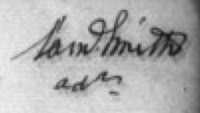
I concluded that the signature was "S Smith".  The first "S" is a very strong straight line S joined to the S in Smith, making it look like a stylized "H" But comparing the signature to the rest of the document leads me to believe it is definitely S. Smith. That meant I was looking for an S Smith in Etobicoke. 

1796 signature
My research found that a Col. Samuel Smith was granted a huge area of land in Etobicoke which he partitioned into smaller sections and leased to early settlers. Etobicoke was right on the border of the exisiting city of Toronto and it seemed very likely that this is where Jonathan had settled after leaving Pennsylvania. 

A check of a map of Toronto Township shows that the Etobicoke River runs along its eastern border. An 1881 map of Toronto Township reveals that Samuel Smith's son or grandson B.S. Smith owns a large tract of land bordering that same river, close to Lake Ontario on the south. The clues are coming together at last! 

Looking for Proof of My Theory

My next step was to prove that the Certificate of Character for Jonathan had indeed been signed by Col. Smith. If it was, it was very strong circumstantial evidence that Jonathan was one of the settlers who leased land from the Col. 

It was easy to find signature samples from Col. Smith. He was an important figure in early Ontario history and as such, signed many documents. You can see a sample of his signature from a 1796 document above. My vote is yes they are the same man. The "S" in Saml. is almost identical to the "S" in Jonathan's Certificate. It is a hard straight line sharp pointed S.

Slow and Steady Wins the Race

And there you have it. This is how I have narrowed my search for Jonathan Butler's whereabouts in Ontario before 1837. A lot of what I have found is circumstantial but as this evidence piles up, each piece adds more weight to what I found previously.

My next step is to find a list of the settlers who leased land from Col. Smith. I might get lucky and find an exact location (lot and concession number). I may have to look further, check other records to find this information but I am hopeful it can be found. It just needs patience and creative thinking. Oh, and not jumping on a "fact" without solid proof or a whole lot of circumstantial evidence to support it!

Part 4 (the last of 4) will be posted tomorrow

September 21, 2013

Finding a Black Ancestor Using Circumstantial Evidence, Part 2

Upper Canada Land Book Entries
Looking for Land Records

I hoped to find an exact land location because then my search could extend to the Abstract Indexes to Deeds. That would allow me to learn exactly when Jonathan obtained his farm land and under what conditions, and when he left and who the land passed to. But the only clues were vague..... "West of Grand River" and a possible lot number of 88.  

Jonathan could not be found after this 1840 assessment. There are no early census records for Ontario before 1851 although there is an 1841/1842 and an 1848 Census which is head of house only.  Many of the 1851 census records are missing for several locations so that quickly became a dead end.

Land records such as the CLRI were no help. There was no record of Jonathan as a first time land owner anywhere in Ontario. I could not find a death record for Jonathan or his wife, Elizabeth Ginkins or Jenkins [Source: 1851 baptism for their son Allen]

Analyzing & Assessing Documents

For several years I was stalled. I mulled over what I had found. I did a lot of examining and re-examing the records I'd found, thinking about my next step. I didn't know where in Toronto (or Toronto Township) Jonathan had resided. It seemed to me that land records were the answer but Jonathan was nowhere to be found on the few indexed records available. I knew that a Jonathan Butler had been granted land in the Wilberforce Settlement which was an area of Ontario settled by men of colour as early as 1819. But was this "my" Jonathan Butler? 

A Serendipitous Email

And then a break. Gary French, the author of "Men of Colour: An Historical Account of the Black Settlement on Wilberforce. Street and in Oro Township, Simcoe County, Ontario 1819-1949", wrote to tell me had found what he was sure was Jonathan's petition for land, and that it gave information on his origins in the USA.

A look at the online petition in the Upper Canada Land Petitions found on Library and Archives Canada provided this information: 

March 9, 1819 Petition for Land Johnathan [sic] Butler, farmer of Toronto Township, Home District. Has a farm of 50 acres, has developed 30, desires some Crown Land. Is a man of colour, a native of Pennsylvania, been in the province upwards of 11 years. 

This wonderful document  narrows the time of Jonathan's arrival in Upper Canada, making his immigration year circa 1808. It also reveals that he lived in Toronto Township and not the city of Toronto. 

A close look of the envelope containing this land petition revealed, in very tiny hard-to-read writing:   Entered in Land Book K, page 93 which is C-103, Vol. 29. Granted 100 acres in Wilberforce.  And now the question: Men of colour who were granted land in Wilberforce were War of 1812 military men. Jonathan Butler was the only non-military man granted land there. Why was he included?


Next stop: Upper Canada Land Books


Armed with these new facts, I next went through the online Land Books on Canadiana.org, which believe me is not an easy or quick task. They are not indexed, but I was able to narrow my search to Land Book K on film C-103. From there it was a case of scrolling until I found the reference to Jonathan on page 93. 

26 April 1819. Land Book K page 93: Jonathan Butler praying for a grant of land as a settler. Granted 100 acres in Wilberforce Street.

The entry did not reveal much more than the original petition in March but that's the thing with genealogy and family tree research. You must track down and follow every clue, every reference, no matter how small. Sometimes you find something huge, sometimes nothing at all. But if you don't retrieve the document you will never know what you might have missed.

Although Jonathan was granted land in the Wilberforce Settlement, Gary French tells me it does not appear he ever lived there. But finding the exact location would give a date he gave the land up and that might lead to knowing when he went to the Queen's Bush settlement in Waterloo.  

Part 3 to be posted tomorrow

September 20, 2013

Finding a Black Ancestor Using Circumstantial Evidence, Part 1

Finding a Black Ancestor Using Circumstantial Evidence
1819 Land Petition Jonathan Butler
My husband has a black ancestor, his 4th great-grandfather Jonathan Butler. For the past 5 years I've been struggling to find all I can about Jonathan. I say "struggling" because Jonathan came from the USA to Upper Canada (present day Ontario) before 1824. He then disappears after 1840. So I have a very limited timeframe in which to search. 

For those who haven't searched for early Ontario ancestors, the records are difficult to find -- if they even exist. Ontario was not settled until after the American Revolution so those are early days in our province's history. Thus they are early days for record taking and archiving. What has survived is scattered in various repositories and much of it is not indexed.

Constructing a Timeline

One of the first things I wanted to do was construct a timeline of events for Jonathan. Where was he living during that limited time frame 1824-1840? Could I extend that timeline? I'd so far been unable to find earlier or later records for Jonathan. My hope was to find out where he came from in America, perhaps even where he was born. A year of birth would prove helpful too. 

What I knew about Jonathan was limited. His son Johannes Alexander Allen (known as Allen) was born in Toronto in 1824. [source: Allen's adult baptism  into the Catholic Church January 26,1851 at St Agatha, Wilmot Township, Waterloo County] This record was not clear as to whether or not "Toronto" referred to the city of Toronto or the township and although it seemed far more likely to be a reference to Toronto Township, it was important that I keep this in mind as I carried on with finding clues to aid me in further research.

Early Tax Assessment Records Helpful

Jonathan himself was found recorded on the following census and tax assessment lists for the Queen's Bush, a black settlement area in Waterloo Ontario:

1834 Assessment for Woolwich Township, Gore District as "Negro, Butler" (note that until August 1, 1834 slavery was legal in Canada. Does this have anything to do with him not being recorded under his full name?)
1837 Assessment same place as "Jonathan Butler"
1838 Assessment same place as "Jonathan Butler"
1839 Assessement same place as "Jonathan Butler (Black)"
1840 Assessement same place as "Jonathan Butler (Black)"

He had 100 acres of farm land and I could follow his improvements over those 7 years. But I could not narrow down when he obtained his 100 acres except by estimating how long it would take a man to cultivate 20 acres (which is how much he had cultivated in that 1834 assessment) The 1834 assessment does not provide any information on family members but the 1837 assessment helps somewhat with this information on who was living there:

1 male over 16, 5 males under 16, 1 female over 16, 3 females under 16
 

It appeared that Jonathan's children were not old enough to be much help clearing land in 1834 and earlier. His owning 100 acres provided some circumstantial "glue" to my theory that he had previously lived in Toronto Township, not the city of Toronto. A farming man would be unlikely to live in the city. 

Part 2 to be posted tomorrow