April 21, 2020
NEW! Genealogy Research Service
My 3 hour package is $150.00 US funds
My 5 hour package is normally $250.00 US funds but with a limited 10% discount it is $225.00
My 10 hour package is normally $500.00 but with a 15% discount of $75.00 it is available for a limited time for $425.00 US funds
To request a package, write to Lorine at olivetreegenealogy@gmail.com with your request. I will then send you a list of what details I need from you. After we work out details you will be invoiced through Paypal.
I am also able to offer individual records search in Ontario Land Records Index and Abstract Indexes to Deeds at a flat rate per record. Please see my Genealogy Research Services page.
April 15, 2019
Finding Nancy Longstreet Part 2
![]() |
| Death Registration |
I made the decision to gather all census data for Nancy and her husband George Fisher before branching out into marriage records or looking for Abigail Longstreet.
George and Nancy were easily found in 1861, 1871, 1881, and 1891 census records on Ancestry.com, still living in Lincoln County Ontario. In 1861 Nancy is recorded as "Elizabeth" so we should keep this in mind as we search - that this might be her middle name.
In the 1891 Census George is recorded as a widower so we have a timeframe for Nancy's death of between 1881 and 1891.
1861 Lincoln Co.
George 44
Elizabeth 39 <--This could be Nancy's middle name
David 20
George 16
Marian 14
Calvin 14
Alfred 8
1871 Gainsboro, Lincoln Co.
George 54
Nancy 50
Calvin 20
Harmy 18
Murray 16
Abigail 13 <-- the naming of a daughter Abigail makes me think that the Abigail from the 1851 census is even more likely to be a sister to Nancy
1881 Gainsboro, Lincoln Co.
George 64
Nancy E. 59 <---further support for the theory that Nancy's middle name is Ellizabeth
Murray 25
Abigail 23
1891 Gainsboro, Lincoln Co.
George is a widower, age 74, living with his married daughter "Abby" (Abigail) Pew, her husband and children.
1842 Census of Canada West
I would have liked to search for George and Nancy in the 1842 census (which is a head of household only) but it is not available online for Gainsborough. There is no proof of course that the family wasn't living elsewhere in 1842 but a search of land records in that area could perhaps solve that question.
Niagara Fonds
The Ontario Archives holds microfilmed (but not digitized) Niagara Fonds which consist of the official records of the Niagara District, including Council Minutes, 1842-1853; Assessment and Census Rolls, 1828-1849; Commons School Accounts Ledger; 1842- 1844; Education Register, 1844-1850.
Fonds also includes assessment and other records from several lower tier municipalities including Gainsborough. It would be worthwhile to search for the family in these fonds. We might not find clues pointing to Nancy's father but we might find a great deal more information about Nancy, George, and their children. We should never overlook that as we try to flesh out a family line.
Agricultural Census & Land Records
I decided to search in the Agricultural census for 1851 and 1861 next. If I can find George I will learn his exact land location and from there I can search the Abstract Indexes to Deeds to see all records pertaining to that specific property. Often land was sold or given to relatives, so there could be more clues found there. The Agricultural census exists for Lincoln County 1861 but unfortunately George could not be found. This is another clue, and may indicate that George did not own land.
Death Records
I decided to do a quick jump to online death records to find Nancy's death. I knew there would not be much new information since parents' names were not recorded that early. It would be unusual for an exact birth location to be recorded but it is always worthwhile looking.
Nancy's death was found on Ancestry as occurring on 28 January 1890 in Gainsborough. Her place of birth was recorded as Ontario, and her age as 69. Her son Calvin E. Fisher was the informant. So nothing new to use as clues for our next step.
What Next?
Speaking of next steps, it was time for me to decide where to search next. I did want to search for the Abigail Longstreet from the 1851 census and the marriage of George and Nancy but perhaps it was time to branch out to the mention in the original query of "John Longstreet, b New Jersey in 1796 (moved to Ontario)". What would your next steps be?
Here are the links to all 5 parts of this series
https://olivetreegenealogy.blogspot.com/2019/04/finding-nancy-longstreet-part-2.html
https://olivetreegenealogy.blogspot.com/2019/04/finding-nancy-longstreet-part-3.html
https://olivetreegenealogy.blogspot.com/2019/04/finding-nancy-longstreet-part-4.html
https://olivetreegenealogy.blogspot.com/2019/04/finding-nancy-longstreet-part-5-end.html
March 20, 2017
A Lost Village of Freed Slaves
![]() |
| Typical slave cabin |
Read more at In tracing Cambridge history, researchers uncover lost village of freed slaves
Because I was curious about who had lived there, I searched the 1870 census and found 201 black individuals listed as living in Ward 2 of Cambridge. I cannot say with certainty that these were families in Lewisville but I plan on doing more research to see what I can find out.
The Summer 2013 Newsletter of the Cambridge Historical Society has this small excerpt which may provide some clues as to the origin of the community's name:
Just east of Observatory Hill was a free, self-sufficient African American community, known as Lewisville, from the beginning of the 19th century. This settlement was roughly between Concord Avenue, Garden Street, and Shepard Street. Some of the residents were the descendants of slaves of the Vassall family, and by the middle of the 19th century, some had become political. In the early 1850s, Adam Lewis joined the abolitionist colony at Dawn, Ontario, and in 1858 Enoch Lewis led a group of 23 members of the Cambridge Liberian Emigrant Association to settle in St. Paul’s River in Liberia.In 1850 and 1855 he is found in Ward 1 with other black famiies.
The Dawn Settlement, founded in 1841, was a rural community where Blacks could pool their labour, resources and skills to help each other and incoming settlers. It contained farm land, a saw mill, gristmill, brick yard, rope manufactory and school. Adam Lewis, age 31, is found in this settlement in the 1851 census of Upper Canada (present day Ontario) with his wife Mary and 6 year old daughter Frances.
April 18, 2016
The King of Cheeses Goes to the New York State Fair 1866
![]() |
| The Ingersoll Mammoth Cheese during its tour in Saratoga, New York in 1866 |
Yes there really was such a thing as a Mammoth Cheese. It took 35 tons of milk to produce a cheese six feet, ten Inches in diameter, three feet in height and about 21 feet in circumference,
![]() |
| Robert & Ann Facey |
A mammoth press was designed that would be used by Robert Facey at James Harris’ cheese factory to produce the 7,300 pound mammoth cheese. When it was ready to be shipped to England, James Noxon was ready to financially support the creation of the Ingersoll Cheese Company which sponsored the cross-Atlantic voyage in 1866.
Library and Archives Canada (LAC) has a very interesting page about Mammoth Cheeses in Ontario. Even though I was born here and have lived in Ontario all my life I never knew we were such amazing cheesemakers - a skill seemingly lost to our province now.
Date: Friday, August 17, 1866 Paper: Boston Herald (Boston, Massachusetts) Page: 2
FN 1 Source: https://ingersolllibrary.wordpress.com/2010/08/11/the-mammoth-cheese/
January 2, 2016
Finding an Ancestor in Canada West
I have traced my Winslow family from Dublin, Ireland to the ship "Constantine" on which they sailed and landed in the Port of NY in 1856. The entire family, which consisted of John, his wife Eliza and their children William Thomas, John, Oliva and Jane, were destined for "Canada West" according to the ship's manifest. Only a few other passengers on that voyage stated their destination as Canada West. I believe I was able to trace one of those other passengers (not related to me) to Perth in 1860.My Answers: Fred, first things first. Hopefully you discovered that "Canada West" is present day Ontario. So you need to find early Ontario records for your family. Before being called Canada West it was called Upper Canada.
The elder John was a carpet cutter and upholsterer and I presume he was seeking a better job in his field. However, there is no trace of John or any member of his family in the Canadian or US census for 1860. Also I have reason to believe that Eliza Winslow died in Canada not too long after immigrating there but I can find no trace of her death record.
By 1863, the family moved to Connecticut and took up work in the spinning mills there and from that year I have been able to trace them without much difficulty. Are there large gaps in the Canadian census that are listed on Ancestry.com and FamilySearch? Presuming they were in Canada in 1860, why am I unable to find any trace of them?
![]() |
| Example of 1861 Census |
There is no 1860 census for Canada. Canada did not exist as a country until Confederation in 1867 and thus the first census for Canada is 1871. The census prior to 1871 was 1861 (not 1860) and consists of records for the 5 provinces that existed that year.
Unfortunately not all of the 1861 returns survived. For a list of the missing returns, see Ontario GenWeb Census Project. As well, many surviving records are badly faded and could not be indexed, so a search on Ancestry.com
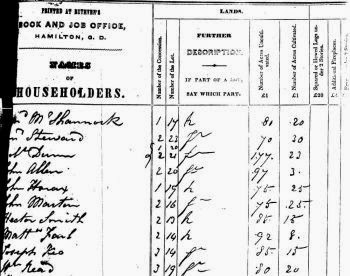
In the Ontario 1851 and 1861 Census, there are agricultural returns as well as personal returns. These are listed by the name of the head-of-household. Agricultural Census returns are often overlooked by genealogists. Agricultural returns provide information such as lot and concession number, acreage, livestock and agricultural products.
Ancestry.com
The bad news is that only half of each page has been scanned.
DEATH RECORDS
You say you cannot find a death record for Eliza "in Canada". Again, you are looking in Ontario and a look at the explanation for Ontario Vital Records on Ancestry.com
You could also check OCFA (Ontario Cemetery Finding Aid) in case Eliza's grave is recorded there. If you get a result you will need to read the website instructions for details on how to obtain the burial information.
DON'T OVERLOOK THE IMPORTANT DESCRIPTION OF RECORDS
This brings me to an important reminder - don't overlook the explanation or description of record sets online. This is where you will learn what the records consist of (what is missing and what is available) and what years the records cover. When you are searching for an ancestor in a place where you are not familiar with the records, you should always consult the local archives or genweb site to find out when records were kept, where they are kept, and what has survived.
SETTLEMENT OF ONTARIO
It is also important to remember that Ontario was not settled until the time of the American Revolution so these are relatively early records you are seeking. Any hope of finding a death record for Eliza rests on knowing a more precise location where they settled in Ontario. If they owned land you might find them in land records, or petitions. If you know their religion you could search church records. But there are few Ontario-wide databases to search, and that is why you must have a more precise location of a county or preferably a township where your family lived.
May 30, 2015
1841 List of Tavern Keepers in Toronto
1 John T Smith
2 William Campbell
3 James Bell
4 Thomas Moore
5 Thomas Thomas
6 William Phair
7 John Manns
8 Thomas Pearson
9 Steers Robinson
10 John Henry
11 Geo W Post
12 Bernard Short
13 Robert Anderson
14 William Griffith
15 John McCarthy
16 Arthur McMahon
17 John Earnest
18 John Earls
19 John Parsons
20 Thomas Bolterell
21 James Trotter
22 George Herron
23 James Mil field
24 Thomas Naylor
25 William Wallis
26 Charles T Gardiner
27 John Elegia
28 William Rolph
29 John Murphy
30 John Stone
31 John Raper
32 John O Keefe
33 Thomas Buttery
34 George McCallum
5 John Henderson
36 Richard Woods
37 John C Scholfield
38 James McConib
39 James Piatt
40 John Baldry
41 James Thompson
42 Joseph Abraham
43 Andrew Gibson
44 WH Boss
45 Peter Nangle
46 Daniel Peterson
47 John Fleming
48 WH Elliott
49 William Noble
50 Robert McMichael
51 Robert Bar wick
52 John P Dunn
53 Thomas Earls
54 Joseph Beatty
55 Robert Alexander
56 John Baker
57 Thomas Ryan
58 Thomas McConkey
59 John Trueman
60 John Anderson
61 John Healy
62 John Powers
63 John Short
64 Thomas Baily
65 Hugh Henderson
66 Joseph H Smith
67 George Price
68 John Bennett
69 Susannah Mathews
70 John Baker
71 Hugh McNeal
72 David Boss
73 Samuel Bain
74 George Evans
75 James Feehan
76 Dennis McEnery
77 John Harley
78 Patrick Ingoldsby
79 Patrick Mitchell
80 Alexander McGregor
81 Richard Crispin
82 Charles Nonhcote
83 William Turriff
84 John McManus
85 George Brown
86 Thomas Wright
87 James Dill
88 Alexander Dill
89 FM Rossi
90 Lewis Boore
91 Francis Bond
92 Daniel Dewdney
93 James Hickman
94 James Graham
95 James Walsh
96 John Thomas
97 John Wesley
98 Asa Reynolds
99 Stanous Daniels
100 Hemy Gillentson
101 Thomas Fanning
102 James Campbell
103 Thomas Durilop
104 Thomas S Cowan
105 James H Hutchinson do
106 Ebon Barclay
107 Francis Berry
108 James Thomas
109 William Heather
110 Robert Scott
11 1 Peter Harkin
112 Herod Noble
1 13 William L Stewart
1 14 Robert Defreise
115 John M Tuis
116 John Earls
117 David McDonald
118 Isaac Johnson
119 William White
Source:
Journals of the Legislative Assembly of the Province of Canada From the 14th Day of June .. Being the First-8th Provincial Parliament ..., Volume 1(Google eBook)
May 28, 2015
Finding a Loyalist in the Haldimand Papers (Loyalist Research Part 6)
Now I want to walk you through finding an ancestor on the challenging set of records called The Haldimand Papers. These important papers were kept by Sir Frederick Haldimand, 1718-1791. The papers document events in North America beginning with the Seven Years War and ending with the settlement by Loyalists after the American Revolutionary War.
Finding an ancestor in the digitized records is a challenge but it can be done and the wealth of information is incredible. The first thing you need to know is that although the papers have not been transcribed or indexed, there is an index to Loyalists found on Heritage Canada's digitized microfilm C-1475.
When you consult this typed index you will see the individual's name followed by a set of numbers as in the example below. Warning: the film is blurry!
Sounds easy, right? Wouldn't we just go to whatever film holds Volume 167 and then look for the pages? How I wish it were that easy but it's not. There are 43 digitized films for the Haldimand Papers on Heritage Canada but there is no explanation of what is found in each film.
A look at Library and Archives Canada also comes up empty. There is nothing found that describes the films and provides a description of each. To complicate things, there are several variations of numbers being used including the Series B transcripts (H-4digits), the Series B transcript volume numbers (B-3digits), the Add MSS 4digits number from the British Library and the WMD film number of the actual papers.
It took me quite awhile to figure out that the Volume (V) number is the equivalent to a B number. So in the example above we want to find B-167. But we still don't know what film it is on. I'll share with you that it took me an entire day to figure out what films I needed. Once I figured it out, I found an impressive set of miscellaneous papers with my ancestors' names receiving rations from the British Government, on Loyalist Muster rolls and more.
Without further ado, here are the steps you need to take to find your own ancestor!
Step 1. Consult the index found on Microfilm C-1475 Four bound volumes of transcripts which relate primarily to Loyalists, together with a typed index have been microfilmed on this reel. The Loyalist volumes in finding aid no. 599 are: Add. MSS. 21765 (B105), 21826 (B166), 21827 (B167), 21828 (B168) and Index. You may find it easier to download the typed index on Collections Canada. It is a PDF file which you can save to your computer.
I should mention that you would be wise to avoid looking for any filmed records (other than the index) in C-1475. The C films are very bad quality and are difficult to read, having been filmed in the 1950s. The H films were filmed in the 1980s and are much better quality.
Step 2: Consult the PDF conversion chart I found online (and a huge thank you to the author!) which gives conversions from B numbers to the correct film. The author created the following columns: LAC (Library and Archives Canada) reel; Batch #s; B series; Add MSS; WMP reel #
You are looking in the B series column and then the LAC reel number.
So for example looking for B-167 on the Conversion Chart we see this:
We can see that B-167 is found on 2 films, H-1654 and H-1655. Ignore the 21827 as that is the Add MSS number. The important fact here is that B-167 pages 1 to 320 are found on H-1654 but they will be found at the end of that film, not the beginning. There are other Volumes (B numbers) at the beginning of the film. Then pages 321 to the end were filmed on H-1655.
Step 3: Go to the list of Haldimand Papers digitized films on Canadiana.org and scroll down to H-1654. Start the film and note what volume (B number) you are viewing. You can see the source details at the bottom or right hand side of each filmed page, as in the example below:
We are only in B-163 and you want B-167 so you will have to scroll quite a bit further. Once you reach your volume (B number) of interest, simply look for the page numbers you want.
Here is an example of what you might find for an ancestor. This is a 1783 list of Loyalists who settled at Niagara, Upper Canada (present day Ontario) along with the number of household members (by gender and age)
May 22, 2015
More Ways to Find an Ancestor in the 1851 Agricultural Census
You can also search on Ancestry.com
![]() |
| Search Results 1851 Census for Charles Black - 2 entries, Agricultural & Personal |
If the person is found in one census and not the other, how do you tell which you have? It's simple. The result for the Agricultural census will not display an age.
![]() |
| Search Result for Agricultural Census - no age is shown |
The database you want to search is called 1851 Census of Canada East, Canada West, New Brunswick, and Nova Scotia. Don't enter the individual's age or year of birth. Just search by first and last name, and location.
It would make life easier if Ancestry had entered the word "Agricultural" into their database fields so we could narrow the search but they have not done so. However with a little patience you can find your ancestor providing that census has survived for the area the ancestor lived in.
Don't overlook this resource as it has great genealogical value to researchers.
May 20, 2015
Finding Ancestors on 1851 Agricultural Census Canada
Why search for ancestors in an Agricultural Census? These records provide details of exact location of land, type of farming, house lived in, livestock and more.
Ancestry.com
In 2011 I talked about how to go directly to the Agricultural census on Collections Canada. That was a great database and search engine, much better than the new one on Library and Archives Canada. But it no longer exists. You must now search for ancestors in the 1851 Agricultural census at Library and Archives Canada.
1. Select Canada West (Ontario) from the drop down list for Province/Colony.
So don't be afraid to give this a try in your search for more details of an Ontario ancestor.
May 19, 2015
Have You Checked Assessment Records for that Elusive Ancestor?
![]() |
| Assessment Record Page |
Some give numbers and type of livestock and crops. Assessment records were used to assess individual's property and holdings in order to calculate and collect tax revenue.
Not all townships' Assessment Records have survived. Not all townships did assessments for the same years. So if you are looking for these records you will need to find out if your County and Township of interest has any that survived.
I am very pleased to announce that thanks to the generousity of transcriber Fred Blair, Olive Tree Genealogy has published 10 Assessment Records for early Ontario. Following is the list of Assessment Records now available for download on Olive Tree Genealogy Ontario Assessment Records section
Assessment Ancaster Township, Wentworth County, Home District 1816
Assessment_Ancaster Township, Wentworth County, Home District 1818
Assessment Beverley Township, Wentworth County, Home District 1816
Assessment Beverley Township, Wentworth County, Home District 1818
Assessment Grand River Tract, Haldimand Township, Wentworth County, Gore District, 1816
Assessment Nelson Township, Halton County, Gore District 1816
Assessment Nelson Township, Halton County, Gore District 1818
Assessment Trafalgar Township, Halton County, Gore District 1816
Assessment Trafalgar Township, Halton County, Gore District 1823
Assessment Trafalgar Township, Halton County, Gore District 1825
June 21, 2014
10 Ways to Find a Loyalist Ancestor
| Petition of Harcor Lyons Loyalist Source Upper Canada Land Petitions |
What is a Loyalist?
A Loyalist is any person who is loyal to their allegiance (especially in times of revolt). During the American Revolution in what was to become the United States of America, a Loyalist (also called UEL - United Empire Loyalist) was anyone who remained loyal to the King of England. They were called Tories in their own country but Loyalists elsewhere. Most fled to Canada and helped settle that country, particularly Ontario and Nova ScotiaOne of the best genealogy resources to find Loyalist ancestors in Ontario are the Upper Canada Land Petitions. Find out how the OIC (Orders in Council) for Loyalists can help you in your search
Tips for Finding a Loyalist Ancestor
1.Check the index to Upper Canada Land Petitions (UCLP) The land petitions often contain invaluable genealogical information including children's or father's names, spouse's names, places of origin, reports of the hardships they endured as Loyalists, Loyalist unit served in, and sometimes ages. The UCLP is available online as a searchable databaseFor help finding the actual certificates and petitions in the online films, see Searching Ontario Canada Land Records, eh? and Understanding Notations on the Envelope of an Upper Canada Land Petition
2. Check Land Books 1793-1826
For Upper Canada Land Books see Finding an Ancestor in the Challenging Upper Canada Land Books This is a step by step tutorial showing researchers how to use the index entries and details to find the Land Book entry online.
3. Check Loyalist Claims and Conversion List [NA MG14] 1790-1837 - Audit Office 12 and 13 compensation cliams for land and goods lost during the American Revolution - 178 reels of microfilm. Not all Loyalists filed claims. Many did and if your ancestor is among those who did, you won't want to overlook this.
4. Search the Heir & Devisee Commission records.
5. Search the Upper Canada Sundries. For help see 12 Months of Finding Ancestors: Upper Canada Sundries (Part 3 of a 12 Part Series)
6. Check Reid, W.D. Loyalists in Ontario: The Sons and Daughters of the American Loyalists of Upper Canada
7. Check the The Old United Empire Loyalists List
8. Check District Loyalist Rolls - transcript on MS803 at the Ontario Archives. Update: Brenda Dougall Merriman informs me that these were published: District Loyalist Rolls transcribed by Keith Fitzgerald (AO, MS 803)were published as his *Ontario People: 1796-1803* by the Ontario Genealogical Society. Brenda did a series on Loyalists and wrote the book called UEL: Finding Your Loyalist Ancestors in Upper Canada.
9. Check United Empire Loyalist Lists [NA RG 1, L7 vol 52a] on C-2222 from the Ontario Archives but be aware that no one list is complete! There were several versions of the lists drawn up and not finding an ancestor's name does not mean he was not a Loyalist.
10. An often overlooked source of information is The Haldimand Papers - papers and correspondence of Haldimand, Sir Frederick from 1758-1784. Available as 115 reels of microfilm from the NAC or as selected records on 50 reels of microfilm from the Ontario Archives. Muster rolls can be found on the H.P. in the National Archives of Canada as MG 21 These Loyalist volumes, and the nominal index to them, are available on microfilm reel C-1475. Avaiable on ILL (InterLibraryLoan)
May 16, 2014
An index to Niagara area Loyalists and their Land Certificates
![]() |
| Image 160 Index of names H 1140 |
But as mentioned in a previous blog post I wrote called Heir & Devisee Commission 1797-1854 on Canadiana.org - Listing Errors and a Workaround, the index and description of what is in each film, as provided on Canadiana.org, is incorrect.
I have been slowly going through each film and noting the correct contents in detail. I have begun to publish my full set of corrections for the digitized records on Olive Tree Genealogy website at Heir & Devisee Commission
![]() |
| Image 174 Jonas Larroway Certificate |
Since the Heir & Devisee Commision records have not been indexed I decided to take the time to copy the names and provide the image number of each claim and the name of the individual. This means that if you spot a name of interest you can go directly to the film (HD 1140) and then directly to the image number for your ancestor.
I will also be publishing an index to 150 claims by individuals living in the Home District (In 1792 Nassau District was renamed Home District). See History of Ontario and Districts of Upper Canada in 1846 for a list of the original Districts and information on name and boundary changes.
H 1140 Volume 41 Land Location Certificates
- Bradt, Aaron 1790
- Brown, Joseph 1791
- Butler Sheehan, Walter 1790
- Clench lieut. Rolfe 1792
- Cunningham, Archibald 1792
- Fanning, John 1791
- Fisher, William 1792
- Haslip, James 1791
- Larraway, Jonas 1792
- Lottridge Capt. Robert 1792
- Lutes, Sampson 1790
- Murray, Lieutenant Duncan 1791
- Palmer, Joseph 1791
- Petri, Joseph 1791
- Reynolds, Lieutenant Caleb 1792
- Robison, James 1790
- Ropp, Andrew 1833
- Image 161 Aaron Bradt certificate
- Image 162-163 Joseph Brown certificate
- Image 164 Walter Butler Sheehan certificate
- Image 165-167 lieut. Rolfe clench certificate
- Image 168-169 John Henry Chrysler, Aaron Young, Philip Young
- Image 170-171 John Fanning certificate
- Image 172–173 James Haslip certificate
- Image 174-175 Jonas Laraway certificate
- Image 176-179 Capt. Robert Lottridge certificate
- Image 180-182 Sampson Lutes certificate
- Image 183-184 lieut. Duncan Murray certificate
- Image 185-187 Joseph Palmer certificate
- Image 188-189 Joseph Petri certificate
- Image 190-195 lieut. Caleb Reynolds certificate
- Image 196-198 Archibald Cunningham certificate
- Image 199 William Fisher certificate
- Image 200 James Robison certificate
- Image 201-209 Joseph Robison certificate
- Image 210-211 Andrew Ropp, Jacob Erb 1833
August 3, 2013
1861 Canadian Census Online at Library and Archives Canada
Please take a moment to sign the petition. Your signature is important!
Following is the announcement of the 1861 Census and a link to the index and images. You might also want to take a look at my previous article about the 1861 Agricultural Census which provides a great deal of valuable information on those who owned land. This agricultural portion of the 1861 census has been scanned and put online on Ancestry.com
Since I'm pointing out errors today, let's talk about the index that LAC has put online for that 1861 Canadian Census. I'm guessing they used the Ancestry.com index since both sites have badly MISindexed my PEER family as ROSS. Here's what LAC shows in their index. It was probably part of the deal they made with Ancestry when they allowed Ancestry to index and put the images of the Canadian Census records on the Ancestry site. The bad part of that is that bad indexing gets perpetuated!
Census Year: 1861
Item Number: 2819914
Surname: Ross
Given Name(s): Levy
Age: 50
Province: Canada West (Ontario)
District Name: Halton
Sub-District Name: Nelson
Ancestry shows the same surname - ROSS. But check out the image. It doesn't look like ROSS to me, it is clearly PEER.
In any case here's the announcement from LAC:
Library and Archives Canada is pleased to announce that the Census of 1861 is now available online. Information was collected for people living in Canada East, Canada West, New Brunswick, Nova Scotia and Prince Edward Island.
Canadians can search this new database by nominal information, such as the surname, given name(s) and age of an individual, as well as by geographical information such as district and sub-district names.
July 28, 2013
Finding an Ancestor in Early Ontario Land Records
![]() |
| Upper Canada Land Petition Isaac Vollick |
Early Ontario records can be challenging to find. Ontario was not settled until the American Revolution when many Loyalists fled the Colonies (later the United States of America) for Canada.Very early records were often not taken or if taken, have not survived.
But there are land records, it's just a matter of knowing what has survived and where a collection can be searched.
It is also important to know the boundary and name changes that occurred in Ontario. From Upper Canada to Canada West to Ontario, you will need to know what years the name changes took place. Also important are the District and County name changes. Here is a complete list of the District Names in 1846 and the counties and townships in each.
Below is a list I compiled of online searchable land records. There are many that are not online and I have also provided a link to my website where a list of offline resources is given. I hope this is of help to struggling genealogists.
* Upper Canada Land Petitions index and images online on Library and Archives Canada (LAC).
Many early settlers, both military and civilian, submitted petitions to the Governor to obtain Crown land. Sons and daughters of Loyalists were also entitled to free lands. The Upper Canada Land Petitions contain petitions for grants or leases of land and other administrative records from 1783 to 1865
* Second Heir and Devisee Commission Case Files Database Index to 5184 case files, from 1804 to 1895, document claims for land made to the Second Heir and Devisee Commission. The second Heir and Devisee Commission was responsible for hearing and determining claims to land brought forward by the heirs, devisees, or assignees of original nominees. (Online Index)
* The Computerized Land Record Index (aka Ontario Land Record Index) summarizes land grants of Crown Land, sales of land from Canada Company sales or leases and from Peter Robinson settlers' grants. If your ancestor settled anywhere in Ontario and he was the first time owner of Crown Land, he should be on these lists. (Lookup Service)
* Return of all Patents for Land 1836 1478 names of patentees with some surnames missing (not found are surnames beginning with H, K, L, M, P, Q, S, T)
* Canadian County Atlas Digital Project at McGill University. The County Atlas Digital Project is a searchable database of property owners' names which appear on the township maps in the county atlases. Township maps, portraits and properties have been scanned, with links from the property owners' names in the database.
* List of land records available for Ontario (aka Canada West aka Upper Canada) and where each set of records can be found (online or offline)