Discover your inside story with AncestryDNA®
Showing posts with label Men of Colour. Show all posts

March 20, 2017

A Lost Village of Freed Slaves

In the late 1800s a small village of freed slaves began on the outskirts of Cambridge Massachusetts. Not much is known of this community which apparently was called Lewisville. The authors of a new book on the history and settlement of Cambridge discovered records of the village accidentally when studying an 1870 map.

Typical slave cabin
According to the authors, Lewisville was an "African-American settlement that dispersed before the Civil War, where many members went to Africa in the African immigration movement. But it really disappeared in the 1880s."

Read more at In tracing Cambridge history, researchers uncover lost village of freed slaves

Because I was curious about who had lived there, I searched the 1870 census and found 201 black individuals listed as living in Ward 2 of Cambridge. I cannot say with certainty that these were families in Lewisville but I plan on doing more research to see what I can find out.

The Summer 2013 Newsletter of the Cambridge Historical Society has this small excerpt which may provide some clues as to the origin of the community's name:

Just east of Observatory Hill was a free, self-sufficient African American community, known as Lewisville, from the beginning of the 19th century. This settlement was roughly between Concord Avenue, Garden Street, and Shepard Street. Some of the residents were the descendants of slaves of the Vassall family, and by the middle of the 19th century, some had become political. In the early 1850s, Adam Lewis joined the abolitionist colony at Dawn, Ontario, and in 1858 Enoch Lewis led a group of 23 members of the Cambridge Liberian Emigrant Association to settle in St. Paul’s River in Liberia.
In 1850 and 1855 he is found in Ward 1 with other black famiies.


The Dawn Settlement, founded in 1841, was a rural community where Blacks could pool their labour, resources and skills to help each other and incoming settlers. It contained farm land, a saw mill, gristmill, brick yard, rope manufactory and school.  Adam Lewis, age 31, is found in this settlement in the 1851 census of Upper Canada (present day Ontario) with his wife Mary and 6 year old daughter Frances.

Adam's death certificate of 1900 indicates his place of birth as Missouri and it is possible that more information could be found if anyone were interested.


September 23, 2013

Finding a Black Ancestor Using Circumstantial Evidence Part 4

Upper Canada Land Petition
Jonathan Butler
envelope

You may recall that the goal I started with in my search for Jonathan Butler, a man of colour, was to create a timeline of his whereabouts before 1824 and after 1840.


And thus I come to my timeline and summary of the new documents and clues I have found in my research:

ca 1808 Jonathan arrives in Upper Canada (present day Ontario), possibly coming directly from Pennsylvania (as per his land petition) Whether he came as an adult or a child with parents is not known.

March 1816. Jonathan is found in Etobicoke (just west of the city of Toronto), possibly leasing land from Col. Samuel Smith (as per Character Certificate). Jonathan was almost probably at least 21 years of age at this time, thus a very rough estimate of his year of birth would be 1795 or earlier.

March 1819. Jonathan is a farmer with 50 acres in Toronto Township (as per his land petition). Toronto Township has the Etobicoke River on its eastern boundary. I believe this is possibly land he leased from Col. Smith. 

April 1819. Jonathan is granted 100 acres of land in the Wilberforce Settlement (black settlement area) in Oro Township. (as per Land books) It does not appear he actually settled there (as per Gary French)

ca 1822-1838. 2 sons and 3 daughters are born in this time period. Names are not known (as per Assessment records)

1824. A son Allen is born in Toronto Township to Jonathan and wife Elizabeth Jenkins or Ginkins (as per 1851 adult baptism in Waterloo)

ca 1829 A son Harry aka Henry is born, location unknown

1832. A son George is born in Toronto Township. 

1834, 1837, 1838, 1839, 1840: Jonathan is found with 100 acres in Woolwich Township, Gore District which was part of the Queen's Bush settlement area for blacks. He lives "west of the Grand River" and may be on Lot 88 (as per Assessment Records) 

Miscellaneous Details

I find no trace of Jonathan after 1840. It is not known when his wife Elizabeth died and the only record of her is the mention in the 1851 baptism of their son Allen. 

The only children found in the 1851 census (which is incomplete with many missing areas) are Allen, George and Harry/Henry Butler.  

In the 1839 Assessment they are listed as belonging to "other religion" which may mean they were attending a black church. They are also listed as "unbaptised or not belonging to any denomination"

The 1881 Atlas for Floradale, Woolwich Township, Waterloo Co. provides details of their son George Butler as follows: born 1832 Toronto Township, settled near Floradale in 1835,  residing Concession GCT Lot 120. My research indicates that GCT stands for German Company Tract

1891 Census for George Butler records his mother as Irish

Summary

There is much research still to do and hopefully many more clues and facts to uncover. I urge others facing their own challenging ancestral searches to develop a timeline as I've done. Record your facts and your clues, being careful to note whether something is proven, a theory or supported by circumstantial evidence. 

Then sit back and study and analyze your findings. You will be amazed at what sudden "aha" moments occur! Organizing your findings will more easily guide you to where you might look as your next step in solving the ancestral puzzle.


September 22, 2013

Finding a Black Ancestor Using Circumstantial Evidence, Part 3

On to Upper Canada Sundries!


Certificate of Character
Still desperately wanting to know where Jonathan's various land lots were located so I could find some exact dates of acquisition and leaving, I decided to next look through the Heir & Devissee Commission records (unindexed but online) and the Upper Canada Sundries (also unindexed but online at Canadiana.org

And once more I got lucky. In the Sundries I found a  Certificate of Character for J. Butler, a black man. It was dated March 1816 and noted as in Etobicoke. That was a huge clue! Etobicoke is on the outside western edge of the city of Toronto. I was getting closer to figuring out exactly where Jonathan lived. 

Another clue in this small document is that signer indicated he had known Jonathan for several years. We're slowly narrowing down his immigration from Pennsylvania to Upper Canada *if* this is our man.

This document does not provide a full first name but in 1816 there were very few people in the Toronto township area, and even fewer black men named J. Butler! As well the date of the certificate fits well with Jonathan's petition for land. After the War of 1812 those born in the USA had to either sign an oath or provide a certificate of character and loyalty to the Crown. 


Think Outside the Box

After mulling on this new find I realized that the man who signed the Certificate of Character had to be someone who knew Jonathan fairly well. That meant it was likely to be a neighbour. Therefore if I could read the signature, I could try to find land records for the person signing. That might give me a more precise location for Jonathan in 1816! 


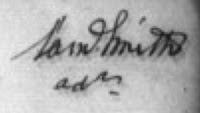
1816 signature
I concluded that the signature was "S Smith".  The first "S" is a very strong straight line S joined to the S in Smith, making it look like a stylized "H" But comparing the signature to the rest of the document leads me to believe it is definitely S. Smith. That meant I was looking for an S Smith in Etobicoke. 

1796 signature
My research found that a Col. Samuel Smith was granted a huge area of land in Etobicoke which he partitioned into smaller sections and leased to early settlers. Etobicoke was right on the border of the exisiting city of Toronto and it seemed very likely that this is where Jonathan had settled after leaving Pennsylvania. 

A check of a map of Toronto Township shows that the Etobicoke River runs along its eastern border. An 1881 map of Toronto Township reveals that Samuel Smith's son or grandson B.S. Smith owns a large tract of land bordering that same river, close to Lake Ontario on the south. The clues are coming together at last! 

Looking for Proof of My Theory

My next step was to prove that the Certificate of Character for Jonathan had indeed been signed by Col. Smith. If it was, it was very strong circumstantial evidence that Jonathan was one of the settlers who leased land from the Col. 

It was easy to find signature samples from Col. Smith. He was an important figure in early Ontario history and as such, signed many documents. You can see a sample of his signature from a 1796 document above. My vote is yes they are the same man. The "S" in Saml. is almost identical to the "S" in Jonathan's Certificate. It is a hard straight line sharp pointed S.

Slow and Steady Wins the Race

And there you have it. This is how I have narrowed my search for Jonathan Butler's whereabouts in Ontario before 1837. A lot of what I have found is circumstantial but as this evidence piles up, each piece adds more weight to what I found previously.

My next step is to find a list of the settlers who leased land from Col. Smith. I might get lucky and find an exact location (lot and concession number). I may have to look further, check other records to find this information but I am hopeful it can be found. It just needs patience and creative thinking. Oh, and not jumping on a "fact" without solid proof or a whole lot of circumstantial evidence to support it!

Part 4 (the last of 4) will be posted tomorrow

September 21, 2013

Finding a Black Ancestor Using Circumstantial Evidence, Part 2

Upper Canada Land Book Entries
Looking for Land Records

I hoped to find an exact land location because then my search could extend to the Abstract Indexes to Deeds. That would allow me to learn exactly when Jonathan obtained his farm land and under what conditions, and when he left and who the land passed to. But the only clues were vague..... "West of Grand River" and a possible lot number of 88.  

Jonathan could not be found after this 1840 assessment. There are no early census records for Ontario before 1851 although there is an 1841/1842 and an 1848 Census which is head of house only.  Many of the 1851 census records are missing for several locations so that quickly became a dead end.

Land records such as the CLRI were no help. There was no record of Jonathan as a first time land owner anywhere in Ontario. I could not find a death record for Jonathan or his wife, Elizabeth Ginkins or Jenkins [Source: 1851 baptism for their son Allen]

Analyzing & Assessing Documents

For several years I was stalled. I mulled over what I had found. I did a lot of examining and re-examing the records I'd found, thinking about my next step. I didn't know where in Toronto (or Toronto Township) Jonathan had resided. It seemed to me that land records were the answer but Jonathan was nowhere to be found on the few indexed records available. I knew that a Jonathan Butler had been granted land in the Wilberforce Settlement which was an area of Ontario settled by men of colour as early as 1819. But was this "my" Jonathan Butler? 

A Serendipitous Email

And then a break. Gary French, the author of "Men of Colour: An Historical Account of the Black Settlement on Wilberforce. Street and in Oro Township, Simcoe County, Ontario 1819-1949", wrote to tell me had found what he was sure was Jonathan's petition for land, and that it gave information on his origins in the USA.

A look at the online petition in the Upper Canada Land Petitions found on Library and Archives Canada provided this information: 

March 9, 1819 Petition for Land Johnathan [sic] Butler, farmer of Toronto Township, Home District. Has a farm of 50 acres, has developed 30, desires some Crown Land. Is a man of colour, a native of Pennsylvania, been in the province upwards of 11 years. 

This wonderful document  narrows the time of Jonathan's arrival in Upper Canada, making his immigration year circa 1808. It also reveals that he lived in Toronto Township and not the city of Toronto. 

A close look of the envelope containing this land petition revealed, in very tiny hard-to-read writing:   Entered in Land Book K, page 93 which is C-103, Vol. 29. Granted 100 acres in Wilberforce.  And now the question: Men of colour who were granted land in Wilberforce were War of 1812 military men. Jonathan Butler was the only non-military man granted land there. Why was he included?


Next stop: Upper Canada Land Books


Armed with these new facts, I next went through the online Land Books on Canadiana.org, which believe me is not an easy or quick task. They are not indexed, but I was able to narrow my search to Land Book K on film C-103. From there it was a case of scrolling until I found the reference to Jonathan on page 93. 

26 April 1819. Land Book K page 93: Jonathan Butler praying for a grant of land as a settler. Granted 100 acres in Wilberforce Street.

The entry did not reveal much more than the original petition in March but that's the thing with genealogy and family tree research. You must track down and follow every clue, every reference, no matter how small. Sometimes you find something huge, sometimes nothing at all. But if you don't retrieve the document you will never know what you might have missed.

Although Jonathan was granted land in the Wilberforce Settlement, Gary French tells me it does not appear he ever lived there. But finding the exact location would give a date he gave the land up and that might lead to knowing when he went to the Queen's Bush settlement in Waterloo.  

Part 3 to be posted tomorrow

September 20, 2013

Finding a Black Ancestor Using Circumstantial Evidence, Part 1

Finding a Black Ancestor Using Circumstantial Evidence
1819 Land Petition Jonathan Butler
My husband has a black ancestor, his 4th great-grandfather Jonathan Butler. For the past 5 years I've been struggling to find all I can about Jonathan. I say "struggling" because Jonathan came from the USA to Upper Canada (present day Ontario) before 1824. He then disappears after 1840. So I have a very limited timeframe in which to search. 

For those who haven't searched for early Ontario ancestors, the records are difficult to find -- if they even exist. Ontario was not settled until after the American Revolution so those are early days in our province's history. Thus they are early days for record taking and archiving. What has survived is scattered in various repositories and much of it is not indexed.

Constructing a Timeline

One of the first things I wanted to do was construct a timeline of events for Jonathan. Where was he living during that limited time frame 1824-1840? Could I extend that timeline? I'd so far been unable to find earlier or later records for Jonathan. My hope was to find out where he came from in America, perhaps even where he was born. A year of birth would prove helpful too. 

What I knew about Jonathan was limited. His son Johannes Alexander Allen (known as Allen) was born in Toronto in 1824. [source: Allen's adult baptism  into the Catholic Church January 26,1851 at St Agatha, Wilmot Township, Waterloo County] This record was not clear as to whether or not "Toronto" referred to the city of Toronto or the township and although it seemed far more likely to be a reference to Toronto Township, it was important that I keep this in mind as I carried on with finding clues to aid me in further research.

Early Tax Assessment Records Helpful

Jonathan himself was found recorded on the following census and tax assessment lists for the Queen's Bush, a black settlement area in Waterloo Ontario:

1834 Assessment for Woolwich Township, Gore District as "Negro, Butler" (note that until August 1, 1834 slavery was legal in Canada. Does this have anything to do with him not being recorded under his full name?)
1837 Assessment same place as "Jonathan Butler"
1838 Assessment same place as "Jonathan Butler"
1839 Assessement same place as "Jonathan Butler (Black)"
1840 Assessement same place as "Jonathan Butler (Black)"

He had 100 acres of farm land and I could follow his improvements over those 7 years. But I could not narrow down when he obtained his 100 acres except by estimating how long it would take a man to cultivate 20 acres (which is how much he had cultivated in that 1834 assessment) The 1834 assessment does not provide any information on family members but the 1837 assessment helps somewhat with this information on who was living there:

1 male over 16, 5 males under 16, 1 female over 16, 3 females under 16
 

It appeared that Jonathan's children were not old enough to be much help clearing land in 1834 and earlier. His owning 100 acres provided some circumstantial "glue" to my theory that he had previously lived in Toronto Township, not the city of Toronto. A farming man would be unlikely to live in the city. 

Part 2 to be posted tomorrow

July 22, 2013

What a Story I Have to Share!

Coffin Plate of Isaac Vollck 1831-1904
Today I became the very excited owner of the coffin plate of my 2nd great grandfather, Isaac Vollick.

Isaac was born in 1832 in what was then Upper Canada (present day Ontario) and he died in 1904 in Hillsdale, Simcoe Co. Ontario. I've never found his gravestone or burial site, nor his wife's even though I know what cemetery they are in.

I hear you asking "ok what's a coffin plate and why is this a great story?"

Coffin plates were decorative adornments attached to the coffin that contain free genealogical information like the name and death date of the deceased. After the funeral service, these plates were often given to family to take home as a memorial to the deceased.

My becoming the owner of this coffin plate is an amazing story. I call it The Domino Effect, meaning everything had to fall into place, one tiny moment at a time.  Here is how it happened, step by step:

1.  Last week I realized I could not log into my website AllCensusRecords.com as I did not remember my password. No amount of searching found it so I did the usual thing - hit the "I forgot my password" link on my webhost. No problem, they email a new temporary password. But I wasn't sure what email address I had used to sign up on this host.

2. After checking my main email addresses with no luck (no response from the web host) I realized my account must be under a very old email address I haven't used in years. I rarely check mail there even though I do still have access. But off I went and yep, the password was there.

But what was even more interesting was an email, months old, from Gary French, the author of "Men of Colour: An Historical Account of the Black Settlement on Wilberforce. Street and in Oro Township, Simcoe County, Ontario 1819-1949" 

Gary was writing to me about my husband's black ancestor, Jonathan Butler, who settled in the Queen's Bush (near Waterloo Ontario) circa 1834. It seems Gary had found some evidence that pointed to Jonathan being originally from Pennsylvania. This was a very exciting lead as we had not been able to find any record of where in the USA he came from. So I quickly replied to Gary's email, hoping he was still interested and still at the same email addy.

Isaac Vollick 1831-1904
3. After a few emails back and forth, I casually mentioned in closing that I thought we had a "sort of" connection, as I knew that a son in his French family married a daughter of one of my Vollick family in Elmvale. When Gary wrote back I almost fell off my chair. This is what he said "..
I am interested in them [the Vollicks] as important settlers in the Elmvale/Orr Lake area. By coincidence, I recently purchased the coffin plate of Isaac Vollick (the one who died in 1904). macabre, but a very Victorian artifact."
 I was so excited. Not only was this MY Isaac Vollick (my great great grandpa) but my husband and I collect coffin plates! We have over 200 in our collection and my husband has put many of them online on AncestorsAtRest in hopes descendants will spot an ancestor.

4. Immediately I responded, telling Gary about our own coffin plate collection and how the coffin plate he had was for my 2nd great grandfather. Then I asked Gary to consider selling the plate to me IF and WHEN he ever decided he no longer wanted it. 

5. Gary agreed to sell it to me since I had such a strong family connection, even though he does not sell the items he finds which have some connection to Flos Township in Simcoe County. One of his missions is to find and preserve as many historical artifacts as he can for this local area. 


Coffin Plate displayed and sold as a tray
And so this morning hubby and I drove to Gary's office and the coffin plate was turned over to me to preserve and cherish. But the story does not end there. I asked Gary where he found the coffin plate and his reply gave me shivers! 

He found it in an antique store in Barrie - one which my husband and I go to frequently. The plate had been turned upside down (see photo on right) and was being sold as a tray! 

For some reason Gary picked it up and turned it over. To his surprise he realized it was actually a coffin plate for a Vollick! Since he recognized the surname and knew they settled in Elmvale he purchased it to add to his collection of historical artifacts for the area. 

And that is how I came to be the very happy and grateful owner of my great-great-grandfather's coffin plate. No doubt his widow Lydia carried it home with her and after her death most likely one of her daughters took it to her home. And so, 104 years later, the coffin plate has come to me. I will have it framed along with a photo I have of Isaac and Lydia, then in turn it will eventually go to one of my sons.

And that is what I call serendipity and an item wanting to be found.


Update: If you are interested in the Vollick family I also wrote three books on the Vollick and Follick descendants of Lambert Van Valkenburg. They are: 


From Van Valkenburg to Vollick: The Loyalist Isaac Van Valkenburg aka Vollick and his Vollick & Follick Children (Volume 1) 

From Van Valkenburg to Vollick: V. 2 Cornelius Vollick and his Follick and Vollick Descendants to 3 Generations 

From Van Valkenburg to Vollick: V. 3: The Loyalist Storm Follick and his Follick and Vollick descendants in North America