Discover your inside story with AncestryDNA®
Showing posts with label Abstract Indexes to Deeds. Show all posts

December 5, 2019

A Challenging Upper Canada (Ontario) Puzzle

Bob S. asked about a challenging ancestor named John Smith. Since Bob's query was very long, I took bits and pieces to respond to.

I have hit a brick wall with with my 2nd great-grandfather John Smith. Based on information that I have been able to find he was born between 1817 and 1826. Most information said that he was born in Canada, but his sons death registration said that he was English. He was a widower when he married my 2nd great-grandmother, Susannah Powles(s), on Jan. 13, 1856 at Christ Church, Tyendinaga, Hastings
Bob - First let me say what terrific research you have done already on this elusive ancestor. I am sorry I can't include everything you sent me here in this blog post.

Searching Land Records
I found a property owned by John M Smith but it said it was Lot 37 in Concession III.  Think that it is the same Lot/person because of proximity but am not familiar with these records.. I also tried looking for property that John Smith indicated on 1851Census.  I think that this is my John Smith but am not positive.  He listed in column "Residence if out of Limits" as "4th Con Richm"  which I interpreted as IV Concession in Richmond, Lennox County which is adjacent to Tyendinaga.  Searching the map for Richmond, Lennox at http://digital.library.mcgill.ca/.../fro-m-richmond.jpg.  I found a J Smith listed as owning property in Concession III Lots 13 and 14 on the 1880 map.  I am not sure if we would have retained that property (if it was his).
The first thing I want to suggest re this land confusion is that you consult land records. I have written extensively about searching for land records in Ontario and you may wish to familiarize yourself with what is available for Ontario Land Records. I suggest you start with the CLRI and also the Abstract Indexes to Deeds for all these properties you have found.

The Computerized Land Record Index (aka Ontario Land Record Index) summarizes land grants of Crown Land, sales of land from Canada Company sales or leases and from Peter Robinson settlers' grants. If your ancestor settled anywhere in Ontario and he was the first time owner of Crown Land, he should be on these lists.

The Abstract Indexes to Deeds are the indexed record of every transaction on a plot of land from Crown ownership to the present day. Using the Abstract Indexes to Deeds you can check for every instance of your name of interest on that parcel of land.

There was a property dispute between Susannah's children and grandmother and Indian Department has file that mentions the property description (part of Lot 38 Con 2).  I think that I have found this on the maps linked to the OliveTree website but the location appears to be off somewhat (lot 37 Con III).  Are these the same lots just different descriptions? 
No those are not the same lot but they were close, perhaps even bordering on each other. Each farm could be quite large so conceivably the lots could touch even though they are on different concessions.  

Formulate a Working Theory

Next - I took a look at that 1851/52 census for John who was visiting other Smiths. I suggest you formulate a theory (which you will work to prove or disprove) that they are his relatives, and quite possibly close relatives such as a father (or mother) and siblings. Research each of the Smith individuals found there and try to find something that links them to John. The following articles may be of help to you.

From Theory to Fact: 30 Years in the Making

Turn a Genealogy Guess Into a Working Theory

Assumptions vs Working Theories - The Good and the Bad

Also, you no doubt noticed the "F" in the column for Place of Birth for those Smith individuals in that 1851/52 census. You didn't ask what it meant so you may already know this, but for those who do not know, here is the official explanation in instructions to census takers in 1851:

"The BIRTH PLACE of each person: you will here note that those born of Canadian Parents are to be marked with an F." [Source: http://www.prdh.umontreal.ca/census/en/uguide/enum_1852.aspx] 

Coffin Plates & Other Death Records

  [I] have what appears to be a plate from a casket or box that indicated he died on Dec. 16th, 1888, aged 71 yrs 5 months.

This is a coffin plate. These were engraved with the deceased's name and death date and sometimes with more information, then placed on top of the coffin during the funeral. After the funeral, the plate was given to the family as a memento. You can read more about coffin plates on the AncestorsAtRest website where over 450 are shown with photos.  It is very possible that John's death was not registered. Even though it was mandatory to register a death, many people did not comply as it cost money and sometimes the trip to the Registry office was too difficult to make in the winter.

I suggest you try church records for the burial information. Check the census records to find out what religion John was, then look to see what church he might have used. Then check Ontario Archives to find out if that church has any surviving records.

Summary

I feel that your best bet is to trace those other Smiths John is visiting in 1851. It will be a lot of work but I believe well worth it. Check and compare every record you can find for them, including John. Are their similarities in the names of their children? In their places of birth? These are just a few of the questions you might ask yourself.


The land records should also help - often sons received land from fathers.

Best of luck!

October 10, 2018

Don't Overlook the Online Ontario Land Records

When you think you've hit a dead end or a brick wall, believe me, there's always more out there!

Case in point: On a genealogy group on Facebook, someone posted about the Pettit family, saying they could not find "much on their father Richard Pettit.... or their mother Nancy Lamon"

So I had a look. There is actually a lot that can be found on this specific family through a simple Google search. One site has sourced details on Richard, his wife and family, and his parents and siblings. The few online trees on Ancestry have errors but they might be used for clues.

But a little known site for those seeking Ontario ancestors is the Ontario Land Registry site. There you can look for Abstract Indexes to Deeds which are the indexed record of every transaction on a plot of land from Crown ownership to the present day. You can often find a record of a will there, or a wife's maiden name.

Henry Petit, also his son Richard (and other family members) are found here
Abstract/Parcel Register Book
MIDDLESEX COUNTY (33), CARADOC, Book 15
CONCESSION 6

We can see that Henry Pettit received a patent for land from the Crown on 26 February 1858. This means he was the first owner of this land and he should also be found in the CLRI (Ontario Land Record Index) which records first time owners. He received 100 acres in the North half of Lot 3, Concession 6.

Continuing to read each line you can see when Henry sold  part of the land, and to whom. You also find that his son Richard is shown as selling some of the land in 1916. There are many Pettit names on these 2 pages for this parcel of land and you can see which Pettit gained possession over the years. This also can indicate relationships. As well you should look for spousal surnames. In this particular case we would want to look for Lamon and Smeath (Henry Pettit married Nancy Smeath)

Richard Pettit is also found here
Abstract/Parcel Register Book
MIDDLESEX COUNTY (33), METCALFE, Book 3
CONCESSION 13

Finding a name of interest in these abstracts means you can obtain the full record by referring to the instrument number beside the name. Remember, as helpful as these are, they are INDEXES.

Sometimes the full record is a lengthy, and often somewhat boring description of the boundaries of the specific parcel of land. Other times it is chock full of amazing details that we genealogists drool over. I once found the name of my husband's long-lost great aunt, her husband's name and more in the full instrument. We had lost all trace of her once she was no longer found with her parents on census records. The instrument details paved the way and led us to many more interesting facts about her life.


February 13, 2018

How to Find Ancestors in Upper Canada (Ontario) Land Records

Recently Olive Tree Genealogy received an intriguing email query from Jennifer.

I have tried on my own to access deed/land record information on an ancestor.William Lamoure bought Thomas Talbot land on a contract in 1804.   He received the deed in 1826....I have those records.   What I am searching for is when he sold it....what year and to whom???   He was in London Township. I believe that he sold his land and moved to Michigan....but I have NO record proof. I hired a researcher previously and they found nothing.
Lorine's Answer: I don't always undertake research when I receive such a query; instead I often offer suggestions as to where the genealogist could look next. But in this case, due to my interest in Ontario land records, the question intrigued me. I am pleased to say I found what Jennifer wanted in less than an hour. Because I think my process may help others searching for such records, I'm outlining my steps here.

Step One: I first searched the online Upper Canada Land Petitions at LAC (Library and Archives Canada) to find out exactly where William's land was. I also sent Jennifer an email asking her for the Concession and Lot if she knew it. Meantime I found William's petition in the online index. This gave me the Volume, Bundle, Petition Number, and Film Number I needed: 240A, L14, Petition 156 on film C 2128.

For more details on searching the UCLP (Upper Canada Land Petitions) see my article Searching Ontario Canada Land Records, eh?


Step Two: Next I went to the online digitized microfilm, also at LAC (Library and Archives Canada), searched for C 2128 and opened it. It didn't take long to find the section of film needed (Images 731-734 if anyone wants to see the petition) The envelope of the petition provided the detail I needed. William was granted land on Concession B, Lot 6, London Township. The date it was granted was July 1826. I also noted the Land Book Reference from the envelope so I could check there too. That was recorded as Land Book "M" page 650.


For help with understanding what is on these Upper Canada Land Petitions, see my article Understanding Notations on the Envelope of an Upper Canada Land Petition


Step Three: To search for the Land Book Reference I needed to find out what film held July 1826. So I went to the online conversion table at Heritage Canadiana and saw that I needed to consult film C-104. The films are online  and it was then a matter of scrolling through to July 1826. William was found on image 424. The record did not reveal much more than was already in the petition but it is always a good idea to check there too just in case.

C-104 Land Book "M"

For more help with finding a record in the Upper Canada Land Books see Finding an Ancestor in the Challenging Upper Canada Land Books

 
Step Four: Next I went to the onine OnLand.com site to search the Abstract Indexes to Deeds. This set of records provides the names of all owners of every piece of Crown Land in Ontario. So finding the abstracts for Lot 6, Concession B in London Township should provide me with dates and details of William obtaining the land in 1826 and when he left it. It was a bit of work to figure out what Book I needed but I did find it (MIDDLESEX COUNTY (33), LONDON, Book 3. ABSTRACT INDEX 1 UP TO 1866; CONCESSION A, B, C; CONCESSION 1 TO 2; PAGE 1 TO 114). I scrolled through many pages of other books before figuring out it was in this specific book.


Learn how to use the information in the Abstract Indexes to Deeds at The Overlooked Abstract Indexes to Deeds - a Useful Genealogy Research Tool

William is noted a few times over the years 1826 to 1849. The last entry is November 1849 so we might assume he left the area that year. Obtaining each of the instruments for each transaction will provide details that may give further clues. The instrument numbers are noted with each transaction. For those interested, the images for William are 31 and 32. It seems this was a 2-sided ledger so look at the left side on one image and the right side on the next.

Other Places to Search

CLRI

I also had a look in the CLRI (Ontario Land Record Index) which is an alphabetical listing of first time land owners of Crown land. William was found as William Lamoure of London Township obtaining Lot 6, Concession ID under Date ID of 8 which is an OIC (Order in Council). It was a Free Grant but he paid Full Fees. The Archival Reference is RG01 Series C13 Volume 033 page 046. It is not likely that much more would be found using the Archival Reference.

Other places one might search are:

Township Papers

Township Papers deal mostly with the original locatees, but may contain other pre-patent records.  These are miscellaneous land-related records, arranged by township name, then by concession and lot or by town name and lot number.These are available on microfilm. See Archives of Ontario.

Heir & Devisee Commission Records

The first Heir and Devisee Commission heard claims to land made by original nominees, their heirs devisees or assignees, the second Commission was confined to claims made solely by heirs, devisees or assignees. 

The First Heir and Devisee records are available on microfilm and have been digitized and placed online at Canadiana.org

 *Note: Researches are advised to consult my corrected Finding Aid for the First Heir and Devisee records at Peristence Pays Off: My Finding Aid is linked to from Library and Archives Canada


The Second Heir and Devisee records can be searched online at Archives of Ontario. Their database consists of an index to 5184 case files

As I explained to Jennifer, I no longer accept payment for research projects. If a query appeals to me, I do the work pro bono. I was happy to do this for Jennifer but I mentioned that if someone I have assisted is happy with the results they might consider buying me a cup of coffee (if they choose to) by using this link PayPal.Me/OliveTreeGenealogy

She very kindly bought me several cups of coffee and I appreciate it! 

January 21, 2018

Finding an Ancestor in Early Upper Canada

Joan P. sent an email to Olive Tree Genealogy because of my research into the Peer family of Ontario and America. Here is Joan's query:
My paternal great-grandmother was Louisa Pear (dob 02 July 1861, born in Matilda, Dundas County, Ontario, Canada. Louisa Pear was married to Ira McIntosh.
Louisa's father my 2nd Great grandfather was Alexander Pear (dob about 1813). I cannot find any other information on where in United Stateshe was born or who his parents or grandparents were. He was married to Elizabeth Bouck (1825-1901). He shows up in Canada census of 1851,1871, and 1881.and lists a place of birth as "United States". As wellthe surname shows as Pear, Pier, or LaPear on various census.

I am hoping you would have some information you may have come across with regards to him and his family.
My answer: As it happens I do have some information on Alexander which I found while researching the Peer family. I do not know who his parents were but I believe that he may have had brothers Joseph born ca 1822 in Ontario and Edward B. born ca 1823 in Ontario.

Here is information on Joseph in the 1851 for Mountain, Dundas County
Joseph Pear  abt 1822  Canada farmer, 30
Mary M Pear 29, abt 1828  Canada
Lucinda Pear 7, abt 1845  Canada
William E Pear 2,  abt 1850  Canada

And here is a bit on Edward on the 1851 Census for Matilda, Dundas Co.

Edward Pear 29, farmer abt 1823  Upper Canada
Maria Pear 28 abt 1824 Upper Canada 
Wm Pear  2  abt 1850 
Mary Keeler, widow, age 60


Is it a co-incidence that Alexander, Edward, and Joseph named first-born sons William? (The 1881 census for Alexander confirms this) I suspect not. I suggest it may very well be that they named their sons in honour of their father. Please remember as you forge ahead that this is what I call a "Working Theory". That means you work towards proving or disproving it.


Here is Alexander in the 1851 census for Matilda, Dundas County

Pear, Alexander, farmer, 30 no place of birth
Elizabeth, 26
Alice, 2

Alexander is found on Conc 4, Lot 13, with 52 acres in 1851 in Matilda, Dundas Co.

Edward is found living Matilda, Dundas co. on conc 2 lot 13 with 100 acres.

Joseph LaPier (sic) is found in Matilda, Dundas Co. on Conc 4, Lot 18

Armed with that I would look in the online Abstract Index to Deeds for all these  properties. You want to choose "Historical Books". Once there you want to view
Abstract/Parcel Register Book, DUNDAS (08), MATILDA, Book 6, CONCESSION 4 for Joseph and Alexander's lots. For Edward you want Book 4, Concession 2. 

Interestingly enough I see a Bouck family in those Abstract indexes purchasing Concession 2, Lot 13 - a relative of Alexander's wife perhaps?

See who they bought from, when they obtained the land, and how. Also who did they sell to, and when? You can also read about the Abstract Indexes to Deeds and other valuable Ontario land records on Olive Tree Genealogy. There are many types of land records available that can lead to wonderful genealogy discoveries, and my articles will help you if you are not familiar with these records.

You will no doubt want to do more research on Edward and Joseph to try to find out their parents' names and to prove or disprove my theory that they are brothers to Alexander. Look for their death certificates, follow their children for more information on the family, and of course, gather census details for all available years.

I also suggest that if you need further help finding vital statistics you might want to refer to the books below:
 

Ancestor Birth Record Finder: Finding a Birth Record When You've Hit a Brick Wall available as an Ebook on Amazon.com or Amazon.ca, also as a paperback on Amazon.com or Amazon.ca

Ancestor Marriage Record Finder: Finding a Marriage Record When You've Hit a Brick Wall available as an Ebook on Amazon.com or Amazon.ca, also soon as a paperback

Ancestor Death Record Finder: Finding a Death Record When You've Hit a Brick Wall available as an Ebook on Amazon.com or Amazon.ca, also as a paperback on Amazon.com or Amazon.ca

September 21, 2013

Finding a Black Ancestor Using Circumstantial Evidence, Part 2

Upper Canada Land Book Entries
Looking for Land Records

I hoped to find an exact land location because then my search could extend to the Abstract Indexes to Deeds. That would allow me to learn exactly when Jonathan obtained his farm land and under what conditions, and when he left and who the land passed to. But the only clues were vague..... "West of Grand River" and a possible lot number of 88.  

Jonathan could not be found after this 1840 assessment. There are no early census records for Ontario before 1851 although there is an 1841/1842 and an 1848 Census which is head of house only.  Many of the 1851 census records are missing for several locations so that quickly became a dead end.

Land records such as the CLRI were no help. There was no record of Jonathan as a first time land owner anywhere in Ontario. I could not find a death record for Jonathan or his wife, Elizabeth Ginkins or Jenkins [Source: 1851 baptism for their son Allen]

Analyzing & Assessing Documents

For several years I was stalled. I mulled over what I had found. I did a lot of examining and re-examing the records I'd found, thinking about my next step. I didn't know where in Toronto (or Toronto Township) Jonathan had resided. It seemed to me that land records were the answer but Jonathan was nowhere to be found on the few indexed records available. I knew that a Jonathan Butler had been granted land in the Wilberforce Settlement which was an area of Ontario settled by men of colour as early as 1819. But was this "my" Jonathan Butler? 

A Serendipitous Email

And then a break. Gary French, the author of "Men of Colour: An Historical Account of the Black Settlement on Wilberforce. Street and in Oro Township, Simcoe County, Ontario 1819-1949", wrote to tell me had found what he was sure was Jonathan's petition for land, and that it gave information on his origins in the USA.

A look at the online petition in the Upper Canada Land Petitions found on Library and Archives Canada provided this information: 

March 9, 1819 Petition for Land Johnathan [sic] Butler, farmer of Toronto Township, Home District. Has a farm of 50 acres, has developed 30, desires some Crown Land. Is a man of colour, a native of Pennsylvania, been in the province upwards of 11 years. 

This wonderful document  narrows the time of Jonathan's arrival in Upper Canada, making his immigration year circa 1808. It also reveals that he lived in Toronto Township and not the city of Toronto. 

A close look of the envelope containing this land petition revealed, in very tiny hard-to-read writing:   Entered in Land Book K, page 93 which is C-103, Vol. 29. Granted 100 acres in Wilberforce.  And now the question: Men of colour who were granted land in Wilberforce were War of 1812 military men. Jonathan Butler was the only non-military man granted land there. Why was he included?


Next stop: Upper Canada Land Books


Armed with these new facts, I next went through the online Land Books on Canadiana.org, which believe me is not an easy or quick task. They are not indexed, but I was able to narrow my search to Land Book K on film C-103. From there it was a case of scrolling until I found the reference to Jonathan on page 93. 

26 April 1819. Land Book K page 93: Jonathan Butler praying for a grant of land as a settler. Granted 100 acres in Wilberforce Street.

The entry did not reveal much more than the original petition in March but that's the thing with genealogy and family tree research. You must track down and follow every clue, every reference, no matter how small. Sometimes you find something huge, sometimes nothing at all. But if you don't retrieve the document you will never know what you might have missed.

Although Jonathan was granted land in the Wilberforce Settlement, Gary French tells me it does not appear he ever lived there. But finding the exact location would give a date he gave the land up and that might lead to knowing when he went to the Queen's Bush settlement in Waterloo.  

Part 3 to be posted tomorrow

March 27, 2012

The Overlooked Abstract Indexes to Deeds - a Useful Genealogy Research Tool

Please note that the following article was written by me (Lorine McGinnis Schulze) and published on my Olive Tree Genealogy website several years ago


Land records are very useful. Originally all land in Ontario belonged to the Crown. Although there were small areas of settlement in 1763 after the British took over, major settlement of Upper Canada began in 1783 and utilized Crown Grants. Many early settlers, both military and civilian, submitted land petitions to the Governor in order to obtain Crown land.
 
Abstract Indexes to Deeds
The Abstract Indexes to Deeds are the indexed record of every transaction on a plot of land from Crown ownership to the present day. Abstract Indexes were created 1865-1866 according to new legislation and were retroactive to the patent on a property, meaning they went back to when the land was first owned by the Crown before it was sold or granted to individuals.

Using the Abstract Indexes to Deeds you can check for every instance of your name of interest on that parcel of land. By referring to the date and Instrument Number found with each transaction, you can look up the complete record. You may find a will (Many wills are filed in the Land Records Offices) or other important genealogical information or document.

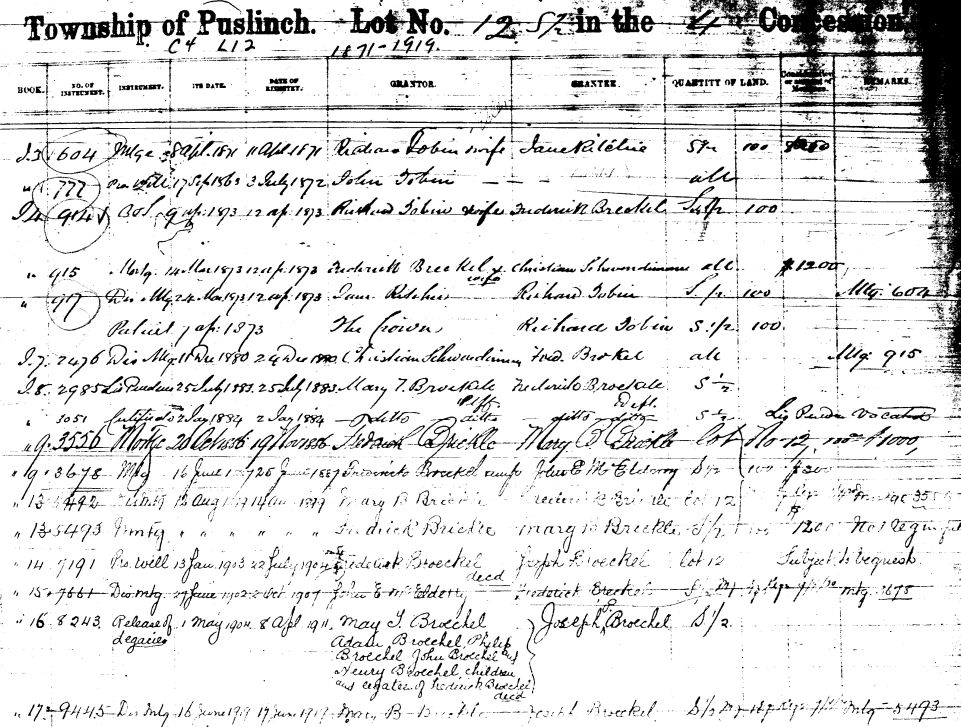
See the example and explanation of the Abstract Indexes to Deeds for Concession 4, Lot 12, Puslinch Township, Wellington County Ontario. You may click on image for a larger graphic.

Abstract Indexes to Deeds for Concession 4, Lot 12, Puslinch Township, Wellington County OntarioLooking at the second from the bottom entry dated 1904 you can see a list of the children of Frederick Broeckel and a notation that he is deceased. If you did not know when Frederick Broeckel died, or the names of his children, this would be a very nice genealogy find. 


After you have found that enty in the Abstract Index to Deeds, you can order the full record to see what other genealogy details might be found. Simply refer to the Book Number, Instrument Number and date to order the full record.

 In this case it is Book I16, Instrument #8243, 1 May 1904. Notice that there is an earlier entry dated 13 Jan. 1903 for Frederick Broeckel and it is called Probate to Will. Sending for the full record would no doubt include Frederick's will.

Where to Find Abstract Indexes to Deeds

Please refer to http://www.olivetreegenealogy.com/can/ont/abstract-indexes.shtml for a complete list of where you can obtain these Abstract Indexes to Deeds


October 19, 2008

Abstract Indexes to Deeds - an Explanation

I've talked about Ontario Land Grants before on Olive Tree Genealogy Blog. They are an amazing resource but often overlooked by researchers.

There have been quite a few questions recently about Free Grants of Land in Ontario as well as curiousity about the Abstract Indexes to Deeds on a mailing list I am on.

So I wrote up what I hope is a helpful explanation for each topic, including examples and a list of where you get these records.

The new pages are online at Abstract Indexes to Deeds The Abstract Indexes to Deeds are the indexed record of every transaction on a plot of land from Crown ownership to the present day. Abstract Indexes were created 1865-1866 according to new legislation and were retroactive to the patent on a property, meaning they went back to when the land was first owned by the Crown before it was sold or granted to individuals

The new page I have online explains what you might find in the Abstract Indexes, how to use the Abstracts, where to find them, and provides a graphic example for a better understanding

You can also start at Land Records in Ontario

There are links provided there for the new pages. The Land Records page provides details of

* Free Grants
* Land Petitions
* The Canada Company
* Crown Land Grants
* CLRI (Computerized Land Record Index)
* Abstract Indexes
* Assessment Records
* Township Papers

and more..