Discover your inside story with AncestryDNA®
Showing posts with label Copyright Issues. Show all posts

September 20, 2018

Reacting to a Copyright Violation of Your Content or Photos

Heads up to the genealogy community - here's what to do if you are a victim of a copyright violation of your photos or articles.

1. Contact Site Owners

If there is no contact information on the site check their WhoIs information. There is an article outlining how to write such an initial take-down letter at Lorelle

In the one and only email I send to a person who uses my content without my permission, I give 24 hours as the timeline in which such articles must be removed or a fee for the use of the article/photo must be paid to me. 

I make it clear to the webmaster that if one of these actions is not take when the 24 hour deadline rolls around, I will file a DMCA notice with his webhost, any ad services he uses such as Google AdSense and feed services if they are used. And I do it. I don't hesitate, I don't give second chances, I file the DMCA notice. I then copy the webmaster on my filing of the notice.  


2. Contact the Host of the Site

Here is an example email to send:

To whom it may concern
You are the hosting company for [name of site] 
[name of site] is using my copyrighted material (writing and images) without my permission. My work is at [name of your own site]
Kindly see that [name of site] remove *all* my blog posts, images, and     articles from their site or shut them down completely.  

3. File a Policy Violation Complaint with Google

File a Policy Violation complaint with Google if the site has Google ads. Google will pull their ads if a site violates their rules so at least you can hit the offenders in the pocketbook with your complaint.

4. File a DMCA Complaint

You can also file a DMCA Complaint  The Digital Millennium Copyright Act (DMCA) is a United States copyright law that helps stop copyright infringement on the Internet. There is a DMCA generator you can use if you are not sure how to do this.


If you want to learn more about copyright in the USA and Canada, see US Copyright Office and Canada Intellectual Property Office 

August 15, 2016

Heads Up! Blogarama Violating Copyright?

Copyright protection is a very important issue, both online and offline. I have written about Copyright Issues many times on Olive Tree Genealogy blog. See Copyright Issues

But first, what is the definition of copyright? From the Merriam-Webster dictionary:

the exclusive legal right to reproduce, publish, sell, or distribute the matter and form of something

Basically it means if I write and publish an article on my blog or my website, and someone copies it without my permission and republish it elsewhere, that person has violated my copyright. It does not matter whether or not they gave attribution to me as the author, it's still a copyright violation.

It's heads up time again. Another splogger has hit the genealogy community. According to techtarget.com, a splog (spam blog) is a fake blog created solely to promote affiliated Web sites, with the intent of skewing search results and artificially boosting traffic.

Blogarama has many genealogy blog posts on their site - mine included - without permission.

Thomas MacEntee first brought this to my attention with his post  Splog Alert – Blogarama Violating Copyright

When I went to the site and checked my name Olive Tree Genealogy  I found twenty-five (25!) of my articles and images posted without my permission.  That's called copyright violation.

Heads up to the genealogy community - if you have a blog, you may want to check to see if your articles have been copied without permission. Here's what to do if you are a victim.

1. Contact Site Owners

Trying to contact the site owners of Blogarama doesn't work because they have carefully made sure there is no contact information on their site. Their WhoIs information shows they are a private registration so there is no information to be found there.

2. Contact the Host of the Site

I wrote to enom.com, who I thought was their hosting company, with this email:
To whom it may concern
You are the hosting company for blogarama.com
Blogarama.com is using my copyrighted material (writing and images) without my permission. My blog is http://olivetreegenealogy.blogspot.com

http://www.blogarama.com/blogs/513127-olive-tree-genealogy-blog shows a list of 25 (twenty-five!) articles and blog posts taken and republished without my permission. There may be more. 
Kindly see that blogarama.com remove *all* my blog posts and articles from their site or shut them down completely.  
Enom.com very quickly replied, stating they are the domain registrar for Blogarama, but not the host. They advised me to ping Blogarama for the IP address which would allow me to find the name of the host. I did that and found that their host is cloudflare.com. I sent them my email outlining my concerns.


UPDATE: Cloudfare informs that the actual host server is Linode.com so please direct your complaint email there

3. File a Policy Violation Complaint with Google

I also filed a Policy Violation complaint with Google since Blogarama has Google ads. Google will pull their ads if a site violates their rules so at least I can hit Blogarama in the pocketbook with my complaint.

4. File a DMCA Complaint

You can also file a DMCA Complaint  The Digital Millennium Copyright Act (DMCA) is a United States copyright law that helps stop copyright infringement on the Internet. There is a DMCA generator you can use if you are not sure how to do this.

I'm very happy to announce that those 25 articles I wrote that were republished without my permission, have been removed from Blogarama! It didn't take long. I also don't see Google ads on the site anymore so another win. 


UPDATE: Two more bloggers have had their articles removed after taking these steps.

If you want to learn more about copyright in the USA and Canada, see US Copyright Office and Canada Intellectual Property Office 

June 6, 2016

This is a Very Bad Idea!

Copyright protection is a very important issue, both online and offline. I have written about Copyright Issues many times on Olive Tree Genealogy blog. See Copyright Issues

Webmasters with copyrighted works for example, have protection against theft of their content. However the act that protects a webmaster can be (and is) abused!

"In May, the US Copyright Office came to San Francisco to hear from various stakeholders about how well Section 512 of the Digital Millennium Copyright Act or DMCA is working.  The DMCA is the part of copyright law that provides for a “notice and takedown” process for copyrighted works on the Internet." [http://blog.archive.org/ Article by Lila Bailey]

DMCA notices can be sent in error or in spite, by a visitor who does not understand whether or not a webmaster has violated copyright, or bears a personal grudge against a webmaster. This happened to Steve Morse of One-Step Search Engine fame when a false DMCA notice was filed against him. Under the regulations, his site was taken down temporarily by his host server, while being investigated.

".... the Copyright Office is strongly considering recommending changing the DMCA to mandate a “Notice and Staydown” regime." [http://blog.archive.org/ Article by Lila Bailey]

Under this proposed legislation Steve Morse's site would never have been allowed back online!  This is a Very Bad Idea and I urge my readers to read the rest of the article Copyright Office’s Proposed Notice and Staydown System Would Force the Internet Archive and Other Platforms to Censor the Web

March 31, 2016

Plagiarism Accusations

 Plagiarism and copyright infringement are a serious issue for those of us publishing our work online.  

Ancestry Insider has done some fact-checking on some recent issues. Please read and form your own opinion.

Continue reading More Accusations of Plagiarism Leveled at Barry Ewell

February 22, 2016

Heads Up! Bloggers Check for Unauthorized Use of Your Content

One of my Legacy Family Tree articles
published in its entirety without my permission
Copyright issues have raised their head again. The following website, TORGGG Blogger: Toronto Galician Genealogy Group, has many bloggers' articles on its site. Perhaps you gave permission for your work to be republished there. I did not give that permission, yet two of my articles written for Legacy Family Tree were found there. 

My articles and images, including graphics I created personally, were taken without permission and published on TORGGG. My name was also missing as the author. 

Other bloggers have reported on Facebook that their unauthorized work is also found on the site. I wrote to the owner, Jim Onyschuk, jodanji@rogers.com.ed to demand he remove all articles written by me which he published without my permission. 

There is an article outlining how to write such an initial take-down letter at Lorelle

In the one and only email I send to the person who used my content without my permission, I give 24 hours as the timeline in which such articles must be removed or a fee for the article must be paid to me

I make it clear to the webmaster that if one of these actions is not take when the 24 hour deadline rolls around, I will file a DMCA notice with his webhost, any ad services he uses such as Google AdSense and feed services if they are used. And I do it. I don't hesitate, I don't give second chances, I file the DMCA notice. I then copy the webmaster on my filing of the notice.  

You can file a Digital Millennium Copyright Act (DMCA) notice by following instructions on How to File a DMCA complaint

My word of caution for today is to go and check out the TORGGG Blogger site if you have concerns that your work might have been taken and published without your permission.  

I won't link to the site and give him a nice backlink. Just use your favourite search engine to search for TORGGG BLOGGER or copy the link you can see in the graphic above.  If your work is there and you don't want it there, please do follow up with a takedown email to the webmaster or a DMCA complaint or both.

Copyright issues, splogs and using content without permission is not okay! We must all fight this attitude that if it's on the internet it's free for the taking. Anything published online is copyright to the author the second it is published. Don't let your rights be trampled on. Don't let your work be devalued. 

September 15, 2015

Possible Copyright Change Re the Lenz Decision

Olive Tree Genealogy received this notice from The SolutionPR about Copyright. Genealogy bloggers may wish to take note!

Yesterday morning the Ninth circuit ruled in  the “dancing baby case,” finding copyright owners must consider the fair use doctrine before sending Digital Millennium Copyright Act takedown notices to online hosts like YouTube.If the decision stands it will  have a massive impact on copyright law and those who choose to put digital content online.

J. Michael Keyes is an intellectual property partner at the international law firm Dorsey & Whitney with extensive trial and litigation experience in cases involving trademarks, copyrights, unfair competition and false advertising. He has tried several cases in federal courts across the United States.

Recently, Mr. Keyes and his team obtained a final judgment and permanent injunction in the U.S. District Court for the Southern District of Florida on behalf of Rovio Entertainment, Ltd., the creator of Angry Birds®. He’s been watching this case closely and of the decision says:

“The Lenz decision is a path marking case in the world of copyright law.  If a copyright holder sees unauthorized use of its content online, the natural inclination is to take appropriate steps to have that content removed (by sending a "take down" notice to the Internet Service Provider that is hosting the content, such as YouTube.com in the Lenz case).  If the Ninth Circuit decision stands, a copyright holder now must first determine if the party that posted the content has a legitimate legal defense before requesting that the material be taken down.  This is a significant development as it forces content holders to engage in a bit of copyright soothsaying before enforcing their rights,”
“What this decision means from a practical point of view is that anytime content owners see the unauthorized use of their content online (for example music, videos, etc) they will want to carefully consider their options before demanding that the content be removed.  If the party that posted the content has a reasonable argument that it's use of the content was "fair" (I.e. That the poster was commenting on the work or engaged in some sort of educational endeavor) the copyright holder faces the specter of a claim for damages if a take down notice is sent,”

May 16, 2015

Copyright Issues Raise Their Ugly Head Again

Will it never end? It seems many web surfers don't understand copyright. When something is published on the internet on a website or a blog, it is copyright to whoever wrote it. It is not up for grabs! 

I don't know why folks can't grasp that an article I write, for example, and publish here on my blog or on one of my websites, is copyright to me.  That means it cannot be published elsewhere without my permission. Think of this way - if you go to a Library and borrow Stephen King's latest book to read, you cannot copy it and republish it anywhere - online or offline, without Mr. King's permission. (which of course he would not give) If you do publish without his okay, even if you clearly state that Mr. King wrote the piece, not you, you can bet your life he will sue your (ahem) off.

So why then do some folks think they can come to a website, read something they like and copy and paste it on their own site? That is called COPYRIGHT VIOLATION! And you can be sued.

I have copyright notices on every page of my site. Yet some still continue to take my work and republish it as if they are entitled to do so. Some plead innocence when confronted but ignorance of the law is no defense. Some leave the author's name on it and even provide a link to the original website, as if that makes everything okay. But theft is theft and violating someone's copyright is, in my opinion, theft. 

Many people also confuse plagiarism and copyright. 

Plagiarism is when someone takes your work and presents it as their own.  I've had that happen to me. A genealogist with a weekly newspaper column took an article from my website, published it word for word in a very large American newspaper and put her name as the author. After a thorough investigation, the newspaper fired her. These are serious offenses we're talking about. And I don't back down. If you take my work, I'll pursue every legal avenue available to get you to stop. 

Copyright violation or infringement is when someone takes  work which is protected by copyright laws without permission.

What can you do if someone takes your hard work without permission? You can write to the person and demand they remove it. I like to give two options - remove the unauthorized work within 24 hours or pay me a publication fee of $500.00. Those who violate copyright need to understand that an author's work is worth money.

If the person isn't compliant, file a DMCA complaint with their website or blog provider. Send the DMCA notice to the person who took your without permission.

Don't let it go. We should all protect our work and take what we do seriously. It is not okay for others to do a hit and run with no regard for legalities or respect for the work of others.

November 3, 2014

The Plagiarism Problem Rears its Ugly Head

The Plagiarism Problem Rears its Ugly Head
Plagiarism. What is it? Why is it a problem? 

Plagiarism is defined as the practice of taking someone else's work or ideas and passing them off as one's own. Copyright laws are there to protect our work but the internet has given rise a new breed of plagiarists and copyright violators who believe that if something is published online it is up for grabs.

Not so. Plagiarism is unethical and against copyright laws. Publishing on the internet is no different than publishing in a book. Once you write and publish something on a website or a blog it is copyright protected.  

There are many who mistakenly believe that as long as they don't try to make money from taking your work, it is okay. Nope. The reasons for the theft are not important. Theft is theft. Copyright violations and plagiarism are theft. 

Copyright and plagiarism are not the same thing however. Copyright is the legal right given to an author to publish his/her works and to authorize others to share them (or refuse permission for others to share them). Plagiarism is when copyright is violated and the person who took the material attaches their own name as if they had written it.

I have had my own share of plagiarists. The most blatant was in 2011 when a writer for a large newspaper in Texas took an article I had written and published on my Olive Tree Genealogy website, and published it in the newspaper she worked for with her name as the author. She even used an identical layout to mine. This woman, to my shock, was a well known and highly placed member of one of the largest American Genealogy Societies.

After getting nowhere trying to discuss the problem with her privately, I wrote to the editor of the newspaper. He and his Ethics Committee investigated my complaint and found my accusations to be true. This woman had worked for the newspaper writing a weekly column on genealogy for almost 20 years. The Ethics Committee took action.  The newspaper fired her and the article was pulled from its online spot. My article with her name as author had gone out the day before in the print edition so a retraction and apology was issued in the next print edition.

I share this with my readers to point out that Plagiarism and Copyright violations happen frequently and they are a serious problem that needs to be dealt with. If your work has been copied without your permission you need to take action. Do not let it slide. Do you think Stephen King shrugs his shoulders if someone pirates one of his novels and republishes it? Your published work is no different. It is protected by copyright and you need to defend your copyright at all times. 

Your first step should be to attach a copyright notice to your online articles. But be aware that this does not often deter the unethical among us. In fact, the article I wrote which this woman attached her name to, has this notice at the bottom of it

This article was written by Lorine McGinnis Schulze of The Olive Tree Genealogy at http://olivetreegenealogy.com/index.shtml Permission to copy is granted as long as the article remains AS IS. No changes may be made to the article and all identifying information and website link must remain intact! This Permission to Copy notice must remain with the article

Even though the use of this specific article was clearly defined, the woman who copied and used it not only removed all reference to me or my website, she put her name as the author.

What brought this back to my mind is the latest in a run of unethical behaviour by a genealogist. To learn more please read GenealogyInTime's article Let's Talk About Plagiarism about an apparent case of plagiarism via email newsletters which affects them personally. 

Plagiarism is not okay and we as a community of genealogists must do our best to stop it from happening. 

December 9, 2013

Monday Musings: Copyright and Plagiarism

Monday Musings: Copyright and Plagiarism
A rather lively discussion of Copyright went on yesterday in a Facebook group. Sadly it degenerated into a couple of participants engaging in name-calling and emotional tirades. But the topic is important and I have been thinking about it more this morning.


One the one side were those who insisted that if you put something online (a family tree, an article, a photo) you must be prepared for it to be taken and used without your permission. 

A few declared that if we don't want our work taken then don't put it online. Then there were those who mistakenly thought that as long as the item(s) taken were not being sold or used to make money in some way, it was okay.

Those groups are wrong. We should not simply shrug our shoulders and ignore copyright violations. Anything original online is immediately under copyright and deserves our protection. That's where education comes in. Many times people violate copyright because they truly do not understand how the internet works and what the copyright laws are. 

In response to the suggestion that if we don't want our work taken, don't put it online -  if we independent webmasters stopped putting articles, photos, and data collections online, all the free websites and blogs would quickly disappear. 

As for the misconception that as long as the stolen work is not being used to profit the person who took it without permission, it does not matter what the intent is. Taking published work without permission violates copyright.

Definitions

There seemed to be confusion over copyright vs plagiarism vs fair use. Here are some definitions that were posted during the discussion yesterday

Definition of plagiarism: copying the work of someone else and publishing it as your own without permission and without crediting the work to the author. [Cyndi Ingle on https://www.facebook.com/groups/17834741205/ ]

Definition of fair use: purposely gray area in copyright law. Fair use includes using something for purely educational purposes or for review or for satire. But the *amount* of something that can be copied and called fair use is purposely vague. It depends on a case by case basis. [Cyndi Ingle on https://www.facebook.com/groups/17834741205/]


and the definition of copyright from the Merriam-Webster dictionary

Copyrightthe exclusive legal right to reproduce, publish, sell, or distribute the matter and form of something (as a literary, musical, or artistic work) 

Examples

Basically it means if I write and publish an article on my blog or my website, and you copy it without my permission and republish it elsewhere, you violated my copyright. It does not matter whether or not you gave attribution to me as the author, it's still a copyright violation. 

If you take a paragraph or a few sentences from my original article and use them in a new article you are writing that is fair use. But if you neglect to cite me as the original author of those words, it's plagiarism

How to Play Fair and Stay Out of Trouble

It's wise to always read a website's Terms of Use or Copyright Statement/Notice to find out what the restrictions (if any) are on items on that specific site. Big companies such as Ancestry.com have very specific Terms of Use that must be followed by anyone using the site. Smaller websites, such as my Olive Tree Genealogy, usually have a Copyright Notice of some kind that explains what the restrictions are for copying items on the site.

Suggested Reading

Cyndi's List has quite a few links related to Copyright Laws and Issues at http://www.cyndislist.com/ip/


July 7, 2013

Personal Opinion About Copyright and Plagiarism Online

Personal Opinion About Copyright and Plagiarism Online
Today I want to point my readers to two blog posts which discuss what to me is a very important topic - copyright and plagiarism on the internet.

This is an issue that hits home as I have had many instances of my work being copied without my permission and published online. I always fight it. I will not allow anyone to get away with violating my copyright. It is my right to publish original works online and to have them respected.

The most recent episode that happened to me involved a well-known and highly placed member of a North American Genealogical Society. This person also wrote a genealogy column for a large American newspaper. I have never talked about it on this blog, and do not intend to give names  but briefly I will share with you the relevant points.

An article I had written and published on my website Olive Tree Genealogy, was copied verbatim and published in an online American newspaper *and* in print - with my name removed as author and replaced with the columnist's name. No attempt had been made to contact me to ask permission and I certainly would not have agreed to someone else's name being put on my original writing. Had the columnist asked my permission to publish my article with my name attached as the author and a link back to my site, I would have agreed. That's called attribution and is the proper ethical way to behave.

My email (low-keyed and polite) to the columnist resulted in a very dismissive response from her. She told me that she "might consider" giving me credit for the IDEA behind her article. Wow. It was my article word for word except for a 3 or 4 words being changed to a similar word such as "suggestion" now being the word "tip". Even the layout was identical.

I don't deal with unreasonable people so my next step was to write to the newspaper editor. I provided the link to my article and the link to the article in his newspaper. His reaction was to immediately pull the online article while he investigated further. The newspaper ethics committee was called in and after much discussion back and forth with me and with the columnist, they agreed "her" article had been copied outright from mine.  She was then dismissed from her position with the newspaper.

The newspaper then printed an apology and retraction in their print version since it had gone to press and could not be stopped. It reached thousands of subscribers. All in all a somewhat happy ending since this person was held accountable by one segment of her genealogy world - the newspaper.

My opinion is we need accountability! We need to accept that there will be consequences to our actions. Unethical behaviour should not be tolerated. And guess what - copyright does exist on the internet! It is no different than if someone writes a book or a song - it is copyright to that individual the minute it is published online or offline. It's not there for the taking and we genealogists need to respect copyright and read the conditions attached to the website we are visiting.  Do they allow for copying for personal use? Do they not allow any reproduction? We must read the copyright policies and follow them.

 There is a lot of discussion among bloggers and webmasters  as to how to handle the rampant unethical behaviour that often occurs.  I urge you to read the following excellent pieces about unethical practices online.

"Copyright, plagiarism, and citing your sources" by Michael Hait at http://michaelhait.wordpress.com/2013/07/07/copyright/ is a must-read

Please also read Dear Myrt's blog post "Is there such a thing as ethical plagiarism?" at http://blog.dearmyrtle.com/2013/07/is-there-such-thing-as-ethical.html

Update: Please also read other bloggers' posts about this important and disturbing issue

How Genealogy Plagiarism and Copyright Infringement Makes Everyone a Loser by Denise Levenick

Time to Name Names by Michele Simmons Lewis

Image courtesy of Stuart Miles / FreeDigitalPhotos.net

May 31, 2013

Update on HEADS UP ALL GENEALOGISTS re copyright issues

Here is the latest update regarding my earlier HEADS UP ALL GENEALOGISTS! blog post. Dozens of genealogists and bloggers have checked this Pinterest user's boards and filed DMCA complaints. (Please read the original blog post for full details on the issue and instructions on how to deal with the problem)
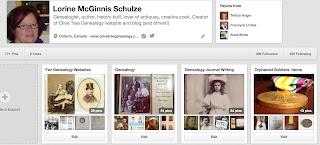
Update on HEADS UP ALL GENEALOGISTS re copyright issues
My Pinterest Boards
THE ISSUE

A Pinterest user is repinning photos from other genealogists' pins (absolutely ok) BUT the links to the original blog post or website are gone and have been replaced with a link to this person's own website (not ok)


Pinterest has acted quickly on all DMCA complaints and so far has removed every inappropriately linked pin once a complaint is filed. 
 
From one Pinterest board with over 4,000 inappropriate pins, it has diminished to 1,384 pins as of today. Unfortunately they are still being redirected to the user's own website instead of to the original owner and website.

WHAT SHOULD WE DO?

We need to continue to spread the word and urge others to check his/her boards for their own photos. If found with the correct original link removed, please follow instructions given at HEADS UP ALL GENEALOGISTS! 
 
 Interestingly enough, shortly after I wrote my HEADS UP post, this user set up a third board called My Family Tree. It has over 800 pins but the majority have the original appropriate link. Many however do not.  This is puzzling to me but I am staying vigilant and checking every few days to see if the original links remain or if they have been magically replaced with links to this user's website. You may wish to also check periodically. 
 
FIGHTING THE ISSUE
 
I thought I would also fill you in on what I am doing to continue to fight this inappropriate pinning by this Pinterest user. Every morning I take a half hour and do a Google Image reverse search for the pins remaining on the one board with 1,384 pins.  What this search does is look for matching images. So if for example, image X is on his board without the original link, I can instruct Google to search for a match elsewhere. Any matches found will display on my browser. It is easy then for me to click through to the original site and notify the site owner. 
 
SAMPLE EMAIL 
 
Here is the email I send to the actual photo owner:
 
Hello

I'm Lorine McGinnis Schulze of Olive Tree Genealogy. Recently I wrote a blog post about an issue with a Pinterest user. This user is using other genealogist's photos but instead of linking back to the owner and the website/blog where the photo is found, legitimate links have been replaced with links to his own website.

One of your photos is on his board but is not linked to your blog where it originated.

Here is the link to your photo on your website [insert link]

and here is the link to the same photo on his Pinterest board (linked to HIS website)
[insert link to pin]
 
Many of us have reported him to Pinterest and filed a DMCA complaint to have our pins removed from his board.

Please see my blog post HEADS UP ALL GENEALOGISTS at http://olivetreegenealogy.blogspot.com/2013/05/heads-up-all-genealogists.html   for full details and complete instructions (with links) on how to report him and how to file that DMCA complaint.

I found 11 of my photos being misused on his boards and within 3 hours of my complaint Pinterest removed them all so we are getting rapid and positive response from Pinterest.

Thank you
Lorine
 
I have had positive responses from everyone I have notified. So I suggest that we all pitch in and do this. Take a few minutes today and search for duplicate images, then notify the site owners. Here is how to do a reverse image search on Google
 
REVERSE IMAGE SEARCH ON GOOGLE
 
I chose to download the add-on for Firefox and I love it. All I need to do is  right click the image I wish to search for, and a drop down menu appears which includes the words "Search Google with this image" I choose this option and any duplicate images appear in the search results, with links to the originating website. 
 
 If we all work together as a team we can stop issues such as this one.
 

December 28, 2012

Cyndislist.com Files Lawsuit Against MyGenShare.com

CyndisList.com has filed a lawsuit against MyGenShare.com. The plaintiff(s) and defendant(s) are listed as

Plaintiffs: Cyndi's List  and Cynthia Howells 
Defendants: Mygenshare.com and Barry J Ewell

 The suit is listed as Intellectual Property - Copyrights. For a brief summary of the case see Justia.com Dockets & Filings

A search for Cause 17:101 as listed on Justia provides information on this specific section of Copyright from Cornell University Law School

Cyndi started her website in 1996, the same year I started Olive Tree Genealogy  and we've been friends since that time. Copyright is a serious issue online and I'm certain the genealogy community will be following Cyndi's case with great interest.

As stated by Michael J. Neil on his blog post at RootDig.com Cyndi will not be responding to questions about this lawsuit.


January 18, 2012

SOPA & PIPA Action Call Today

Today is a day to take action against SOPA and PIPA.  Wikipedia and other websites are blacking out their pages for 24 hours today to protest SOPA (Congress' proposal) and PIPA (the Senate's proposal).


Here is the message seen on WikiPedia a few days ago

"Today, the Wikipedia community announced its decision to black out the English-language Wikipedia for 24 hours, worldwide, beginning at 05:00 UTC on Wednesday, January 18 . The blackout is a protest against proposed legislation in the United States — the Stop Online Piracy Act (SOPA) in the U.S. House of Representatives, and the PROTECT IP Act (PIPA) in the U.S. Senate — that, if passed, would seriously damage the free and open Internet, including Wikipedia.

This will be the first time the English Wikipedia has ever staged a public protest of this nature, and it’s a decision that wasn’t lightly made."
Yes we should all be concerned about copyright and violation of copyright. But these proposed legislative acts are using censorship to try to achieve an end to copyright violations.  If the acts pass it will almost certainly mean an end to the Internet as we know it - the end of an exchange of free information.

Legitimate websites and site owners will suffer badly and may go under. Not because they are violating copyright but because of the draconian measures SOPA and PIPA want to put into place.

Many geneabloggers are blacking out their blogs today in protest. Olive Tree Genealogy has Guest Author posts and therefore will not be blacking out as I cannot make that decision for others who have posted articles here.  However I have filed my protest of SOPA as a Canadian at Stop American Censorship

I suggest reading a few of the many blog posts and website articles about SOPA, PIPA and today's call for blackout.

Web Goes on Strike! on SopaStrike

DM supports SOPA and PIPA protest by Dear Myrtle


Today We Fight Back... by Reddit