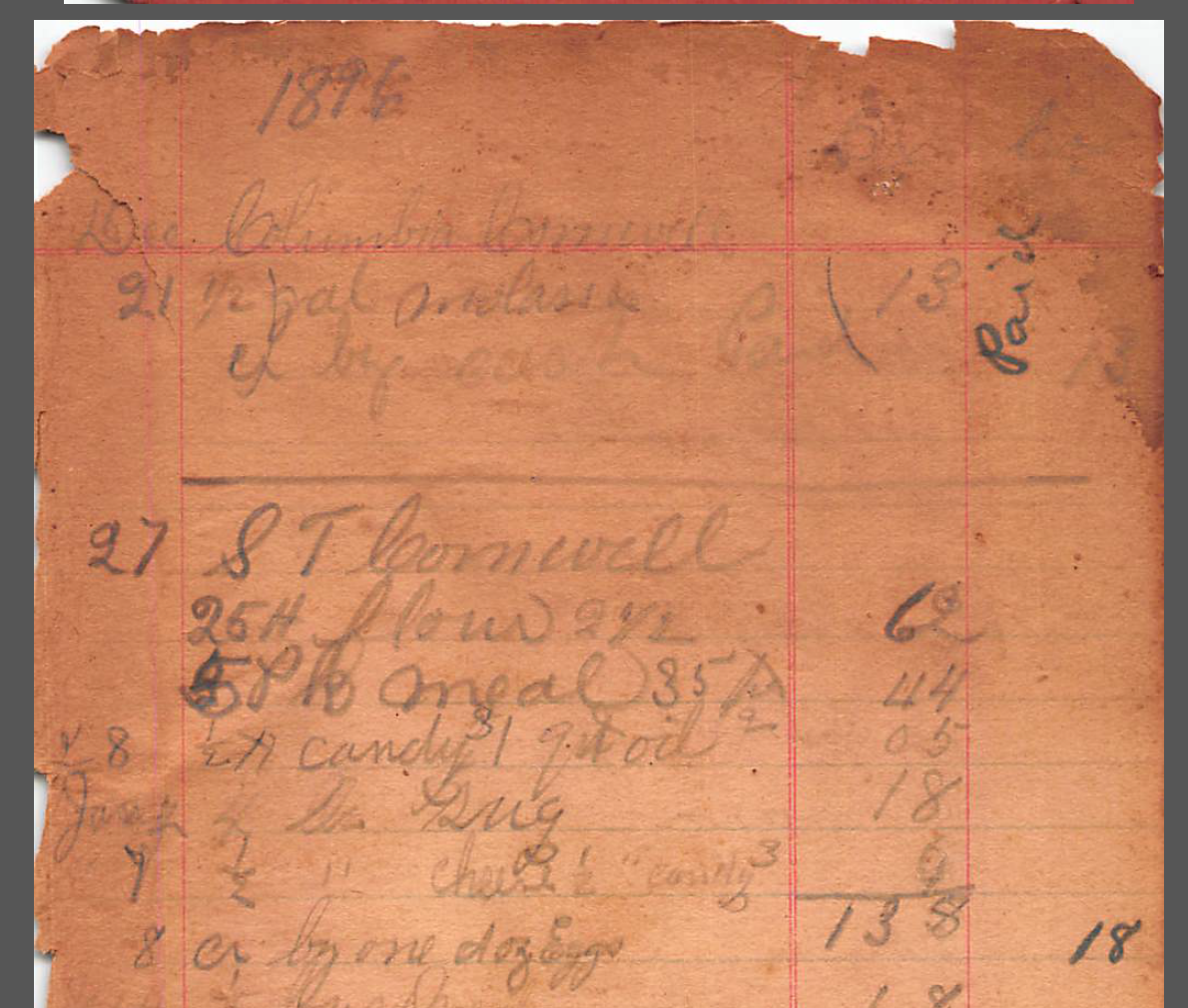
Great news. The S. R. Turley Ledger Book from Culpeper Virginia for the year 1896 is now online and available for download as a PDF file. There are 5 files total on the Ancestors At Rest website.
There are many names of customers in this one-of-a-kind ledger book. Each page has a customer name and the list of items purchased that year plus the cost. Some customers have more than one page of items. It's very interesting to see what food cost in 1896 and what an ancestor was buying!
S. T. Cornwell in the image on the left, bought eggs, candy, oil, flour, socks, shoes and more. One pair of shoes cost $1.15 that year.
In some cases, one page has several customer names on it, such as the page on the right. If your ancestor lived in Culpeper Virginia in 1896 there's a good chance you will find his or her name in this gem.
I had a quick look for some of these names and found several of them living in Prince William County, Virginia. It seems Mr. Turley was a very bad speller as many seem to be phonetic representations of the person's name.
For example there is a "Page Bumery" buying laundry and gloves on one page. However his real name is Page Bumbery. We also see "Tasker Fisher" and "Georgiana Fisher" A search of the 1900 census shows a black man Tasker Fisher and his wife Georgia in Prince William County, Virginia.
All pdf file downloads are freely available. Brian is scanning adding the ledger books he owns as quickly as he can, so be sure to keep checking on Ancestors At Rest for updates
Showing posts with label Digital Books. Show all posts
March 18, 2014
August 19, 2010
Creating A Family Tree Booklet
A few days ago I talked about my surprise that my nephew did not know about my mother and father's (his grandparents) double wedding ceremony in 1936. That story is at The Things Family Don't Know
His surprise at finding this out made me realize I know a lot of things that other family members don't. And I have a lot of items - newspaper clippings, photos and so on, that other family members have probably never seen.
It seemed to me I needed to start creating family booklets which contained all this information. That's not as easy or quick as it might seem, because I have become the unofficial keeper of the family papers and photographs. It started when I was about 16 and my grandmother gave me her "stuff". Every time someone in the family passed away, their "stuff" ended up with me. I'm not complaining, but it's a lot of "stuff" to sort and organize before it is ready for a booklet.
Several readers have asked me how to create such a booklet - what do you include, how big do you make it, etc. I've completed one on my McGinnis family which I'll be giving to my brother and nephew today. Here's how I tackled it:
1. Decide what your focus is for your booklet. I wanted to provide photographs and newspaper clippings plus a few documents for my generation (my siblings and I), my parents, my McGinnis grandparents, my great-grandparents and my great-great grandparents. You could focus simply on your generation and your parents, the choices are endless.
2. What size will your booklet be? I made mine on 8.5x11 inch paper, portrait orientation.
3. How many pages will you include? I didn't decide on a specific number other than less than 25 pages. I just kept adding photos until I decided I was done. Actually in my case, my LaserJet Printer ran out of black ink and that ended my project.
4. Think about your audience. What format will you use for your booklet for that audience? Since my booklet won't be in the hands of any avid genealogists, I wanted it to be easy to read, not too many dry facts, and appealing enough to be looked at more than once.
I decided to do brief write-ups on the first 3 generations down to my parents, each write-up giving a few basic facts interspersed with images. I used a program called PictureIt! to create these pages.
So I talked a bit about my Irish McGinnis family coming from Ireland to Ontario during the Famine. I gave some details from various census and land records (but not too many! I kept in mind that no one in my family but me is a fanatical genealogist)
When I got to my parents' section, I started adding photographs, the more the better.
My next section was a scrapbook type section, created in Picassa using the Collages feature.
I created several pages of scrapbook photos complete with captions. These pages were focused on my mom and dad and my siblings and myself.
Some things I mulled over were whether or not to include death certificates. I decided against it because I felt that my family members would not want to read such an item (again - they are not die-hard genealogists!) These are all personal decisions and keeping in mind who will be receiving your booklet helps you make a decision appropriate for that audience.
One item I added was a family tree chart of head shots of our ancestors. It doesn't follow our McGinnis line exclusively because I only have some ancestors' photographs. So these were the ones I put in my chart.
Last, I created a cover page on card stock, laminated front and back and then bound the entire booklet together with a coil spine.
Here is an example of the finished product (two pages from the completed booklet) which will be given to my brother and nephew today.
His surprise at finding this out made me realize I know a lot of things that other family members don't. And I have a lot of items - newspaper clippings, photos and so on, that other family members have probably never seen.
It seemed to me I needed to start creating family booklets which contained all this information. That's not as easy or quick as it might seem, because I have become the unofficial keeper of the family papers and photographs. It started when I was about 16 and my grandmother gave me her "stuff". Every time someone in the family passed away, their "stuff" ended up with me. I'm not complaining, but it's a lot of "stuff" to sort and organize before it is ready for a booklet.
Several readers have asked me how to create such a booklet - what do you include, how big do you make it, etc. I've completed one on my McGinnis family which I'll be giving to my brother and nephew today. Here's how I tackled it:
1. Decide what your focus is for your booklet. I wanted to provide photographs and newspaper clippings plus a few documents for my generation (my siblings and I), my parents, my McGinnis grandparents, my great-grandparents and my great-great grandparents. You could focus simply on your generation and your parents, the choices are endless.
2. What size will your booklet be? I made mine on 8.5x11 inch paper, portrait orientation.
3. How many pages will you include? I didn't decide on a specific number other than less than 25 pages. I just kept adding photos until I decided I was done. Actually in my case, my LaserJet Printer ran out of black ink and that ended my project.
4. Think about your audience. What format will you use for your booklet for that audience? Since my booklet won't be in the hands of any avid genealogists, I wanted it to be easy to read, not too many dry facts, and appealing enough to be looked at more than once.
I decided to do brief write-ups on the first 3 generations down to my parents, each write-up giving a few basic facts interspersed with images. I used a program called PictureIt! to create these pages.
| First Generation Story |
So I talked a bit about my Irish McGinnis family coming from Ireland to Ontario during the Famine. I gave some details from various census and land records (but not too many! I kept in mind that no one in my family but me is a fanatical genealogist)
When I got to my parents' section, I started adding photographs, the more the better.
| The Double Wedding |
I tried to focus just on our direct male ancestor and not get side-tracked by siblings or spousal lines. Adding photos and documents for siblings and spouses would have meant creating a huge book, not a booklet. For myself and my siblings I didn't provide any text, just photos.
My next section was a scrapbook type section, created in Picassa using the Collages feature.
| Scrapbook Section: Mother's Early Years |
Some things I mulled over were whether or not to include death certificates. I decided against it because I felt that my family members would not want to read such an item (again - they are not die-hard genealogists!) These are all personal decisions and keeping in mind who will be receiving your booklet helps you make a decision appropriate for that audience.
One item I added was a family tree chart of head shots of our ancestors. It doesn't follow our McGinnis line exclusively because I only have some ancestors' photographs. So these were the ones I put in my chart.
| Family Tree Chart |
| Booklet Cover |
| Final Product - Coil Bound Booklet |
February 3, 2007
The Champlain Society - Finding Loyalists
The Champlain Society at has a collection of digital books online.
Look for Loyalist Loyalist families in the books The Town of York [Toronto] 1793-1815 and Kingston before the War of 1812.
FOr more help with Loyalist Research see Loyalist Genealogy
Thanks to Annette Fulford for this tip
Look for Loyalist Loyalist families in the books The Town of York [Toronto] 1793-1815 and Kingston before the War of 1812.
FOr more help with Loyalist Research see Loyalist Genealogy
Thanks to Annette Fulford for this tip
Subscribe to:
Posts (Atom)