Discover your inside story with AncestryDNA®
Showing posts with label 52 Ancestors in 52 Weeks. Show all posts

July 11, 2014

52 Ancestors: Cornelis Van Slyke 17th Century Adventurer


52 Ancestors: Cornelis Van Slyke 17th Century Adventurer
In the early 1630s, a Dutchman named Van Rensselaer began to advertise for people to colonize his New World venture. Van Rensselaer envisioned the Patroon system of ownership with the landowner a feudal lord over his tenants. A tenant would be required to contract himself to the Patroon for a specified time, after which he could become an independent settler.

The colony of Rensselaerswyck was thus formed. By 1634, there were only twenty-six settlers living there. Rensselaerswyck lay in a wilderness surrounded by Mahicans on the east and Mohawks on the west.

My ancestor Cornelis Antonissen Van Slijk [sic] from Brueckelen,  Netherlands, left the Netherlands in May 1634 from the Texel on board De Endracht and sailed to the New World.  He was a thirty year old carpenter and mason, and his skills were desirable in a new colony.

During his lifetime in what was to become the state of New York, Cornelis met and married a Mohawk woman, had several children with his Mohawk wife (all of whom became valued interpreters between the Mohawk and the Dutch), and rose to a position of importance in the colony.

Cornelis Starts as a Farmer

Cornelis Van Slyke contracted to Kilean van Rensselaer as a carpenter and mason, but agreed to do farm work when necessary, for the fee of 180 florins a year. In the contract he signed on April 5, 1634 he stated he was 30 years of age.  Farmhands received 100 to 150 gl. per year so we can see that Cornelis' skills were highly valued. But what did that 180 florins per year buy, remembering that one florin equalled one guilder? In 1639 a mare was sold for 200 gl., a shirt for 3 gl., a pair of farmer's shoes for 4 gl. and a pound of butter or pork 6 stuivers, with 20 stuivers equal to one guilder.

Cornelis Gains Favour in the Colony

Between 1643 and 1648 Cornelis spent much of his time at Manhattan, as interpreter and negotiator with the natives. His absence did not always sit well with the authorities, and the Secretary of  Rensselaerswyck, Antony de Hooges, wrote to him in 1646 urging him to             "...come up the river to see how the harvest proceeds" and hinted that he might at least come to the Colony once a year to look after his farm.

Van Rensselaer was not happy with Cornelis by this time, and complained about his personal accounts and his service as representative, threatening to end their association if matters did not improve.

Cornelis as Interpreter and Representative

In September 1650 tensions increased with the natives and rumours of an impending attack on Fort Orange by the Mohawks were rampant. The settlers at Rensselaerswyck were anxious so they decided to send five trusted representatives into Mohawk country to renew old friendships and ensure peace.

On 23 September, 1650 Cornelis was one of those chosen to act as an ambassador to the Mohawks. He went on this important mission into what was called Maquas country. The mission was successful and the colony could relax.

Cornelis Marries a Mohawk Woman
 
By this date, Cornelis had already formed his liaison with Ots-Toch, a Mohawk woman, which produced at least four but possibly five children: Jacques, Marten, Hilletie and Lea, and  Cornelis.  Jacques and Hilletie occupied a very strategic position among the Dutch, English and Iroquois and became trusted interpreters for the state of New York.

By all accounts Cornelis was a much respected and trusted man. He would never have dreamed that his life could take such a turn from a simple carpenter in Holland to marrying a Mohawk woman  and becoming a fairly important man in the new colony.

Credit: This blog post was extracted from my book The Van Slyke Family in America: A Genealogy of Cornelise Antonissen Van Slyke, 1604-1676 and his Mohawk Wife Ots-Toch, including the story of Jacques Hertel, 1603-1651,Father of Ots-Toch and Interpreter to Samuel de Champlain REVISED EDITION published May 2010. Coil bound 8.5x11. 287 pages by Lorine McGinnis Schulze.

If you are a descendant and wish to purchase this book, Download an Order Form to pay by check or pay using Paypal

July 4, 2014

52 Ancestors: Joseph McGinnis - A Riddle, Wrapped in a Mystery, Inside an Enigma

Joseph McGinnis - a riddle, wrapped in a mystery, inside an enigma
1871 Census Guelph Ontario Canada Joseph McGinnis & Family
I'm writing about my 2nd great grandfather Joseph McGinnis as part of Amy Crow's Challenge: 52 Ancestors in 52 Weeks 

Joseph McGinnis came to Ontario Canada from Ireland in 1847 with a wife (Fanny Downey) and a toddler (Bridget aka Delia). He was about 20 years old and a general labourer. After the 1871 census was taken in Guelph, Joseph disappeared. What happened to him? 

There are two possibilities. Many of Joseph's family (either siblings or cousins, that relationship has not been worked out yet) left Guelph area after 1861 with their families. John and Daniel left after 1871 for Michigan. Constantine and Frank left shortly after 1861 - Francis for Ohio and Constantine for Michigan. Mary Jane left for Ohio after 1851 and Sarah left after 1864 for Iowa. It seems very possible that my Joseph could have left with John and Daniel, perhaps for the same area. Did he die there? 

Joseph is not found in the 1880 U.S. census, nor in the 1881 Canadian census. So did he leave Ontario after that 1880 census was taken but before the 1881 Canadian? My Fanny is found in the 1881 census for Guelph as a widow but with another puzzle added. More on that later in this blog post!

However there is another possibility - and another "wrinkle" thrown in to add to the mystery. For there was another couple in the same location, around the same ages, also named Joseph and Fanny McGinnis. Or was there? In 1877 a Joseph McGinnis died in Guelph. For years descendants, including me, believed this was our Joseph. But a search by me of the Catholic church burial records revealed that *this* Joseph was married to a Fanny Foster, not Fanny Downey! The thought that perhaps my Fanny Downey had been married more than once occurred. 

But in 1890 Fanny (Foster) McGinnis also died. Since Fanny (Downey) McGinnis was alive and kicking in 1891 and in fact did not die until 1904, the two women were not the same individual. 

But what about Joseph? Could he have been married to both women? Is he in fact the Joseph who died in 1877?  Is that why he disappeared after 1871 and no record of his death or his residence has been found? 

There is no trace of Joseph and Fanny (Foster) McGinnis in any census records. There is one Fanny McGinnis, a widow in the 1881 Guelph census. A second Fanny appears in that 1881 census for Guelph, also listed as a widow and with her 15 year old son Joseph. Given the errors that creep into census records the age difference (Joseph should have been 17) isn't enough to say that this one isn't my Fanny. But certainly one of the women must be mine.

But because there is no trace of Joseph #2 (married to Fanny Foster) it leads to suspicion that indeed there may only be ONE Joseph McGinnis - married to two different women.

It is possible that my Joseph did indeed die in 1877 and that Fanny Downey left Ontario with her youngest children - perhaps to live with a sibling or other relative. Another intriguing fact is that Daniel McGinnis, who was either the brother or cousin of my Joseph McGinnis, and the man who moved to Michigan with his family after 1871, was married to a Margaret Downey. Was she my Fanny Downey's sister? Could my Fanny have left Ontario to live near her sister, then moved back to Ontario by 1881? Or did she never leave Guelph? There is not much to go on other than the census every 10 years. Catholic records for Guelph are not open to the public so I am unable to search to see if she happened to be a baptismal sponsor for grandchildren during those crucial years 1871 to 1881.

That brings me to trying to decide which is the most likely scenario - that my Joseph packed up his family and left Ontario for parts unknown, died there, and his widow Fanny Downey moved back to Ontario to be with her eldest daughter OR that my Joseph was married to both Fanny Foster and Fanny Downey and that he died in Guelph in 1877? 

I don't know. I waffle between one scenario and the other. I have spent years going over and analyzing the clues and the documents I've found on the family. Sometimes I feel I'm going in circles, hoping for that one clue that will provide me with an "aha!" moment.

June 11, 2014

52 Ancestors: An Abusive Ancestor Charged with Attempted Murder of His Wife

I'm writing about Edward Buckland as part of Amy Crow's Challenge: 52 Ancestors in 52 Weeks Edward is my sister-in-law's 3rd great grandfather.

Edward was not the kind of ancestor you would want. He was born into a Gypsy family in England around 1806. At the age of 14 he was arrested and charged with grand larceny for stealing two coach-holders from a coach passing by. His punishment was 7 years banishment to Australia. He may have avoided this however as in 1830 he is found marrying in Westminster England. His wife was only 12 years old.

He and his wife Mary had several children but it's been difficult finding out exactly how many. Edward was a brutal character, often abusing his wife (and no doubt his children as well). I found a few court records and newspaper accounts of some horrific abuse he carried out on his poor wife. In fact he was charged with abusing her and was sent to jail for one year in 1851. 

The Morning Post. Dec. 17, 1851. Edward Buckland, age 46, was indicted for having unlawfully and maliciously assaulted and wounded his wife Mary Buckland with a knife.  The prisoner was a brushmaker and lived with the prosecutrix at 7 Norton St. Somers Town. On Tues. last they had  quarrel and whilst she was standing at the door of their house he rushed out and knocked her down. He had in his hand a table knife which had been sharpened to a point, and drawing his hand back, he declared in language too disgusting and filthy to be repeated, he would use it and would cut her gullet out. At the same time he struck her on the hand with it and cut open the middle finger of her left hand. The poor woman appeared to have been subjected to shocking brutality, both her eyes being frightfully blackened. The jury found the prisoner guilty and he was sentenced to one year's imprisonment.
Another story about this incident reads:

1851 Dec. 17. London Standard. Another Brutal Husband. Edward Buckland, 46, was indicted for having maliciously assaulted Mary Buckland, his wife. It appeared from the evidence that the prisoner is a brushmaker, and lived at No. 7, Northam St., Somers Town. Between 12 and 1 o'clock in the morning of the 7th instant, the complainant was observed to push his wife violently out of doors, and then knock her down. He repeated this, and then went in, closing and bolting the door behind him. She then got up and knocked at the private door, when the prisoner came out with a sharp knife in his hand, and putting himself in a threatening attitude, said with an oath, he would "rip her bowels out, and would cut her gullet." The jury found the prisoner guilty and he was sentenced to imprisonment and hard labour for 12 calendar months.
Some newspaper accounts describe Edward as "a downcast desperate looking fellow" and "a great ruffian"

After getting out of jail Edward apparently went right back to abusing Mary and in 1852 was sent to jail for 2 months for beating her unmercifully. His abuse escalated and in 1853 he was charged with trying to murder her. The newspaper account reads:

1853 May 2. Court. Clerkenwell. Attempted Murder of a Wife. A Monster. Edward Buckland, a brushmaker, was charged with having attempted the life of his wife. The unfortunate prosecutrix was assisted into the courtroom by Sergt. Wilkes of the S. Division, and placed in a chair near the worthy magistrate, who elicited the following particulars of the dreadful suffering she had undergone. She had been the wife of the prisoner nearly twenty years, and had been subjected to the most brutal treatment at his hands nearly the whole of that time. At eleven o'clock on the previous night he came home, and after abusing her, he beat her on the head and other parts of the body with a hammer, and finally struck her many dreadful blows with a pair of shears, and broke her arm. She escaped in a most miraculous manner from him, and meeting Sergt. Wilkes, placed herself under his protection and she was removed to the University Hospital. The accused muttered that he had no observation to make whatever.... remanded for the present and to be turned over to a jury for trial. Victim taken back to hospital.
 In the 1861 census Mary is not living with Edward. She is the head of house with two children ages 9 and 11. One can only hope she was finally able to escape the clutches of this monstrous man and live a life of some peace. She died in 1883 at the age of 70.


May 23, 2014

52 Ancestors: 5th Great Grandpa Ordered Out of His Parish with Wife and Family in 1778

52 Ancestors: 5th Great Grandpa Ordered Out of His Parish with Wife and Family in 1778 I'm writing about my 5th great-grandfather Thomas Blanden as part of Amy Crow's Challenge: 52 Ancestors in 52 Weeks

On 18 MAY 1778, a Removal Order was served on my 5th Great Grandfather THOMAS BLANDON, DRUMMER in the Western Battalion Militia of Suffolk. Thomas, Mary, his wife, and their children Mary, Elizabeth, Ann, Thomas & Susannah were ordered removed from St. James, Bury St. Edmunds and sent to Wenhaston. [Source: Removal Order FC189/G4/14. Suffolk, Ipswich Branch, WENHASTON PARISH RECORDS Date: 1778]


The basis for Removal Orders was the fact that each parish was responsible for any poor citizens. If a person or their family was too much of a drain on the parish resources, they could toss them out and have them sent back to their parish of birth. 

If a person entered a parish in which he did not have official settlement, and if it seemed likely he might become chargeable to the new parish, then an examination would be made by the justices or parish overseers. From this examination on oath, the justices would determine if that person had the means to sustain himself and, if not, which was that person's parish of settlement. As a result of the examination the intruder would then either be allowed to stay, or would be removed by a Removal Order.

Chelsea Pensioner Thomas Blandon

Removal Orders would often take a person or a family back to a place of settlement miles across the country, sometimes to a parish they had only known briefly as a small child. It was not uncommon for a husband and wife to have their children taken from them, each being removed to separate scattered parishes.


In Thomas' case, he and his wife and 5 children ages 1 to 13, were sent back to Wenhaston where Thomas was born. So far no records have turned up to indicate how the family fared, but 9 years later, in 1787, Thomas was pensioned out of the Army, having served 28 years as a Drummer. This entitled him, as a Chelsea Pensioner, to receive a small amount of  money. I wish I knew what happened to Thomas and his wife Mary Jackson but I've not found any more records for them.

May 13, 2014

52 Ancestors: My Cousin Caused the Death of my Daughter-in-law's 9th Great Grandmother


52 Ancestors: My Cousin Caused the Death of my Daughter-in-law's 9th Great Grandmother
My cousin 10x removed was responsible for the death of my daughter-in-law''s 9th great grandmother. This is one of those strange-but-true stories that researchers sometimes encounter while researching family lines.

My Cousin Jean-Baptiste Hertel de Rouville 1668-1722

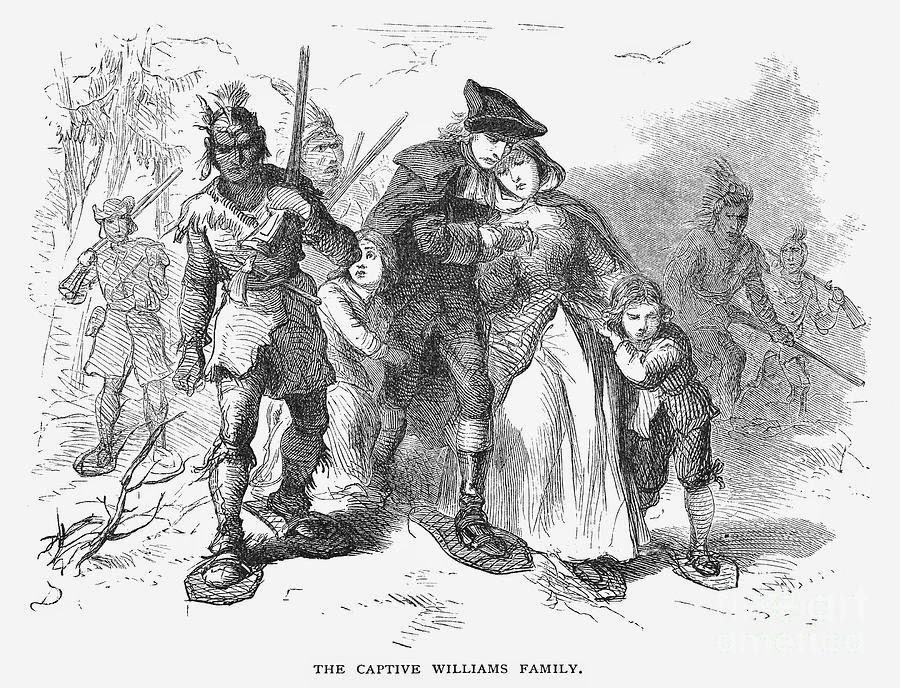
My first cousin 10x removed, Jean-Baptiste Hertel de Rouville (1668-1722), was the soldier put in charge of the Deerfield Raid in March 1704. Approximately 300 French and Native allies raided the English settlement of Deerfield, Massachusetts. 112 Deerfield men, women, and children were captured and taken on a 300-mile forced march to Quebec. Some of the captives were later redeemed and returned to Deerfield, but one-third decided to remain among their French and Native captors.

Daughter-in-law's 9th Great Grandmother Mehitable Smead Nims

Two of those captured by the French and Indians at Deerfield were Josiah Rising and Abigail Nims. These two captives chose to remain with their captors when offered freedom, and later married. Josiah and Abigail are my daughter-in-law's 8th great-grandparents. Abigail's mother Mehitable Smead Nims (my daughter-in-law's 9th great grandmother) died on the march to Quebec. Since Jean-Baptiste Hertel was my cousin, he was indirectly responsible for the death of my daughter-in-law's 9th great-grandmother.

Abigail Nims aka Elisabeth Towatogowach/T'atog'ach

Abigail, the youngest daughter of Godfrey Nims and his second wife Mehitable Smead was 4 years old when she was captured. Her mother died on the trek to Canada. A native woman Ganastarsi took Abagail on her arrival at the fort Sault-au-Recollet, she was given the name Elisabeth Towatogowach or T'atog'ach which means 'She withdraws from the water'.
"On Jun 15, 1704, the rites of baptism have been administered by me, the undersigned priest, to a little English girl named in her country Abigail, and now Marie Elisabeth, born at Deerfield in New England the (31 May O.S.) 11 June 1700 of the marriage of Geoffroi Nimbs, shoemaker, and of Meetable Smeed also deceased. The child, taken at the said place 11th March last and living in the wigwam of a squaw of the Mountains, called Ganastasi. The godmother was Damoiselle Marie Elisabeth Lemoyne daughter of Messire Charles Le Moine, Ecuyer, Baron de Longueuil, Chevalier de l'Ordre de St Louis, and Captain of a company; with Francois Bounet who said he could not sign, inquiry having been made according to law.
Several years later Abigail's brother John arranged for her return to New England but she refused to leave the Indian village. Approximately thirteen years after her capture she married Josiah Rising, another captured child.

Josiah Rising aka Ignace Raizenne or Shonatakaki 

Josiah Rising aka Ignace Raizenne or Shonatakaki was 10 years old when he was taken by his captor, Macqua, and given the name Shoetakwanni, which means 'he was taken away from his village'.

On July 29, 1715  Ignace Raizenne (Josiah Rising)  21 years old, married Elisabeth (Abigail Nims) who was 15 years old. The marriage took place in Oka.

"July 29, 1715, I have married Ignace Shoentak'ani and Elisabeth T'atog'ach, both English, who wish [to] remain with the Christian Indians, not only renounce their nation but even wishing to live as Indians. In person [the presence] of Jean Baptiste Haronhiatek, Gabriel Tsirok'as, Pierre Asonthen, Alexis Tarhi. Ignace Shoentak'ani, about 23 or 24 years, and Elisabeth, about 15 years old. Both were taken at Dierfile [sic], about 13 years ago. Maurice Quere, priest"
Eight children were born to this couple. Marie Elisabeth Nims died and was buried at the mission cemetery on 3 Jan 1747. Ignace Raizenne died at age 77 in 1771 and was buried at Oka. 

Credit: Image from http://fineartamerica.com/

May 6, 2014

52 Ancestors: William Solomon and His Ojibwa Wife

52 Ancestors: William Solomon and His Ojibwa Wife
Voyageurs: Lewis Solomon on left
I'm writing about my daughter-in-law's 6th great grandfather William Solomon as part of Amy Crow's Challenge: 52 Ancestors in 52 Weeks .

William Solomon was the fourth child of Ezekiel Solomon, a German Jewish merchant who had come to New France from Berlin during the Seven Years' War and acted as a supplier to the British army. Following the conquest, Ezekiel Solomon, one of the first non-French fur traders to penetrate as far as the upper Great Lakes, spent part of each year in the interior and the remainder at Montreal, where William apparently received some education. 

By the mid 1790's William was working in the interior as an employee of the North West Company, and he evidently lived for some time with his parents on Mackinac Island (Michigan). There he and an Ojibwa woman, Agibicocoua, had an illegitimate daughter, who was baptized on July 28, 1796. In 1797, 1799, and 1800 he fathered three other illegitimate children. Shortly thereafter he appears to have married Marguerite Johnston, who had been born on Mackinac Isand. The were to have ten children.

William is the 7th great grandfather of four of my grandchildren and his life story is fascinating. His son Lewis Solomon wrote the following narrative:

My name is Lewis Solomon-spelled L-e-w-i-s-though they call me Louie. I was born on Drummond Island in 1821, moved to St. Joseph Island in 1825, back to Drummond Island again, and then to Penetanguishene in 1829. 

My father's name was William Solomon, Government interpreter. His father, Ezekiel Solomon, was born in the city of Berlin, Germany, came to Montreal and went up to the "Sault." [Sault Ste Marie] My father was appointed Indian interpreter by the British Government and was at Mackinaw during the War of 1812, then moved to Drummond Island with the British forces, and afterwards to Penetanguishene. 

My mother's maiden name was Johnston, born in Mackinaw, where she and my father were married. She died in Penetanguishene. My father received his discharge under Sir John Colborne, retiring on a pension of seventy-five cents a day after a continued service of fifty-six years with the Government, and he died at Penetanguishene also.

When the military forces removed from Drummond Island to Penetanguishene, the Government authorities chartered the brig Wellington to carry the soldiers, military and naval supplies, and government stores; but the vessel was too small, and they were obliged to charter another vessel, and my father was instructed by the Government to charter the schooner Hackett (Alice) commanded by the owner, Capt. Hackett.

My father came to Penetanguishene in another vessel with the officers and soldiers. The rest of the family left Drummond Island the next spring (1829). We started on the 25th of June and arrived at Penetanguishene on the 13th of July, coming in a bateau around by the north shore, and camping every night on the way.

My mother, brother Henry and his wife and eight children, myself, Joseph Gurneau and his wife, and two men hired to assist (Francis Gerair, a French-Canadian, and Gow-bow, an Indian), all came in one bateau. We camped one night at the Hudson's Bay Company's fort at Killarney. We landed at the Barrack's Point, near the site of the garrison, and where the officers' quarters were erected, now occupied as a residence by Mr. Band, the Bursar of the Reformatory. We camped there in huts made of poles covered with cedar bark. 


There were only three houses there: a block-house, the quarters of Capt. Woodin, the post-commander; a log-house covered with cedar bark for the sailors near the shore; and a log-house on the hill, called the "Masonic Arms," a place of entertamment kept by Mrs. Johnson.

William brought the Drummond Island settlers to Penetanguishene. They left Michilmackinac on November 16, 1828. A severe snowstorm slowed their progress and the Brig Wellington with its 91 passengers arrived in Penetanguishene November 28, 1828. He died at Penetanguishene on Jan. 26, 1867 and is buried at the old St. Anne's cemetery beside his wife Marguerite.

There is quite a bit of biographical information on William Solomon, such as the following: 

Solomon supported his growing family by working at Michilmackinac, on Mackinac Island, as a clerk for the merchant Joseph Guy and occasionally by doing some interpreting, since he had learned several Indian languages. In 1809 his father died, leaving him land on Mackinac Island and on the mainland at Saint Ignace (Michigan). Though Mackinac had been turned over by the British to the United States in 1796, in accordance with Jay's Treaty, Solomon felt no strong loyalty to the Stars and Stripes. After war broke out between the United States and Great Britain in 1812, a force assembled by Captain Charles Roberts swiftly descended upon Mackinac Island and captured the fort and town for the British on July 17, the first military action of the war and a source of some satisfaction to Solomon. By February 1814 he had secured a position with the Indian Department as an interpreter at 4s 6d per day.

Since the number of British soldiers at Mackinac Island was small, their Indian allies were vital for their survival. When the Americans attempted to recapture the island in 1814, it was the Indians who swung the battle in favour of the British. The Americans never took Mackinac, but under the Treaty of Ghent it was returned to the United States. In July 1815 the British under Lieutenant-Colonel Robert McDouall, withdrew their forces. The following month they settled on nearby Drummond Island and Solomon and his family accompanied them. Solomon was provided with a government lot on which he built a home for his family and established a small farm. His duties were to make out requisitions for provisions and to order the repair of the Indians's guns.

Along with Jean-Baptiste Assiginack and a few others, Solomon was one of the interpreters kept on at Drummond Island as part of the peace-time garrison, which included the Indian Department establishment under the superintendence of William McKay. Though characterized somewhat harshly by John Askin, of official of the department in 1816 as a "sober man" who could not interpret at Indian councils but who "may answer about a post to see an equal distribution of Provisions," Solomon did in fact interpret at various councils. As well, when the Indians of the Upper Lakes flocked to Drummond Island to receive the presents which the British doled out to ensure their loyalty, Solomon probably participated in distributing the goods. In 1816, when the Indian Department was reduced, he lost his job. He was reinstated, however, on May 29, 1821.

The British were not to remain long on Drummond Island, for when the border between Upper Canada and the Unites States was surveyed, it was found to be American territory. Once again the garrison, including Solomon, David Mitchell, and other Indian Department officials, was forced to move, this time to Penetanguishene on Georgian Bay, where a British naval establishment had already been located. In late 1828 a brig was chartered to move the forces, but when it proved too small Solomon was instructed to charter a schooner as well. He did not accompany it, however, since he had been ordered to spend the winter at St. Joseph Island, where he had lived briefly in 1825, in order to inform the Indians about the British move. In all, the families of between 75 and 100 soldiers, voyageurs, and small traders came from Drummond Island to Penetanguishene, which Lewis Solomon, a son described as "then mostly a cedar swamp, with a few Indian wigwams and fishing shanties."


In 1829 William Solomon and his family finally moved to Penetanguishene, although his livestock and implements were lost in a shipwreck on July 12 of that year. He built a home nearby, on lot 105, and continued to work as an interpreter. In 1837 he attended, along with Thomas Gummersall Anderson, Samuel Peters, JARVIS, Jean-Baptiste Assiginack and others, a major Indian conference on Manitoulin Island, which was graphically described by Anna Brownell Jameson ( MURPHY) in her account of travels in Upper Canada. On a longer trip, made in the early 1840's for the distribution of presents, he served as interpreter for a party that included Lord Morpeth, Lord Lennox Jarvis, and 56 voyageurs from Penetanguishene; they visited Manitoulin, Sault Ste. Marie, and Detroit.

Solomon received his discharge on June 30, 1845 and retired on a pension of 75 cents a day, according to his son Lewis. William afterwards moved into town, where he died and was buried in the cemetery of Ste. Anne's Church. Surviving him were a large family and his second wife Josephine Legris, whom he had married late in life.

[Source: Dictionary of Canadian Biography, Volume viii page 830-31 c. University of Toronto Press]

April 25, 2014

52 Ancestors: Found Details re Great-Grandpa Peer Attacked By Axe-Wielding Neighbour in 1895

52 Ancestors: Found Details re Great-Grandpa Peer Attacked By Axe-Wielding Neighbour in 1895
Windsor Evening Record (Windsor, ON), 28 May 1895
Look what a very kind reader (Marsha W.) found for me! This is the story of what happened to my great-grandfather Stephen Peer the day he was attacked by an axe-wielding neighbour.

Marsha read my story Sometimes the Best Find Comes When You Least Expect it! which had a brief condensed published version of Stephen Peer and Walter Hyde, then she found this more detailed version in a different newspaper.

So now I have to wonder why on earth Great-Grandpa would not let Mr. Hyde pump water from the well. I'm guessing there was some kind of long-standing feud but it still seems extreme.

Now I want to find out how long Great-grandpa was hospitalized and whether or not Walter Hyde went to jail.

Contrary to the article title "Murder May Result From a Neighbour's Quarrel in Guelph" my great-grandfather lived another two years. But he must have been quite seriously injured in this attack for such a headline. 


Bellevue Hospital Ambulance, New York 1895
Another thing that interested me was the mention of Stephen being taken to the Hospital in an ambulance. This was 1895 and I'm wondering what an ambulance consisted of - a horse drawn covered wagon like this one in New York City in 1895?

Now I'm curious about ambulances and what each community used in various decades. I think an email to the Guelph Civic Museum is in order. Perhaps they have some information or photos.

April 19, 2014

52 Ancestors: Ots-Toch, the Mohawk Wife of Cornelis Van Slyke

I'm writing about my Mohawk ancestor Ots-Toch as part of Amy Crow's Challenge: 52 Ancestors in 52 Weeks . Ots-Toch was my 9th great-grandmother and I've written about her in my book on the Van Slyke family of New Netherland (New York).

After researching her extensively, I was able to obtain my Metis status in Ontario. Luckily she is written about in contemporary records and thus proving my Native American heritage was possible.

In 2009 I submitted DNA kits to different companies for both myself, my brother and my son. Our Native American ancestry was confirmed through DNA which was like icing on the cake.

My book The Van Slyke Family in America: A Genealogy of Cornelise Antonissen Van Slyke, 1604-1676 and his Mohawk Wife Ots-Toch, including the story of Jacques Hertel, 1603-1651, Father of Ots-Toch and Interpreter to Samuel de Champlain REVISED EDITION was published May 2010 and is out of print.

However a 3rd edition is now available. It contains 30+ years of research.  "New Netherland Settlers Van Slyke Family: Cornelis Antonissen Van Slyke 1604-1676 & his French-Mohawk Wife Ots-Toch" 366 pages, over 1200 footnotes available on Amazon

Caveat: In the theories of Ots-Toch's heritage, please take the use of the word "princess" with a grain of salt. It was common for 19th century writings to romanticize Native American women in particular, assigning daughter of a chief status to them.

There are two prevalent theories of Ots-Toch's heritage,
one that she was a full-blooded Mohawk of the Turtle Clan, the daughter of a Mohawk chief or Sachem. [FN 1] The second theory is that Ots-Toch was the daughter of a French man Jacques Hertel and a full-blooded Mohawk Princess.

Ots-Toch was in fact fathered by Jacques Hertel, a French interpretor to Samuel de Champlain. It is not known who her Mohawk mother was.

There were many original records pertaining to Ots-Toch. As an example here is one given in my book as found in land records of 1713 for Harmen Van Slyke, grandson of Ots-Toch.

Harmen was a Captain in a Schenectady Company in 1714 and an Indian trader in 1724. He received a grant of 300 morgens of land at Canajoharie NY from the Mohawks because

     "his grandmother was a right Mohawk woman" and "his father born with us at Canajoharie".

His father was Jacques Cornelise, son of Ots-Toch, the half French, half Mohawk woman who married Cornelis Antonissen Van Slyke.

The deed was conveyed 12 Jan. 1713 and consisting of 2000 acres, stated:

    "in consideration of ye love, good will and affection which we do bear toward our loving cozen and friend Capt. Harmon Van Slyke of Schenectady, aforesaid, whose grandmother was a right Mohawk squaw and his father born with us in the above said Kanajoree [Canajoharie].......it being his the said Harmen Van Slyke's by right of inheritance from his father"

 Little is known of the wife of Cornelis Van Slyke although she was written of by the Dutch minister Jasper Dankaerts when he visited Schenectady and spoke with her son Jacques and daughter Hilletie.

Her name, Ots-Toch, is clouded in controversy, with some writing it as Alstock. One word in the Mohawk language which may provide a clue to her name is "Otsihsto" meaning "the stars". "Otsihsto" is pronounced so that the sound is similar to "Asistock". It must be remembered that her name was recorded phonetically from verbal accounts and it is possible that Otsihsto is the correct interpretation of Ots-Toch's name. 

    It is important that descendants understand that in my book I have chosen to use the name Ots-Toch as that has come down through history. Included in the book is my chapter discussing the loss of her through time and why I chose to use the name Ots-Toch to represent her.

    The use of the word "Princess" would imply that Ots-Toch's mother was the daughter of the Sachem or chief of her tribe but I have found NO evidence to support this romantic version of her parentage.

    According to Nelson Greene and other sources, Ots-Toch was "wild and savage like her mother". Ouida Blanthorn, in her genealogy of Cornelis Van Slyck and his descendants written 1973, states that Ots-Toch was a "half-French, half-Indian maiden of compelling grace and beauty, whose mother was a Mohawk princess [sic] and whose father, Jacques Hartell [sic] was a French trader."

Note: Greene and Blanthorn are not contemporary sources and as such must be treated cautiously as primary sources are sought to verify or disprove these statements.

April 11, 2014

52 Ancestors: It's All in the Name

52 Ancestors: It's All in the Name
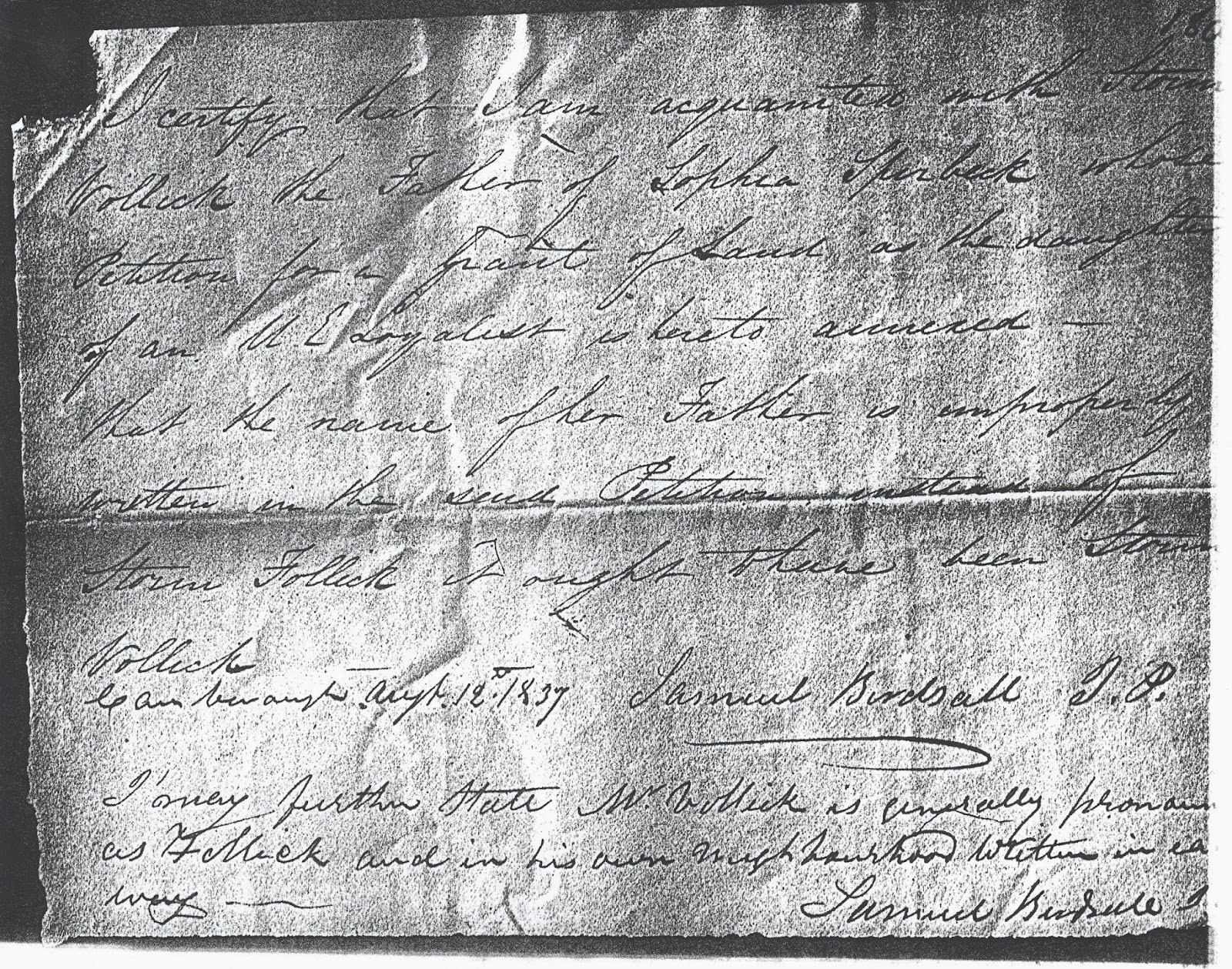
1837 document from Storm starting he is known as
both Vollick and Follick in his neighbourhood
My 5th great-grandfather Isaac Vollick, born 1732 in Schoharie, New York, was a United Empire Loyalist who came to Upper Canada from the United States during the American Revolution. He was the illegitimate son and only child of Isaac VanValkenburg and Maria Bradt.

It is through Isaac the Loyalist that Follick and Vollick descendants claim their Mohawk heritage. Isaac's great-great-grandmother was Ots-Toch a half French, half Mohawk woman who married Cornelis Van Slyke a Dutchman who settled in Albany New York in 1627

Although no record of a marriage has been found for Isaac and Maria, their son Isaac used his father's surname until 1782. During his years as a private in Butler's Rangers, Isaac's surname changed from Van Valkenburg, meaning in Dutch, 'from the castle of the falcons' (van=from; valken=falcons; burgh=castle), to Valk or Valck which means 'falcon'. It appears that Valk was his nickname and on being recorded by English clerks, a vowel was inserted between the final 'l' and 'k' making the surname Valic or Volick. Over the years, the surname was written as Vollick, Volic, Valic, Valck, Valk, Volk and Follick (the German/Dutch accent making a 'v' sound like 'f' to English ears).

My line, descended from his son Cornelius, took the Vollick surname. His son Storm used the Follick surname. In the next generation some Follick descendants used Vollick while some Vollick descendants used Follick.  It makes it interesting trying to research all branches of this family!

April 3, 2014

52 Ancestors: Charles Fuller, an Ordinary Man But Loved by All

Charles Fuller in The Buffs, Ramsgate Kent England
I'm writing about my grandfather Charles Henry Fuller as part of Amy Crow's Challenge: 52 Ancestors in 52 Weeks 

I never knew my grandfather. He died in Guelph Ontario in 1941 at the age of 48. I do have many photos of Charles and heard many stories about him from my mother, her sisters and my grandmother Ruth. 

Charles was born and grew up in Ramsgate, a seaside town in Kent England. It was there he met my grandmother Ruth. I don't know much about his life in England although I have  photos of him as a young teen still living in Ramsgate.

As a young lad he joined The Buffs and was sent to ride along the coast on his bicycle watching for invading Germans. 

When Charles was 19 years old he and his fiance Ruth decided to come to Canada. On May 29, 1913  Charles Fuller and Ruth Simpson sailed on the Cunard Line ship Ausonia from Southampton to Montreal then Quebec, Canada. The ship arrived in Quebec on 9 June at 8:10 p.m. My grandmother often spoke of this journey with loathing. She was terrified of the water and the trip was something she never wanted to do again.

1914 Wedding Charles Fuller & Ruth Simpson
One year later in August 1914, Charles and Ruth were married in Toronto. Shortly afterwards they moved to Guelph where Charles obtained a position as bookkeeper in the Guelph Lumber Company. It didn't take long before he was promoted to manager. 

Apparently my grandfather had a wonderful singing voice and used to sing in the church choir as well as entertain on stage in amatuer vaudeville performances.  My aunt, his daughter, remembers the Sunday afternoons when her dad would entertain the neighbours and his family at the piano.

Charles in Blackface
Although it is certainly not appropriate in today's world, his forte was singing in blackface, much as the singer Al Jolsen had done.  This was a popular way to entertain in the 1920s. And Grandpa was certainly not a bigot, he respected everyone.


Charles was by all accounts, extremely kind-heared. He would help anyone and often brought strangers home for dinner. His wife, my grandmother, was used to having Charles walk in the door from work with one or two down-on-their luck men he'd spotted on the street. No one was turned away from their table and Grandma always found a way to stretch the meal to accomodate. 

WW1 had not seen Charles enlist because as the manager of the lumber company he was needed at home. Since he had been active in The Buffs in England I am sure he was disappointed at not being able to join in the fight. 


And so Charles lived out his short life, not having done anything particularly outstanding, but a kind decent man who was loved by family and friends. His mother adored him and in fact his parents left England, bought a house beside Charles and Ruth and planned to live out their lives in Guelph. Eventually they were so homesick for Ramsgate that they returned but that is how much his mother missed him. As an aside, she and  her daughter-in-law (my grandmother) did not get along and I'm willing to bet the years when they lived next door were a struggle for Ruth. 

Grandpa Charles fell ill sometime in 1940 and doctors could not determine what was wrong. After a year of pain and fatigue he died in the Guelph Hospital. My grandmother never got over his death and even though she married two more times during her life, she always spoke of "Charlie" and how much she missed him. In some strange ironic twist of fate and genetics, Charles youngest brother is still alive at the age of 102. 


March 25, 2014

52 Ancestors: Hannah Philpot Golding and George Norris - Friends With Benefits?

52 Ancestors: Hannah Philpot Golding and George Norris - Friends With Benefits?
Pluckley, Kent England
I'm writing about my 3rd great grandmother Hannah Philpot Golding as part of Amy Crow's Challenge: 52 Ancestors in 52 Weeks and also as part of Women's History Month Challenge
 

Hannah was born in 1805 in the little hamlet of Pluckley in Kent England to John & Susanna Philpot. 

Pluckley is said to be the most haunted village in England. At age 18, Hannah left Pluckley for Lenham, a nearby small town. There she married Edward Golding and over the next 14 years the couple had 6 children. When their youngest was 9 months old Edward died and Hannah was left a widow at the age of 28. 

Church in Lenham
Hannah had no family in Lenham but luckily she was able to take in laundry to support her young family. My mother went to Lenham to research my 2nd great grandmother Georgiana Golding who was born there in 1840. To our surprise Georgiana's mother Hannah was noted in the church record as "the widow Hannah Golding". My next find was the fact that Hannah's husband died some 3 years earlier in 1837. So obviously my 2nd great grandmother was an illegitimate birth. 

It took a few years to find out who had fathered Georgiana but eventually I had the proof that it was Hannah's next door neighbour, George  Norris. Hannah went on to have another child after Georgiana, and Georgiana named George as her father at her marriage to Charles Simpson, so obviously this was not a secret in the village. 

Hannah never remarried after Edward's death and George Norris remained single his entire life. I've always wondered what their relationship was. They never lived together so were they an early example of  "friends with benefits"? Was it a casual but consensual relationship? Or was it a long-lasting love that carried on over the years. I suspect I will never know. 

Kent County Insane Asylum
The last record of Hannah is the 1881 census where she is found as an 85 year old widow, an inmate of Kent County Asylum. Often paupers were sent to the Lunatic Asylum but it may also be that Hannah suffered from senility or some other disorder that labelled her as insane. It's very sad that none of her children could support her or take her into their own home. I have never found Hannah's death although she may be the Hannah Golding who died in June 1881 in Maidstone (which is where the Asylum was located).

As for George Norris he disappears after the 1861 census where he is found as a 50 year old single man living with his mother in Lenham.

March 15, 2014

52 Ancestors: Another Strong Female Ancestor Fanny Higginson born 1769

Brig Joseph Charles 1831 Passenger List
I'm writing about my 4th great grandmother Frances (Fanny) Holford Higginson as part of Amy Crow's Challenge: 52 Ancestors in 52 Weeks and also as part of Women's History Month Challenge

Fanny was born in Lower Peover, Cheshire England in 1769 to John Holford and Ann Harrison. The village of Lower Peover was in existence as early as the middle of the 13th century and it appears that Fanny's family may have lived there for many generations. Shortly before her 18th birthday, young Fanny married Thomas HIgginson who was also from the village. 

Thomas and Fanny had a large family of 8 children born between 1788 and 1802. Sometime after the birth of their youngest child John in 1802 and before 1831, her husband Thomas died. 

By 1823 Fanny's daughter Betty Bell was living with her husband and children in Nether Peover and I suspect Fanny Higginson may have been living with them. The family was stil there in 1831 when they left for America. [Source: England, Cheshire Land Tax Assessments, 1778-1832 on FamilySearch]

1831. Brig Joseph Charles. Fanny Higginson & daughter Elizabeth Bell & family
The last record of Fanny is on December 3, 1831 when the Brig Charles Joseph arrived in New York from England. She is on the passenger list as "Frances Higginson, carpenter's wife" and is listed as 65 years old. Traveling with Fanny were her daughter Betty (Higginson) Bell, my 3rd great-grandmother, and Betty's children Ann, Phoebe, 12 year old Mary (my 2nd great grandmother), Peter and Joseph. [Source: Ancestry.com]

The group was on its way to Betty's husband Peter Bell who had settled in New York some time earlier. I often think about Fanny, a 65 year old widow leaving her home and many of her children to come to a new land. In 1831 it would have been rough. 

I don't know what happened to Fanny. Peter Bell and his wife and children left New York to settle in what was then the wilderness of Wellington County Ontario. In fact they were among the very first settlers of a new community called Arkell. 
"Peter Bell, a native of Chesshire Eng, left his native land in 1832 and after spending 6 years in New York State, came to Puslinch in 1838 with two sons, Peter and Joseph and one daughter, Mary."
[Source: County of Wellington, Township of Puslinch by W. MacKenzie, published in the Guelph Weekly Mercury and Advertiser 7 March 1907: Early Settlers of Puslinch]

UCLP 1839 for Peter Bell
It's interesting to note how pioneer memories can hit on some truths but get many facts wrong.  Peter Bell's land petition submitted in 1839 stated that he left England for New York where he bought a farm in Sullivan County. 

He lived there for 3 years then left for Puslinch Township Wellington County with his wife and 3 children. His brother-in-law John Higginson and one daughter Phoebe with her husband John Petty were already in the new settlement of Arkell and Peter requested that he be allowed land near them. [Source: UCLP Microfilm:C-1633, Volume 63, Bundle B-21, Petition 153]

Since his mother-in-law Fanny is not mentioned in Peter's 1839 petition I suspect she may have died but whether she died in New York or in Arkell is not known.

I admire Fanny greatly for the difficult journey she took as a 65 year old woman in 1831.

March 6, 2014

52 Ancestors: Anna Kuhn Bellinger, Naughty Girl!

52 Ancestors: Anna Kuhn Bellinger, Naughty Girl!
My 8th great-grandmother Anna Kuhn was born in Germany about 1659. I'm writing about Anna as part of Amy Crow's Challenge: 52 Ancestors in 52 Weeks and also as part of Women's History Month Challenge.

In 1674, at the age of 15, she was married to Jorg Bruning at Huttengesas, Germany. Jorg Bruning was a much older man, and the marriage was a most unhappy one for poor Anna. 

While living at Huttengesas with her husband, she fell in love with Nicholaus Bellinger, son of Hans Bellinger. She  ran away with Nicholaus  and had a son, my 7th great-grandfather Marcus Bellinger, in 1682. Nicholaus Bellinger and Anna Maria finally  received church permission to marry, and were wed on 25  November 1685.

It was considered such scandalous behaviour to run off with another man while married to someone else and have an illegitimate child that the minister in the church entered this in the church books:

"Nicolaus Bellinger and Anna, daughter of Hans Kuhn, were married 25 November 1685 as per the order of the noble government. She had md. some years ago Jorg Bruning at Huttengesab, but she was not compatible with him, so Bruning went from her and she from him. She went away with this Nicolaus Bellinger and had an illegitimate child - a little son,  so that the aforementioned Jorg Bruning has contracted another marriage. 

After all this however, the above mentioned Bellinger has remained as a stranger. She sent a request to the honourable government to let them stay in the country, and this finally has been permitted by the aforementioned honourable government which ordered me to marry them with prior published penitence and to avoid further trouble and also to legitimize the rearing of this blameless child" 
In 1710 the Bellinger family joined with other Palatine refugees coming to New York. There were 3 000 Palatines on 10 ships that sailed for New York and approximately 470 died on the voyage or shortly after their arrival.  I've always felt sorry for poor Anna married at 15 to someone she didn't love. I really can't blame her for running away to find happiness. But she suffered greatly, as did all the Palatines. First persecuted in their own country because of their religion and then treated as indentured servants by the British. 

Another strong female ancestor for me! 

February 27, 2014

52 Ancestors: Great-Grandpa's Horse Saves the Day!

52 Ancestors: Great-Grandpa's Horse Saves the Day!
1882 Wedding
David George Simpson & Sarah Stead
Amy Johnson Crow has a new challenge for geneabloggers called Challenge: 52 Ancestors in 52 Weeks. Amy challenges genealogists to write about one ancestor once a week. I'm having fun with this and I hope you are too! 

My great-grandfather David George Simpson (1861-1921) was a coal dealer in Ramsgate England. My grandmother, his daughter Ruth, used to tell me stories about her dad. I loved hearing them! 

One I remember most was how her dad made his daily rounds with a cart and his horse to deliver coal to his customers. Great-grandpa had epilepsy and so frequently he suffered seizures on his route. Apparently his horse, knowing the route well, simply carried on without any guidance from David.  

At each house on the route, the horse would stop and the customer would come out, check on Great-grandpa, take their allotment of coal and send the horse on its way. Then the horse would take Great-grandpa home when the route was done.

Grandma Ruth also told me that her father had what she called "a withered left arm". I don't know exactly what she meant by that but she said he had no use of it, and when I look at photos I have of David George it does seem that he hides one of his hands. 

My Great-grandpa had a sad childhood. When he was 13 his father died suddenly of pneumonia. David's mother was pregnant with her 5th child and David was her oldest. Two months after the father's death, David's youngest sibling was born but sadly that child died at the age of one month. David's mother had to take in laundry to support her family. After David married his widowed mother came to live with the family.

David George died of an epileptic seizure at the age of 59 at his home in Ramsgate. 

Simpson Family Ramsgate, Kent England ca 1900
Standing Left-Right: Ruth (my grandmother), Albert, Lillian, Ernest (Uncle Ern), Frank
Seated: David George & wife Sarah Stead. In front is Uncle Syd. Syd, Ern, Frank and Ruth emigrated to Canada while Albert settled in Australia.

February 21, 2014

52 Ancestors: Were Thomas and Lewis King Illegitimate?

Amy Johnson Crow has a new challenge for geneabloggers called Challenge: 52 Ancestors in 52 Weeks. Amy challenges genealogists to write about one ancestor once a week. I'm having fun with this and I hope you are too!

My 3rd great grandfather was Thomas King born 1796 in Wenhaston, Suffolk County England to James King and Hannah Blanden (Blandon aka Blanding). In 1831 Thomas and his brother Lewis joined a small group of Englishmen and set sail for Canada. They were the first settlers in what is now Arkell Ontario. 

in my research on this family I found that Thomas' parents had undergone a Bastardy Examination in 1791 over the birth of their illegitimate daughter. 

Because parishes did not want to be responsible for the care of an illegitimate child, a pregnant woman or one who had just given birth, would be questioned by a midwife or other authority and the name of the child's father recorded. The father would then be ordered to provide financial support, either as a lump sum payment to the parish for the child until he/she reached the age of majority, or as a monthly sum (also payable to the parish for the child's welfare). In many cases the mother too would be ordered to make payments. This ensured that the child did not become a burden on the parish. 

Bastardy Examination of Hannah Blandon 6 July 1791. Under Oath Hannah states that on Thursday 14 October 1790 she gave birth to female bastard child at Ephraim Lockwood’s house in Holton Parish, Blything Hundred, Suffolk Co. James King was the father.

52 Ancestors: Were Thomas and Lewis King Illegitimate?


Bastardy Order James King & Hannah Blandon 6 July 1791. Justices of Peace Eloazar Davy and Charles Purvis in Parish of Holton, Hundred of Blything, County of Sufoolk hear the case brought by Robert Smith, Guardian of the Poor in Blything. James to pay 1 shilling per week to John Robinson of Southwald or to Treasurer of the Poor, for maintenance of child as long as living in the parish. Hannah to pay 6 pence weekly. 

At some point after the birth of their daughter James and Hannah may have married because they had at least two sons - Lewis in 1793 and Thomas in 1796. I have not found a marriage record for them so it is possible they never formalized their union. The sister born earlier has been elusive and I've not yet found her name or what happened to her.

Lewis and Thomas made a new life for themselves in Ontario Canada and helped carve out a settlement in what was then the wilderness. If you descend from either of these brothers you may be interested in the book I wrote "From England to Arkell: The story of two pioneer settlers, Lewis & Thomas King who left Suffolk England for the Wilds of Upper Canada in 1831 A Genealogy to 4 Generations following their descendants in Ontario, Alberta, Australia & Michigan." 

It's always fun and extremely interesting to research an ancestor who was a pioneer in some field, and then write their story.  

February 15, 2014

52 Ancestors: A Fishy Story about William Peer and William Learn

52 Ancestors: A Fishy Story about William Peer and William Learn
Amy Johnson Crow has a new challenge for geneabloggers called Challenge: 52 Ancestors in 52 Weeks. Amy challenges genealogists to write about one ancestor once a week. I'm having fun with this and I hope you are too!

Today I'm going to share a fish story with you - well, really it's two fish stories - about two of my relatives.

First up is the sad story of my 3rd cousin twice removed, William Edward Learn

A bit of family lore from a family bible concerning Edward had always intrigued me.  

William Edward Learn (1885-1908) died tragically while fishing in the Niagara River. He had a rope tied around his waist while he was fishing and hooked a sturgeon which pulled him in and under. It was a month before his body was found with the rope and sturgeon still attached.
 
I wondered how accurate it was. Another cousin sent this to me several years ago, copied directly from the Learn Family Bible. When the Ontario Death Records went online on Ancestry.com in 2008 I decided to see what William's death registration gave for his cause of death. I expected to see "Drowning" as the cause of death.

Much to my surprise the cause of death was given as pneumonia! It seems a rather fanciful story for someone to dream up and record in a Family Bible. 


How did poor William's death from pneumonia end up being passed down in the family as William being killed by a fish?


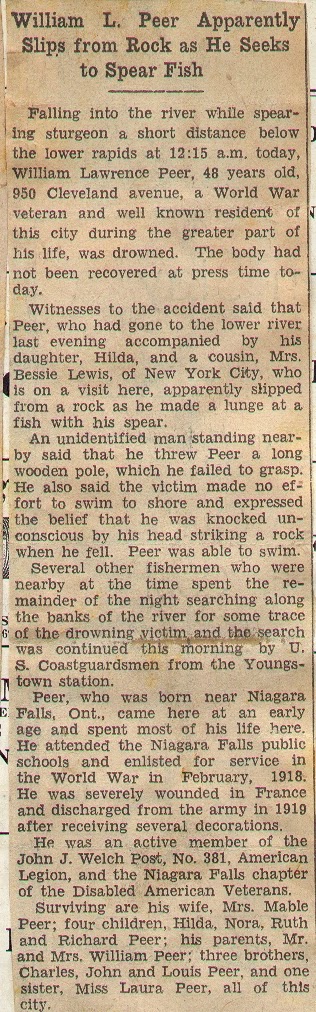
Next up is the true story of another 3rd cousin twice removed, William Peer. William drowned in 1937 while fishing for sturgeon. His death is fact and the details given in a newspaper account (on the left). While attempting to spear a sturgeon in the Niagara River, William Peer slipped and fell in. He drowned and several days later his body was recovered. 

The tale of his death is very similar to that given in the family bible for William Learn. Perhaps the two men were confused by whoever entered the information in the bible? I may never know, but these are fish stories to be remembered.