Here is a Challenge
for all genealogy bloggers. I want you to keep a weekly journal called
Sharing Memories. Some of you may recall that in 2010, 2011 and 2012 I
provided weekly prompts to help with writing up memories of ancestors and ourselves.
If
you missed this weekly series called Sharing Memories you might want to
have a look and see if any of the prompts appeal to you. Many readers
asked me to continue with the prompts this year so that is what I am
going to do.
This week's prompt is Let's Visit Grandma!
Was visiting Grandma a favorite time for you? Did you get to see her very often? Which grandmother was it? What did you like best about the visit and was there anything you didn't like?
We went to Guelph Ontario about once a month to visit my Grandma McGinnis. I loved going although I hated the actual car ride as I got carsick every time. But I loved getting to see my cousins much more than Grandma. Grandma rarely spoke to us children. She wasn't unkind, she just didn't talk to us except to say hello and ask how school was.
We'd make the rounds to dad's brothers Joe and Roy. His other brother Clare lived with Grandma so that was two visits in one. I didn't like Grandma's house on Water Street - it smelled and the only bathroom was in the basement. Her basement scared me. It had a dirt floor and a single light bulb hanging from the ceiling. The bathroom was very small and the sink was stained and yellow. There wasn't a shower, and in fact I can't recall if there was even a bathtub! I've never quite gotten over my fear of basements and I make my husband go with me when I go to ours. it doesn't have a dirt floor but it still makes me anxious.
The one cool thing was that Grandma lived just a few houses down the street from John McCrae's house (author of In Flanders Fields). She lived there from the early 1900s so it is quite possible she knew him.
I never thought of this as a child but as an adult I have to wonder why we never visited my mother's mother. She lived in Guelph too but I don't remember us taking time to drop in on her.
Showing posts with label Weekly Writing Challenge. Show all posts
August 17, 2014
June 29, 2014
Sharing Memories Week 26: Prom Night, Fun or Disaster?
![]() |
| Me at my sister's wedding a year before Prom Did I wear this dress?? |
The prompt for this week is Prom Night. Did you have a Prom at your High School? What was it like, what did you wear, who did you go with.... Tell us about your most memorable moment.
We had a prom at my High School but I was between boyfriends and had no one to go with. So my brother-in-law took me! It was so much fun for a few different reasons. First, no one knew my brother-in-law and my classmates were so impressed that I was with this older guy from the big city. Second, he loved to dance and I don't think we sat down once. I wish I could remember what I wore but I've no idea. We didn't have much money so I can't imagine being able to buy a new dress. I wonder if I wore this mauve dress that I wore to my sister's wedding the year before?
I'd been to a prom before with my real city boyfriend before I was 16. He was older than me and I was only 15 when he graduated from Grade 12. That was intimidating actually because it was in "the city" at a huge High School. For any Torontonians reading this, it was at Earl Haig. There was a theme and the gym was beautifully decorated. Our small town school didn't have the resources to decorate like the city one did. I don't know if what I wore wasn't of great concern or interest to me but again I do not recall what I wore to that prom either.
June 11, 2014
52 Ancestors: An Abusive Ancestor Charged with Attempted Murder of His Wife
I'm writing about Edward Buckland as part of Amy Crow's Challenge: 52 Ancestors in 52 Weeks Edward is my sister-in-law's 3rd great grandfather.
Edward was not the kind of ancestor you would want. He was born into a Gypsy family in England around 1806. At the age of 14 he was arrested and charged with grand larceny for stealing two coach-holders from a coach passing by. His punishment was 7 years banishment to Australia. He may have avoided this however as in 1830 he is found marrying in Westminster England. His wife was only 12 years old.
He and his wife Mary had several children but it's been difficult finding out exactly how many. Edward was a brutal character, often abusing his wife (and no doubt his children as well). I found a few court records and newspaper accounts of some horrific abuse he carried out on his poor wife. In fact he was charged with abusing her and was sent to jail for one year in 1851.
After getting out of jail Edward apparently went right back to abusing Mary and in 1852 was sent to jail for 2 months for beating her unmercifully. His abuse escalated and in 1853 he was charged with trying to murder her. The newspaper account reads:
Edward was not the kind of ancestor you would want. He was born into a Gypsy family in England around 1806. At the age of 14 he was arrested and charged with grand larceny for stealing two coach-holders from a coach passing by. His punishment was 7 years banishment to Australia. He may have avoided this however as in 1830 he is found marrying in Westminster England. His wife was only 12 years old.
He and his wife Mary had several children but it's been difficult finding out exactly how many. Edward was a brutal character, often abusing his wife (and no doubt his children as well). I found a few court records and newspaper accounts of some horrific abuse he carried out on his poor wife. In fact he was charged with abusing her and was sent to jail for one year in 1851.
The Morning Post. Dec. 17, 1851. Edward Buckland, age 46, was indicted for having unlawfully and maliciously assaulted and wounded his wife Mary Buckland with a knife. The prisoner was a brushmaker and lived with the prosecutrix at 7 Norton St. Somers Town. On Tues. last they had quarrel and whilst she was standing at the door of their house he rushed out and knocked her down. He had in his hand a table knife which had been sharpened to a point, and drawing his hand back, he declared in language too disgusting and filthy to be repeated, he would use it and would cut her gullet out. At the same time he struck her on the hand with it and cut open the middle finger of her left hand. The poor woman appeared to have been subjected to shocking brutality, both her eyes being frightfully blackened. The jury found the prisoner guilty and he was sentenced to one year's imprisonment.Another story about this incident reads:
1851 Dec. 17. London Standard. Another Brutal Husband. Edward Buckland, 46, was indicted for having maliciously assaulted Mary Buckland, his wife. It appeared from the evidence that the prisoner is a brushmaker, and lived at No. 7, Northam St., Somers Town. Between 12 and 1 o'clock in the morning of the 7th instant, the complainant was observed to push his wife violently out of doors, and then knock her down. He repeated this, and then went in, closing and bolting the door behind him. She then got up and knocked at the private door, when the prisoner came out with a sharp knife in his hand, and putting himself in a threatening attitude, said with an oath, he would "rip her bowels out, and would cut her gullet." The jury found the prisoner guilty and he was sentenced to imprisonment and hard labour for 12 calendar months.Some newspaper accounts describe Edward as "a downcast desperate looking fellow" and "a great ruffian"
After getting out of jail Edward apparently went right back to abusing Mary and in 1852 was sent to jail for 2 months for beating her unmercifully. His abuse escalated and in 1853 he was charged with trying to murder her. The newspaper account reads:
1853 May 2. Court. Clerkenwell. Attempted Murder of a Wife. A Monster. Edward Buckland, a brushmaker, was charged with having attempted the life of his wife. The unfortunate prosecutrix was assisted into the courtroom by Sergt. Wilkes of the S. Division, and placed in a chair near the worthy magistrate, who elicited the following particulars of the dreadful suffering she had undergone. She had been the wife of the prisoner nearly twenty years, and had been subjected to the most brutal treatment at his hands nearly the whole of that time. At eleven o'clock on the previous night he came home, and after abusing her, he beat her on the head and other parts of the body with a hammer, and finally struck her many dreadful blows with a pair of shears, and broke her arm. She escaped in a most miraculous manner from him, and meeting Sergt. Wilkes, placed herself under his protection and she was removed to the University Hospital. The accused muttered that he had no observation to make whatever.... remanded for the present and to be turned over to a jury for trial. Victim taken back to hospital.In the 1861 census Mary is not living with Edward. She is the head of house with two children ages 9 and 11. One can only hope she was finally able to escape the clutches of this monstrous man and live a life of some peace. She died in 1883 at the age of 70.
May 23, 2014
52 Ancestors: 5th Great Grandpa Ordered Out of His Parish with Wife and Family in 1778
I'm writing about my 5th great-grandfather Thomas Blanden as part of Amy Crow's Challenge: 52 Ancestors in 52 WeeksOn 18 MAY 1778, a Removal Order was served on my 5th Great Grandfather THOMAS BLANDON, DRUMMER in the Western Battalion Militia of Suffolk. Thomas, Mary, his wife, and their children Mary, Elizabeth, Ann, Thomas & Susannah were ordered removed from St. James, Bury St. Edmunds and sent to Wenhaston. [Source: Removal Order FC189/G4/14. Suffolk, Ipswich Branch, WENHASTON PARISH RECORDS Date: 1778]
The basis for Removal Orders was the fact that each parish was responsible for any poor citizens. If a person or their family was too much of a drain on the parish resources, they could toss them out and have them sent back to their parish of birth.
If a person entered a parish in which he did not have official settlement, and if it seemed likely he might become chargeable to the new parish, then an examination would be made by the justices or parish overseers. From this examination on oath, the justices would determine if that person had the means to sustain himself and, if not, which was that person's parish of settlement. As a result of the examination the intruder would then either be allowed to stay, or would be removed by a Removal Order.
![]() |
| Chelsea Pensioner Thomas Blandon |
Removal Orders would often take a person or a family back to a place of settlement miles across the country, sometimes to a parish they had only known briefly as a small child. It was not uncommon for a husband and wife to have their children taken from them, each being removed to separate scattered parishes.
In Thomas' case, he and his wife and 5 children ages 1 to 13, were sent back to Wenhaston where Thomas was born. So far no records have turned up to indicate how the family fared, but 9 years later, in 1787, Thomas was pensioned out of the Army, having served 28 years as a Drummer. This entitled him, as a Chelsea Pensioner, to receive a small amount of money. I wish I knew what happened to Thomas and his wife Mary Jackson but I've not found any more records for them.
May 6, 2014
52 Ancestors: William Solomon and His Ojibwa Wife
![]() |
| Voyageurs: Lewis Solomon on left |
William Solomon was the fourth child of Ezekiel Solomon, a German Jewish merchant who had come to New France from Berlin during the Seven Years' War and acted as a supplier to the British army. Following the conquest, Ezekiel Solomon, one of the first non-French fur traders to penetrate as far as the upper Great Lakes, spent part of each year in the interior and the remainder at Montreal, where William apparently received some education.
By the mid 1790's William was working in the interior as an employee of the North West Company, and he evidently lived for some time with his parents on Mackinac Island (Michigan). There he and an Ojibwa woman, Agibicocoua, had an illegitimate daughter, who was baptized on July 28, 1796. In 1797, 1799, and 1800 he fathered three other illegitimate children. Shortly thereafter he appears to have married Marguerite Johnston, who had been born on Mackinac Isand. The were to have ten children.
William is the 7th great grandfather of four of my grandchildren and his life story is fascinating. His son Lewis Solomon wrote the following narrative:
My name is Lewis Solomon-spelled L-e-w-i-s-though they call me Louie. I was born on Drummond Island in 1821, moved to St. Joseph Island in 1825, back to Drummond Island again, and then to Penetanguishene in 1829.
My father's name was William Solomon, Government interpreter. His father, Ezekiel Solomon, was born in the city of Berlin, Germany, came to Montreal and went up to the "Sault." [Sault Ste Marie] My father was appointed Indian interpreter by the British Government and was at Mackinaw during the War of 1812, then moved to Drummond Island with the British forces, and afterwards to Penetanguishene.
My mother's maiden name was Johnston, born in Mackinaw, where she and my father were married. She died in Penetanguishene. My father received his discharge under Sir John Colborne, retiring on a pension of seventy-five cents a day after a continued service of fifty-six years with the Government, and he died at Penetanguishene also.
When the military forces removed from Drummond Island to Penetanguishene, the Government authorities chartered the brig Wellington to carry the soldiers, military and naval supplies, and government stores; but the vessel was too small, and they were obliged to charter another vessel, and my father was instructed by the Government to charter the schooner Hackett (Alice) commanded by the owner, Capt. Hackett.
My father came to Penetanguishene in another vessel with the officers and soldiers. The rest of the family left Drummond Island the next spring (1829). We started on the 25th of June and arrived at Penetanguishene on the 13th of July, coming in a bateau around by the north shore, and camping every night on the way.
My mother, brother Henry and his wife and eight children, myself, Joseph Gurneau and his wife, and two men hired to assist (Francis Gerair, a French-Canadian, and Gow-bow, an Indian), all came in one bateau. We camped one night at the Hudson's Bay Company's fort at Killarney. We landed at the Barrack's Point, near the site of the garrison, and where the officers' quarters were erected, now occupied as a residence by Mr. Band, the Bursar of the Reformatory. We camped there in huts made of poles covered with cedar bark.
There were only three houses there: a block-house, the quarters of Capt. Woodin, the post-commander; a log-house covered with cedar bark for the sailors near the shore; and a log-house on the hill, called the "Masonic Arms," a place of entertamment kept by Mrs. Johnson.
William brought the Drummond Island settlers to Penetanguishene. They left Michilmackinac on November 16, 1828. A severe snowstorm slowed their progress and the Brig Wellington with its 91 passengers arrived in Penetanguishene November 28, 1828. He died at Penetanguishene on Jan. 26, 1867 and is buried at the old St. Anne's cemetery beside his wife Marguerite.
There is quite a bit of biographical information on William Solomon, such as the following:
Solomon supported his growing family by working at Michilmackinac, on Mackinac Island, as a clerk for the merchant Joseph Guy and occasionally by doing some interpreting, since he had learned several Indian languages. In 1809 his father died, leaving him land on Mackinac Island and on the mainland at Saint Ignace (Michigan). Though Mackinac had been turned over by the British to the United States in 1796, in accordance with Jay's Treaty, Solomon felt no strong loyalty to the Stars and Stripes. After war broke out between the United States and Great Britain in 1812, a force assembled by Captain Charles Roberts swiftly descended upon Mackinac Island and captured the fort and town for the British on July 17, the first military action of the war and a source of some satisfaction to Solomon. By February 1814 he had secured a position with the Indian Department as an interpreter at 4s 6d per day.
Since the number of British soldiers at Mackinac Island was small, their Indian allies were vital for their survival. When the Americans attempted to recapture the island in 1814, it was the Indians who swung the battle in favour of the British. The Americans never took Mackinac, but under the Treaty of Ghent it was returned to the United States. In July 1815 the British under Lieutenant-Colonel Robert McDouall, withdrew their forces. The following month they settled on nearby Drummond Island and Solomon and his family accompanied them. Solomon was provided with a government lot on which he built a home for his family and established a small farm. His duties were to make out requisitions for provisions and to order the repair of the Indians's guns.
Along with Jean-Baptiste Assiginack and a few others, Solomon was one of the interpreters kept on at Drummond Island as part of the peace-time garrison, which included the Indian Department establishment under the superintendence of William McKay. Though characterized somewhat harshly by John Askin, of official of the department in 1816 as a "sober man" who could not interpret at Indian councils but who "may answer about a post to see an equal distribution of Provisions," Solomon did in fact interpret at various councils. As well, when the Indians of the Upper Lakes flocked to Drummond Island to receive the presents which the British doled out to ensure their loyalty, Solomon probably participated in distributing the goods. In 1816, when the Indian Department was reduced, he lost his job. He was reinstated, however, on May 29, 1821.
The British were not to remain long on Drummond Island, for when the border between Upper Canada and the Unites States was surveyed, it was found to be American territory. Once again the garrison, including Solomon, David Mitchell, and other Indian Department officials, was forced to move, this time to Penetanguishene on Georgian Bay, where a British naval establishment had already been located. In late 1828 a brig was chartered to move the forces, but when it proved too small Solomon was instructed to charter a schooner as well. He did not accompany it, however, since he had been ordered to spend the winter at St. Joseph Island, where he had lived briefly in 1825, in order to inform the Indians about the British move. In all, the families of between 75 and 100 soldiers, voyageurs, and small traders came from Drummond Island to Penetanguishene, which Lewis Solomon, a son described as "then mostly a cedar swamp, with a few Indian wigwams and fishing shanties."
In 1829 William Solomon and his family finally moved to Penetanguishene, although his livestock and implements were lost in a shipwreck on July 12 of that year. He built a home nearby, on lot 105, and continued to work as an interpreter. In 1837 he attended, along with Thomas Gummersall Anderson, Samuel Peters, JARVIS, Jean-Baptiste Assiginack and others, a major Indian conference on Manitoulin Island, which was graphically described by Anna Brownell Jameson ( MURPHY) in her account of travels in Upper Canada. On a longer trip, made in the early 1840's for the distribution of presents, he served as interpreter for a party that included Lord Morpeth, Lord Lennox Jarvis, and 56 voyageurs from Penetanguishene; they visited Manitoulin, Sault Ste. Marie, and Detroit.
Solomon received his discharge on June 30, 1845 and retired on a pension of 75 cents a day, according to his son Lewis. William afterwards moved into town, where he died and was buried in the cemetery of Ste. Anne's Church. Surviving him were a large family and his second wife Josephine Legris, whom he had married late in life.
[Source: Dictionary of Canadian Biography, Volume viii page 830-31 c. University of Toronto Press]
April 19, 2014
52 Ancestors: Ots-Toch, the Mohawk Wife of Cornelis Van Slyke
I'm writing about my Mohawk ancestor Ots-Toch as part of Amy Crow's Challenge: 52 Ancestors in 52 Weeks . Ots-Toch was my 9th great-grandmother and I've written about her in my book on the Van Slyke family of New Netherland (New York).After researching her extensively, I was able to obtain my Metis status in Ontario. Luckily she is written about in contemporary records and thus proving my Native American heritage was possible.
In 2009 I submitted DNA kits to different companies for both myself, my brother and my son. Our Native American ancestry was confirmed through DNA which was like icing on the cake.
My book The Van Slyke Family in America: A Genealogy of Cornelise Antonissen Van Slyke, 1604-1676 and his Mohawk Wife Ots-Toch, including the story of Jacques Hertel, 1603-1651, Father of Ots-Toch and Interpreter to Samuel de Champlain REVISED EDITION was published May 2010 and is out of print.
However a 3rd edition is now available. It contains 30+ years of research. "New Netherland Settlers Van Slyke Family: Cornelis Antonissen Van Slyke 1604-1676 & his French-Mohawk Wife Ots-Toch" 366 pages, over 1200 footnotes available on Amazon
Caveat: In the theories of Ots-Toch's heritage, please take the use of the word "princess" with a grain of salt. It was common for 19th century writings to romanticize Native American women in particular, assigning daughter of a chief status to them.
There are two prevalent theories of Ots-Toch's heritage,
one that she was a full-blooded Mohawk of the Turtle Clan, the daughter of a Mohawk chief or Sachem. [FN 1] The second theory is that Ots-Toch was the daughter of a French man Jacques Hertel and a full-blooded Mohawk Princess.
Ots-Toch was in fact fathered by Jacques Hertel, a French interpretor to Samuel de Champlain. It is not known who her Mohawk mother was.
There were many original records pertaining to Ots-Toch. As an example here is one given in my book as found in land records of 1713 for Harmen Van Slyke, grandson of Ots-Toch.
Harmen was a Captain in a Schenectady Company in 1714 and an Indian trader in 1724. He received a grant of 300 morgens of land at Canajoharie NY from the Mohawks because
"his grandmother was a right Mohawk woman" and "his father born with us at Canajoharie".
His father was Jacques Cornelise, son of Ots-Toch, the half French, half Mohawk woman who married Cornelis Antonissen Van Slyke.
The deed was conveyed 12 Jan. 1713 and consisting of 2000 acres, stated:
"in consideration of ye love, good will and affection which we do bear toward our loving cozen and friend Capt. Harmon Van Slyke of Schenectady, aforesaid, whose grandmother was a right Mohawk squaw and his father born with us in the above said Kanajoree [Canajoharie].......it being his the said Harmen Van Slyke's by right of inheritance from his father"
Little is known of the wife of Cornelis Van Slyke although she was written of by the Dutch minister Jasper Dankaerts when he visited Schenectady and spoke with her son Jacques and daughter Hilletie.
Her name, Ots-Toch, is clouded in controversy, with some writing it as Alstock. One word in the Mohawk language which may provide a clue to her name is "Otsihsto" meaning "the stars". "Otsihsto" is pronounced so that the sound is similar to "Asistock". It must be remembered that her name was recorded phonetically from verbal accounts and it is possible that Otsihsto is the correct interpretation of Ots-Toch's name.
It is important that descendants understand that in my book I have chosen to use the name Ots-Toch as that has come down through history. Included in the book is my chapter discussing the loss of her through time and why I chose to use the name Ots-Toch to represent her.
The use of the word "Princess" would imply that Ots-Toch's mother was the daughter of the Sachem or chief of her tribe but I have found NO evidence to support this romantic version of her parentage.
According to Nelson Greene and other sources, Ots-Toch was "wild and savage like her mother". Ouida Blanthorn, in her genealogy of Cornelis Van Slyck and his descendants written 1973, states that Ots-Toch was a "half-French, half-Indian maiden of compelling grace and beauty, whose mother was a Mohawk princess [sic] and whose father, Jacques Hartell [sic] was a French trader."
Note: Greene and Blanthorn are not contemporary sources and as such must be treated cautiously as primary sources are sought to verify or disprove these statements.
April 13, 2014
Sharing Memories Week 15: A Special Song
Sharing Memories is a series of weekly prompts to help all genealogists (including me!) with writing up memories of our ancestors and our childhood.
We all love to find a diary or letters written by great grandma or grandpa where they talk about their lives and share their memories. Think how excited one of your descendants will be to read about your memories and your stories! These stories will be lost after a few generations unless we preserve them. And what better way than in a weekly themed post.
This week's prompt is "A Special Song", a song you loved as a teenager. What music was popular when you were young? What did your parents listen to? What bands or groups did you ooh and aww over?
We didn't have a radio or record player until I was about 9 or 10 years old as my mother always wrinkled her nose in disgust when she heard music and would emphatically state to anyone who would listen, "I hate music!" After my father bought a player, he got several 33LP records (remember those?) of musical show such as Oklahoma and South Pacific. I soon learned all the songs and my favourite was "Happy Talk" from South Pacific. Dad also had lots of Irish crooners and an album by George Formby which he listened to constantly. I loved the song on that album "Does your Chewing Gum Lose its Flavour.."
When I was 10 I chose to have my own record player rather than the bicycle which was tradition in our family. At the age of 10 each of my siblings got a bike but I wanted to be able to listen to music. My mother was shocked but she begrudgingly went along with my choice. I was so thrilled when my little plastic record player with plastic records arrived!
My bedroom became my haven and I'd sit and play my records over and over.
I was a teen in the 60s so of course The Beatles were a huge impact then! But I have to be honest and say I preferred The Rolling Stones.When I was a young teen I started off listening to folk music - Ian and Sylvia, The Mamas and Papas, and other similar groups but it didn't take long before I was heavily into The Stones, Jefferson Airplane, The Animals, The Doors and other "edgier" groups.
I still love music and even though I'm a "senior" I try to keep up with what's new and what's happening in the music world. The gals where I get my hair done chuckle over my iTunes songs in my playlist as it's quite a mixture of songs by such artists as Shinedown, One Republic, Dashboard Confessional, Adele, Ed Kowalczyk, Pit Bull, Walk off the Earth, Flo Rida, Hedley, Hawksley Workman, The Killers, Jazmine Sullivan, Lady GaGa, Elton John, Maroon 5, Mary J. Blige, Pink Floyd, Radiohead, Santana, Shawn Mullins, Sting, TIna Turner, Sublime, Velvet Revolver, Melissa Etheridge, Green Day and many more.
Credits: "Music Card" by digitalart at FreeDigitalPhotos.net
We all love to find a diary or letters written by great grandma or grandpa where they talk about their lives and share their memories. Think how excited one of your descendants will be to read about your memories and your stories! These stories will be lost after a few generations unless we preserve them. And what better way than in a weekly themed post.
This week's prompt is "A Special Song", a song you loved as a teenager. What music was popular when you were young? What did your parents listen to? What bands or groups did you ooh and aww over?
We didn't have a radio or record player until I was about 9 or 10 years old as my mother always wrinkled her nose in disgust when she heard music and would emphatically state to anyone who would listen, "I hate music!" After my father bought a player, he got several 33LP records (remember those?) of musical show such as Oklahoma and South Pacific. I soon learned all the songs and my favourite was "Happy Talk" from South Pacific. Dad also had lots of Irish crooners and an album by George Formby which he listened to constantly. I loved the song on that album "Does your Chewing Gum Lose its Flavour.."
When I was 10 I chose to have my own record player rather than the bicycle which was tradition in our family. At the age of 10 each of my siblings got a bike but I wanted to be able to listen to music. My mother was shocked but she begrudgingly went along with my choice. I was so thrilled when my little plastic record player with plastic records arrived!
My bedroom became my haven and I'd sit and play my records over and over.
I was a teen in the 60s so of course The Beatles were a huge impact then! But I have to be honest and say I preferred The Rolling Stones.When I was a young teen I started off listening to folk music - Ian and Sylvia, The Mamas and Papas, and other similar groups but it didn't take long before I was heavily into The Stones, Jefferson Airplane, The Animals, The Doors and other "edgier" groups.
I still love music and even though I'm a "senior" I try to keep up with what's new and what's happening in the music world. The gals where I get my hair done chuckle over my iTunes songs in my playlist as it's quite a mixture of songs by such artists as Shinedown, One Republic, Dashboard Confessional, Adele, Ed Kowalczyk, Pit Bull, Walk off the Earth, Flo Rida, Hedley, Hawksley Workman, The Killers, Jazmine Sullivan, Lady GaGa, Elton John, Maroon 5, Mary J. Blige, Pink Floyd, Radiohead, Santana, Shawn Mullins, Sting, TIna Turner, Sublime, Velvet Revolver, Melissa Etheridge, Green Day and many more.
Credits: "Music Card" by digitalart at FreeDigitalPhotos.net
April 11, 2014
52 Ancestors: It's All in the Name
![]() |
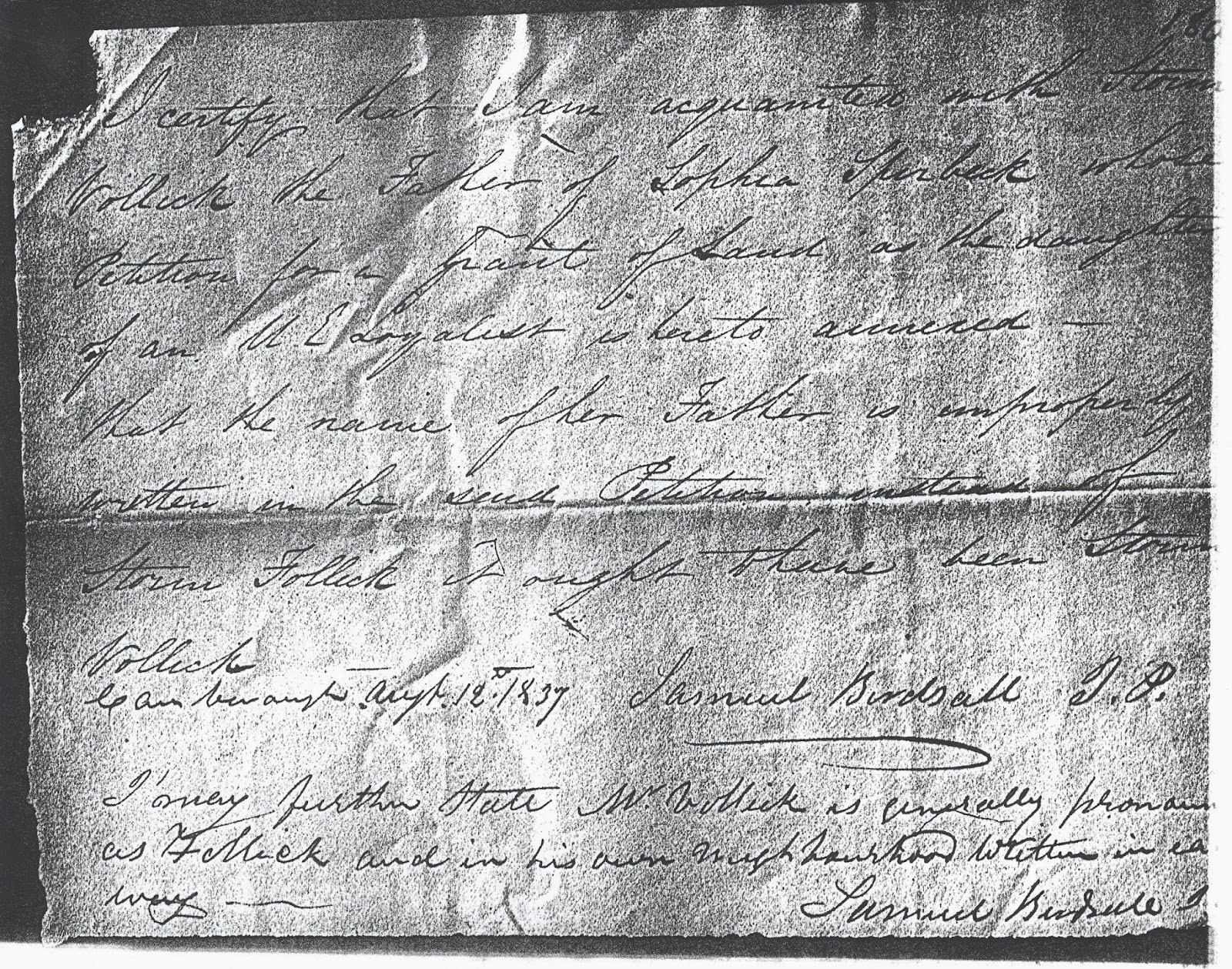
| 1837 document from Storm starting he is known as both Vollick and Follick in his neighbourhood |
It is through Isaac the Loyalist that Follick and Vollick descendants claim their Mohawk heritage. Isaac's great-great-grandmother was Ots-Toch a half French, half Mohawk woman who married Cornelis Van Slyke a Dutchman who settled in Albany New York in 1627
Although no record of a marriage has been found for Isaac and Maria, their son Isaac used his father's surname until 1782. During his years as a private in Butler's Rangers, Isaac's surname changed from Van Valkenburg, meaning in Dutch, 'from the castle of the falcons' (van=from; valken=falcons; burgh=castle), to Valk or Valck which means 'falcon'. It appears that Valk was his nickname and on being recorded by English clerks, a vowel was inserted between the final 'l' and 'k' making the surname Valic or Volick. Over the years, the surname was written as Vollick, Volic, Valic, Valck, Valk, Volk and Follick (the German/Dutch accent making a 'v' sound like 'f' to English ears).
My line, descended from his son Cornelius, took the Vollick surname. His son Storm used the Follick surname. In the next generation some Follick descendants used Vollick while some Vollick descendants used Follick. It makes it interesting trying to research all branches of this family!
April 6, 2014
Sharing Memories Week 14: Grade 9 - Love it or Hate it?
| Me at Gr. 9 Initiation Day |
We all love to find a diary or letters written by great grandma or grandpa where they talk about their lives and share their memories. Think how excited one of your descendants will be to read about your memories and your stories! These stories will be lost after a few generations unless we preserve them. And what better way than in a weekly themed post.
This week's prompt is "Grade 9". Did you love it or hate it? Did you walk to High School or take a bus? How did you feel going into Grade 9 - were you scared or excited?
We had Initiation Day in my High School. It was horrible. We Grade niners had to dress as Romans in old bedsheets to look like togas. We had to fashion crowns of ivy to wear on our hands too. We were slaves for the day and had to carry books for several students at once. We had to use our noses to roll marbles up the cement incline to the front door of the school and at lunch time we had to kneel on the floor under the lunch tables so the older students could use our backs as a foot rest.
The worst was the shaving creme they squirted into our faces and mouths. Initiation lasted the entire day and it really wasn't any fun at all. I had my photo taken and put in the local paper while I was rushing down the hallway.
Grade 9 was a bit of a blur for me. My father died that year on Christmas Day so from January on I really don't remember much of what went on in school. I was very shy and it was all my teachers could do to get a word out of me.
My favourite teacher was Mr. Parrott. He taught English and I thought he was wonderful. He took an interest and tried to coax me to answer questions in class. He told my mother that I knew the answers but wouldn't put my hand up to volunteer them. Eventually he was able to get me to come out of my shell and start enjoying and participating in class.
I actually enjoyed High School and all the new things I was learning. I signed up for Music class and learned to play French Horn. As usual I joined the school choir. I also joined the school newsletter as a reporter/writer (yep I loved to write even back then!)
I loved taking part in all of these activities but then my mother said I had to get an after-school and weekend job. The extra-curricular went out the window as I could not do both. I worked at our local library every day after school (4 pm - 6 pm), two evenings a week (7pm - 9pm) and all day Saturday. It wasn't easy to keep up with my school work and get good grades with all the hours spent working but somehow I managed. But I sure missed my after school activities.
April 3, 2014
52 Ancestors: Charles Fuller, an Ordinary Man But Loved by All
![]() |
| Charles Fuller in The Buffs, Ramsgate Kent England |
I never knew my grandfather. He died in Guelph Ontario in 1941 at the age of 48. I do have many photos of Charles and heard many stories about him from my mother, her sisters and my grandmother Ruth.
Charles was born and grew up in Ramsgate, a seaside town in Kent England. It was there he met my grandmother Ruth. I don't know much about his life in England although I have photos of him as a young teen still living in Ramsgate.
As a young lad he joined The Buffs and was sent to ride along the coast on his bicycle watching for invading Germans.
When Charles was 19 years old he and his fiance Ruth decided to come to Canada. On May 29, 1913 Charles Fuller and Ruth Simpson sailed on the Cunard Line ship Ausonia from Southampton to Montreal then Quebec, Canada. The ship arrived in Quebec on 9 June at 8:10 p.m. My grandmother often spoke of this journey with loathing. She was terrified of the water and the trip was something she never wanted to do again.
![]() |
| 1914 Wedding Charles Fuller & Ruth Simpson |
Apparently my grandfather had a wonderful singing voice and used to sing in the church choir as well as entertain on stage in amatuer vaudeville performances. My aunt, his daughter, remembers the Sunday afternoons when her dad would entertain the neighbours and his family at the piano.
![]() |
| Charles in Blackface |
Charles was by all accounts, extremely kind-heared. He would help anyone and often brought strangers home for dinner. His wife, my grandmother, was used to having Charles walk in the door from work with one or two down-on-their luck men he'd spotted on the street. No one was turned away from their table and Grandma always found a way to stretch the meal to accomodate.
WW1 had not seen Charles enlist because as the manager of the lumber company he was needed at home. Since he had been active in The Buffs in England I am sure he was disappointed at not being able to join in the fight.
And so Charles lived out his short life, not having done anything particularly outstanding, but a kind decent man who was loved by family and friends. His mother adored him and in fact his parents left England, bought a house beside Charles and Ruth and planned to live out their lives in Guelph. Eventually they were so homesick for Ramsgate that they returned but that is how much his mother missed him. As an aside, she and her daughter-in-law (my grandmother) did not get along and I'm willing to bet the years when they lived next door were a struggle for Ruth.
Grandpa Charles fell ill sometime in 1940 and doctors could not determine what was wrong. After a year of pain and fatigue he died in the Guelph Hospital. My grandmother never got over his death and even though she married two more times during her life, she always spoke of "Charlie" and how much she missed him. In some strange ironic twist of fate and genetics, Charles youngest brother is still alive at the age of 102.
March 23, 2014
Sharing Memories Week 12: Gardening
![]() |
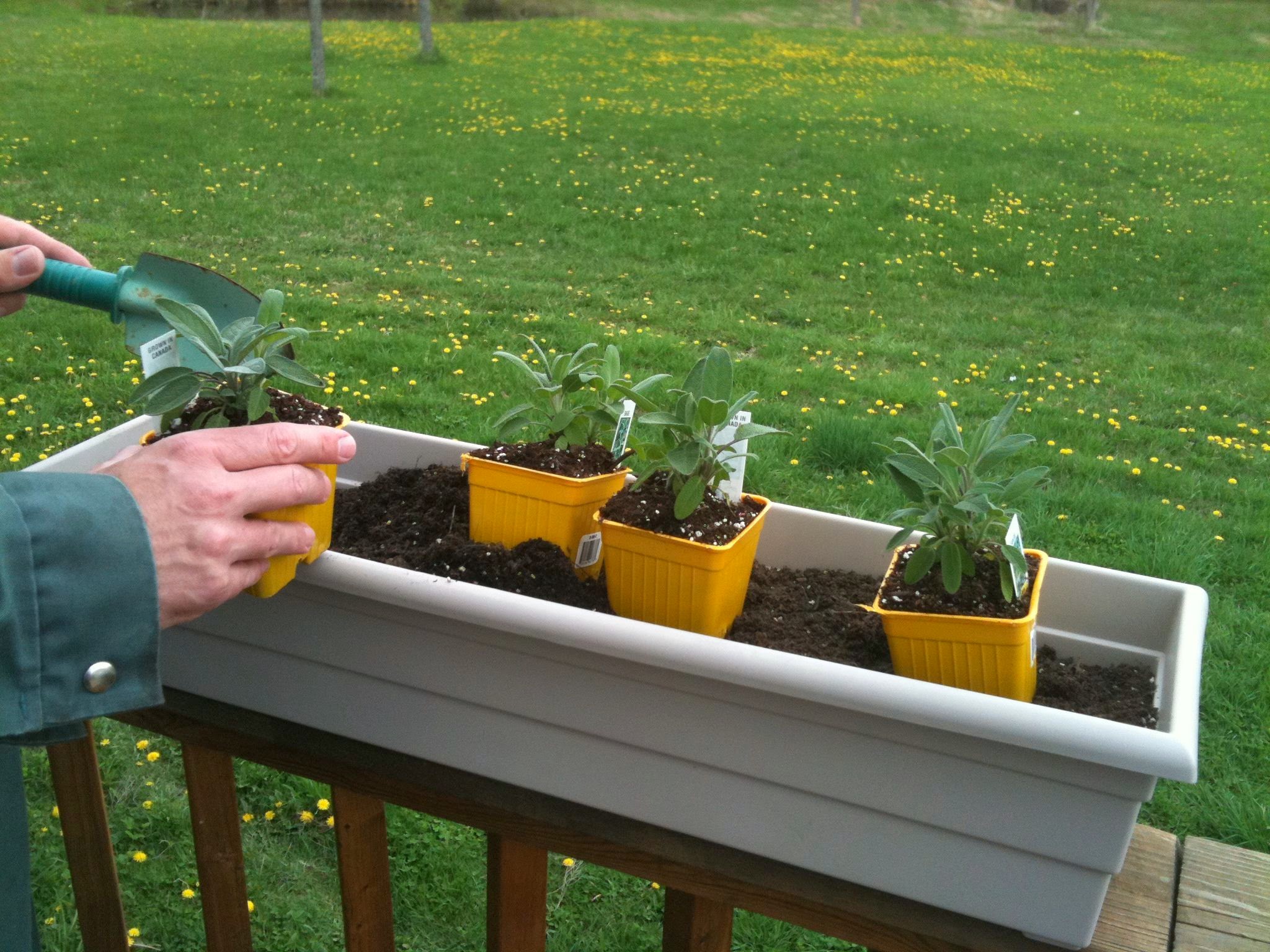
| Hubs planting some of my herbs |
We all love to find a diary or letters written by great grandma or grandpa where they talk about their lives and share their memories. Think how excited one of your descendants will be to read about your memories and your stories! These stories will be lost after a few generations unless we preserve them. And what better way than in a weekly themed post.
The prompt for today is Gardening. What kind of gardens did your parents have? How about your grandparents? Did they grow vegetables? Maybe your grandmother had a prize flower garden? Did any fruit trees or edible plants grow on your property or nearby? Did you garden as a child? Some families might just have had indoor plants.
My father loved African Violets and he grew them inside the house. I remember him using milk to wash their leaves. He also planted marigolds outside in our tiny planter on our front lawn. There may have been other flowers but I don't remember them.
In our back yard we had a pretty lilac tree that smelled really good but there were tons of bees around it all the time. I don't remember my mom or dad with any kind of vegetable garden but we did have a huge clump of rhubarb which my mom used to make stewed rhubarb for us.
My Aunt Rose was an amazing gardener. Her backyard was almost all vegetable garden. She always had used tea bags drying on the heating ducts because she used the leaves to fertilize her plants.
I'm not a gardener both because of physical limitations but also because I just don't enjoy it! I do however grow my own herbs which I use in my cooking. Back in my late 20s and early 30s I tried my hand at a vegetable garden but the day I picked lettuce and made salad for company and didn't notice the little green worms crawling in the lettuce was the last time I had a vegetable garden.
March 16, 2014
Sharing Memories Week 11: Grades 7 & 8
![]() |
| Lord Elgin Public School |
We all love to find a diary or letters written by great grandma or grandpa where they talk about their lives and share their memories. Think how excited one of your descendants will be to read about your memories and your stories! These stories will be lost after a few generations unless we preserve them. And what better way than in a weekly themed post.
At the end of the year you will have 52 stories written about your childhood, your parents, grandparents and who knows what else.Today's prompt is to write your memories of Grades 7 and 8.
For me, Grade 7 was a huge change. My old school, Lord Elgin, only went to Grade 6. So for Grade 7 all the kids in the "old area" and the "new area" of my town went to St. Andrew's. That was a scary but exciting event as previously only the "old area" kids attended Lord Elgin while those on the "good" side of the railway tracks (and Highway 401) went to a different school.
I don't remember too much about Grade 7 or 8 except I was in the choir and also in a Triple Trio. There was one other Triple Trio of girls with very strong voices while my Triple Trio had softer ones. Our teacher was young and inexperienced while the stronger voiced girls had a woman who'd been teaching music forever! We were both in a province-wide competition, and the strong-voiced girls were favoured to win.
It was exciting to travel to Peterborough the night of the finals! We sang "Little Lamb Who Made Thee" - so weird that I remember the song so well. Anyway in a surprise turnaround, my Triple Trio won! Yep we came first place - and it was an amazing feeling.
March 9, 2014
Sharing Memories: Movie Time!
Sharing Memories is a series of weekly prompts to help all genealogists (including me!) with writing up memories of our ancestors and our childhood.
We all love to find a diary or letters written by great grandma or grandpa where they talk about their lives and share their memories. Think how excited one of your descendants will be to read about your memories and your stories! These stories will be lost after a few generations unless we preserve them. And what better way than in a weekly themed post.
At the end of the year you will have 52 stories written about your childhood, your parents, grandparents and who knows what else.
If you write your own blog please use the hashtag #52SharingMemories if you are posting on Twitter or Google+ You can also post your stories as comments on this blog post or in a private journal. It's your choice! The important thing is to write those memories down now!
Today's topic or prompt is Movie Time! Did you go to the matinees every Saturday? Maybe your town or village didn't have a movie theater - mine didn't. Maybe you remember your very first movie. What did you see? How old were you? Tell us about the experience - the sights, the sounds, the smells of food in the lobby.
The village where I grew up did not have a local theater and the closest was in Oshawa which was about 16 km (10 miles) away. I don't recall my parents ever going to what we called "the show" so of course we kids never got to go either. I was quite young when my sister-in-law took me to see Alfred Hitchcock's Psycho. Yep. My mother had forbidden her to take me but she did it anyway!
And my mother was right. I had nightmares for months. But I loved the adventure and the excitement of being with my sister-in-law who I adored. I'd never had popcorn before and Jeanette bought me popcorn and a coke. For a shy quiet kid from the wrong side of the tracks who rarely had a treat of any kind, it was a heavenly day for me.
The next movie I saw was Walt Disney's "The Parent Trap". I loved it! But I don't remember who I went with and I was too young to go on my own.
Then came the big excitement of going all the way to the big city of Toronto with my first boyfriend to see "Ben Hur". The only other times I'd ever been to the city was for the yearly Santa Claus Parade (but I always got terribly car sick and threw up for the entire 40 minute drive each way) and for my eye appointments at Sick Children's Hospital (ditto re the throwing up!)
By the time I was 16 years old I had probably seen 4 movies. To this day I'm not really a movie fan.
Credits: "Vintage Film Reel" by ponsulak at freedigitalphotos.net
March 6, 2014
52 Ancestors: Anna Kuhn Bellinger, Naughty Girl!
My 8th great-grandmother Anna Kuhn was born in Germany about 1659. I'm writing about Anna as part of Amy Crow's Challenge: 52 Ancestors in 52 Weeks and also as part of Women's History Month Challenge.
In 1674, at the age of 15, she was married to Jorg Bruning at Huttengesas, Germany. Jorg Bruning was a much older man, and the marriage was a most unhappy one for poor Anna.
While living at Huttengesas with her husband, she fell in love with Nicholaus Bellinger, son of Hans Bellinger. She ran away with Nicholaus and had a son, my 7th great-grandfather Marcus Bellinger, in 1682. Nicholaus Bellinger and Anna Maria finally received church permission to marry, and were wed on 25 November 1685.
It was considered such scandalous behaviour to run off with another man while married to someone else and have an illegitimate child that the minister in the church entered this in the church books:
Another strong female ancestor for me!
In 1674, at the age of 15, she was married to Jorg Bruning at Huttengesas, Germany. Jorg Bruning was a much older man, and the marriage was a most unhappy one for poor Anna.
While living at Huttengesas with her husband, she fell in love with Nicholaus Bellinger, son of Hans Bellinger. She ran away with Nicholaus and had a son, my 7th great-grandfather Marcus Bellinger, in 1682. Nicholaus Bellinger and Anna Maria finally received church permission to marry, and were wed on 25 November 1685.
It was considered such scandalous behaviour to run off with another man while married to someone else and have an illegitimate child that the minister in the church entered this in the church books:
"Nicolaus Bellinger and Anna, daughter of Hans Kuhn, were married 25 November 1685 as per the order of the noble government. She had md. some years ago Jorg Bruning at Huttengesab, but she was not compatible with him, so Bruning went from her and she from him. She went away with this Nicolaus Bellinger and had an illegitimate child - a little son, so that the aforementioned Jorg Bruning has contracted another marriage.In 1710 the Bellinger family joined with other Palatine refugees coming to New York. There were 3 000 Palatines on 10 ships that sailed for New York and approximately 470 died on the voyage or shortly after their arrival. I've always felt sorry for poor Anna married at 15 to someone she didn't love. I really can't blame her for running away to find happiness. But she suffered greatly, as did all the Palatines. First persecuted in their own country because of their religion and then treated as indentured servants by the British.
After all this however, the above mentioned Bellinger has remained as a stranger. She sent a request to the honourable government to let them stay in the country, and this finally has been permitted by the aforementioned honourable government which ordered me to marry them with prior published penitence and to avoid further trouble and also to legitimize the rearing of this blameless child"
Another strong female ancestor for me!
March 2, 2014
Sharing Memories & Women's History Month: Who Was Your Favourite Relative?
![]() |
| Ruth Simpson 1907 |
We all love to find a diary or letters written by great grandma or grandpa where they talk about their lives and share their memories. Think how excited one of your descendants will be to read about your memories and your stories! These stories will be lost after a few generations unless we preserve them. And what better way than in a weekly themed post.
At the end of the year you will have 52 stories written about your childhood, your parents, grandparents and who knows what else.
If you write your own blog please use the hashtag #52SharingMemories if you are posting on Twitter or Google+ You can also post your stories as comments on this blog post or in a private journal. It's your choice! The important thing is to write those memories down now!
I'm also posting this as part of my challenge for Women's History Month. See Women's History Month: A Challenge to Geneabloggers! for 10 suggestions for honouring women in March. I'm writing about Prompt #4: Write a biography of your favourite female Ancestor. Be sure to tell us why she's your favourite
Hands down it was my Grandma Bates. I think of her as Grandma Ruth but we never used her first name. Grandma was fun and lively and loved the colour red. She often wore a red pantsuit with a white blouse or a red skirt and white blouse and she always wore her ruby ring. That ring is now mine and I wrote about it coming back to me on Grandma's Ruby Ring
Born in Ramsgate Kent England in 1894 to parents David George Simpson and Sarah Jane Stead, Grandma was a sickly child and spent a lot of her days in bed only able to peek out her bedroom window. Her family called her Dolly because she was so tiny and cute.
| Miss Mulligan's Dance Classes. Ruth is back row center |
![]() |
| Simpson Family ca 1900 Grandma is 2nd from left |
She and my mom did not get along, and they fought constantly. Grandma was rather delicate and could become quite frightened or upset very easily. The wind bothered her and she would become very agitated on windy days. She was terrified of water and when I would visit her when I was in school she would only allow me a few inches of water in the bathtub in case I drowned.
Her husbands adored her! She was their little princess and had them wrapped around her little finger. She married three times, and outlived all of her husbands. They waited on her hand and foot and never seemed to mind her idiosyncracies.
I loved listening to her stories of her life in Ramsgate and about her siblings and parents. In fact she was the reason I became so fascinated with family history and stories at a young age.
![]() |
| Ruth and daughters Lillian (left) & Joan (right) Guelph ca 1918 |
In 1913 at the age of 19 Grandma sailed for Canada with her fiance Charles Fuller. They were joining her older brother Ern in Toronto Ontario and would make Canada their new home. Grandma never recovered from the terror of that sea voyage. Years later when she was in a home and near death she would tell me how much she longed to see her mother again and in a shaky voice ask me repeatedly "Do we have to go by boat?" At that point she could not remember that her mother was long gone.
Grandma and her husband Charles settled in Guelph Ontario where they raised a family of 3 girls, including my mother. After Charles died, Grandma married a man who was hired as a guard at the DIL Munitions Factory in Ajax Ontario during WW2 so Grandma also took a job there.
My mother followed suit and also moved to Ajax with her sister and their 4 children while their husbands were overseas in WW2. Mother also worked at the Munitions Factory during the war. Grandma didn't build bombs, instead she worked in the Cafeteria at the plant. Grandma was a bit unusual for her time as she almost always had a job of some sort. Her first husband bought her a Tobacco Store beside the Movie Theater in Guelph so that she would have something to keep her occupied. After working in the Munitions Factory during WW2, she moved back to Guelph and took a job at a large department store. She worked behind the counter of the women's dress and glove department and she loved it.
![]() |
| Fuller family in Guelph 1923 Baby Eileen, Ruth, Charles, my mother Joan seated & Lily standing |
My family have always told me I am just like Grandma Ruth. My mother told me that's why she and I didn't get along because I was, in her words, "...just like my mother!"
Here's the odd bit - Grandma married 3 times. So did I. Grandma was 47 when she was widowed. So was I.
Grandma ended up living with my widowed mother and another widowed daughter but that was quite stressful for all concerned as she and my mother could not go more than an hour without arguing.
Eventually she had to be moved to a home in Owen Sound where she became increasingly confused and frightened. It was very difficult to visit her and see how far she had slipped from reality. She died in 1985 at the age of 90 and I remind myself she had a good long life and was loved by many. But I miss her.
March 1, 2014
Women's History Month: A Challenge to Geneabloggers!
![]() |
| DIL Plant Ajax Ontario where my Mom & Grandmother worked in WW2 |
I'm going to tackle this challenge too. I plan to write about 10 women who made a difference somehow. Perhaps they made a difference in my life, or to the world. But I want to recognize women this month - women who suffered hardships but endured, women who were the first to challenge what had been a man's world, women who made important discoveries, and women who were pioneers.
Ten ideas that might help you to join me in honouring women this month are
- Which of your female ancestors were alive when women achieved the right to vote. How do you think they reacted to the ongoing suffragette movement? Different countries extended the right of voting for women in different years and even within one country, different areas sometimes had different rights. For example in Ontario Canada women who owned property could vote for school trustees as early as 1850. In 1917 women in Canada gained the right to vote in all elections. It was 1920 before women in the USA were given the right to vote. In the UK women over the age of 30 who met certain property qualifications could vote but it was not until 1928 that all women over the age of 21 achieved that right.
- Do you have a female relative (direct ancestor or collateral lineage) who played an active role in women's issues? Perhaps one who was a Suffragette or was a pioneer in a male-dominated role or occupation? Perhaps she sailed to the New World to start a new life in the 1600s or was a refugee from a war-torn or religious-intolerant location. Tell her story in a blog post or comment here on this blog.
- Choose one female ancestor and the historical context during her life. Pick one historical event that would have impacted on her life. Perhaps she lived through the Spanish influenza in the early 1900s or she was widowed during the Civil War, or lived through the Depression.
- Write a biography of your favourite female Ancestor. Be sure to tell us why she's your favourite
- Make a list of your direct line maternal ancestors beginning with your mother. So you will list your mom, her mom, her mom's mom and so on, back as far as you can. Now figure out how many children each female ancestor had. Did the females in your direct maternal line tend to have the same numbers of children each generation? Did they have more? Less? Were they prolific or are there few children born to each woman? Is there a pattern emerging?
- Write about your mtDNA findings. If you haven't been tested yet, order an mtDNA kit! There are several companies offering DNA tests - Family Tree DNA, Ancestry DNA, 23andMe.com
- Did any of your female ancestors participate in some kind of war-related activity? My mother and grandmother both worked in a Munitions Factory in WW2. Perhaps your ancestor rolled bandages or knitted socks for the troops. Write about one ancestor who was active in some way during a war or skirmish.
- Which female ancestor do you most identify with? Tell us what she did or what she was like and why you identify with her
- Was there a female (teacher, minister, friend, relative) who impacted on your life? Tell us about her
- Did any of your female ancestors or relatives follow a non-traditional female role either in their relationships, occupations or in society?
February 27, 2014
52 Ancestors: Great-Grandpa's Horse Saves the Day!
| 1882 Wedding David George Simpson & Sarah Stead |
My great-grandfather David George Simpson (1861-1921) was a coal dealer in Ramsgate England. My grandmother, his daughter Ruth, used to tell me stories about her dad. I loved hearing them!
One I remember most was how her dad made his daily rounds with a cart and his horse to deliver coal to his customers. Great-grandpa had epilepsy and so frequently he suffered seizures on his route. Apparently his horse, knowing the route well, simply carried on without any guidance from David.
At each house on the route, the horse would stop and the customer would come out, check on Great-grandpa, take their allotment of coal and send the horse on its way. Then the horse would take Great-grandpa home when the route was done.
Grandma Ruth also told me that her father had what she called "a withered left arm". I don't know exactly what she meant by that but she said he had no use of it, and when I look at photos I have of David George it does seem that he hides one of his hands. My Great-grandpa had a sad childhood. When he was 13 his father died suddenly of pneumonia. David's mother was pregnant with her 5th child and David was her oldest. Two months after the father's death, David's youngest sibling was born but sadly that child died at the age of one month. David's mother had to take in laundry to support her family. After David married his widowed mother came to live with the family.
David George died of an epileptic seizure at the age of 59 at his home in Ramsgate.
![]() |
| Simpson Family Ramsgate, Kent England ca 1900 |
Seated: David George & wife Sarah Stead. In front is Uncle Syd. Syd, Ern, Frank and Ruth emigrated to Canada while Albert settled in Australia.
Subscribe to:
Posts (Atom)