
Updates about Olive Tree Genealogy website and other FREE genealogy records. Bringing you tutorials, genealogy book and app reviews, genealogy news, genealogy specials and more. Helping you find your family tree and ancestors.


Showing posts with label Historical Preservation. Show all posts
Showing posts with label Historical Preservation. Show all posts


January 20, 2020
Beyond 22: Virtual Record Treasury for Irish history
 Thanks to Gail Dever of Genealogy a la Carte for reporting on "Beyond 22: Ireland's Virtual Record Treasury"
The Beyond 22 website explains:
June 30th, 2022, marks the centenary of the terrible explosion and fire at the Four Courts, Dublin, which destroyed the Public Record Office of Ireland (PROI) and, with it, seven centuries of Ireland’s collective memories. While incomparable with the loss of human life, the destruction of the Record Treasury at the PROI was one of the great tragedies of the Civil War.
Beyond 2022 is an all-island and international collaboration. Working together, we will launch a Virtual Record Treasury for Irish history—an open-access, virtual reconstruction of the Record Treasury destroyed in 1922.What an exciting new project for those of us with Irish ancestors! According to the organizers, more than seventy repositories world-wide hold substitute materials that can replace the documents destroyed in the Four Courts fire.
The Project has four phases: Discover, Digitize, Reconstruct, Reveal
With the identification of those records, Beyond 22 will digitize and restore what is found, then bring them online for researchers, historians, and genealogists to access.
I am looking forward to searching these records for my McGinnis, Downey, Jamieson, and Greenlees families. What names will you be looking for?
April 9, 2014
One Man in England Saves 5000 WW1 Photos from Being Destroyed
 |
| Screen Dump from BBC News Sussex website |
Bob Smethurst worked at collecting garbage for decades. In the early days there were garbage pails that had to be dumped into the trucks. As these pails were dumped, papers and photos were easily spotted. Not wanting some of the lovely photos of soldiers and WW1 postcards he saw to be lost forever, Smethurst began saving them. Little did he know that he would end up with over 5000 photographs and letters, some of them very rare.
Mr. Smethurst defines himself as a custodian of these documents and is making plans on what should happen to the collection.
This is a fascinating story and how I would love to visit Mr. Smethurst and look through is amazing collection.
For more details and photos see Revealed: Extraordinary collection of 5,000 WWI photographs salvaged from RUBBISH DUMPS by a former dustman and Sussex dustman saved rare WW1 photographs
December 20, 2013
Preserving Paper Treaures: Step 3 Ready To Create & Store
This is Step 3 of preserving your family ephemera. Yesterday I talked about sorting and organizing all those family papers into piles (See Preserving Paper Treasures: Step 2 Sorting & Organizing)
We're going to talk about paper Pile #1 and Pile #2 today. These consisted of your most important and valuable papers and documents. To refresh memories, Pile #1 consists of your most valuable ORIGINAL documents that you are not ever going to throw out or see ruined.There is probably a strong emotional attachment to most items in this pile.
WHERE DO I STORE PAPERS FROM PILE #1?
Pile #1 is easy to deal with. You want to preserve these items intact for future generations. You are never going to throw them out or alter them in any way. You have digitized the papers but you need to do something with the actual documents. Here are my suggestions:
SMALL DECORATIVE BOX

Keep the treasured documents and papers in a small decorative box, one that is likely to be passed on down through the family after I'm gone. It's small enough that it is probably never going to be used for something else. You might want to add a family chart or note describing the contents of the box. See Passing on Your Family Genealogy Treasures to a Descendant
 Remember
my huge blanket box full of papers? That would almost certainly result in
someone at some time in the future dumping the papers and using the box for
storage of blankets or towels or some other household item. But the small
antique box I use looks important enough to not be trashed and isn't big
enough to store much more than the documents I've placed in it.
Remember
my huge blanket box full of papers? That would almost certainly result in
someone at some time in the future dumping the papers and using the box for
storage of blankets or towels or some other household item. But the small
antique box I use looks important enough to not be trashed and isn't big
enough to store much more than the documents I've placed in it.
Update January 20, 2014: Please see Oops I goofed! A Correction re Preserving Paper Treasures for a caveat and correction
ACID FREE BINDER STORAGE You can also place the documents and papers from Pile #1 into acid free sleeves and keep in an archival binder or box. The idea is to keep them in something that will protect them from deteriorating and maximize the chance that they will still be in your family 100 years from now. Whatever method you use, the papers from Pile #1 are intact and tucked away safely. And you have digital copies you can print to create something nice. (more on that after we talk about Pile #2)
WHAT DO I DO WITH PAPERS FROM PILE #2? Pile #2 is where you put papers that have meaning for you but are not as important or unique as Pile #1. You would like to see these documents survive and be passed on in the family but they do not have the same emotional attachment for you.
Pile #2 is where you can be a bit more flexible. Remember this is the pile that contains items you didn't mind altering, keeping in mind that you have digital copies as a backup. Before I get to what you should do with Pile #2, let me show you some ways to create some nice items from both piles that you can pass on to other family members.
CREATE BOOKS FROM YOUR DIGITAL COPIES
You've scanned and digitized all the items in both piles. This is where I take my digital copies and create books in Shutterfly. See my YouTube Video Tutorial on Using Shutterfly. You can use any self-publishing service such as Blurb or Lulu or, for those in the USA, MyCanvas.
The benefit of creating a coffee table sized book (30 pages or less) is that it looks professional and therefore important enough to keep and you can have multiple copies printed. This means you can give copies to family members and thus maximize your chances that at least one of those copies will survive in the future.
Shutterfly keeps your original book which means you can have copies printed at any time. Blurb has restrictions on how long they will store your book so be sure to read any restrictions before starting your book.
But what to do if you don't want to create a self-published book? Perhaps you don't want to undertake such a big project. Maybe you've never used Shutterfly or any self-publishing service and the task seems daunting. Perhaps it is just too expensive for your budget. That's okay because I have another solution for you.
MAKE A SCRAPBOOK
Consider creating an old-fashioned scrapbook. If you've been lucky enough to inherit a scrapbook that your mom or grandmother kept, you know the kind I mean. Or perhaps you kept one as a teenager - many of us gals glued in tickets from our first prom or a ribbon from a corsage given to us by a boyfriend.
You can purchase acid-free scrapbook paper to create a lovely book that can be passed on to someone in the family. As you create your scrapbook remember that you are not going to use the original documents in Pile #1. Instead you will use copies. You've scanned them all so it will be easy to print copies on good quality paper. You can cut those copies up and glue them in your book. Using copies allows you to create more than one scrapbook.
Pile #2 is where you have more flexibility because you can use the originals. The papers in this pile can be cut up or altered and used in your scrapbooks. These documents don't have to be handled as carefully as those in Pile #1. You are still preserving these papers for future descendants in book format. Glue them into a scrapbook. Cut them up and create a collage. The sky's the limit because you have digital copies and you can always print more. If you're going to make more than one scrapbook you have copies of the papers in Pile #2.
I know that professional archivists will be gasping in horror at the thought of cutting up or using the originals from Pile #2 in a scrapbook but we are preserving them and creating a way to view them and enjoy them.
YOUR SCRAPBOOK - FANCY OR PLAIN?
 Your scrapbook can be as simple or as elaborate as you want. You can create fancy borders, add stickers or designs and be very creative or not, as you see fit. Remember your scrapbook does not have to be a work of art. The goal is to achieve a way of keeping these family papers together in a format that can be passed on.
Since your goal is to maximize the chances that this scrapbook will survive and be passed on, you need to put more thought and time into creating the outside cover. The nicer and more professional the cover of your scrapbook looks, the more likely it will be treasured and preserved and given to yet another generation. My husband has a saying "If it looks like junk it will be treated like junk. If it looks important it will be treated with reverence."
ARCHIVAL BINDERS
If creating a scrapbook or a self-published book seems too daunting or time-consuming you might choose to place your original documents from both piles in an archival binder to pass on to a family member at some point.
THE GOALS
Whatever method you choose, there are 3 goals:
1. To preserve the documents
2. To pass them on to other family members
3. To be able to enjoy the documents yourself in an easy-to-use manner
THERE'S MORE!
You probably think this is the last post in this series. But guess what? We've talked about how to preserve, share and enjoy your ancestors' treasured paper records. But we haven't talked about you and your life and your documents! If you have descendants they are going to want to know about you, their ancestor. So keep watching this space for a new series on making sure you are keeping and preserving records about your life as well as the lives of your ancestors.
We're going to talk about paper Pile #1 and Pile #2 today. These consisted of your most important and valuable papers and documents. To refresh memories, Pile #1 consists of your most valuable ORIGINAL documents that you are not ever going to throw out or see ruined.There is probably a strong emotional attachment to most items in this pile.
WHERE DO I STORE PAPERS FROM PILE #1?
Pile #1 is easy to deal with. You want to preserve these items intact for future generations. You are never going to throw them out or alter them in any way. You have digitized the papers but you need to do something with the actual documents. Here are my suggestions:
SMALL DECORATIVE BOX
Keep the treasured documents and papers in a small decorative box, one that is likely to be passed on down through the family after I'm gone. It's small enough that it is probably never going to be used for something else. You might want to add a family chart or note describing the contents of the box. See Passing on Your Family Genealogy Treasures to a Descendant
Update January 20, 2014: Please see Oops I goofed! A Correction re Preserving Paper Treasures for a caveat and correction
ACID FREE BINDER STORAGE You can also place the documents and papers from Pile #1 into acid free sleeves and keep in an archival binder or box. The idea is to keep them in something that will protect them from deteriorating and maximize the chance that they will still be in your family 100 years from now. Whatever method you use, the papers from Pile #1 are intact and tucked away safely. And you have digital copies you can print to create something nice. (more on that after we talk about Pile #2)
WHAT DO I DO WITH PAPERS FROM PILE #2? Pile #2 is where you put papers that have meaning for you but are not as important or unique as Pile #1. You would like to see these documents survive and be passed on in the family but they do not have the same emotional attachment for you.
Pile #2 is where you can be a bit more flexible. Remember this is the pile that contains items you didn't mind altering, keeping in mind that you have digital copies as a backup. Before I get to what you should do with Pile #2, let me show you some ways to create some nice items from both piles that you can pass on to other family members.
CREATE BOOKS FROM YOUR DIGITAL COPIES
 |
| Shutterfly Book Example Page with scanned document |
You've scanned and digitized all the items in both piles. This is where I take my digital copies and create books in Shutterfly. See my YouTube Video Tutorial on Using Shutterfly. You can use any self-publishing service such as Blurb or Lulu or, for those in the USA, MyCanvas.
The benefit of creating a coffee table sized book (30 pages or less) is that it looks professional and therefore important enough to keep and you can have multiple copies printed. This means you can give copies to family members and thus maximize your chances that at least one of those copies will survive in the future.
Shutterfly keeps your original book which means you can have copies printed at any time. Blurb has restrictions on how long they will store your book so be sure to read any restrictions before starting your book.
But what to do if you don't want to create a self-published book? Perhaps you don't want to undertake such a big project. Maybe you've never used Shutterfly or any self-publishing service and the task seems daunting. Perhaps it is just too expensive for your budget. That's okay because I have another solution for you.
MAKE A SCRAPBOOK
 |
| Trip Scrapbook I created for grandchildren |
Consider creating an old-fashioned scrapbook. If you've been lucky enough to inherit a scrapbook that your mom or grandmother kept, you know the kind I mean. Or perhaps you kept one as a teenager - many of us gals glued in tickets from our first prom or a ribbon from a corsage given to us by a boyfriend.
You can purchase acid-free scrapbook paper to create a lovely book that can be passed on to someone in the family. As you create your scrapbook remember that you are not going to use the original documents in Pile #1. Instead you will use copies. You've scanned them all so it will be easy to print copies on good quality paper. You can cut those copies up and glue them in your book. Using copies allows you to create more than one scrapbook.
Pile #2 is where you have more flexibility because you can use the originals. The papers in this pile can be cut up or altered and used in your scrapbooks. These documents don't have to be handled as carefully as those in Pile #1. You are still preserving these papers for future descendants in book format. Glue them into a scrapbook. Cut them up and create a collage. The sky's the limit because you have digital copies and you can always print more. If you're going to make more than one scrapbook you have copies of the papers in Pile #2.
I know that professional archivists will be gasping in horror at the thought of cutting up or using the originals from Pile #2 in a scrapbook but we are preserving them and creating a way to view them and enjoy them.
YOUR SCRAPBOOK - FANCY OR PLAIN?
Since your goal is to maximize the chances that this scrapbook will survive and be passed on, you need to put more thought and time into creating the outside cover. The nicer and more professional the cover of your scrapbook looks, the more likely it will be treasured and preserved and given to yet another generation. My husband has a saying "If it looks like junk it will be treated like junk. If it looks important it will be treated with reverence."
ARCHIVAL BINDERS
 |
| Archival Binder Box |
If creating a scrapbook or a self-published book seems too daunting or time-consuming you might choose to place your original documents from both piles in an archival binder to pass on to a family member at some point.
THE GOALS
Whatever method you choose, there are 3 goals:
1. To preserve the documents
2. To pass them on to other family members
3. To be able to enjoy the documents yourself in an easy-to-use manner
THERE'S MORE!
You probably think this is the last post in this series. But guess what? We've talked about how to preserve, share and enjoy your ancestors' treasured paper records. But we haven't talked about you and your life and your documents! If you have descendants they are going to want to know about you, their ancestor. So keep watching this space for a new series on making sure you are keeping and preserving records about your life as well as the lives of your ancestors.
December 18, 2013
Preserving Paper Treasures: Step 2 Sorting & Organizing

Today I'm going to show you how to handle all those tubs, filing cabinets and blanket boxes full of unsorted miscellaneous ephemera. Because you and I both know that we genealogists are savers. We save copies of documents we find. We save great-grandma's bill for flowers dated 1889. We save Grandpa's love letter to Grandma from WW1.
Let me preface this blog post with saying that I am not including photos in this tutorial. That's a different subject with it's own issues but I'll talk about preserving your most precious photos in a future blog post.
The problem is that it is extremely unlikely that anyone in the future will want to digitize all those papers. So we must do that now. But if we want to maximize the chances that the originals will still be in the family 100 years from now we have to go beyond digitization.
Trust me, no one will want to keep a huge blanket box full of papers. It will be used for some other purpose or sold and the contents tossed out. But I have a few suggestions for how best to ensure that your family papers survive for many more generations to come.
DIGITIZE FIRST!
First you must scan and digitize all of these papers. Save the scans to your computer, to a cloud service (or several cloud services), burn them to a CD ROM, put copies on a flash drive or an external hard drive and share them with family members.
CRITERIA FOR SORTING DOCUMENTS

For me personally I determine a document's "value" or importance based on:
a) the age of the document. The older the document is, the more valuable it is to me. My great-great-grandmother's receipt for bolts of cloth she bought in 1857 is a valuable document in my mind
b) the amount of information or story the document holds. The story it holds is not the same as the number of words, it is the detail within and how it sets my ancestor in history. For example a military discharge certificate tells a huge story about my grandfather even though there are very few words on it.
c) how unique the document is. In other words if I have my mother's report card from 1922 that might be difficult or impossible to get from any other source. It is a one-of-a-kind document and is thus valuable.
ORGANIZING DOCUMENTS INTO PILES

Pile #1 consists of your most valuable ORIGINAL documents that you are not ever going to throw out or see ruined. I stressed original because this is not where you put copies of images of census records that you found online. Instead these would be such items as that WW1 love letter from Grandpa to Grandma, your uncle's military discharge papers, your dad's death certificate, or your grandmother's baptism record. You probably have a strong emotional attachment to items in this pile and you likely feel they are of historical importance.
Pile #2 This is where you put papers that have meaning for you but are not as important or unique as Pile #1. You would like to see these documents survive and be passed on in the family but they do not have the same emotional pull for you.
This pile might include such things as a newspaper clipping from Grandma's scrapbook, or Christmas cards that were sent to an ancestor from one of their friends. Perhaps there is a Valentine's card from Grandpa to Grandma with only his signature. In other words these are items that you find interesting or your parents or grandparents treasured but they don't carry the same weight in your mind as the items in Pile #1. This is a very personal decision as to what is most important or valuable and what is of lessor importance.
Pile #3 is the toss pile. For me personally there is a good chance there will be nothing in this pile! I should purge but I will have a difficult time doing so. But the more papers you have in your possession the more ruthless you will need to be. If you can bring yourself to create this pile, please do. To show you how difficult a toss pile is for me, I have a ticket stub for a dance that my mother had in her possessions. I don't know the story behind this ticket. I don't know when the dance took place. I don't know why my mother kept it. So it has no meaning, no story behind it. I should toss it. But I doubt I will.
You may also wish to consider creating a 4th Pile. Pile #4 consists of original documents that you are willing to pass on to other family members right now. If you aren't prepared to do this or there is no one in your family who is ready or willing to accept some of the items, that's fine. But consider doing this as it will reduce the stress on family who may be left to decide who gets what after you are gone.
As an example you can see in my photos above that I have a serviette (napkin) from my brother's first wedding in the 1950s. It has the names of the bride and groom and the date of the wedding so it holds important details. I don't really want that napkin but perhaps one of his children would like to take over as guardian and keeper! As well I have two birth announcements for two of my nieces. They include photos of each baby at birth, plus details of time of birth, weight, size, parents' names etc. Those notices aren't important for me to keep any longer and I think it is time to put them in Pile #4 then pop them in envelopes and mail to my nieces.
In my next blog post I will talk about what we're going to do with Pile #1 and Pile #2 in order to maximize our chances that those papers will still be in the family 100 years from now.
You can follow these upcoming blog posts by choosing the topic "Preserving Paper Treasures" from the right hand side bar.
December 17, 2013
Preserving Paper Treasures: What's New Today is Obsolete Tomorrow
.JPG "Preserving Paper Treasures: What's New Today is Obselete Tomorrow") |
| Obsolete floppy discs |
I could, with a great deal of effort, get my hands on something that would allow me to look through those discs and extract any information I might want to keep. But I won't. That's way too much work and time and effort!
And this is but one example of outdated technology. At the time didn't we all figure we could digitize our documents, create our files and save them until we wanted/needed them? But that is what happens with the rapid advance of technology. We end up with important data that can't be read in 5, 10, 15 or more years from when we created it.
As genealogists we save documents, whether original or copies. We need that marriage license of our great-grandparents. We treasure the original 1918 bill for Grandpa Bob's funeral. The push is on to digitize them, to go paperless. But let's be realistic! Will we be able to read or access those treasured digitized items in 10 years or 20 years time?
Sure we saved a copy on our harddrive but computers crash and data is lost. We saved a copy to the Cloud, that was good wasn't it? But we have zero control over cloud services and they may disappear overnight, or there could be a catastrophic failure and saved data is lost. We have copies on CDs and flash drives and external hard drives and we've shared some of those with family. We're covered, right? Wrong. CDs and flash drives might not be readable in the future, just as those little floppy discs are unreadable to most of us.
Even if the cloud with our digitized documents is still there, if you are no longer around, is there anyone in your family who knows your password or has the technical skills to get to it?
So what's a genealogist to do? Well, first of all you should absolutely digitize your papers and photos and save them in every spot you can think of! The more backups the better. But don't be too quick to throw out those paper originals!
.JPG "Preserving Paper Treasures: What's New Today is Obselete Tomorrow") |
| Blanket Box of Ephemera |
But I know that at some point in the future someone (most likely one of my grandson's wives, or a granddaughter) will almost certainly look at that blanket box and think "Hmmmm I could store a lot of bedding in here! And what's with these papers? Holy cow, do we really need to give up good storage space for my husband's great grandmother's driver's licence or her marriage certificate?" And his grandpa's death certificate!!??"
And the papers I have treasured and saved for future generations will be tossed. So what do we do? How do we get the maximum chances that our paper ephemera will be kept by future generations?
In the next few blog posts I'm going to show you several different plans for preserving these paper documents and treasures such as Great Grandmother Harriet's baptism certificate or Great uncle Syd's military discharge papers.
You can follow these upcoming blog posts by choosing the topic "Preserving Paper Treasures" from the right hand side bar.
September 29, 2013
Hooper-Squires Photo Archives Treasure No. 8

I'm sure this is 3 sisters but am not positive who they are. Perhaps a reader familiar with the family can help.
To view all the photos in this collection as they are published here on Olive Tree Genealogy blog, click on Hooper-Squires Photo Archives link.
August 25, 2013
Hooper-Squires Photo Archives Treasure No. 7: 5 Gals

On the reverse of this photo of these five lovely ladies is written:
Reberta [sic] Parker, Marg Carter, Gladys Parker, Josephine McCabe, Isabel Laurie
I do not know who these women are and how they connect to the Hooper or Squires family.
The photo looks like 1940s to me. If you recognize any of the faces or names, please do leave a comment on this blog post

July 18, 2013
The House That Time Forgot
 |
| From Google Maps |
It's a home that two brothers lived in with their parents and when their dad died in 1932 nothing was ever changed or disturbed or rearranged after that date. It was frozen in time. The brothers remained bachelors and stayed in the home until death or old age forced removal. With no heirs, the last surviving brother left the house and it's contents to The National Trust. It is now preserved as a museum
When I say they left it as it was in 1932, this includes food in the kitchen pantry, original appliances from the 1920s, all their dad's coats and hats still hung on pegs in the hall, and so on. So a little piece of a historical era has been frozen.
As intriguing and interesting as it is, I find it a tad creepy. Don't get me wrong! I love antiques, in fact our home is filled with them and visitors often remark that it is like entering a museum with so much to look at in our home. And of course I am all for preserving family memories (which these brothers did - perhaps too well?) For me it seems as if the boys (and their mother) were unable to move on after the dad's death. So they too were stuck in time, perhaps never fully grieving his passing. And I think that's very sad.
What do you think? Amazing and a wonderful tribute or just a wee bit disturbing?
May 19, 2013
Documenting and Passing on Family Treasures
 |
| Grandpa Fuller's engraved Gold Pocket Watch from 1914 Given by his parents on his 21st birthday before leaving England to settle in Canada |
My hope is that one or more of my children or grandchildren will keep them safe and continue passing them down to the next generation. I've considered giving each family member one treasure to keep safe.
I've also mulled over passing all of the items on to one person for safekeeping. Dilemma #1 - who will get what treasure? And #2 - should I give them now or write out a note explaining who gets what after I'm gone?
The Provenance
I can see a wife looking at it and asking why they are keeping it. Without some paper record, I suspect my sons would shrug a shoulder and say "Geez I dunno, Mom said it was one of her relatives but I don't remember who" Bingo - a label of 25 cents is put on it and it goes out to the front yard.
So I added another dilemma to the mix - #3 how to document the provenance of each family heirloom so that it stays with the specific item
The Dilemmas
That makes 3 dilemmas I need to solve:
- Who will get what treasure? Do I split them up or give them all to one person?
- Should I give them now or write out a note explaining who gets what after I'm gone?
- How do I document the provenance of each family heirloom so that it remains with the item
Here are some of my solutions. Nothing strikes me as the perfect answer but so far these are the best methods I've come up with
1. I've attached labels to many items. The labels indicate who is to have the item after my demise and there is a brief bio of who owned it. There is no info as to when and how I ended up with said item due to space limitations. Some items such as my Grandpa Fuller's gold pocket watch don't lend themselves to having a label affixed!
2. I've inventoried all my family treasures. I took photos then inserted them into WORD and then typed up an explanation of the item, the original owner (with some family tree info), who gave it to me and when. Beside each item I've put the name of who I want to have it (if I've decided!) I printed all the pages off and bound them as a coil bound booklet for my executors. My hope is that as an item is given, the page(s) that apply to it will be torn out and passed on with the item
3. I've tried some online methods including a nice little iPhone app called Heirlooms. But they aren't exactly what I am looking for
4. I've written blog posts about some of my family heirlooms and I am thinking about creating a Shutterfly book with each of these blog posts, then giving one copy to each of my children. So far this is the idea I'm liking the best! Here are a few of the heirlooms I've written about:
A 1913 Fireplace Screen's Long Journey
Great-Grandpa's Trunk
3 Generations of Baby Cups
Cabinet of Curiosities: A Christmas Toast!
Perhaps inside each book I could indicate which heirlooms each of my children or grandchildren is to receive at some point in the future.
So far this seems like the best method as I believe a hard cover book will survive through the generations much better than pieces of paper or labels attached to the back or underside of objects.
And of course, as always, I will continue to tell my children and grandchildren the stories behind each object every time we get together for Thanksgiving or Christmas. I figure repetition of family stories shouldn't be overlooked!
So what are your plans for documenting and passing on your family heirlooms?
February 27, 2013
Hooper-Squires Photo Archives Treasure No. 6
This is the 6th photo in our collection of rescued photographs of the
Hooper and Squires families of St. Mary's Ontario Canada. To view all
the photos in this collection as they are published here on Olive Tree
Genealogy blog, click on Hooper-Squires Photo Archives link.
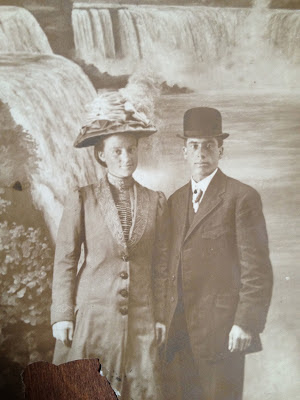


This lovely photo taken at Niagara Falls has writing on the back as it was a postcard sent to Mr. Edgar Hooper from his sister who was on her honeymoon at the time. I assume this Edith Hooper and her new husband Joseph Camm, as they married on September 10, 1910

Sept. 19/10
Hello Edgar, How is Ettie? Hope she is better by this time. We are well and having a pretty nice honeymoon. Will soon be home. Your loving sister
February 12, 2013
Consult with a National Archives conservator on how to preserve your family treasures!
 | ||
Image of letters from Pearl Harbor via Preservation Programs of the U.S. National Archives. |
Bring in a document, book, photo, artifact, or motion picture film for a consultation with a conservator on how to preserve it. Appointments are required for individual consultations; contact Preservation@NARA.gov or Preservation Programs Officer Allison Olson at 301-837-0678 to schedule one.
The fair is free and open to the public! Enter at the Special Events Entrance on Constitution Avenue between 7th and 9th Street NW.
December 22, 2012
Hooper-Squires Photo Archives Treasure No. 5
This is the 5th photo in our collection of rescued photographs of the
Hooper and Squires families of St. Mary's Ontario Canada. To view all
the photos in this collection as they are published here on Olive Tree
Genealogy blog, click on Hooper-Squires Photo Archives link.
I did some research and found the family of Arthur Leo Currah, the son of William Currah and Rebecca Hutcinson. Arthur was born in 1878 and died in 1958. In 1899 he married Ida Bullock. Their children were:
Louise May, Ada, Eve, Dorah, Beatrice, Nellie and Lawrence.Notice that there are 7 girls which corresponds with the girls in this photo with their mother.
I believe this is the family in the photo as Ada married Llloyd Poulton on the lawn of "The Oaks" in Bright Ontario in 1927. You can see that A. L. Currah (no doubt Arthur Leo) mentions that they live at The Oaks in his remark "...we raise more than Herefords at the Oaks..."
 |
| The Currah Family 1921 |
 |
| Handwritten text back of photo |
Louise May, Ada, Eve, Dorah, Beatrice, Nellie and Lawrence.Notice that there are 7 girls which corresponds with the girls in this photo with their mother.
I believe this is the family in the photo as Ada married Llloyd Poulton on the lawn of "The Oaks" in Bright Ontario in 1927. You can see that A. L. Currah (no doubt Arthur Leo) mentions that they live at The Oaks in his remark "...we raise more than Herefords at the Oaks..."
November 28, 2012
Genealogy Treasure No. 15: Tax Deed 1938 Hart
This is the 15th and last set of documents in the batch I purchased at an
antique store in Kingston Ontario July 27, 2012. For details, see Found! Treasure Trove of Land Documents from Ontario Canada
 This last document in the collection is a Tax Deed dated 29 November 1938.
It states that Charles W. Walker, village of Newburgh, Warden, and Thomas J. Cook of Napanee, Treasurer, grant to Frederick Hart 100 acres in the Township of Denbigh, Counties of Lennox and Addington.
It is specified as Lot 2 West Range Denbigh.

More documents will follow as I scan them and extract their details. To view all documents as they are published on Olive Tree Genealogy blog, click on Lennox-Addington Collection in the tags at the end of this post.
If you are a descendant and would like to see these records, they are now with Lennox and Addington County Museum and Archives,
97 Thomas Street East,
Napanee, Ontario
K7R 4B9

It states that Charles W. Walker, village of Newburgh, Warden, and Thomas J. Cook of Napanee, Treasurer, grant to Frederick Hart 100 acres in the Township of Denbigh, Counties of Lennox and Addington.
It is specified as Lot 2 West Range Denbigh.

More documents will follow as I scan them and extract their details. To view all documents as they are published on Olive Tree Genealogy blog, click on Lennox-Addington Collection in the tags at the end of this post.
If you are a descendant and would like to see these records, they are now with Lennox and Addington County Museum and Archives,
97 Thomas Street East,
Napanee, Ontario
K7R 4B9
November 20, 2012
Hooper-Squires Photo Archives Treasure No. 4
This is the 4th photo in our collection of rescued photographs of the
Hooper and Squires families of St. Mary's Ontario Canada. To view all
the photos in this collection as they are published here on Olive Tree
Genealogy blog, click on Hooper-Squires Photo Archives link.
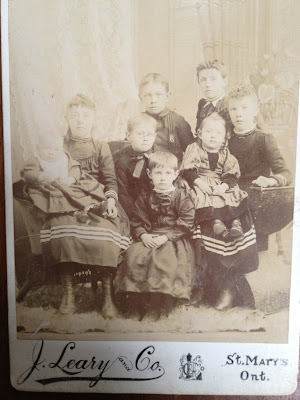 This Cabinet Card photo is faded but still adorable. Eight young children in their Sunday best in St. Mary's Perth County Ontario.
The photography studio, J. Leary and Co., was in operation in St. Marys between 1891 and 1896. This helps date this photograph and aids in identifying the family.
I believe these are the following children of George Squires and Louisa Augusta Gunning:
Ettie born 1879
Bertha Louise born 1879
Ida Maud born 1882
Harry Russell born 1884
Lottie May born 1887
Francis Chester born 1889
Verda Pearl born 1891
Edgar Victor born 1892
If I am correct this photo was taken circa 1892-1893.

The photography studio, J. Leary and Co., was in operation in St. Marys between 1891 and 1896. This helps date this photograph and aids in identifying the family.
I believe these are the following children of George Squires and Louisa Augusta Gunning:
Ettie born 1879
Bertha Louise born 1879
Ida Maud born 1882
Harry Russell born 1884
Lottie May born 1887
Francis Chester born 1889
Verda Pearl born 1891
Edgar Victor born 1892
If I am correct this photo was taken circa 1892-1893.
November 14, 2012
Genealogy Treasure No. 14: Deed of Land 1922 Card-Hartman-Denison-Foster
This is the 14th set of documents in the batch I purchased at an
antique store in Kingston Ontario July 27, 2012. For details, see Found! Treasure Trove of Land Documents from Ontario Canada
 This is a Deed of Land dated 14 September 1922 in Napanee.
It is signed Archie Denison but the parties involved are George A. Hartman and his wife Edith Victoria to Henry Forguson Card, Agent.
A payment of $1.00 is given for a half interest in Lots 1 and 2 on the North side of Dundas St.
The document states that the land is described in detail in a deed from Mary Adney Foster to George Albert Hartman and Henry Forguson Card dated 8 March 1920.
 More documents will follow as I scan them and extract their details. To
view all documents as they are published on Olive Tree Genealogy blog,
click on Lennox-Addington Collection in the tags at the end of this
post.
More documents will follow as I scan them and extract their details. To
view all documents as they are published on Olive Tree Genealogy blog,
click on Lennox-Addington Collection in the tags at the end of this
post.
If you are a descendant and would like to see these records, they are now with Lennox and Addington County Museum and Archives,
97 Thomas Street East,
Napanee, Ontario
K7R 4B9

It is signed Archie Denison but the parties involved are George A. Hartman and his wife Edith Victoria to Henry Forguson Card, Agent.
A payment of $1.00 is given for a half interest in Lots 1 and 2 on the North side of Dundas St.
The document states that the land is described in detail in a deed from Mary Adney Foster to George Albert Hartman and Henry Forguson Card dated 8 March 1920.

If you are a descendant and would like to see these records, they are now with Lennox and Addington County Museum and Archives,
97 Thomas Street East,
Napanee, Ontario
K7R 4B9
November 13, 2012
Genealogy Treasure No. 13: Farm Lease 1923 McKittrick-Dennison
This is the 13th set of documents in the batch I purchased at an
antique store in Kingston Ontario July 27, 2012. For details, see Found! Treasure Trove of Land Documents from Ontario Canada
 This is two documents. One is a Farm Lease. The second is an Indenture. Both are dated 1 May 1923 for Lot 17, Concession 6, Richmond Township, Lennox & Addington Co. Ontario
It is leasing the property from 1 May 1923 to 15 March 1924 for $100.00
Details: Matilda McKittrick, widow, Richmond Township to Archie Dennison, Richmond Township, farmer.
Land: North 49 Acres Lot 17 Concession 6, Richmond Township.
The lease is for a dwelling house, hen house and pig pen, also stabling of one horse and a small spot for a garden.
 Lorine's Research:
Matilda McKittrick was the wife of James McKittrick. He was the son of Rebecca. Rebecca's first husband was William Parks. See his 1849 will.
More documents will follow as I scan them and extract their details. To view all documents as they are published on Olive Tree Genealogy blog, click on Lennox-Addington Collection in the tags at the end of this post.

If you are a descendant and would like to see these records, they are now with Lennox and Addington County Museum and Archives,
97 Thomas Street East,
Napanee, Ontario
K7R 4B9

It is leasing the property from 1 May 1923 to 15 March 1924 for $100.00
Details: Matilda McKittrick, widow, Richmond Township to Archie Dennison, Richmond Township, farmer.
Land: North 49 Acres Lot 17 Concession 6, Richmond Township.
The lease is for a dwelling house, hen house and pig pen, also stabling of one horse and a small spot for a garden.
 Lorine's Research:
Matilda McKittrick was the wife of James McKittrick. He was the son of Rebecca. Rebecca's first husband was William Parks. See his 1849 will.
More documents will follow as I scan them and extract their details. To view all documents as they are published on Olive Tree Genealogy blog, click on Lennox-Addington Collection in the tags at the end of this post.

If you are a descendant and would like to see these records, they are now with Lennox and Addington County Museum and Archives,
97 Thomas Street East,
Napanee, Ontario
K7R 4B9
October 27, 2012
Genealogy Treasure No. 12: Receipt 1910 Dennison - McQuaig
This is the 12th set of documents in the batch I purchased at an
antique store in Kingston Ontario July 27, 2012. For details, see Found! Treasure Trove of Land Documents from Ontario Canada
 This document is a scrap of paper containing a hand-written note signed by Angus McQuaig.
It is dated 26 February 1910 and is a receipt for money ($120.00) received from Archibald Denison.
The scrap of paper states the payment is being applied to a note and includes interest of $20.00
More documents will follow as I scan them and extract their details. More documents will follow as I scan them and extract their details.
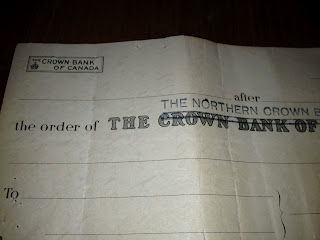 This is the reverse of the receipt above. I thought it was interesting to see that the receipt was written on the back of a cheque from the Crown Bank of Canada. This was then stamped above as The Northern Crown Bank of Canada.
The Northern Crown Bank was the offspring of the 1908 merger of Winnipeg's Northern Bank and the Ontario-based Crown Bank of Canada. The Royal Bank purchased the Northern Crown Bank in 1918.
To read details of documents I've published here on Olive Tree Genealogy blog, see Lennox-Addington Collection in the right hand navbar.
If you are a descendant and would like to see these records, they are now with Lennox and Addington County Museum and Archives,
97 Thomas Street East,
Napanee, Ontario
K7R 4B9

It is dated 26 February 1910 and is a receipt for money ($120.00) received from Archibald Denison.
The scrap of paper states the payment is being applied to a note and includes interest of $20.00
More documents will follow as I scan them and extract their details. More documents will follow as I scan them and extract their details.

The Northern Crown Bank was the offspring of the 1908 merger of Winnipeg's Northern Bank and the Ontario-based Crown Bank of Canada. The Royal Bank purchased the Northern Crown Bank in 1918.
To read details of documents I've published here on Olive Tree Genealogy blog, see Lennox-Addington Collection in the right hand navbar.
If you are a descendant and would like to see these records, they are now with Lennox and Addington County Museum and Archives,
97 Thomas Street East,
Napanee, Ontario
K7R 4B9
October 8, 2012
Genealogy Treasure No. 11: Mortgage 1908 Dennison-Jemmett
This is the 11th set of documents in the batch I purchased at an
antique store in Kingston Ontario July 27, 2012. For details, see Found! Treasure Trove of Land Documents from Ontario Canada
 This document is a Mortgage dated 25 February 1908 for $2000.00
Parties are Archibald Dennison & Gertrude Elizabeth his wife to Rebecca G. Jemmett, widow.
The land is noted as the East 75 Acres of Lot 16 Concession 6 in Richmond Township, Lennox & Addington Co Ontario and now owned by Archibald Dennison.
 Witness to the signing is Gertrude M. Anderson, Book-keeper
More documents will follow as I scan them and extract their details. To read details of documents I've published here on Olive Tree Genealogy blog, see Lennox-Addington Collection in the right hand navbar.

If you are a descendant and would like to see these records, they are now with Lennox and Addington County Museum and Archives,
97 Thomas Street East,
Napanee, Ontario
K7R 4B9

Parties are Archibald Dennison & Gertrude Elizabeth his wife to Rebecca G. Jemmett, widow.
The land is noted as the East 75 Acres of Lot 16 Concession 6 in Richmond Township, Lennox & Addington Co Ontario and now owned by Archibald Dennison.

More documents will follow as I scan them and extract their details. To read details of documents I've published here on Olive Tree Genealogy blog, see Lennox-Addington Collection in the right hand navbar.

If you are a descendant and would like to see these records, they are now with Lennox and Addington County Museum and Archives,
97 Thomas Street East,
Napanee, Ontario
K7R 4B9
October 3, 2012
Genealogy Treasure No. 10: Land Deed 1905 Hall-Davis
This is the 10th set of documents in the batch I purchased at an
antique store in Kingston Ontario July 27, 2012. For details, see Found! Treasure Trove of Land Documents from Ontario Canada
 This document is a Deed of Land dated 9 March 1905. It is from Frederick H. Hall et ux (and wife) to Alexander Dais, farmer, single man.
The witness is Viva May Lane, Stenographer
The land is the East 75 acres of Lot 16, Concession 6, Richmond Township, Lennox & Addington Co. Ontario
Price is $2600.00

More documents will follow as I scan them and extract their details. To read details of documents I've published here on Olive Tree Genealogy blog, see Lennox-Addington Collection in the right hand navbar.
If you are a descendant and would like to see these records, they are now with Lennox and Addington County Museum and Archives,
97 Thomas Street East,
Napanee, Ontario
K7R 4B9

The witness is Viva May Lane, Stenographer
The land is the East 75 acres of Lot 16, Concession 6, Richmond Township, Lennox & Addington Co. Ontario
Price is $2600.00

More documents will follow as I scan them and extract their details. To read details of documents I've published here on Olive Tree Genealogy blog, see Lennox-Addington Collection in the right hand navbar.
If you are a descendant and would like to see these records, they are now with Lennox and Addington County Museum and Archives,
97 Thomas Street East,
Napanee, Ontario
K7R 4B9
Subscribe to:
Posts (Atom)