Discover your inside story with AncestryDNA®
Showing posts with label Mohawk. Show all posts

August 19, 2018

Avaialble now! 3rd edition of New Netherland Settlers Van Slyke Family: Cornelis Antonissen Van Slyke 1604-1676 & his French-Mohawk Wife Ots-Toch

30+ years of research pulled together. The 3rd Edition of my Van Slyke book. "New Netherland Settlers Van Slyke Family: Cornelis Antonissen Van Slyke 1604-1676 & his French-Mohawk Wife Ots-Toch" with 366 pages, and over 1200 footnotes is now available on Amazon
 
In 1634 the Dutchman Cornelis Antonissen Van Slyke set out on a perilous journey to New Netherland (present day New York). He was a thirty year old carpenter and mason whose skills were desirable in the new colony. Little did he know that a lifetime of adventure and hardship awaited him. Within a few years after his arrival in the New World he would meet a French-Mohawk woman named Ots-Toch.

Together they carved out a life in the wilderness, raising three children who became valued interpreters for the Dutch, British, and Iroquois. This is the story of Cornelis and Ots-Toch, and of Ots-Toch’s father Jacques Hertel, interpreter in New France (present day Quebec) to Samuel de Champlain, the Father of Canada. This book also follows the descendants of Cornelis and Ots-Toch to 5 generations.

September 8, 2017

Two Van Slyke Books for Van Slyke Descendants

Another new book! If you are tracing your Van Slyke ancestors you might want to check out my TWO books on the family.

Cornelis Antonissen Van Slyke & Ots-Toch

The Van Slyke Family in America: A Genealogy of Cornelise Antonissen Van Slyke, 1604-1676 and his Mohawk Wife Ots-Toch, including the story of Jacques Hertel, 1603-1651, Father of Ots-Toch and Interpreter to Samuel de Champlain REVISED EDITION The Van Slyke Family in America: A Genealogy of Cornelise Antonissen Van Slyke, 1604-1676 and his Mohawk Wife Ots-Toch, including the story of Jacques Hertel, 1603-1651, Father of Ots-Toch and Interpreter to Samuel de Champlain REVISED EDITION Coil bound 8.5x11. 287 p. Download an Order Form to pay by check or pay using Paypal


and secondly ---

Cornelis' nephew Willem Pieterse Van Slyke

New Netherland Settlers: Willem Pieterse Van Slyke aka Willem Neef: A genealogy to 5 generations of the descendants of Willem Pieterse Van Slyke (Volume 10) Available from CreateSpace and on Amazon.com or Amazon.ca 180 pages

February 2, 2015

The Ryckman Family - Harmen Janse Ryckman of New Netherland New York

Harmen Janse Ryckman (my 9th great grandfather) came to the New World with at least one child - his daughter Margarita (Grietje) Harmense Ryckman. By 1662 Grietje had married Jacques Cornelise Van Slyke, the son of Cornelis Antonissen Van Slyke and his Mohawk wife, Ots-Toch. Jacques and Grietje settled in the new village of Schenectady. Grietje's father lived in Albany as early as 1666 and there he died circa 1677

Official Seal of New Netherland
Harmen was living near Albany in 1667 as per a court record which states

"....in his [Robert Sanders] house and lot standing here and lying here in Albany, adjoining to the south and east the street, to the north Harmen Janse Ryckman, and to the west Volkie Jurriaense, widow of the late Jan Van Hoesen...'
[Source: Early Records of the City and Colony of Albany and Colony of Rensellaerswyck, 1656-1675, translated by Jonathan Pearson. Vol. 1:410]

Harmen's brother, Jan Janse Ryckman, married Tryntie Janse and settled in Beverwyck. By 1663 Jan was dead, his widow remarried to Eldert Gerbertse Cruyff. They had one son living in 1663 - Albert Janse Ryckman, married to Neeltie Quackenbos. From this line came many of the Ontario Rykman families.

Continue reading about the Ryckman family at http://www.olivetreegenealogy.com/nn/surnames/ryckman.shtml

July 11, 2014

52 Ancestors: Cornelis Van Slyke 17th Century Adventurer


52 Ancestors: Cornelis Van Slyke 17th Century Adventurer
In the early 1630s, a Dutchman named Van Rensselaer began to advertise for people to colonize his New World venture. Van Rensselaer envisioned the Patroon system of ownership with the landowner a feudal lord over his tenants. A tenant would be required to contract himself to the Patroon for a specified time, after which he could become an independent settler.

The colony of Rensselaerswyck was thus formed. By 1634, there were only twenty-six settlers living there. Rensselaerswyck lay in a wilderness surrounded by Mahicans on the east and Mohawks on the west.

My ancestor Cornelis Antonissen Van Slijk [sic] from Brueckelen,  Netherlands, left the Netherlands in May 1634 from the Texel on board De Endracht and sailed to the New World.  He was a thirty year old carpenter and mason, and his skills were desirable in a new colony.

During his lifetime in what was to become the state of New York, Cornelis met and married a Mohawk woman, had several children with his Mohawk wife (all of whom became valued interpreters between the Mohawk and the Dutch), and rose to a position of importance in the colony.

Cornelis Starts as a Farmer

Cornelis Van Slyke contracted to Kilean van Rensselaer as a carpenter and mason, but agreed to do farm work when necessary, for the fee of 180 florins a year. In the contract he signed on April 5, 1634 he stated he was 30 years of age.  Farmhands received 100 to 150 gl. per year so we can see that Cornelis' skills were highly valued. But what did that 180 florins per year buy, remembering that one florin equalled one guilder? In 1639 a mare was sold for 200 gl., a shirt for 3 gl., a pair of farmer's shoes for 4 gl. and a pound of butter or pork 6 stuivers, with 20 stuivers equal to one guilder.

Cornelis Gains Favour in the Colony

Between 1643 and 1648 Cornelis spent much of his time at Manhattan, as interpreter and negotiator with the natives. His absence did not always sit well with the authorities, and the Secretary of  Rensselaerswyck, Antony de Hooges, wrote to him in 1646 urging him to             "...come up the river to see how the harvest proceeds" and hinted that he might at least come to the Colony once a year to look after his farm.

Van Rensselaer was not happy with Cornelis by this time, and complained about his personal accounts and his service as representative, threatening to end their association if matters did not improve.

Cornelis as Interpreter and Representative

In September 1650 tensions increased with the natives and rumours of an impending attack on Fort Orange by the Mohawks were rampant. The settlers at Rensselaerswyck were anxious so they decided to send five trusted representatives into Mohawk country to renew old friendships and ensure peace.

On 23 September, 1650 Cornelis was one of those chosen to act as an ambassador to the Mohawks. He went on this important mission into what was called Maquas country. The mission was successful and the colony could relax.

Cornelis Marries a Mohawk Woman
 
By this date, Cornelis had already formed his liaison with Ots-Toch, a Mohawk woman, which produced at least four but possibly five children: Jacques, Marten, Hilletie and Lea, and  Cornelis.  Jacques and Hilletie occupied a very strategic position among the Dutch, English and Iroquois and became trusted interpreters for the state of New York.

By all accounts Cornelis was a much respected and trusted man. He would never have dreamed that his life could take such a turn from a simple carpenter in Holland to marrying a Mohawk woman  and becoming a fairly important man in the new colony.

Credit: This blog post was extracted from my book The Van Slyke Family in America: A Genealogy of Cornelise Antonissen Van Slyke, 1604-1676 and his Mohawk Wife Ots-Toch, including the story of Jacques Hertel, 1603-1651,Father of Ots-Toch and Interpreter to Samuel de Champlain REVISED EDITION published May 2010. Coil bound 8.5x11. 287 pages by Lorine McGinnis Schulze.

If you are a descendant and wish to purchase this book, Download an Order Form to pay by check or pay using Paypal

April 19, 2014

52 Ancestors: Ots-Toch, the Mohawk Wife of Cornelis Van Slyke

I'm writing about my Mohawk ancestor Ots-Toch as part of Amy Crow's Challenge: 52 Ancestors in 52 Weeks . Ots-Toch was my 9th great-grandmother and I've written about her in my book on the Van Slyke family of New Netherland (New York).

After researching her extensively, I was able to obtain my Metis status in Ontario. Luckily she is written about in contemporary records and thus proving my Native American heritage was possible.

In 2009 I submitted DNA kits to different companies for both myself, my brother and my son. Our Native American ancestry was confirmed through DNA which was like icing on the cake.

My book The Van Slyke Family in America: A Genealogy of Cornelise Antonissen Van Slyke, 1604-1676 and his Mohawk Wife Ots-Toch, including the story of Jacques Hertel, 1603-1651, Father of Ots-Toch and Interpreter to Samuel de Champlain REVISED EDITION was published May 2010 and is out of print.

However a 3rd edition is now available. It contains 30+ years of research.  "New Netherland Settlers Van Slyke Family: Cornelis Antonissen Van Slyke 1604-1676 & his French-Mohawk Wife Ots-Toch" 366 pages, over 1200 footnotes available on Amazon

Caveat: In the theories of Ots-Toch's heritage, please take the use of the word "princess" with a grain of salt. It was common for 19th century writings to romanticize Native American women in particular, assigning daughter of a chief status to them.

There are two prevalent theories of Ots-Toch's heritage,
one that she was a full-blooded Mohawk of the Turtle Clan, the daughter of a Mohawk chief or Sachem. [FN 1] The second theory is that Ots-Toch was the daughter of a French man Jacques Hertel and a full-blooded Mohawk Princess.

Ots-Toch was in fact fathered by Jacques Hertel, a French interpretor to Samuel de Champlain. It is not known who her Mohawk mother was.

There were many original records pertaining to Ots-Toch. As an example here is one given in my book as found in land records of 1713 for Harmen Van Slyke, grandson of Ots-Toch.

Harmen was a Captain in a Schenectady Company in 1714 and an Indian trader in 1724. He received a grant of 300 morgens of land at Canajoharie NY from the Mohawks because

     "his grandmother was a right Mohawk woman" and "his father born with us at Canajoharie".

His father was Jacques Cornelise, son of Ots-Toch, the half French, half Mohawk woman who married Cornelis Antonissen Van Slyke.

The deed was conveyed 12 Jan. 1713 and consisting of 2000 acres, stated:

    "in consideration of ye love, good will and affection which we do bear toward our loving cozen and friend Capt. Harmon Van Slyke of Schenectady, aforesaid, whose grandmother was a right Mohawk squaw and his father born with us in the above said Kanajoree [Canajoharie].......it being his the said Harmen Van Slyke's by right of inheritance from his father"

 Little is known of the wife of Cornelis Van Slyke although she was written of by the Dutch minister Jasper Dankaerts when he visited Schenectady and spoke with her son Jacques and daughter Hilletie.

Her name, Ots-Toch, is clouded in controversy, with some writing it as Alstock. One word in the Mohawk language which may provide a clue to her name is "Otsihsto" meaning "the stars". "Otsihsto" is pronounced so that the sound is similar to "Asistock". It must be remembered that her name was recorded phonetically from verbal accounts and it is possible that Otsihsto is the correct interpretation of Ots-Toch's name. 

    It is important that descendants understand that in my book I have chosen to use the name Ots-Toch as that has come down through history. Included in the book is my chapter discussing the loss of her through time and why I chose to use the name Ots-Toch to represent her.

    The use of the word "Princess" would imply that Ots-Toch's mother was the daughter of the Sachem or chief of her tribe but I have found NO evidence to support this romantic version of her parentage.

    According to Nelson Greene and other sources, Ots-Toch was "wild and savage like her mother". Ouida Blanthorn, in her genealogy of Cornelis Van Slyck and his descendants written 1973, states that Ots-Toch was a "half-French, half-Indian maiden of compelling grace and beauty, whose mother was a Mohawk princess [sic] and whose father, Jacques Hartell [sic] was a French trader."

Note: Greene and Blanthorn are not contemporary sources and as such must be treated cautiously as primary sources are sought to verify or disprove these statements.

April 11, 2014

52 Ancestors: It's All in the Name

52 Ancestors: It's All in the Name
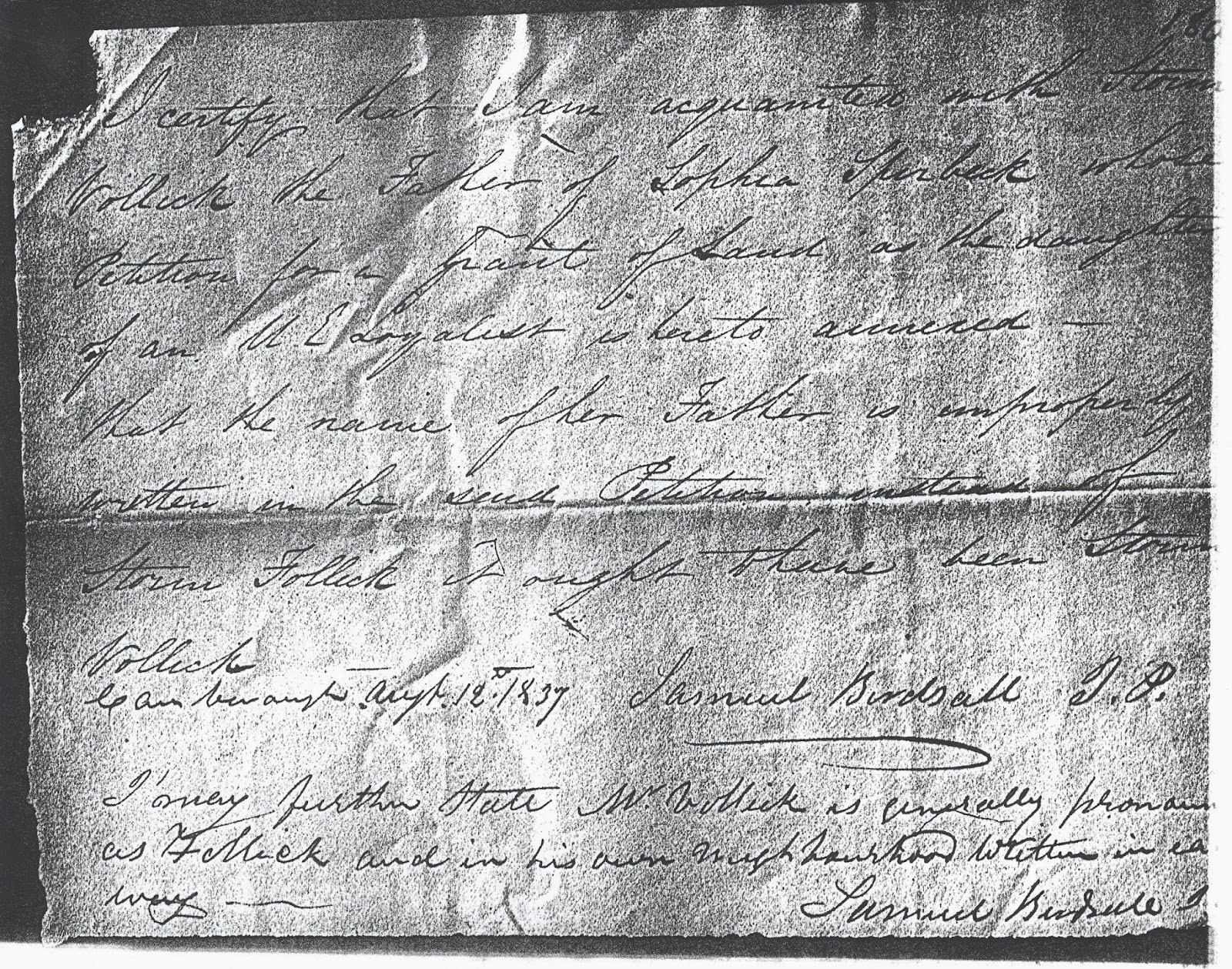
1837 document from Storm starting he is known as
both Vollick and Follick in his neighbourhood
My 5th great-grandfather Isaac Vollick, born 1732 in Schoharie, New York, was a United Empire Loyalist who came to Upper Canada from the United States during the American Revolution. He was the illegitimate son and only child of Isaac VanValkenburg and Maria Bradt.

It is through Isaac the Loyalist that Follick and Vollick descendants claim their Mohawk heritage. Isaac's great-great-grandmother was Ots-Toch a half French, half Mohawk woman who married Cornelis Van Slyke a Dutchman who settled in Albany New York in 1627

Although no record of a marriage has been found for Isaac and Maria, their son Isaac used his father's surname until 1782. During his years as a private in Butler's Rangers, Isaac's surname changed from Van Valkenburg, meaning in Dutch, 'from the castle of the falcons' (van=from; valken=falcons; burgh=castle), to Valk or Valck which means 'falcon'. It appears that Valk was his nickname and on being recorded by English clerks, a vowel was inserted between the final 'l' and 'k' making the surname Valic or Volick. Over the years, the surname was written as Vollick, Volic, Valic, Valck, Valk, Volk and Follick (the German/Dutch accent making a 'v' sound like 'f' to English ears).

My line, descended from his son Cornelius, took the Vollick surname. His son Storm used the Follick surname. In the next generation some Follick descendants used Vollick while some Vollick descendants used Follick.  It makes it interesting trying to research all branches of this family!

August 26, 2013

Which Ancestor Would You Like to Walk Back Into Your Life?

Which Ancestor Would You Like to Walk Back Into Your Life?
Joseph McGinnis' brother Hugh McGinnis
This morning one of my Facebook friends, Midge Frazel of Granite in My Blood blog, was talking about a book and one of her comments was:  "Think about which ancestor [edited] that you would like to walk back into your life."

What an interesting thought! Which ancestor would I like to walk back into my life....

I was torn between three ancestors - Ots-Toch, my Mohawk ancestor born ca 1634 in New York, Joseph McGinnis my Irish great-great grandfather, and my 4th great-grandpa Jacob Peer whose origins and whereabouts before 1786 in New Jersey are a mystery.  

One thought that came to me was - would I even like my ancestor when I met him or her? I suspect Ots-Toch would be a little rough around the edges for me, and she might not want to talk or share her stories. It's kind of odd to really think about your ancestors because I suspect we all naively expect that they'd be refined and gracious and lovely people and we'd adore them. But I think the reality is that it's just as likely they could be uncouth, unpleasant and perhaps not up to our standards of personal cleanliness! 

Ignoring those extraneous thoughts, I'm going to ask Joseph McGinnis to come pay me a visit. Because my father inspired me to start searching, because he wanted to know about his Irish ancestry so badly, and because he died when I was just barely 14 years old, I am choosing Joseph. Joseph was my dad's great grandfather and I dont' know much more about him than I did 30 years ago. 

I don't have a photo of Joseph but the photo on this post is of his brother Hugh. All I know of Joseph is that he was born in Co. Down Ireland, probably near Belfast and that he married Frances (Fanny) Downey ca 1845 and had a daughter Bridget (aka Delia) born 1846 in Co. Down. Shortly after Bridget's birth he brought his family to Ontario Canada and settled in Puslinch Township near Guelph Ontario. I do not know for sure who his parents were. So Joseph please do drop by for a chat. I'll even offer you a drop of good Irish whiskey!  

I want to hear about the place where you grew up, about your voyage from Ireland during the Famine years to the wilds of Canada and how you coped once you were here. I hope you have a few hours to spend because I want to listen to your Irish lilt and hear you talk about Ireland.  


March 3, 2013

What Would You Do With a Genealogy Time Machine?

Wouldn't you love it if Time Machines were available? I think all genealogists, archaeologists and historians would. So let's pretend we are being given the opportunity to use one.

Here are the rules of the Time Machine:

1. You can travel to any year you wish

2. You can travel to any geographic location you wish

3. You only have the time machine for 24 hours

4. You will be invisible to those you encounter so it will be challenging or impossible to interact with them

5. Be cautious about bringing back mementos. Any action you take may affect the present timeline. As an example you decide to grab that precious family bible and bring it back to the future. But the loss of the bible creates a huge fight in the family and one of the sons (your direct ancestor) storms out and never returns home. He does not marry the girl next door (your ancestor) and thus his future changes. So when you return to your present time, nothing is as you left it. 

So - what are you going to do with your Time Machine?

I had so much trouble deciding what to do and where to go. There are three ancestors I desperately want to visit but doubt I have time to see them all in 24 hours. 

McGinnis Family Guelph 1849

My first thought was to hop out Guelph way to 1847 which is when my Irish ancestor Joseph McGinnis arrived from Ireland. But then I realized that without knowing his exact date of arrival the chances were good that I'd get there before he did! And even if he were there with his wife Fanny and toddler Delia, what are the odds he'd be sitting around reminiscing about the good ole days in Ireland?? Because what I want to find out from him is the name of his parents, or siblings and maybe even the town in Ireland he came from. 

Then I had another thought - he and Fanny baptised my great-grandfather Alex in the Church of Our Lady in Guelph in 1849. There must have been a party, a celebration of some kind. I wouldn't be surprised if family members went to the church to witness such an occasion. Decision made, my first stop is going to be that christening in the church. Maybe I'll even follow the family back to their log cabin in Puslinch after the ceremony. I bet there's a gathering at their home and hopefully he'll greet someone with "Good to see ya Uncle xxx!" 

Even if attending the party as an invisible guest doesn't yield any further information, I'm going to try to take some photos with my digital camera. Wow wouldn't that be cool? At the very least I'll get to see what my 2nd great grandparents look like. 

Once I decided on that course of action my mind began whirling, and I started second guessing myself. Maybe I should make my first stop a wedding of an ancestor. After all, weddings bring dozens of family members together! I could run around taking pictures but I might not figure out who everyone is. 

So my first stop is definitely my great-grandpa's christening in 1849. 

My Mohawk Ancestor 1640s or Jacob Peer 1790s?

Then I have to choose between trying to find out  more about Ots-Toch, my Mohawk ancestor born ca 1620 in what is now New York state, or Jacob Peer, who cannot be found before 1793 in New Jersey. I'd sure love to know who his parents were! Or his wife Anna's maiden name. 

Decision made - I doubt I'll learn anything more genealogically about Ots-Toch although it would be fascinating to see how she lived before and after her marriage to the Dutchman Cornelis Van Slyke. So I'm going to hop down to New Jersey to September 1793, specifically to NewTown, Sussex County where I know Jacob Peer and his older sons were being taxed. My goal for this part of my time machine travel is to look for a family bible. It's a long shot but Jacob and most of his sons left wills and that makes me think they might be the kind of ancestors who also kept a family bible with births, marriages and deaths in it.

At least I'd get to see their faces and hang around for a few hours to see how they lived. But once again I'm torn in my decision-making! I do know the exact date and location one of Jacob's sons was married. Would it be wiser for me to attend that wedding to see if any of the guests are family members? I think that's a bit of a gamble because maybe there were no relatives living nearby (other than siblings I already know about) or maybe the couple ran off and married quietly that day with no family in attendance. 

Photos

And then just as I was about to end this blog post, I had another thought - what if I took my digital camera and simply hopped from place to place, from year to year - popping in and taking photos like crazy of each of my ancestors. I'd build quite a collection in 24 hours! And it would be so amazing to be able to see so many of those lost faces. I could run around New Amsterdam (now New York City) snapping photos of all my Dutch ancestors who settled there in the 17th Century. I could go on to various parts of Ontario Canada where many of my father's ancestors settled. It would be kind of like speed dating which I've never participated in but I've read about it) except I'd be speed ancestor hunting. 

Having a Time Machine at my disposal might not be quite so much fun as I originally thought! I'd have to do a lot of planning - figure out where ancestors were (exact locations) on precise days and years. And that takes me back to choosing weddings, funerals and baptisms as my best bet for finding certain ancestors and family members. So that's my choice. I'm going to time travel to as many celebrations where my ancestors were involved, and take as many photos as possible while eavesdropping to try to hear names of other family - parents, aunts, uncles, grandparents and so on.

It was fun writing this and letting my imagination go wild, but I'm curious to hear what you would do with a Time Machine!


Credits: 
Log Cabin drawing by Brian Massey of AncestorsAtRest 
Time Machine image by Salvatore Vuono, on FreeDigitalNet


January 9, 2013

New Court Ruling for Metis in Canada Shows Importance of Genealogy

A landmark victory for non-reserve aboriginals in Canada has just taken place.

The Federal Court has ruled Métis and non-status Indians are indeed “Indians”  FN under a section of the Constitution Act, and fall under federal jurisdiction.

This is important because in Canada status Indians receive many benefits including free health care (dental and medical), education benefits, no tax on purchased goods and no income tax. Metis and non-status Indians do not receive these benefits.

Metis and non-status Indians have been fighting the government for years for access to the same health, education and other benefits Ottawa gives status Indians. This means they could also hunt, trap, fish and gather on public land.

So why does this make Genealogy important? I'm a Metis. I applied for and received my Metis status card many years ago. Without genealogy I would never have known I had native heritage. My native ancestor was a Mohawk woman named Ots-Toch who married a Dutchman named Cornelis Van Slyke.  I would never have discovered this without pursuing my family tree. It was not common knowledge in our family.

This new ruling could have a huge positive financial impact for me, my children and grandchildren. And we have genealogy to thank for me applying for and being granted my Metis status.

You can read more about this decision here. 

FN Please note that I am using the word "Indian" here as that is the term with legal meaning in the Indian Act of Canada


July 30, 2009

A Family Abandoned in the Wildnerness

Carnival of Genealogy, 77th Edition is about Disasters. The prompt states "For the next Carnival of Genealogy, tell about a disaster that one or more of your ancestors lived through: Did they survive a hurricane, flood, tornado, train wreck, sinking ship, plague, genocide, explosion, mine collapse, or some other terrible event? How did they survive?"

Anna Maria (Mary) Warner, my 5th great grandmother, was baptised in 1735 in Schoharie New York. She was descended from Palatines who fled starvation and religious persecution in Germany for New York in 1710. In 1757 at the age of 22 she married Isaac Van Valkenburg, descendant of Dutch settlers to New Netherland (and a Mohawk great great grandmother named Lydia Van Slyke)

When the American Revolution broke out in 1775, Mary and her husband remained loyal to the King even though Isaac’s father was a Patriot,

Isaac was imprisoned in Albany three times by the Americans for his loyalty to the British King. After his release in 1777, Isaac joined the Loyalist unit Butler's Rangers and fled to Canada. Mary was left with ten children ages 2 to 18 years.

Mary continued to aid the British, and in 1779 she and the children were taken from their home at North River, New York, by American patriots. Their home and all their clothing and belongings were burned by the patriots. The patriots then forced Mary and eight of her children (two of her sons ages 14 and 18 had already joined their father in Butler’s Rangers) to march 80 miles north through the forest. There they were abandoned by the Patriots and left to die. Mary’s youngest child was only 4 years old.

An excerpt from one of the affidavits presented to the Council when Isaac petitioned for his land grant in 1797 briefly describes Isaac's imprisonment and Anna Maria's ordeal.

Luckily friendly Indians found the family and took them to Montreal where they joined Isaac and the other Loyalist families who had made it to safety. In Montreal, the starving Loyalists were given food, blankets and minimal clothing. The British government had not made provisions for so many Loyalists’ families arriving with nothing but the clothes on their backs. For 5 difficult years the Loyalists and their families were quartered at a small barracks and given a meager allowance of food rations, blankets and clothing by the Government.

But the family survived, and Mary with Isaac and 9 of their children agreed to join other Rangers and families who were promised land in the Niagara area of Ontario. In April 1784 the family arrived at Niagara, where they would make their home. Rations were still dispensed to the settlers as after 5 years of living with nothing to call their own, they still had no land, and no homes. Again they were quartered in barrack style living and so they began to build their own shelters on land that was not theirs.

A descendant of one of the refugee families states that the family dinner-table was a huge stump, hewn flat on top, standing in the middle of the floor. When their clothing wore out, the settlers made new garments from deerskin.

They also had yet to endure (and survive!) what became known as “The Hungry Year” in 1787 In that year the government stopped giving out food rations. But there was a drought, then a freezing winter, and no grain crop or supplies. Many families had neither guns nor powder to shoot what game was near. Many starved that winter in Upper Canada (Ontario). The Loyalists and their families were reduce to eating leaves and drinking water which had been boiled with a bit of bark in it. Mary’s oldest son soon gave up and returned to New York where he married and raised his family.

And yet Mary and her husband and children survived. They suffered one trial after another – the free land promised had not been forthcoming and had to be petitioned for. That meant writing out lengthy pleas stating the reasons why they felt they were qualified to receive the land. Statements and affidavits had to be gathered from those who had known them back in New York (or wherever they once lived)

Loyalists and their families had to present their petitions for free land to the Council where they were read and then a decision made. Even if a Loyalist received his grant of land it was not likely to be the land where he had begun building his new home. Families were often separated and older men who had counted on their young sons being next door to help them clear the land and farm it, were suddenly on their own. Their sons might be hundreds of miles away.

Life had been a struggle for Mary and her family from 1775 until 1797 when she and Isaac were finally granted their 500 acres near what is now St. Catharines Ontario. 22 years of hardship, danger and starvation – far from home and with family left behind. How many of us could (or would!) endure that for the sake of remaining loyal to a distant ruler? I admire Mary and Isaac and all the Loyalist families tremendously for their courage, their spirit and their refusal to commit what was in their minds, an absolute betrayal to King and country.

September 4, 2008

Rensselaerswijck Seminar of New Netherland Institute

NEW NETHERLAND NEWS CONTACT: Nancy Curran tel. 393-5905

nancycurran@prodigy.net

Trustee, New Netherland Institute

RENSSELAERSWIJCK SEMINAR SEPTEMBER 13

ABOUT THE FRENCH AND THE DUTCH IN THE NEW WORLD

31ST Annual Rensselaerswijck Seminar of New Netherland Institute Saturday, Sept. 13, 2008, New York State Museum, Empire State Plaza, Albany Registration 9:30 a.m. Reception and dinner 5 p.m. Pre-registration: $50, $30 for students. Registration at the door $60.

Theme: “Neighbors in the New World: New Netherland and New France” Register on line at http://www.nnp.org

For more information, call (518) 486-4815

Speakers and topics:

José António Brandão of Western Michigan University, Kalamazoo, Mich.: “An Unreasonable Offer: Iroquois Policy towards their Huron and Mahican Neighbors”

James Bradley of ArchLink, Boston:“In Between Worlds: New Netherland and New France at Mid Century”

Conrad Heidenreich on York University, Ontario, Canada:“The Skirmish with the Mohawk on Lake Champlain”

Willen Frijhoff of the Free University of Amsterdam, the Netherlands:“Jesuits, Calvinists and Natives: Attitudes, Agency, and Encounters in the Early Christian Missions to the North”