Discover your inside story with AncestryDNA®
Showing posts with label Ancestor Photos. Show all posts

April 22, 2021

Identifying Ancestor Photographs: Ambrotypes

Ambrotype of the Treadway cousins

Genealogists often have old family photos in their possession or they find some in Great Aunt Matilda's attic. But how do we know when the photograph was taken? One method is to determine what type of photograph it is. 

Photography arrived in the United States in 1839 thanks to Samuel F. B. Morse, an American artist and inventor.The earliest type is the Daguerreotype. Ambrotypes followed, coming into use circa 1854.

Ambrotypes (circa 1854)

The ambrotype was a glass negative backed with black material, which enabled it to appear as a positive image. Patented in 1854, the ambrotype was made, packaged, and sold in portrait studios as the daguerreotype had been, but at a lower cost. The ambrotype produced a single image on glass.

From My Collection of Ambrotypes 


1861 Ambrotype


1858 Ambrotype


Another Civil War era ambrotype of a young woman in day dress with a typical snood and ringlets.  

Don't Be Confused 

Ambrotypes are often confused with daguerreotypes as they are similar in size and usually cased. If the image "disappears" when you move the photo around, it is a daguerreotype, not an ambrotype. Unlike daguerreotypes, which can appear as a positive, negative or reflective (mirror) image, ambrotypes are always a positive image no matter how they are held. 

Learn More

Watch my video Five Types of Early 19th Century Photographs

Read more about ambrotypes on Lost Faces website

April 18, 2021

Identifying Ancestor Photos: Tintypes

Genealogists often have old family photos in their possession or they find some in Great Aunt Matilda's attic. But how do we know when the photograph was taken? One method is to determine what type of photograph it is. 

Photography arrived in the United States in 1839 thanks to Samuel F. B. Morse, an American artist and inventor.The earliest type is the Daguerreotype. Ambrotypes followed, coming into use circa 1854. By 1855 Tinytypes had begun to replace Ambrotypes

Tintypes (circa 1855)

The Ferrotype process (tintypes) was introduced in the United States in 1855. It substituted an iron plate for glass and was even cheaper than the ambrotype. Because tintypes were placed in albums along with CDVs, they were often trimmed at the sides and corners.

Tintypes were produced in various sizes
  • Full plate 6 1/2" x 8 1/2"
  • Half plate 4 1/2" x 51/2"
  • 1/4 plate 3 1/8" x 4 1/8"
  • 1/6 plate 2 1/2" x 3 1/2"
  • 1/9 plate 2" x 2 ½"
  • Gem approximately 1/2" x 1"
Examples of Tintypes


Gem Tintype


9th plate Tintype


Watch my video on Five Types of Early 19th Century Photographs

Read more about Tintypes on Lost Faces website

April 16, 2021

Identifying Ancestor Photos: Cartes de Visite

Genealogists often have old family photos in their possession or they find some in Great Aunt Matilda's attic. But how do we know when the photograph was taken? One method is to determine what type of photograph it is

Photography arrived in the United States in 1839 thanks to Samuel F. B. Morse, an American artist and inventor. The earliest type is the Daguerreotype. Ambrotypes followed, coming into use circa 1854. By 1860 Cartes de Visite (CDVs) were becoming popular.

Cartes de Visite

Cartes de Visite are photographs mounted on a small (4x2.5") cardboard card. They became extremely popular as a method of collecting photographs of friends and family members to place in elaborate albums. A CDV could be easily duplicated in contrast to the earlier daguerreotypes and ambrotypes.

Estimating Dates of a CDV

Early 1860s CDVs have square corners. By 1870 many had rounded corners. The thinner the cardboard backing, the earlier the Cartes de Visite. Photographers logos, found on the verso (back) of the CDV also began to change, becoming more elaborate in later years.

Examples of Cartes de Visite

1877 Cartes de Visite, round corners

1864 CDV
 
1872 CDV with round corners
  

CDV 1872
  
1871 CDV
 

Learn More about Cartes de Visite

Watch my video on Five Types of Early 19th Century Photographs

Read more about Cartes de Visite on my Lost Faces website

October 18, 2020

Lost and Found: HAIGHT family mementoes

 Joyce McFarlane in Ontario has the following items to give to any descendant who wants them.

Have been going through some old boxes of parents stuff. I have come across, a picture, a bible, and hymn book. picture labelled Jay Haight, bible belonged to Mrs Claire Haight, and Hymn book, Clement Haight. Looking for any relatives that might want these.


You can contact Joyce through her Facebook page

Looking for an ancestor photo? See LostFaces.com!


September 27, 2019

What Strange Inscriptions Have You Seen on a Photo?

Photo Detective posed an interesting question on her Facebook page: "What's the strangest thing you've ever seen written on a family photo?"

I have a few vague or humourous inscriptions on photos but my favourite is this photo on the left with the inscription:

"Merchant Maulsby, cousin Matilda’s father the meanest man that ever lived"


I also like this inscription on an 1860s cartes de visite (CDV) of Lydia Edwards. She does look ill or at the very least, depressed.
 
"Lydia Edwards, Grandfather’s wife and a great invalid" 
 
What are some of the unusual writings you've ever found on an old photo? 

September 20, 2019

Listowel Ontario Photo Album Found

Shelley C. posted on the Ontario Genealogy Facebook page:


I've "rescued" an old photograph album that belonged to the STRACHAN Family from Ontario, Canada. The album includes photographs of:

Jim STRACHAN (2 photos)
Ed STRACHAN
Nellie DAVIDSON
Alex STRACHAN
Kate CAMPBELL
Dale FRANKISH
Agnes STRACHAN MEEKS
Margaret PENOYER
Uncle Alex STRACHAN + CAMPBELL
Hugh & Maggie STRACHAN
Tom & George STRACHAN
Len MEEKS
+ six unidentified photographs

The photographs were taken in Listowel, Ontario, Canada; Watkins, NY; Canandaigua, NY; and Waterloo, Ontario, Canada in the 1870's through 1900's.


If you know the family you can either contact Shelley through Facebook or leave a comment on this post and I will see that she receives it.

September 6, 2019

Introducing The Photo Alchemist!

Olive Tree Genealogy is thrilled to introduce my readers to Claudia D'Souza aka The Photo Alchemist. I first noticed Claudia's amazing restorations and colourization of ancestor photos a few months ago. 

Read Claudia's story and visit her website at www.thephotoalchemist.biz

I have watched the video of Claudia colourizing a photo at least a dozen times. I'm fascinated by her technique and in awe of the finished product.  And now ... Claudia's story below

In 2009, I started researching my family history. Soon I was diving into the fortunes and misfortunes of my ancestors.

I marvelled at the explorer life of German great grandad Frederick, whose father was a founding member of the now extinct German Club in Burma, and who was forced to flee to India, and leave all his wealth behind, following the invasion of the Japanese; I cried as I unravelled the tragic life of British great grandma Jayne who, by the age of 23, had already buried three husbands and my heart broke while trying to discover the mysterious origins of Portuguese Grandfather Candido, who was abandoned at a doorstep of a rich doctor, on a cold Christmas Eve.
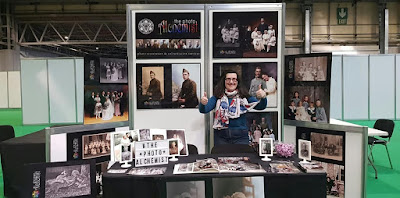
Claudia at The Genealogy Show in Birmingham England

Photographs became a huge part of my newly found obsession. If records, letters and documents are the bones of a family history, photos are without doubt the flesh. However, I was sad to find that photos were scarce, and often in very bad condition. I searched for restoration services, but they all required me to part with my precious originals, and there was no way on earth I was prepared to do that!

So, combining my advanced IT skills with my Fashion History passion and Art skills, I started exploring and developing ways of not only restoring and retouching old photos, but also adding carefully researched colour, enabling us to see our ancestors, just like they saw themselves and each other.
Knowing Grandfather Candido was abandoned on Christmas Eve felt 100 times more vivid, once I restored and colourised his photo and looked into his profound, sorrowful brown eyes.  Seeing the face of great grandma Jayne in colour, showed me a strong woman with whom suddenly I felt a deep connection even though we never met!

In 2017, I started interacting with genealogists across the world via social media and, after sharing one of my pieces online, I was flooded with requests for help with old photos. Realising I could help others and feed my passion, I quit my job as a Marketing Director and launched “The Photo Alchemist”.

Now I spend my days digitally bringing to life photos from clients all over the world, without the need for them to part with their precious originals. But the best part of my job is getting to know other people’s family histories, being trusted with their precious family photos, and playing a small part in keeping their legacies alive.

WEBSITE: www.thephotoalchemist.biz  
TWITTER: @Dsouza_Claudia
FACEBOOK: www.facebook.com/thephotoalchemist

September 5, 2018

Identifying Ancestor Photos: Cabinet Cards

Genealogists often have old family photos in their possession or they find some in Great Aunt Matilda's attic. But how do we know when the photograph was taken? One method is to determine what type of photograph it is

Photography arrived in the United States in 1839 thanks to Samuel F. B. Morse, an American artist and inventor. The earliest type is the Daguerreotype. Ambrotypes followed, coming into use circa 1854. 1860 saw the Cartes de Visite becoming popular and the larger Cabinet Cards began to slowly replace the popular CDVs in the mid 1860s.

Cabinet Cards

Cabinet Cards were basically a larger version of the earlier Cartes de Visite. Photographs on paper were pasted onto a large stiff backing measuring 6.5 x 4.25 inches. Photographer logos can be found on the front or verso and were often very elaborate. Around 1880 the cards became more elaborate, sometimes having gold or silver edges. At this time the colour of the cards began to change to darker tones and black, burgundy and deep green became popular.

Examples of Cabinet Cards 

 
1877 Cabinet Card
 1882 Cabinet Card

 
1900 Cabinet Card

1890s Cabinet Card


Learn More

Watch my video on Five Types of Early 19th Century Photographs

Read more about Cabinet Cards on Lost Faces website

September 3, 2018

Identifying Ancestor Photos: Cartes de Visite

Genealogists often have old family photos in their possession or they find some in Great Aunt Matilda's attic. But how do we know when the photograph was taken? One method is to determine what type of photograph it is

Photography arrived in the United States in 1839 thanks to Samuel F. B. Morse, an American artist and inventor. The earliest type is the Daguerreotype. Ambrotypes followed, coming into use circa 1854. By 1860 Cartes de Visite (CDVs) were becoming popular.

Cartes de Visite

Cartes de Visite are photographs mounted on a small (4x2.5") cardboard card. They became extremely popular as a method of collecting photographs of friends and family members to place in elaborate albums. A CDV could be easily duplicated in contrast to the earlier daguerreotypes and ambrotypes.

Estimating Dates of a CDV

Early 1860s CDVs have square corners. By 1870 many had rounded corners. The thinner the cardboard backing, the earlier the Cartes de Visite. Photographers logos, found on the verso (back) of the CDV also began to change, becoming more elaborate in later years.

Examples of Cartes de Visite

1877 Cartes de Visite, round corners

1864 CDV
 
1872 CDV with round corners
  

CDV 1872
  
1871 CDV
 

Learn More about Cartes de Visite

Watch my video on Five Types of Early 19th Century Photographs

Read more about Cartes de Visite on Lost Faces website

August 27, 2018

Identifying Ancestor Photos: Tintypes

Genealogists often have old family photos in their possession or they find some in Great Aunt Matilda's attic. But how do we know when the photograph was taken? One method is to determine what type of photograph it is. 

Photography arrived in the United States in 1839 thanks to Samuel F. B. Morse, an American artist and inventor.The earliest type is the Daguerreotype. Ambrotypes followed, coming into use circa 1854. By 1855 Tinytypes had begun to replace Ambrotypes

Tintypes (circa 1855)

The Ferrotype process (tintypes) was introduced in the United States in 1855. It substituted an iron plate for glass and was even cheaper than the ambrotype. Because tintypes were placed in albums along with CDVs, they were often trimmed at the sides and corners.

Tintypes were produced in various sizes
  • Full plate 6 1/2" x 8 1/2"
  • Half plate 4 1/2" x 51/2"
  • 1/4 plate 3 1/8" x 4 1/8"
  • 1/6 plate 2 1/2" x 3 1/2"
  • 1/9 plate 2" x 2 ½"
  • Gem approximately 1/2" x 1"
Examples of Tintypes


Gem Tintype


9th plate Tintype


Watch my video on Five Types of Early 19th Century Photographs

Read more about Tintypes on Lost Faces website

August 23, 2018

Identifying Ancestor Photographs: Ambrotypes

Ambrotype of the Treadway cousins

Genealogists often have old family photos in their possession or they find some in Great Aunt Matilda's attic. But how do we know when the photograph was taken? One method is to determine what type of photograph it is. 

Photography arrived in the United States in 1839 thanks to Samuel F. B. Morse, an American artist and inventor.The earliest type is the Daguerreotype. Ambrotypes followed, coming into use circa 1854.

Ambrotypes (circa 1854)

The ambrotype was a glass negative backed with black material, which enabled it to appear as a positive image. Patented in 1854, the ambrotype was made, packaged, and sold in portrait studios as the daguerreotype had been, but at a lower cost. The ambrotype produced a single image on glass.

From My Collection of Ambrotypes 


1861 Ambrotype


1858 Ambrotype


Another Civil War era ambrotype of a young woman in day dress with a typical snood and ringlets.  

Don't Be Confused 

Ambrotypes are often confused with daguerreotypes as they are similar in size and usually cased. If the image "disappears" when you move the photo around, it is a daguerreotype, not an ambrotype. Unlike daguerreotypes, which can appear as a positive, negative or reflective (mirror) image, ambrotypes are always a positive image no matter how they are held. 

Learn More

Watch my video Five Types of Early 19th Century Photographs

Read more about ambrotypes on Lost Faces website

April 18, 2018

Philetus Sawyer Family Photo Album

8. May Eugenia Ellsworth
taken circa 1864-1866
The Philetus Sawyer Family Photo Album from the Civil War era is now online on my Lost Faces website. I rescued this album several years ago and am delighted to present it today for all to enjoy freely.

It consists of 50 gorgeous cartes de visite (CDVs) in the 1860s such as the beautiful child on the left.

Be sure to check out all the photos I have rescued at Lost Faces.

March 19, 2018

Preservation of a Lost Faces Album Part 3

Please see Part 1 and Part 2 for the start of this process of how I rescue, archive, and publish on Lost Faces antique photo albums I save from disappearing.

After I have finished documenting every page in the rescued photo album, I sart the process of gently and carefully removing the photos. This can be a very laborious process are many are "stuck" to the pages with 100 or more years of dust and grime. I use a very thin plastic flexible ruler when necessary to gently assist each photo out of its slot. My goal is to not damage the album pages or the photo of course, so I do not want to just grab the photo and pull it out.

As I remove each photo, I assign a two letter abbreviation designating the name of the album and a number consistent with the order the photo was placed in the album on the verso (back) in pencil. If there is anything written on the album page that is not also written on the photo, I add that information to the photo back.

I also note (in pencil) the album number and name in the front inside page of the album. This allows me to reassemble the photos with the correct album in the future.

The next stage involves scanning, then storing each photo in an acid-free sleeve and storage box. More on that in my next blog post!