Discover your inside story with AncestryDNA®
Showing posts with label Alberta. Show all posts

January 4, 2017

Can You Believe 6 Generations All Alive?

A 4-Generation Family
Some of us might be lucky enough to live long enough to become great-grandparents. But 96 year old Vera Sommerfeld of Lethbridge, Alberta, Candaa, just became a great-great-great-grandmother! That's right, she is the head of 6 generations of living females.

The youngest is baby Callie born in October 2016. Her mother, Alisa Marsh, is 20. Grandmother Amanda Cormier is just 39, and Grace Couturier became a great-grandmother at 59. Great-great-grandmother Gwen Shaw is 75.

I have family photos of 4 generations living but no more than that. On the left is a photo taken in 1958 of my niece (my brother's daughter), my grandmother, my mother and my brother - 4 generations.

Read the story and see pictures at Alberta woman becomes great-great-great-grandmother

July 20, 2016

Celebrating Sisterhood - 100th Anniversary of Canadian Women's Right to Vote

2016 is the 100th Anniversary of Women first obtaining the right to vote in Canada. Manitoba, Saskatchewan and Alberta were the first Canadian provinces to grant women this right. Canadian women who owned land however had the right to vote as early as 1791 but that right was taken away in 1849.

It was not until 1917 that British Columbia and Ontario followed suit and granted women the right to vote. I wish I knew if either of my grandmothers, who lived in Ontario, were involved in the struggle for women's rights, or at the very least were pleased with their new-found rights! But it is not something I thought to ask about when I was a young teenager.

1918 saw Nova Scotia come on board, then New Brunswick in 1919. Prince Edward Island and Newfoundland lagged behind, not granting women the right to vote until 1922 and 1925 respectively. But the biggest and most shameful holdout was Quebec. That province did not grant women the right to vote until 1940!

I have talked before about Canada's Famous Five, that group of 5 courageous and determined women who forced Canada to recognize women as "persons" in 1929.

You can read more about women's rights in Canada at A greater sisterhood: the Women’s Rights struggle in Canada

June 29, 2016

3 New Canadian Databases on Ancestry

Niagara Falls, Ontario, Canada, Honeymoon and Visitor Registries, 1949-2011

·         Commonly known as the “Honeymoon Capital of the World”, Niagara Falls is visited by approximately 50,000 newlywed couples each year.

o   Fun fact: Niagara Falls received its reputation as the “Honeymoon Capital of the World” in 1801 when Theodosia Burr Alston (daughter of the 3rd Vice President of the United States, Aaron Burr), chose to honeymoon at the Falls. Napoleon Bonaparte’s brother, Jerome Bonaparte did the same in 1804, starting the popular tradition that continues today.

·         Many of the newlyweds who visit choose to sign their names in register books kept by the Niagara Falls Tourism Office, and now, these records have been digitized and indexed and are available online for Ancestry users.

·         The collection contains 680,114 records and 17,593 images from 1949 to 2011.

·         Exploring this collection, you’ll discover visitors who travelled near and far to the Falls, and how soon after their wedding they arrived.

·         The Niagara Falls, Ontario, Canada, Honeymoon and Visitor Registries, 1949-2011 are now available online on Ancestry.com and Ancestry.ca

Canada Photographic Albums of Settlement, 1892-1917


·         Just in time for Canada Day, Ancestry users can now access photos that paint a picture of what everyday life was like for Canadians during the early days of our nation.

·         Compiled by the Department of Interior, the collection contains 3,358 images, the majority of which were captured by John Woodruff and Horatio N. Topley. These photographers were hired by the Canadian government to capture the spirit of Canada during this period.

·         From the original logging process implemented to harvest one of Canada’s greatest resources, to the expansive ranches and wide open spaces of the true north in its original state, this collection details the life and times of some of Canada’s earliest settlers.

·         The Canada Photographic Albums of Settlement, 1892-1917 Collection is now available on Ancestry.com and Ancestry.ca

Canada Homestead Grant Registers, 1892-1930

·         To continue to shed light into life in Canada during its first few decades as a nation, Ancestry has launched a collection of registers of applications for land grants for the Western Canadian provinces of Manitoba, Saskatchewan and Alberta.

·         Under the Dominion Land Acts in 1872, individuals could apply to homestead a quarter section of land (160 acres) and then apply for a patent (title) to the land after occupying and improving the land for three years. The average cost of land during this time was $10.

·         With 668,623 records and 78,794 images, Ancestry users can learn about some of Canada’s earliest settlers such as applicants’ names, region, date of application and homestead fee paid.

·         The Canada Homestead Grant Registers 1892-1930 Collection is now available on  Ancestry.com and Ancestry.ca

Credit: Images from Ancestry.com and Ancestry.ca 

February 9, 2016

Update on Alberta Homestead Collection

Olive Tree Genealogy received this note about the Alberta Homestead Collection which I believe will be of interest to those using the online database:

Hi Viewers, 

With Ancestry’s recent announcement in launching the Alberta, Canada, Homestead Records, 1870-1930 , the Alberta Genealogical Society would like viewers to seriously compare the scope of the two indexes. Ancestry’s index is has a minimal listing of approximately 207,000 records, whereas the Alberta Genealogical Society has in their combined database over 520,000 entries. 

The AGS all name homestead index for 1870 to post-1930, lists those applying for land patents between 1885 and 1897; those who completed the homesteading process and eventually obtained a title; those who applied but abandoned their homesteads; and other individuals whose name appears in the files for a variety of reasons—something the Library and Archives of Canada nor Ancestry has done. 

We invite everyone to view the AGS databases which have twice as many records, and twice the knowledge over the record index at http://www.abgenealogy.ca/alberta-homestead-indexes. 

Thank you, 
Lyn Meehan, 
AGS Communications

Image: screenshot from Alberta Genealogical Society

February 4, 2016

Alberta, Canada, Homestead Records, 1870-1930

A new collection launched on Ancestry will be of interest to those with ancestors in Alberta Canada.  

Alberta, Canada, Homestead Records, 1870-1930  is a valuable land record collection that includes the names of approximately 200,000 people who applied for homesteads in Alberta under the Dominion Lands Act - an 1872 law aimed to encourage the settlement of the Canadian Prairies. 


Compiled during a time where the population was expanding to Western Canada, this collection is a valuable resource for those hoping to learn more about their ancestors who settled in The Princess Province.


Here’s a bit more insight on the collection:
 

Background:
·         In order to encourage migration to the west, settlers were offered the chance to apply for a 160-acre homestead in areas of their choice in Alberta.
·         After paying a $10 filing fee and agreeing to build up their homestead to include items such as a house and barn, fencing, breaking and cropping a portion of the land, the homesteader could apply for the title to the land.  

The Collection:
·         The collection contains 1,622,218 images and 206,457 records showing basic biographical information such applicants’ name, age, place of birth, former place of residence, date of entry on the land and marital status. 

Image: Alberta, Canada, Homestead Records, 1870-1930 for Amy Ellen Brown (Smith)

March 5, 2014

Women's History Month: Irene Parlby One of the Famous Five

The Famous Five were 5 Canadian women who created a petition  in 1927 they sent to the Supreme Court of Canada to ask if women were "persons" under the law. In 1928 it was unanimously decided by the Court that the answer was "no" but in October 1929 the decision was overturned and for the first time women were legally considered "persons". 


It totally blows my mind to put this in context - my mother was 13 years old before she was considered a person. My grandmother was 35. I cannot imagine not being considered a "person". 

Women's History Month: Irene Parlby One of the Famous Five One of the group of Famous Five was Irene Parlby. I wanted to know more about Irene - who was she and what kind of upbringing did she have that contributed to her determination to make changes for women.  

Unforunately I've never had the opportunity to see the movie The Relunctant Politician about Irene's contributions to the women's movement.   

There are a few brief biographies of Irene online but they don't have the kind of meat I was looking for. Who were her parents? Where did she live? What was her life like?

Baptism Elizabeth Lynch in Bombay India 1845. FindMyPast.co.uk
My research found that Irene was born Mary Irene Marryat in London England in 1868 to parents Ernest Lindsay Marryat and Elizabeth Lynch. Her father was a British Army Colonel and was stationed in India for part of his military career. Irene's mother Elizabeth was born in Bombay India in 1845 to Edward Patrick Lynch, a well-known Lt.-General in the English Army. Edward Lynch entered the India army in 1826 and was stationed in India, Persia and Afghanistan. 
Marriage Marryat-Lynch in Bombay India 1866. FindMyPast.co.uk
Elizabeth lynch was a widow when she and Ernest married in Bombay India in 1866. She had married Maxwell Graham in India 3 years previously. Her first husband died of cholera one year later in March 1864 at the age of 25. Maxwell was also in the Army. Elizabeth was 20 years old when she was widowed. At the time of their marriage, Ernest Marryat was  a Lieutenant in the Royal Bombay Engineers. 

There was a strong military presence in Irene's family with her father, maternal grandfather and maternal great-grandfather highly placed army officers. Being raised in a military family no doubt meant a strong emphasis on routine, discipline, accountability and duty. 

The Lynch family had long standing ties in the military. Irene's great-grandfather Henry Blosse Lynch had a varied career - as a mountaineer, volunteer in the Indian Navy, Persian Gulf surveyor, explorer, interpretor who was fluent in Arabic and Persian. and many other accomplishments. 

Irene's father Edward Patrick Lynch was born in Mayo Ireland. He enlisted in the Indian Army in 1825 and did not marry until 1843 when he wed Louisa Stirton in Bombay.  Louisa died in October 1846 on board a ship sailing to England [Gentleman's Magazine. Jan. 1847. p. 110. http://search.fibis.org/frontis/bin/aps_detail.php?id=1162466 On her passage to England, Louisa, wife of Major E.P. Lynch, K.L.S., Bombay Army]. In 1848 Edward married her younger sister Emily Elizabeth.

The Stirton sisters were the daughters of Andrew and Sarah Stirton and were born in London England. Andrew was born circa 1784 in London England and in the 1851 census he is listed as a Marine Fund Holder. 1851 was a rough year for the Lynch family. On January 1 of that year, Edward and Elizabeth Lynch's 16 year old servant Sarah Shuaghnessey died of Cholera and the next day their only son, 1 year old Edward Bloss Stirton Lynch, also passed away. By the time of that 1851 census the two older sisters, 6 year old Elizabeth and 7 year old Sarah were living with their Stirton Grandparents, Andrew and Sarah, in England. The girls were most likely sent away after their younger half-brother died.

The 1871 census for London England finds Mary Irene as a 3 year old living with her mother Elizabeth age 25 and younger brother Ernest Patrick Lynch Marryat age 1. 

By 1896 Mary Irene had left England for Alberta Canada where she met and married Walter Parlby. It was then that Irene began taking an active role in women's issues. She became President of the United Farm Women of Alberta and was later elected the first female cabinet minister in Alberta. Irene's focus was on improving the lives of rural women and children but her social activism had far-reaching effects for all women once she became involved in the petition to have women recognized as people. The decision that women were persons eligible to be named to the Senate of Canada was handed down on October 18, 1929.

Her only child Humphrey Parlby was born in 1899 in Alberta. Irene retired from politics in 1935 but continued to speak passionately about women's rights. She died at the age of 97 in Alberta.

Notes: Other information and material about Irene Parlby is available at the Glenbow Archives, Alberta

February 28, 2014

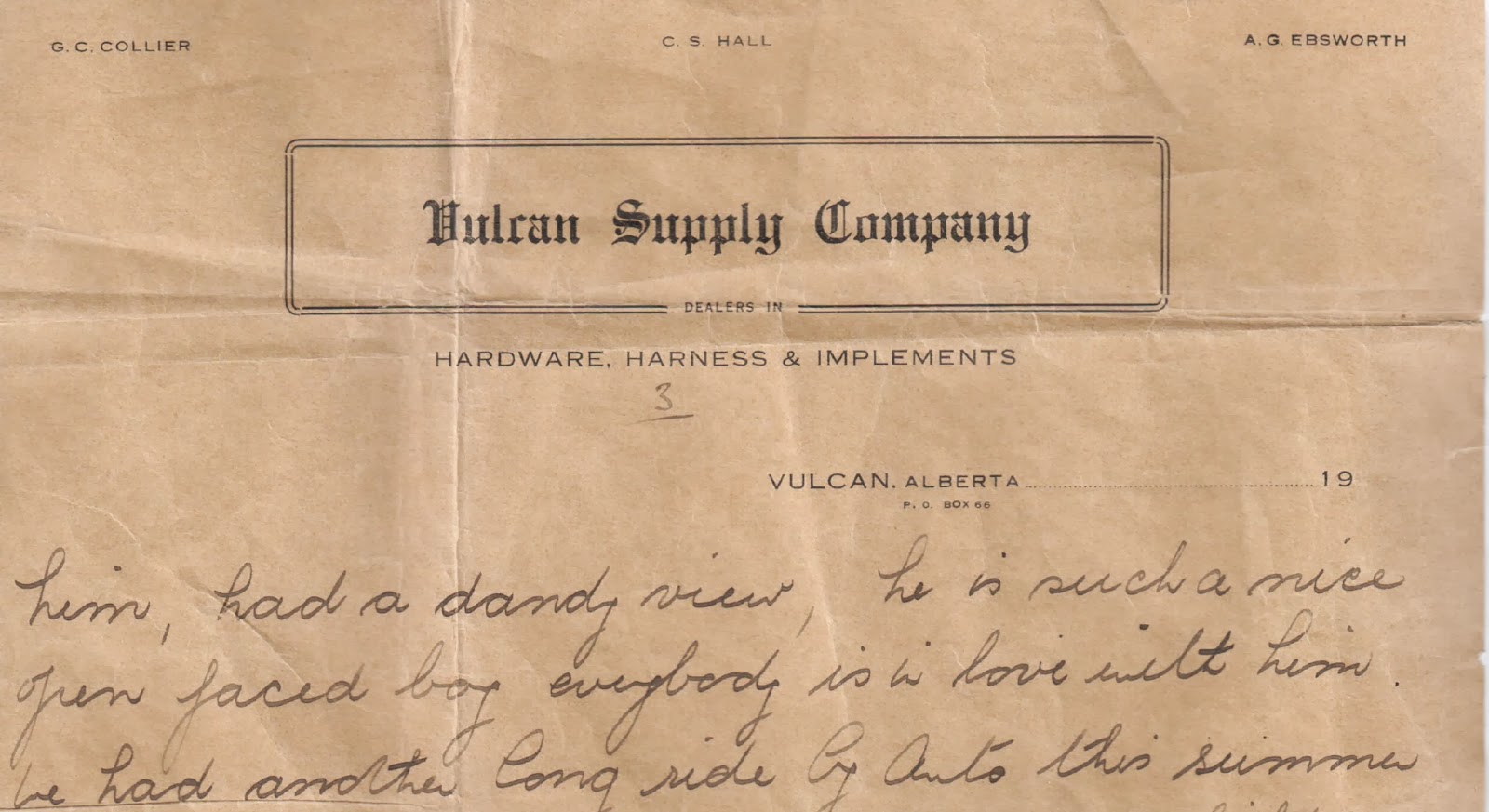
1919 Letter from Canada Surfaces in Old Trunk in Australia

1919 Letter from Canada Surfaces in  Old Trunk in Australia
An old trunk in Australia held a small treasure - a letter written November 15, 1919 in Vulcan Alberta Canada. Victoria Collier wrote the letter on stationary of the Vulcan Supply Co. and addressed it to a Miss Scholz. 

The letterhead provides 3 names in its business header, one being G. C. Collier. In the first paragraph the writer talks about welcoming the boys home [back from the war] and adds "Geoff has his four brothers home now. One was killed and one sent to Siberia."

The letter gives a fascinating peek into post-war times in the small town. It also provides terrific clues to the families, providing tiny entries such as these:


"My sister Mabel is well and talks of coming out to see me..."
"Aunt Julia in England... is 85 next birthday..."

A genealogist can't let those clues go, can they? You guessed it, I had to investigate to see if I could turn up anything more on the families!

In 1911 the Collier family was living in Medicine Hat, Alberta. They are recorded as:
  • Goffrey, 22, harness maker born England
  • Violet, 21
  • Walter, brother, 20, salesman for stoves, born England
The 1916 census for Alberta reveals that Guthrie [sic] Collier, 27, his wife Violet, 26 and two sons Russell (4) and Albert (10 months) were living in Lethbridge Alberta. Guthrie was born in England and shows his immigration year as 1907. Violet was born in Tasmania and gives her immigration year as 1910.[Ancestry.com ]

By 1921 the family was living in Bow River Alberta and were listed as:
  • Joseph [sic], 33 born England, harness maker, owns his own shop, immigrated 1907
  • Violet, 31 born Tasmania, immigrated 1911
  • Russell, 9, born Alberta
  • Albert, 5, born Alberta
  • Ruby, 3, born Alberta 

The Lethbridge Herald of July 04, 1940 - Page 8 reveals that Godfrey's mother was visiting the family. I found evidence that she died in 1943 and is buried in Lethbridge Alberta

Searching in U.K. records found Godfrey as a young man in 1901 with his family in Dorset. His parents were William, born Buckland Newton, Dorset, and Emily Collier born
Piddletrenthide, Dorset. Their children were Charles E. 16, Harry J. 14, Godfrey C. 12, Walter G. 10, Horace A. 7, Sydney L 4 and William W. 2 [Ancestry.com ]


British Army WWI Service Records, 1914-1920
According to online ships passenger lists on Ancestry.com , 19 year old Godfrey arrived in Canada on
25 Mar 1908 on board the Empress of Ireland


Godfrey's brother Horace enlisted in the British Army in WW1 and was killed 13 October 1914. He was a Lance Corporal in the Dorsetshire Regiment.

Further research found Violet and Geoff's graves in Vulcan Cemetery, Vulcan Alberta.

Violet Nora Collier
1890-1962

Godfrey Cyril Collier
1889-1965

Finding Violet's middle name on her grave marker allowed me to find her and her sister Mabel (mentioned in Violet's letter) and their parents. Violet was born in 1890 in Frankford Tasmania to Alfred Boucher Welch and Albertina Bugg. Her sisters Mabel Dora were born in 1884 and Florence Kate in 1886. [http://portal.archives.tas.gov.au/menu.aspx?detail=1&type=P&id=302555]

Violet's father Alfred Welch was from Surrey England. He and Albertina applied for land in Tasmania in 1882.  The record states that Alfred was 21 and Albertina was 25 and they had recently arrived on the SS. Garanne or Garonne [Tasmania, Australia, Land Applications and Warrants, 1868-1887] The Garonne arrived in Sydney from London England on 10 November 1882.

20 year old Violet arrived in British Columbia Canada from Sydney Australia on 21 September 1910 on board the Marama. [Canadian Passenger Lists, 1865-1935]
 
Read Newly found First World War-era letter from Alberta woman a window through time to early 20th century for the complete story. You can also download the entire letter in .PDF format