Discover your inside story with AncestryDNA®
Showing posts with label Assessment Records. Show all posts

August 31, 2017

Check out Ancestry Free Access for Labor Day Weekend

Free Access to Occupational Records! Starting Thursday, August 31st until Monday, September 4th

Databases searched include census records, tax and assessment records, employment records, military records, voter registrations and more. Don't miss this chance to look for your ancestors.

Search Ancestry.com Occupational Records for free this Labor Day!

Search Ancestry.ca Labour Day Free Access to Occupational Records all Weekend Long

July 15, 2015

10 Important Characteristics of a Good Genealogist

10 Important Characteristics of a Good Genealogist
We all want to be good genealogists, don't we. We want to know that we did our best to find our ancestors and that what we found is accurate. We don't want to spend time searching an individual's ancestors and adding them to our family tree only to find out it was the wrong person!

That means we need to be thorough and methodical and very very cautious about accepting documents and individuals without verifying and double-checking every fact we find. 

I've come up with a list of the 10 most important characteristics that will tell you if you're on the right track to being a good genealogist.

A good genealogist

1. Finds every document possible on an ancestor. He/she does not stop at census and vital registrations but looks beyond to records such as land records, court records, military records, church records, immigration records, education records, newspaper articles, tax and assessment records, etc. Checks for more obscure records such as coffin plates, funeral cards, and other miscellaneous records pertaining to the time and location of his/her search.

2.  Learns what records have survived for the location and time period for each ancestor's life.

3. Copies documents exactly as found, not as he/she thinks it should be. Example: You know your Grandmother's name to be Mary but in one census she is record as Marie. A good genealogist copies her name exactly as found in the original record, not as he/she knows it. A good genealogist notes the discrepancy in names but does not alter what was found in the original document.

4. Cites sources for all facts found.

5. Never relies blindly on family stories or online family trees but searches out a source for each. Verify, verify, verify! Example: If great aunt Harriet told you Great-Grandpa was a trapeze artist who deserted his wife and children, make note of this in your notes with the source and date you were given this information, then hunt for proof of her statement.

6. Makes an accurate copy of all records found. Carefully notes spelling of names while copying and does not make changes. Example: my name (Lorine) is often carelessly copied from my websites, blogs or emai by genealogists who write to me and address me as Lorrine, Lorraine or Lori.This makes me wonder how good a genealogist they are if they are unable to copy a name correctly.

7. Keeps a research log of all sources checked, and notes if the search was successful or not.

8. Analyzes each record and document carefully in order to spot clues that may lead to other areas of research and to accurately understand what the record is  and is not. Example: A woman who asked me for help told me she knew when her grandfather arrived in N. America and had his immigration record. She provided a complete date - day, month and year. But when I looked at the original document it was not an immigration record but rather his naturalization paper.

9. Searches siblings of a challenging ancestor in order to find more documents that may hold clues pertaining to his/her ancestor.

10. Leaves no stone (record) unturned. Extends his/her search to records not found online such as in local courthouses or archives. 

There are more characteristics of a good genealogist and the list could be extended. But these may be the 10 most important and if we make sure we are following these characteristics, we are definitely on the way to being a good genealogist.

What would you add to the list? 

May 19, 2015

Have You Checked Assessment Records for that Elusive Ancestor?

Genealogy records for early Ontario (Canada West, Upper Canada) are challenging to find. They are sporadic and held in different repositories. Some often over-looked pre 1850 records include Assessment Records. 

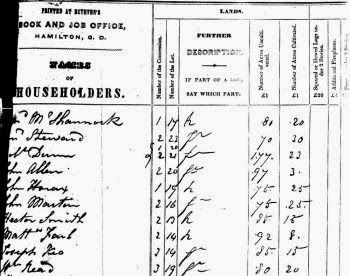
Assessment Record Page
These work well as a census substitute and they usually provide an exact location of land (Lot and Concession Number) within a Township.

Some give numbers and type of livestock and crops. Assessment records were used to assess individual's property and holdings in order to calculate and collect tax revenue.  

Not all townships' Assessment Records have survived. Not all townships did assessments for the same years. So if you are looking for these records you will need to find out if your County and Township of interest has any that survived. 

I am very pleased to announce that thanks to the generousity of transcriber Fred Blair, Olive Tree Genealogy has published 10 Assessment Records for early Ontario. Following is the list of Assessment Records now available for download on Olive Tree Genealogy Ontario Assessment Records section

    Assessment Ancaster Township, Wentworth County, Home District 1816
    Assessment_Ancaster Township, Wentworth County, Home District 1818
    Assessment Beverley Township, Wentworth County, Home District 1816
    Assessment Beverley Township, Wentworth County, Home District 1818
    Assessment Grand River Tract, Haldimand Township, Wentworth County, Gore District, 1816
    Assessment Nelson Township, Halton County, Gore District 1816
    Assessment Nelson Township, Halton County, Gore District 1818
    Assessment Trafalgar Township, Halton County, Gore District 1816
    Assessment Trafalgar Township, Halton County, Gore District 1823
    Assessment Trafalgar Township, Halton County, Gore District 1825