Discover your inside story with AncestryDNA®
Showing posts with label Ontario Land Records. Show all posts

July 28, 2013

Finding an Ancestor in Early Ontario Land Records

Finding an Ancestor in Early Ontario Land Records
Upper Canada Land Petition Isaac Vollick
Many researchers ask me where and how they can find information about an early Upper Canada (aka Canada West aka Ontario) ancestor and where he or she settled.

Early Ontario records can be challenging to find. Ontario was not settled until the American Revolution when many Loyalists fled the Colonies (later the United States of America) for Canada.Very early records were often not taken or if taken, have not survived.

But there are land records, it's just a matter of knowing what has survived and where a collection can be searched.

It is also important to know the boundary and name changes that occurred in Ontario. From Upper Canada to Canada West to Ontario, you will need to know what years the name changes took place. Also important are the District and County name changes. Here is a complete list of the District Names in 1846 and the counties and townships in each.

Below is a list I compiled of online searchable land records. There are many that are not online and I have also provided a link to my website where a list of offline resources is given. I hope this is of help to struggling genealogists.

* Upper Canada Land Petitions index and images online on Library and Archives Canada (LAC).
Many early settlers, both military and civilian, submitted petitions to the Governor to obtain Crown land. Sons and daughters of Loyalists were also entitled to free lands. The Upper Canada Land Petitions contain petitions for grants or leases of land and other administrative records from 1783 to 1865

* Second Heir and Devisee Commission Case Files Database Index to  5184 case files, from 1804 to 1895, document claims for land made to the Second Heir and Devisee Commission. The second Heir and Devisee Commission was responsible for hearing and determining claims to land brought forward by the heirs, devisees, or assignees of original nominees. (Online Index)

* The Computerized Land Record Index (aka Ontario Land Record Index) summarizes land grants of Crown Land, sales of land from Canada Company sales or leases and from Peter Robinson settlers' grants. If your ancestor settled anywhere in Ontario and he was the first time owner of Crown Land, he should be on these lists. (Lookup Service)

* Return of all Patents for Land 1836 1478 names of patentees with some surnames missing (not found are surnames beginning with H, K, L, M, P, Q, S, T) 

* Canadian County Atlas Digital Project at McGill University. The County Atlas Digital Project is a searchable database of  property owners' names which appear on the township maps in the county atlases. Township maps, portraits and properties have been scanned, with links from the property owners' names in the database.

* List of land records available for Ontario (aka Canada West aka Upper Canada) and where each set of records can be found (online or offline)

March 27, 2012

The Overlooked Abstract Indexes to Deeds - a Useful Genealogy Research Tool

Please note that the following article was written by me (Lorine McGinnis Schulze) and published on my Olive Tree Genealogy website several years ago


Land records are very useful. Originally all land in Ontario belonged to the Crown. Although there were small areas of settlement in 1763 after the British took over, major settlement of Upper Canada began in 1783 and utilized Crown Grants. Many early settlers, both military and civilian, submitted land petitions to the Governor in order to obtain Crown land.
 
Abstract Indexes to Deeds
The Abstract Indexes to Deeds are the indexed record of every transaction on a plot of land from Crown ownership to the present day. Abstract Indexes were created 1865-1866 according to new legislation and were retroactive to the patent on a property, meaning they went back to when the land was first owned by the Crown before it was sold or granted to individuals.

Using the Abstract Indexes to Deeds you can check for every instance of your name of interest on that parcel of land. By referring to the date and Instrument Number found with each transaction, you can look up the complete record. You may find a will (Many wills are filed in the Land Records Offices) or other important genealogical information or document.

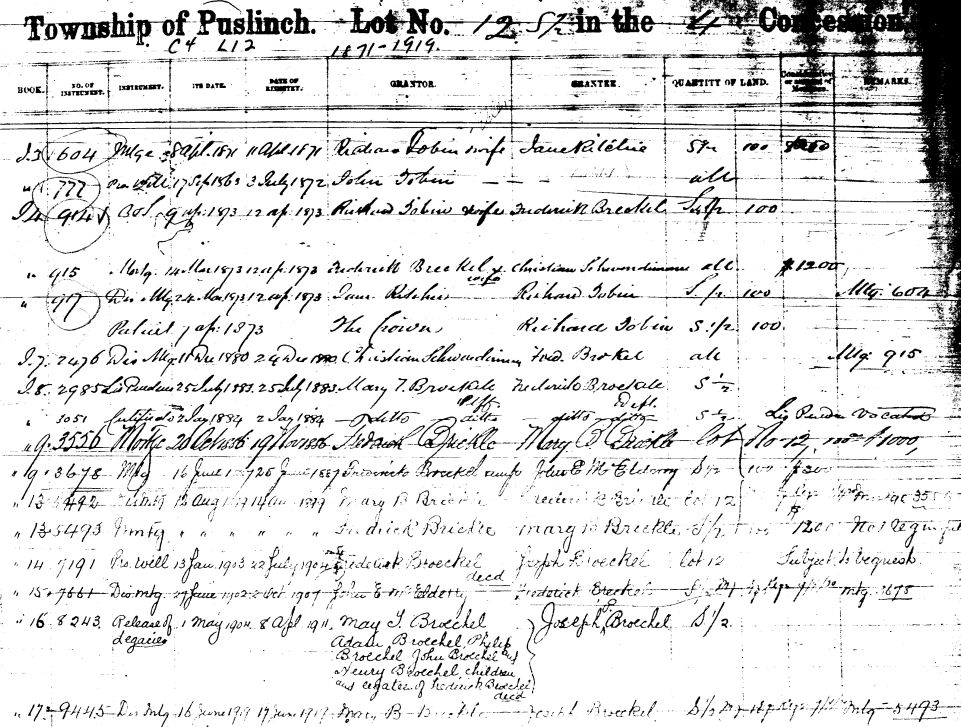
See the example and explanation of the Abstract Indexes to Deeds for Concession 4, Lot 12, Puslinch Township, Wellington County Ontario. You may click on image for a larger graphic.

Abstract Indexes to Deeds for Concession 4, Lot 12, Puslinch Township, Wellington County OntarioLooking at the second from the bottom entry dated 1904 you can see a list of the children of Frederick Broeckel and a notation that he is deceased. If you did not know when Frederick Broeckel died, or the names of his children, this would be a very nice genealogy find. 


After you have found that enty in the Abstract Index to Deeds, you can order the full record to see what other genealogy details might be found. Simply refer to the Book Number, Instrument Number and date to order the full record.

 In this case it is Book I16, Instrument #8243, 1 May 1904. Notice that there is an earlier entry dated 13 Jan. 1903 for Frederick Broeckel and it is called Probate to Will. Sending for the full record would no doubt include Frederick's will.

Where to Find Abstract Indexes to Deeds

Please refer to http://www.olivetreegenealogy.com/can/ont/abstract-indexes.shtml for a complete list of where you can obtain these Abstract Indexes to Deeds


February 15, 2012

Land Registry Offices - No Need for Fear!

Outside the Land Registry Office
I confess. In all my years as a genealogist I've only been to the Land Registry Offices once, and that was to accompany an experienced Land Registry Office user. I've never been on my own and thus I've never actually used their resources.

Curious about the Land Registry Offices? The official website states:

"The Central Production and Verification Services Branch of ServiceOntario manages and operates 54 Land Registry Offices throughout Ontario which register, store and manage documents such as deeds, mortgages and plans of survey. Registration of real property is done under either the Land Titles Act or the Registry Act. All registered and deposited records are available to the public (for a fee) to search title or obtain information about the ownership of real property."

Part of my reluctance to visit my local Land Registry Office in Barrie Ontario was that I'd heard stories from other genealogists - not about the Barrie office but about Land Registry Offices in general - that genealogists were not welcome and that staff were reluctant to assist genealogists. But I'm here to tell you otherwise!

This past week I took the plunge and visited the Barrie Land Registry Office to look up records for the land that we own. It was a wonderful experience. The staff were amazing.  The young woman at the desk was helpful, courteous and patient with my husband and I.

She explained how the services worked, asked questions to determine what we required, and took us to the exact book we needed to start the process. She explained all the steps we needed to take, and showed us to the drawer for the microfilm we needed, then proceeded to pull the film box for us.

At the Reader-Printer
Next step she chose a microfilm reader-printer, brought us a second chair and even put the reel of film on the reader. She also arranged for me to speak to the manager, Steve Small, to ask if my husband could take a few photos of me at the computers, the microfilm reader and the microfilm drawers.

The general policy at the Land Registry Office is that no photographs are allowed.  Mr. Small was very accomodating and agreed that as long as I did not photograph documents or maps or other materials, I could use my camera for pictures to illustrate this article.

It was very easy once we got started (thanks to the assistance of the LRO staff) and  I want to share the steps with you.  It was a fun project as we now know the name of the first time buyer of our land, the date (1839) and what it cost. We were curious as to when the original farmhouse was built on our property and who lived in it. We knew the house was built ca 1890-1910 but that was all.

While the building of a house was not listed in the land records, we were able to narrow down the family who lived there in 1911 and I later found them on the 1911 census for this area. We plan to go back to look up the history of other homes I have lived in over the past 40 years. 

To find records you must know the proper designation of your land or home. In our case we needed Lot and Concession number plus Township. For a house in town you would need the designation on your deed of ownership.

At the Computers
You can use computers which are the more recent transactions dating from present day back to when the original land books were transferred to microfilm.  The computer records do not go back very far, only to around 2000 or 2001 I believe.

To use the computer you can search by name of the current owner or by street name and number or by the registration number which is a unique number assigned when documents, deeds and mortgages are registered. When you find a record of interest, you can pay by credit card or debit card online or by cheque or cash at the front desk, then print your record.


Microfilm Drawers
To find earlier records you will need to search microfilm. Your first step is to check the book which is a Finding Aid to the correct reel of film. Check your township, then concession number. Write down the microfilm reel number and go to the labelled drawers. Then start viewing your roll of film on a reader-printer.

To print records you need a $5.00 copy card which is refundable when you turn the card in when you're done. You can pay for a copy card with cash or a cheque. Each page you print costs 50 cents. We printed everything from 1839 to the present day - a total for us of about 20 pages.

It's been really interesting researching the family who lived in the original farm house in 1911.  I'm looking forward to researching the early families of my last home which I suspect was built around 1870 or 1880.

There is much of value to genealogists in the land records. For example you might find mention of a spouse, and sometimes a first name is given which could be the answer to a brickwall. Often there is mention of an estate for an owner which is an indication that the individual has died. You can track the trail of ownership which may help determine relationships of individuals. The benefits to genealogists deserves a blog post of its own but that's for another day.

So don't hesitate - visit your local Land Registry Office and have a look at the history of your house! But please ask if photographs can be taken. Remember that  repositories such as Archives. Libraries, Museums etc. have different rules. Find out what they are and follow them.

It's a little matter of courtesy and respect.