March 8, 2013
Women's History Month: Pattern of Children of Your Female Ancestors
My friend and fellow Blogger Lisa Alzo has a Meme for March - Fearless Females: 31 Blogging Prompts to Celebrate Women's History Month
I encourage readers to join in. Lisa has some terrific blogging prompts for each day of Women's History Month.
Meanwhile, because there are 5 Fridays in March, I have written 5 Blogging Prompts for Women's History Month. I will write my own stories each Friday (and participate in as many of Lisa's 31 Prompts as I can!) I hope you'll join in with your own.
Here is my second blog post for the topic Make a list of your female ancestors beginning with your mother. Go back as far as you can. Now figure out how many children each female ancestor had. Did the females in your direct maternal line tend to have the same numbers of children each generation? Did they have more? Less? Were they prolific or are there few children born to each woman? Is there a pattern emerging?
My mom: 4 children - 2 boys, 2 girls
Maternal grandmother: 3 girls
Paternal grandmother: 6 boys
Great grandmother Simpson: 6 children - 4 boys, 2 girls
Great grandmother Fuller:5 children - 4 boys, 1 girl
Great grandmother McGinnis: 5 children - 3 boys, 2 girls
Great grandmother Peer: 9 children - 5 boys, 4 girls
Of a total of 38 children, there were 24 boys and 14 girls. Statistically there were almost double the number of boys than girls each generation.
I was curious about the ages of the above ancestors when they had their children. My great grandmother Peer was the youngest, only 17 when her first child was born. The others were aged 19, 21, 22, 23, 26 and 29. There's certainly no consistency there, which makes sense because it would depend on when they fell in love and married.
Four of my female ancestors above had late-in-life babies - my Grandmother McGinnis who was 45 when her last child was born, and my great-grandmothers Fuller who was 42, Peer who was 44 and McGinnis who was 40. I suppose the quality of birth control at the time may have factored into those later children for my great-grandmothers.
What about your female ancestors? How do they compare?
March 7, 2013
Olive Tree Genealogy CBC Interview Segment Tonight!
Today CBC News sent a reporter and a cameraman to my home to interview me about the genealogy research I did to find a descendant of WW 1 soldier Norman E. Waring.
For those who missed my post yesterday about the stash of letters and photos found in an attic in a home in Toronto, please see WW1 Soldier's Letters Found in Attic of Home
I don't want to say too much as the story is scheduled to air tonight on CBC at 6 p.m. EST.
.JPG)
It is supposed to go online too on the CBC website so stay tuned for a link once I have it.
For those who missed my post yesterday about the stash of letters and photos found in an attic in a home in Toronto, please see WW1 Soldier's Letters Found in Attic of Home
I don't want to say too much as the story is scheduled to air tonight on CBC at 6 p.m. EST.
It is supposed to go online too on the CBC website so stay tuned for a link once I have it.
FamilySearch Has Launched Family Tree
FamilySearch has now launched Family Tree,
the first in a series of exciting services planned for release in 2013
at FamilySearch.org to enrich patron experiences. Family Tree, is a
free, online family history tree service. Family Tree brings
collaborative web tools together with FamilySearch resources to create
an engaging way to discover, preserve, grow, and share your family
history as a family community online. Family Tree is now available at
FamilySearch.org (Look for the Family Tree tab).
Users of Family Tree can:
· Organize family information into a genealogy tree
· Edit and delete incorrect data, including relationships
· Connect and collaborate with others on shared family lines
· Provide sources and link to online information that shows where you found family information
FamilySearch has created a training website
to educate and help new patrons make the most out of Family Tree. The
site includes quick instructional videos, a reference guide, webinars,
practice exercises, and much more.
Development on Family Tree is aggressive and
exciting new features will continue to be added in the next few months.
Some of these new features will include:
· Additional features to reduce merging of non-duplicate records
· Ability to add photos and stories
· The migration from new.FamilySearch.org of individual and family notes as well as user-entered sources
· The ability to print pedigree charts, family group records, and other reports
Give Family Tree a try today.
March 6, 2013
WW1 Soldier's Letters Found in Attic of Home
Yesterday I read a CBC news story about a treasure trove of letters and photos from WW1 found in an attic. A young couple opened the trap door in the ceiling of their home to look for storage space and discovered a box full of letters written by a soldier in the CEF (Canadian Expeditionary Force) from the front lines.
The only clues given in the news story were that the soldier's name was N. E. Waring and the person he was writing to was Hilda McLeod. A short video with the story clearly shows Hilda's address as 126 Hampton Ave, Toronto Ontario. The couple want to return the letters and photos to a descendant and are asking for help.
CEF DATABASE
How I wish I could see those letters and photos to pick out more clues and details but I decided to look for the author of the letters with the clues provided. A search of the online CEF database on Ancestry.com
and on
Collections Canada brought up the most likely candidate for the letter
writer - Norman Edmund Waring of Carleton St. in Toronto. He gave his
next of kin as Mrs. James Waring, same address as his, when he enlisted
in December 1915.
The video shows parts of the letters and you can see the beautiful clear handwriting. Norman's signature on his Attestation papers in 1915 matches the signature on a postcard shown on the video.
Norman gives his birth date as February 1886 and that allowed me to find his birth registration on Ancestry. His parents are listed as James Waring and Bessie Waring and his place of birth, Ingersoll, agreed with the Attestation Papers.
CENSUS RECORDS
No marriage record for Norman was found on Ancestry.com
so I began a hunt for possible siblings of Norman. The 1891 census for Ingersoll reveals the family of
James Waring, 42 born Ireland
Bessie, 35 born Ireland
Henry, 12 born Ireland
Willie, 10 born Ontario
Albert, 8 born Ontario
Norman, 5 born Ontario
and Frederick 2 born Ontario
A later census record for 1911 shows one more son, Samuel, age 19 in 1911. The family is living at 279 Carleton Street in 1911. Henry, Norman and Fred are still at home with their parents and still single.
It doesn't appear that Norman ever married, as he is later found as a single man on a 1940 Voter's List, living at 279 Carleton Street with his widowed mother Bessie and his brother William (also single)
So I decided to trace Norman's brothers to find out if they married and left descendants
NORMAN'S BROTHERS
A search for Norman's brothers revealed the following:
Henry Waring was found on Ancestry.com
on a Border Crossing Record in 1915 crossing at Buffalo New York. His birth place is given as Belfast Ireland. I could fairly easily trace the family backwards and in fact, discovered their names on a passenger list for the ship The Montreal arriving Quebec from Ireland in June 1880. But the couple who found the letters and photos want to give them to a descendant so I had to stay focused and trace down from James and Bessie, not back. Henry died in August 1933, never having married. He lived with his brother Norman at the Carleton Street address and in fact died in the house.
Willie (William Alexander) Waring went to Detroit Michigan in 1911 [Source: Border Crossing Records] He married Edith Boyd and had one known son, Roy Waring born Dec. 1900 in Sacremento California (Source: US Passport Application 1920). His son Roy's passport application dated 1920 states his father William is deceased. Roy died in 1969 in Los Angeles California but I've not yet found if he had children.
Albert (James Albert) Waring enlisted during WW1 in Nevada, USA. In January 1917 he is found on a list of individuals crossing from British Columbia to Marcus Washington. I have not yet hunted for Albert after 1917 so perhaps my readers will take on that task.
Frederick (John Frederick) Waring married Violet May Cridland in 1914 according to the online marriage registrations on Ancestry. I have not yet searched for further details on Frederick.
Samuel (Samuel Holt) Waring is found in the CEF database as enlisting in January 1918. He was single and living with his mother at the Carleton Street address. A marriage registration on Ancestry.com
shows him marrying Jane Elizabeth Gardner in 1924. The last record I found for Samuel was a 1963 Voter's List for Eglinton Ontario. His wife "Jane" is with him. I found two children, both stillborn. I do not know if he and Jane had more children.
HILDA
Searching for Hilda McLeod proved a little more challenging. I found a possible candidate living for Hilda, born in 1893 and living in Toronto in 1911 with her parents Dougald and Mary Ann, and marrying in Toronto in 1921. But not to Norman Waring. I do not know if this is Hilda of the letters.
Whatever the relationship between Norman and Hilda, they did not marry and so far I have not found a living relative of Norman E. Waring. Perhaps my readers can use their genealogy sleuthing skills to help bring these letters and photos home.
The only clues given in the news story were that the soldier's name was N. E. Waring and the person he was writing to was Hilda McLeod. A short video with the story clearly shows Hilda's address as 126 Hampton Ave, Toronto Ontario. The couple want to return the letters and photos to a descendant and are asking for help.
CEF DATABASE
How I wish I could see those letters and photos to pick out more clues and details but I decided to look for the author of the letters with the clues provided. A search of the online CEF database on Ancestry.com
The video shows parts of the letters and you can see the beautiful clear handwriting. Norman's signature on his Attestation papers in 1915 matches the signature on a postcard shown on the video.
Norman gives his birth date as February 1886 and that allowed me to find his birth registration on Ancestry. His parents are listed as James Waring and Bessie Waring and his place of birth, Ingersoll, agreed with the Attestation Papers.
CENSUS RECORDS
No marriage record for Norman was found on Ancestry.com
James Waring, 42 born Ireland
Bessie, 35 born Ireland
Henry, 12 born Ireland
Willie, 10 born Ontario
Albert, 8 born Ontario
Norman, 5 born Ontario
and Frederick 2 born Ontario
A later census record for 1911 shows one more son, Samuel, age 19 in 1911. The family is living at 279 Carleton Street in 1911. Henry, Norman and Fred are still at home with their parents and still single.
| 1940 Voter's List |
So I decided to trace Norman's brothers to find out if they married and left descendants
NORMAN'S BROTHERS
A search for Norman's brothers revealed the following:
Henry Waring was found on Ancestry.com
Willie (William Alexander) Waring went to Detroit Michigan in 1911 [Source: Border Crossing Records] He married Edith Boyd and had one known son, Roy Waring born Dec. 1900 in Sacremento California (Source: US Passport Application 1920). His son Roy's passport application dated 1920 states his father William is deceased. Roy died in 1969 in Los Angeles California but I've not yet found if he had children.
Albert (James Albert) Waring enlisted during WW1 in Nevada, USA. In January 1917 he is found on a list of individuals crossing from British Columbia to Marcus Washington. I have not yet hunted for Albert after 1917 so perhaps my readers will take on that task.
Frederick (John Frederick) Waring married Violet May Cridland in 1914 according to the online marriage registrations on Ancestry. I have not yet searched for further details on Frederick.
Samuel (Samuel Holt) Waring is found in the CEF database as enlisting in January 1918. He was single and living with his mother at the Carleton Street address. A marriage registration on Ancestry.com
HILDA
Searching for Hilda McLeod proved a little more challenging. I found a possible candidate living for Hilda, born in 1893 and living in Toronto in 1911 with her parents Dougald and Mary Ann, and marrying in Toronto in 1921. But not to Norman Waring. I do not know if this is Hilda of the letters.
Whatever the relationship between Norman and Hilda, they did not marry and so far I have not found a living relative of Norman E. Waring. Perhaps my readers can use their genealogy sleuthing skills to help bring these letters and photos home.
March 5, 2013
Send a Postcard from Canada
My daughter-in-law forwarded this message to me and I thought it was a pretty interesting project so I participated. All it involved was a postcard of something in my area and a short note on the back.
Even though the class is studying Canadian Geography I turned it into a history lesson by telling them about Ste. Marie Among the Hurons, which was the first European settlement in what is now Ontario Canada.
Here's the information if you want to join in this project. And yes, I checked the Henderson Elementary School out on line and it appears to be a legitimate request.
For Canadians:
There is a 3rd & 4th grade class from Dauphin, Manitoba that are
learning about the Geography of Canada. They would love it if you could
send them a postcard from where you are from ASAP. They request that you
write some interesting facts about your community and what being a
Canadian citizen means to you on the back.
Here's their address:
Mr. H's Grade 3/4 Class
Henderson Elementary School
911 Bond Street
Dauphin, MB R7N 3J7
There is a 3rd & 4th grade class from Dauphin, Manitoba that are learning about the Geography of Canada. They would love it if you could send them a postcard from where you are from ASAP. They request that you write some interesting facts about your community and what being a Canadian citizen means to you on the back.
Here's their address:
Mr. H's Grade 3/4 Class
Henderson Elementary School
911 Bond Street
Dauphin, MB R7N 3J7
March 4, 2013
Evernote Security Issue - Reset Your Password
For those who, like me, couldn't get into their Evernote account over the weekend, Evernote reset all users' passwords. The site was compromised by hackers so as a security precaution, Evernote reset passwords. To log back into your account you will need to reset your password at the Evernote site.
The company said it has seen no evidence that any customer data had been tampered with or that any payment information had been compromised.
Evernote did send emails to all their users but mine went into my SPAM folder (thanks gmail!) so I didn't realize until I tried to use my account. When you reset your password, make it a good one that will be more difficult to break when it's encrypted by Evernote. I suggest using 14 characters made up of a mix of letters and numbers and special characters.
March 3, 2013
What Would You Do With a Genealogy Time Machine?
Wouldn't you love it if Time Machines were available? I think all genealogists, archaeologists and historians would. So let's pretend we are being given the opportunity to use one.
Here are the rules of the Time Machine:
1. You can travel to any year you wish
2. You can travel to any geographic location you wish
3. You only have the time machine for 24 hours
4. You will be invisible to those you encounter so it will be challenging or impossible to interact with them
5. Be cautious about bringing back mementos. Any action you take may affect the present timeline. As an example you decide to grab that precious family bible and bring it back to the future. But the loss of the bible creates a huge fight in the family and one of the sons (your direct ancestor) storms out and never returns home. He does not marry the girl next door (your ancestor) and thus his future changes. So when you return to your present time, nothing is as you left it.
So - what are you going to do with your Time Machine?
I had so much trouble deciding what to do and where to go. There are three ancestors I desperately want to visit but doubt I have time to see them all in 24 hours.
McGinnis Family Guelph 1849
My first thought was to hop out Guelph way to 1847 which is when my Irish ancestor Joseph McGinnis arrived from Ireland. But then I realized that without knowing his exact date of arrival the chances were good that I'd get there before he did! And even if he were there with his wife Fanny and toddler Delia, what are the odds he'd be sitting around reminiscing about the good ole days in Ireland?? Because what I want to find out from him is the name of his parents, or siblings and maybe even the town in Ireland he came from.
Then I had another thought - he and Fanny baptised my great-grandfather Alex in the Church of Our Lady in Guelph in 1849. There must have been a party, a celebration of some kind. I wouldn't be surprised if family members went to the church to witness such an occasion. Decision made, my first stop is going to be that christening in the church. Maybe I'll even follow the family back to their log cabin in Puslinch after the ceremony. I bet there's a gathering at their home and hopefully he'll greet someone with "Good to see ya Uncle xxx!"
Even if attending the party as an invisible guest doesn't yield any further information, I'm going to try to take some photos with my digital camera. Wow wouldn't that be cool? At the very least I'll get to see what my 2nd great grandparents look like.
Once I decided on that course of action my mind began whirling, and I started second guessing myself. Maybe I should make my first stop a wedding of an ancestor. After all, weddings bring dozens of family members together! I could run around taking pictures but I might not figure out who everyone is.
So my first stop is definitely my great-grandpa's christening in 1849.
My Mohawk Ancestor 1640s or Jacob Peer 1790s?
Then I have to choose between trying to find out more about Ots-Toch, my Mohawk ancestor born ca 1620 in what is now New York state, or Jacob Peer, who cannot be found before 1793 in New Jersey. I'd sure love to know who his parents were! Or his wife Anna's maiden name.
Decision made - I doubt I'll learn anything more genealogically about Ots-Toch although it would be fascinating to see how she lived before and after her marriage to the Dutchman Cornelis Van Slyke. So I'm going to hop down to New Jersey to September 1793, specifically to NewTown, Sussex County where I know Jacob Peer and his older sons were being taxed. My goal for this part of my time machine travel is to look for a family bible. It's a long shot but Jacob and most of his sons left wills and that makes me think they might be the kind of ancestors who also kept a family bible with births, marriages and deaths in it.
At least I'd get to see their faces and hang around for a few hours to see how they lived. But once again I'm torn in my decision-making! I do know the exact date and location one of Jacob's sons was married. Would it be wiser for me to attend that wedding to see if any of the guests are family members? I think that's a bit of a gamble because maybe there were no relatives living nearby (other than siblings I already know about) or maybe the couple ran off and married quietly that day with no family in attendance.
Photos
And then just as I was about to end this blog post, I had another thought - what if I took my digital camera and simply hopped from place to place, from year to year - popping in and taking photos like crazy of each of my ancestors. I'd build quite a collection in 24 hours! And it would be so amazing to be able to see so many of those lost faces. I could run around New Amsterdam (now New York City) snapping photos of all my Dutch ancestors who settled there in the 17th Century. I could go on to various parts of Ontario Canada where many of my father's ancestors settled. It would be kind of like speed dating which I've never participated in but I've read about it) except I'd be speed ancestor hunting.
Having a Time Machine at my disposal might not be quite so much fun as I originally thought! I'd have to do a lot of planning - figure out where ancestors were (exact locations) on precise days and years. And that takes me back to choosing weddings, funerals and baptisms as my best bet for finding certain ancestors and family members. So that's my choice. I'm going to time travel to as many celebrations where my ancestors were involved, and take as many photos as possible while eavesdropping to try to hear names of other family - parents, aunts, uncles, grandparents and so on.
It was fun writing this and letting my imagination go wild, but I'm curious to hear what you would do with a Time Machine!
Credits:
Log Cabin drawing by Brian Massey of AncestorsAtRest
Time Machine image by Salvatore Vuono, on FreeDigitalNet
March 2, 2013
3 Generations of Baby Cups
This photo shows three generations of baby cups. The one in the front is my husband Brian's. It has his first and middle name engraved.
The cup on the right is engraved "Tommy" and was Brian's father's.
The cup on the left was Brian's grandfather Charlie's baby cup. It is engraved "L.T.M." for his full legal name - Leon Thomas Massey
What family heirlooms do you treasure?
The cup on the right is engraved "Tommy" and was Brian's father's.
The cup on the left was Brian's grandfather Charlie's baby cup. It is engraved "L.T.M." for his full legal name - Leon Thomas Massey
What family heirlooms do you treasure?
March 1, 2013
Women's History Month: My Favourite Female Ancestor
My friend and fellow Blogger Lisa Alzo has a Meme for March - Fearless Females: 31 Blogging Prompts to Celebrate Women's History Month
I encourage readers to join in. Lisa has some terrific blogging prompts for each day of Women's History Month.
Meanwhile, because there are 5 Fridays in March, here are my 5 Blogging Prompts for Women's History Month. I will write my own stories each Friday (and participate in as many of Lisa's 31 Prompts as I can!) I hope you'll join in with your own.
Here is my first Friday post for Women's History Month:
1. Choose your favourite female ancestor and write a brief biography of her life. Add it as a short comment here or as a blog post on your own blog. Add a photo if you have one.
This was an easy one. It has to be my maternal grandmother, Ruth Simpson Fuller Richardson Bates. Here's a blog post bio I wrote about her a few years ago called Happy Birthday Grandma Ruth!
and another one I wrote for Sharing Memories called Sharing Memories (Week 47): Thinking of Grandma
I miss her!
Celebrate Women's History Month! Time for Stories
I encourage readers to join in. Lisa has some terrific blogging prompts for each day of Women's History Month.
Meanwhile, because there are 5 Fridays in March, here are my 5 Blogging Prompts for Women's History Month. I will write my own stories each Friday (and participate in as many of Lisa's 31 Prompts as I can!) I hope you'll join in with your own:
1. Choose your favourite female ancestor and write a brief biography of her life. Add it as a short comment here or as a blog post on your own blog. Add a photo if you have one.
2. Make a list of your female ancestors beginning with your mother. Go back as far as you can. Now figure out how many children each female ancestor had. Did the females in your direct maternal line tend to have the same numbers of children each generation? Did they have more? Less? Were they prolific or are there few children born to each woman? Is there a pattern emerging?
3. Make a list of your direct line female ancestors starting with your mom. You will list your mother, her mother, her mother's mother and so on. Write about your mtDNA findings. If you haven't been tested yet, order an mtDNA kit! There are several companies offering DNA tests - Family Tree DNA, Ancestry DNA
4. Do you have a female relative (direct ancestor or collateral lineage) who played an active role in women's issues? Perhaps one who was a Suffragette or was a pioneer in a male-dominated role or occupation? Perhaps she sailed to the New World to start a new life in the 1600s or was a refugee from a war-torn or religious-intolerant location. Tell her story in a blog post or comment here on this blog.
5. Choose one female ancestor and the historical context during her life. Pick one historical event that would have impacted on her life. Perhaps she lived through the Spanish influenza in the early 1900s or she was widowed during the Civil War, or lived through the Depression.
February 28, 2013
Deadline Extended for New Netherland Institute Prize For The Best Published Article
The deadline for this prize has been extended to March 31, 2013
Beginning
in 2013, the New Netherland Institute will offer an annual $1000 prize
for the best published article relating to the Dutch colonial experience
in the Atlantic world, with a special sensitivity to New Netherland or its legacy.
A committee of scholars will consider entries in the fields of history,
archaeology, literature, language, geography, biography, and the arts.
Entries must be based upon original research. Articles must be written
in English and be published for the first time from 2010 to the present.
Chapters from a monograph, works of fiction, and encyclopedia entries
will not be considered. Both academic and independent scholars are
invited to participate.
Prize-winning
articles should make an important contribution to the understanding of
New Netherland and its legacy, specifically or broadly defined, exhibit
exceptional research and be well written. Submissions
may come from self-nomination, an outside nomination, committee
members, or in response to invitations to submit articles from committee
members.
Four copies
of articles for consideration (non returnable) may be submitted by the
author, editor, colleague, or other interested party no later than March 31, 2013. Articles may be sent either electronically (nyslfnn@mail.nysed.gov)
or in hard copy to the Article Prize Committee, New Netherland
Institute, P.O. Box 2536, Empire State Plaza Station, Albany, NY
12220-0536. The winner will be notified by August 1, 2013 and the prize
will be presented at the New Netherland Seminar in September.
If
you have questions or comments about the article prize, please contact
James F. Sefcik, Trustee liaison to the Article Prize Committee at jfssrny@yahoo.com or by phone at 518-374-2747
For more information go to www.newnetherlandinstitute.org and click on the first item under 'News and Events'
February 27, 2013
Hooper-Squires Photo Archives Treasure No. 6
This is the 6th photo in our collection of rescued photographs of the
Hooper and Squires families of St. Mary's Ontario Canada. To view all
the photos in this collection as they are published here on Olive Tree
Genealogy blog, click on Hooper-Squires Photo Archives link.
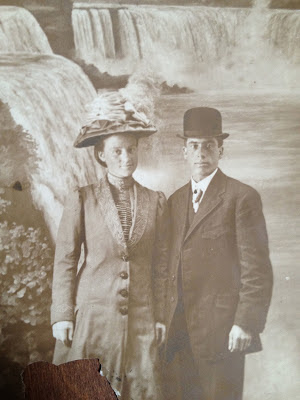
This lovely photo taken at Niagara Falls has writing on the back as it was a postcard sent to Mr. Edgar Hooper from his sister who was on her honeymoon at the time. I assume this Edith Hooper and her new husband Joseph Camm, as they married on September 10, 1910
Sept. 19/10
Hello Edgar, How is Ettie? Hope she is better by this time. We are well and having a pretty nice honeymoon. Will soon be home. Your loving sister
February 26, 2013
Genealogical Research Death Index for New York 1957-1962
The New York State Department of Health has some death records online from 1957 to 1962.
In the drop down menu in the “category” box, choose “Genealogical Research.” There are instructions for downloading the data.
The Genealogical Research Death Index assists individuals with locating New York State (NYS) death records that fall within defined genealogy years, exclusive of New York City recorded death records.
The Index contains information on decedents, parents, date of death, gender, age at death and NYS file number that will allow the public to search for individuals on a variety of genealogy criteria; if on file for at least 50 years.
Thanks to The New York Genealogical & Biographical Society for the heads-up about this online databaseFebruary 25, 2013
Family Tree DNA Special - Now is the Time!
Family Tree DNA special until Feb 28, 2013! $39.00 for a 12-marker Y-DNA test.
This helps make DNA testing affordable so if you've been putting off ordering your DNA kit, now's the time. The beauty of this is that you can wait until you see a sale for an upgrade and then start getting more and more markers tested.
See my other blog posts about testing my brother's Y-DNA and the upgrades (67 markers, Family Finder, etc) I've ordered by going to my posts under DNA JOURNEY
I've had my own mtDNA tested through Family Tree DNA
And I've ordered my brother's and my DNA tested through 23andMe. It's been an interesting DNA Journey and it's not over yet!
February 24, 2013
Heirlooms - iPhone App for Recording Family Treasures
Heirlooms is a terrific little app for keeping track of family treasures and mementos. It's fast, easy to use and pretty.
You choose an heirloom - I chose my great grandmother's toast rack and my grandfather's gold pocket watch - then you follow the instructions and icons to enter information about that item.
The empty fields include a spot to put the owner's name, the name of who owned the item originally, and a story about how the item came into your hands. Then you either take a photo, direct from the app, or choose one from your camera roll, and add that to your item entry.
Update Allows Sharing
Heirlooms also has an update available from the App Store that's pretty cool. File sharing! Now you can share your heirloom collection entries with family members via email. It's also possible to email your entries to your computer or laptop so you can access your notes on family treasures from there too.
If your relative doesn't have the Heirloom App they can get the free Reader in the App Store. This allows for viewing of the exported entry on any IOS device.
I tried emailing an entry to myself about my grandpa's gold pocket watch. It worked great! The email arrived, I opened and read it on my iPhone, then clicked on the attachment which opened in Heirlooms.
I'm impressed! All we genealogists need to do now is get our family members using this terrific little app. It's a great way to preserve family heirlooms digitally, and to share them with long-distance family.
I enjoyed using this new app and am hoping to convince my brother and my children to download it so I can share my entries with them.
Heirlooms App
Heirlooms Free Reader
Technical Details: Compatible with iPhone 3GS, iPhone 4, iPhone 4S, iPhone 5, iPod touch (3rd generation), iPod touch (4th generation), iPod touch (5th generation) and iPad. Requires iOS 5.0 or later. This app is optimized for iPhone 5.
Disclosure: I received a free copy of Heirlooms for review purposes
February 23, 2013
Creating a Family Story Book Using Flip-Pal and Shutterfly
Yesterday Volume 2 of my McGinnis Family Story Books arrived from Shutterfly. I'm really pleased with how it turned out!
First I used my amazing Flip-Pal Mobile Scanner to scan the family photos I wanted to use in my book. I like using the Flip-Pal Mobile Scanner because I can sit on my sofa and watch television while I"m scanning the photographs!
After transferring the scanned photos to my computer (easy with the memory card and USB adaptor that comes with the scanner!) I organized them into a directory on my laptop Then I uploaded them to Shutterfly. I created a different size book this time. Usually I go with the 8x8 books because they are small, easy to pick up and glance through and I just like the look of them. But this time I went with the 8 1/2 x 11 and I'm really glad I chose that size.
The 8 1/2 x 11 allowed me to insert a census image that was legible but had room around the edges for the page background. I could have added a border around those images or embellished the page with a "sticker" but I like the larger images to be simple and plain.
You can read how I organized my book at Creating Memory Books on Shutterfly It's important to plan the layout of your book before starting. Decide on how you want to organize the pages and photos - by person? Chronologically? You can always switch pages around once you've created pages in Shutterfly but you need a plan to begin.
Think about how many pages you want. I create mine to be between 20 and 25 pages. If it is going to be bigger, I break the book into separate volumes. As an example, my Story Books on my McGinnis family are in 4 volumes, one for each generation starting with my father. The smaller the book, the more manageable to create and the more likely your recipients will be to pick it up and skim through it. Anything larger than 25 pages is, for me, overwhelming to create and I believe would be too much for most people to want to glance through.
Shutterfly allows me to create photo pages, or text pages or a combination of both. It's easy to quickly pick a layout for each page using their layout options. So if you want to place two photos and one text box on a page, for example, you choose from their options for 2 photos plus text.
Then by using the "customize" feature found on each page you can resize and rearrange the photo and text boxes. You can add more text boxes if you want. Then you can change the background by choosing from their options for whatever theme you are using.
In this volume of the McGinnis family story, I added scans of newspaper clippings from a family double wedding. I am lucky enough to have the actual wedding invitation so I added that to the page along with photos of the church and of the happy couples. Using my Flip-Pal Mobile Scanner
this section took less than 10 minutes to scan and upload.
In the end the book is a lovely coffee table book resembling a scrapbook. But it has enough genealogical information and documents to give family members a taste of what I have found on the family. It also allows me to share the wonderful family photos, documents and newspaper clippings in my possession.
I can hardly wait to start on my next family story book project!
First I used my amazing Flip-Pal Mobile Scanner to scan the family photos I wanted to use in my book. I like using the Flip-Pal Mobile Scanner because I can sit on my sofa and watch television while I"m scanning the photographs!
After transferring the scanned photos to my computer (easy with the memory card and USB adaptor that comes with the scanner!) I organized them into a directory on my laptop Then I uploaded them to Shutterfly. I created a different size book this time. Usually I go with the 8x8 books because they are small, easy to pick up and glance through and I just like the look of them. But this time I went with the 8 1/2 x 11 and I'm really glad I chose that size.
The 8 1/2 x 11 allowed me to insert a census image that was legible but had room around the edges for the page background. I could have added a border around those images or embellished the page with a "sticker" but I like the larger images to be simple and plain.
You can read how I organized my book at Creating Memory Books on Shutterfly It's important to plan the layout of your book before starting. Decide on how you want to organize the pages and photos - by person? Chronologically? You can always switch pages around once you've created pages in Shutterfly but you need a plan to begin.
Think about how many pages you want. I create mine to be between 20 and 25 pages. If it is going to be bigger, I break the book into separate volumes. As an example, my Story Books on my McGinnis family are in 4 volumes, one for each generation starting with my father. The smaller the book, the more manageable to create and the more likely your recipients will be to pick it up and skim through it. Anything larger than 25 pages is, for me, overwhelming to create and I believe would be too much for most people to want to glance through.
Shutterfly allows me to create photo pages, or text pages or a combination of both. It's easy to quickly pick a layout for each page using their layout options. So if you want to place two photos and one text box on a page, for example, you choose from their options for 2 photos plus text.
Then by using the "customize" feature found on each page you can resize and rearrange the photo and text boxes. You can add more text boxes if you want. Then you can change the background by choosing from their options for whatever theme you are using.
In this volume of the McGinnis family story, I added scans of newspaper clippings from a family double wedding. I am lucky enough to have the actual wedding invitation so I added that to the page along with photos of the church and of the happy couples. Using my Flip-Pal Mobile Scanner
In the end the book is a lovely coffee table book resembling a scrapbook. But it has enough genealogical information and documents to give family members a taste of what I have found on the family. It also allows me to share the wonderful family photos, documents and newspaper clippings in my possession.
I can hardly wait to start on my next family story book project!
February 22, 2013
NEW WEB SITE EXPLORING AMERICA’S DUTCH HERITAGE
|
The New Netherland Institute in collaboration with
the New Netherland Research Center has launched a new web site exploring
America’s Dutch heritage at www.newnetherlandinstitute.org
| |
|
|
In History & Heritage, explore Dutch America through documents, artifacts, people and places. Currently featuring two new exhibits: “Arent van Curler & the Flatts: How History, Archaeology & Art Illuminate a Life on the Hudson” and “Charting New Netherland: 1597 – 1684.”
|
|
|
In Research, discover original documents through which scholars study the New Netherland era and its ongoing legacy. Just published online: A new translation of the memorandum book of Antony de Hooges, business manager of Rensselaerswijck, and an introductory essay by Dirk Mouw.
|
|
|
In Education, find tools for teachers and fun ways for students to explore on their own. Now introducing lessons plans from the 2012 Summer Institute for teachers held at the New York State Museum – first in the series is “The Fur Trade: Contact and Commerce between Indians and Dutch Settlers.”
|
|
|
In the new Shop, explore, celebrate, educate or just have fun with a basket of products related to New Netherland. Newest Book: New Netherland in a Nutshell: A Concise History of the Dutch Colony in North America by Firth Haring Fabend. (The Shop now accepts Mastercard, Visa and American Express.)
|
February 21, 2013
Ancestry DNA Now Available to USA Residents
AncestryDNA Test Provides An Affordable, Easy Way to Learn About Your Past and Family
Innovative
test now available to the general public provides analysis of your
genetic ethnicity, living relative matches, and further insight into
family history research
(PROVO, Utah) – February 21, 2013 Ancestry.com
Interest in using
DNA to explore family history is growing. In a 2012 Harris Interactive
survey, 56 percent of Americans—more than 110 million people—stated they
would be interested in taking a DNA genealogy
test. This number is 14 percent higher than the previous year. For
many, this interest in family history extends far beyond American soil.
Nearly two out of three respondents told Harris that learning about
their family’s roots outside the U.S. is one of the
most important benefits of researching family history.
AncestryDNA picks up
where the paper trail leaves off. Whereas older consumer DNA tests
utilized only 46 DNA markers, this new test analyzes more than 700,000
DNA marker locations and cross-references them
with its one-of-a-kind comprehensive worldwide catalogue of DNA
samples. The combination of an individual’s DNA with more than 40
million family trees and 11 billion records on Ancestry.com can help
people find specific ancestors as far back as the mid-17th
century by connecting with living relatives. Additionally, AncestryDNA
gives people their ethnic breakdown by percentage from 20 populations
including the British Isles or Native American—automatically tracing
their ethnicity and displaying the results in
an interactive and simple way.
“AncestryDNA
provides consumers with exciting insights into their ethnic background
and helps them find relatives who may hold the keys to exciting new
family history discoveries,” said Tim Sullivan, President
and CEO of Ancestry.com. “As a company, we are committed to helping
people connect with their past and we are excited to be able to offer a
unique, affordable, and easy way for people to learn even more about
their personal history.”
AncestryDNA helps
determine geographic and ethnic origins by comparing test-takers’ unique
DNA signatures to the DNA of people from across the globe. In the
initial beta release, users were matched with a
significant number of living relatives, and more than two million fourth-cousin DNA matches have been found for customers potentially sharing an ancestor in the database.
As more people take the test, the database will continue to grow,
providing a richer experience and more clues. People who have already
taken the test receive regular updates with the latest findings. Because
these results include the users’ ethnicities,
they may produce surprising findings that provide additional
curiosities for future research. Since the launch, 7.7 million ancestors
are now available to discover through family trees linked to DNA
results.
“We believe that the
cutting edge of DNA technology used in AncestryDNA will revolutionize
the entire family history experience,” said Ken Chahine, Senior Vice
President and General Manager of AncestryDNA.
“We have already seen huge success with our beta launch as users
discover new clues and living relatives passed down through DNA. As more
people take the test, we look forward to seeing even greater results
and more family history connections.”
Find out where you come from with an
Ancestry DNA test
You can learn even more about your family history by visiting
Ancestry.com
and signing up for a free 14-day trial.
Pricing and Availability
AncestryDNA is now available [Lorine's Note: only to those living in USA at this time] and tests start at $129 for Ancestry.com
Subscribe to:
Posts (Atom)


.jpg)


