Discover your inside story with AncestryDNA®

March 10, 2014

A Lot of Gnashing of Teeth over New Search vs Old Search

A Lot of Gnashing of Teeth over New Search vs Old Search
Approximately one year ago, Ancestry.com warned users that they would be eliminating the Old Search Engine at year's end. Meantime New Search was online and users were encouraged to use it, get used to it and be ready for Old Search to disappear.

Last Monday Old Search was removed from the website.  The predictable happened. The same genealogists who moan and groan every time any website makes changes (Facebook comes to mind...) were once more front and center. Complaints ("New Search sucks!" "I hate New Search") and threats ("I'll unsubscribe if they don't bring Old Search back!") poured onto Facebook and other Social Media.

But let's look at the facts. According to Ancestry.com only 3% of their users were still sticking to Old Search when both options were available. Also, no matter how much a vocal minority claimed that Old Search was better, it wasn't. New Search is more powerful and can do so much more than Old Search.

Yes it is a new tool. There is a learning curve. It doesn't work the same way as Old Search. But we all had over a year to learn how to make the best use of it to deliver the results we are looking for. And there are several excellent tips and videos on using New Search that are available to help the transition.

So why are some genealogists refusing to give it a try? I believe it is because deep down we don't like change. And the older we get the less we like it! One of my Facebook friends said he was cancelling his subscription to Ancestry because using New Search was frustrating. I bet it was equally frustrating when he learned to do long division or ride a bike or swim or drive a car. But I also bet he persevered and learned how to do it.

And for those who are threatening to unsubscribe or who have already done so in protest, that's what my mother always called "Biting off your nose to spite your face". Yes there are many wonderful genealogy websites out there. And yes, FamilySearch has so many databases you could spend weeks going through them. But Ancestry has many databases that are not online anywhere else. So I truly don't understand why anyone would deliberately cut themselves off from accessing every possible database they could.

I use Ancestry.com New Search. And I like it. I have no problems narrowing down my searches to get more relevant results. If you want to learn how to use New Search, please have a look at these wonderful tips that Randy Seaver has been posting and the Videos that Crista Cowan has put online.

Start with Randy's post Ancestry Drops "Old Search" - Hysteria Ensues He has links there to his helpful tips for using New Search. Then pop over to YouTube for one of Crista Cowan's videos Smart Search: Tips & Tricks

You might also check out my July 2013 blog post Old Search vs New Search - Your Chance to Submit Feedback. It's too late for feedback but you can read the explanation from Ancestry.com and follow their links for tips and suggestions.

Just because something is new or different doesn't mean we all have to ignore it or get angry, or cry out "why do they have to keep changing things". It's called progress. And without progress we would still be using smoke signals as a method of communication instead of email, texting, telephones, Skype, iPhones, Video Chats, Magic Jack and more.  And who knows, those genealogists who are refusing to accept New Search might just surprise themselves with how great it is if they gave it half a chance.

March 9, 2014

Sharing Memories: Movie Time!


Sharing Memories: Movie Time!
Sharing Memories is a series of weekly prompts to help all genealogists (including me!) with writing up memories of our ancestors and our childhood. 

We all love to find a diary or letters written by great grandma or grandpa where they talk about their lives and share their memories. Think how excited one of your descendants will be to read about your memories and your stories! These stories will be lost after a few generations unless we preserve them. And what better way than in a weekly themed post. 

At the end of the year you will have 52 stories written about your childhood, your parents, grandparents and who knows what else.

If you write your own blog please use the hashtag #52SharingMemories if you are posting on Twitter or Google+  You can also  post your stories as comments on this blog post or in a private journal. It's your choice! The important thing is to write those memories down now! 

Today's topic or prompt is Movie Time! Did you go to the matinees every Saturday? Maybe your town or village didn't have a movie theater - mine didn't.  Maybe you remember your very first movie. What did you see? How old were you? Tell us about the experience - the sights, the sounds, the smells of food in the lobby. 

The village where I grew up did not have a local theater and the closest was in Oshawa which was about 16 km (10 miles) away. I don't recall my parents ever going to  what we called "the show" so of course we kids never got to go either. I was quite young when my sister-in-law took me to see Alfred Hitchcock's Psycho. Yep. My mother had forbidden her to take me but she did it anyway! 

And my mother was right. I had nightmares for months. But I loved the adventure and the excitement of being with my sister-in-law who I adored. I'd never had popcorn before and Jeanette bought me popcorn and a coke. For a shy quiet kid from the wrong side of the tracks who rarely had a treat of any kind, it was a heavenly day for me.

The next movie I saw was Walt Disney's "The Parent Trap".  I loved it! But I don't remember who I went with and I was too young to go on my own. 

Then came the big excitement of going all the way to the big city of Toronto with my first boyfriend to see "Ben Hur". The only other times I'd ever been to the city was for the yearly Santa Claus Parade (but I always got terribly car sick and threw up for the entire 40 minute drive each way) and for my eye appointments at Sick Children's Hospital (ditto re the throwing up!) 

By the time I was 16 years old I had probably seen 4 movies.  To this day I'm not really a movie fan.

Credits: "Vintage Film Reel" by ponsulak at freedigitalphotos.net

March 8, 2014

Six Generations of Strong Females on International Women's Day

Six Generations of Strong Females on International Women's Day

Today is International Women's Day and to celebrate I am sharing a collage of 6 generations of my direct maternal line. It is wonderful to have photos of our direct female lineage back to my great-great grandmother Sarah born in 1836.

Starting from the left we have Sarah Stead, my great-great grandmother. Next is Sarah's daughter Sarah Simpson, my great grandmother. Then we have Sarah Simpson's daughter Ruth Fuller, my grandmother. Then comes Ruth's daughter Joan, my mother. Then me and then my daughter Judy. Then our direct maternal line is done as my daughter had sons but no daughters.

My maternal DNA has been tested and shows that I am Haplogroup J2a1a1b . My DNA shows my origins as Irish, British,  French, German, Scandinavian, Northern European, East Asian and Native American.

Have you tested your MtDNA? It's interesting and fun to do that!

March 7, 2014

Searching Ontario Canada Land Records, eh?

Searching Ontario Canada Land Records, eh?
1826 Land Petition John Greenlees
Last night I stumbled on two land petitions for my 3rd great grandfather John Greenlees. That's right, I said "stumbled on". Yes it's a bit embarrassing to admit my finding these petitions from 1826 and 1833 was not an act of brilliant genealogy sleuthing. 

Finding land petitions may not sound exciting but not only do they add details to an ancestor's life, they often contain clues to other records or facts that were not previously known. In this specific instance the 1826 petition gave John's year of immigration from Ireland to Ontario Canada. It also provided the number of children he had in 1826.

Last night I went to a lookup service site I use sometimes and entered GREENLEES into the site search engine. I’ve searched for my Greenlees family before on this site but the owner often adds new indexes so since I was bored with TV I figured what the heck. Bingo! Up popped two index entries for my ancestor in the Upper Canada Land Petitions (UCLP). That puzzled me because the UCLP have been online as a searchable index at Library & Archives Canada (LAC) since 2010, and the actual images have been online for at least a year.  I’ve searched them dozens if not hundreds of times but I’ve never seen a petition for John Greenlees. 
 
My next stop was the online UCLP indexes at LAC. It’s a bit tricky finding the petitions there because the searchable indexes are on one spot on the site and the actual digitized images are on another – and there is no link from one to the other. First you head to the Indexto Upper Canada Land Petitions (1763-1865) to search the indexes. But here’s the important part of searching this index. When you search for an ancestor, take advantage of the wildcards that LAC allows. 


For example, searching for GREENLEES does not bring up my ancestor John. But searching for GREEN* brings him up for both those petition entries I found on the other website. For those his name is rendered as GREENLESS.   Here’s the embarrassing bit – I know to use wildcards. I do use wildcards. But apparently I never used them when searching for my Greenlees family! Either that or I somehow overlooked searching for them in the UCLP. Once your name of interest is found you must click on the link for each name. 

Clicking on the index entry for John Greenlees 1826 provides me with the information I need to find the digitized image(s) online. 

Name:  Greenless, John
Place:  Nelson
Year:  1826
Volume:  208A
Bundle:  G 14
Petition: 142
Microfilm:  C-2032
Reference: RG 1 L3
It would be nice if LAC had an easily found link to the digitized images but unless you then go back to your results, click on SEARCH HELP, then choose HOW TO OBTAIN COPIES you will be lost as to what to do next. Choosing HOW TO OBTAIN COPIES takes you to an explanation and buried in it is a sentence saying you can view the digitized images for the UCLP online. The word “online” is linked. 

But guess what! Clicking on that link takes you to another page of information about LAC’s digitization projects. Buried within this page is an explanation that “some” items from LAC’s “numerous collections” have been digitized and you can search for what you want by going to a BROWSE BY TITLE or BROWSE BY TOPIC page. Phew! Nowhere will you find a link that specifies you can search the UCLP digitized images. That's a major fail in my mind.

But the workaround is that you can go directly to the digitized UCLP images with the link I have provided here. I suggest you open a second browser window for the actual images so that you have your first window still open to the information you need (Microfilm #, Volume #, Bundle and Petition #) You'll be jumping back and forth to doublecheck that you are in the right volume and bundle as you search for the petition you want.


Using John Greenlees 1826 petition, I’ll show you how you find the image you want on the digitized microfilm. I need Microfilm:  C-2032 so I must go page by page until I find the film number I need.  It is on the 3rd page of film numbers. I click on the film number and the first image of 749 appears. The first page won’t help me so I usually enter 50 in the box so I go to image 50. 

Source details at bottom of digitized image
 Scroll right to the bottom until you can see Upper Canada Land Petitions and the source detail including the Volume, Bundle, Years and more. We need Volume 208A for John Greenlees. But a look at the info on image 50 shows we are in Volume 208. So we have to jump ahead. There is no way of knowing how far ahead you need to go so I just usually go by 50 at a time. Sometimes I go head a few hundred because you can always go back. So I jumped to image 100 (still not the right volume) and then 200. Image 200 shows me I am in Volume 208A, Bundle 14.  We can also see it is for letter “G”. Now we check what Bundle we needed for John Greenlees and it is G14. So we are in the right Volume and Bundle. 

Next is the all-important petition number. We need #142. So now we scroll UP on the image we are on (200) and check the top of the actual petition.   The petition number is usually on the right top but sometimes on the left. In this case Image 200 shows the petition number on the top left is 120a

The petition we want (142) is ahead on the reel. You might do the math and think you only need to go head by 22 but most petitions have at least 2 pages, sometimes dozens. So I would go ahead 50. I’m not worried because if I jump past #142 I can always go back.

Going ahead 50 takes me to image 250 and I can see that it is Petition 131a. I’ll go ahead another 25 and see where I am. That brings me to Petition 139. Finally I hit on image 302 which shows me the petition #142 for John Greenlees. If you happen to get to your desired petition # but it has a letter after it (such as 142b) then you have gone too far. The petitions are numbered in sequence and always start with a number. Each page of the same individual’s petition is given a letter so if John Greenlees has a 4 page petition they will be numbered 142, 142a, 142b and 142c.

Be sure to save every page including the “envelope” as it has important information on it. I’ll explain how to interpret the information on the "envelope" in another blog post. Meantime you may want to read about other land records in Ontario - where to find them and how to search the databases. It is found at Finding Ancestors in Ontario Land Records


March 6, 2014

52 Ancestors: Anna Kuhn Bellinger, Naughty Girl!

52 Ancestors: Anna Kuhn Bellinger, Naughty Girl!
My 8th great-grandmother Anna Kuhn was born in Germany about 1659. I'm writing about Anna as part of Amy Crow's Challenge: 52 Ancestors in 52 Weeks and also as part of Women's History Month Challenge.

In 1674, at the age of 15, she was married to Jorg Bruning at Huttengesas, Germany. Jorg Bruning was a much older man, and the marriage was a most unhappy one for poor Anna. 

While living at Huttengesas with her husband, she fell in love with Nicholaus Bellinger, son of Hans Bellinger. She  ran away with Nicholaus  and had a son, my 7th great-grandfather Marcus Bellinger, in 1682. Nicholaus Bellinger and Anna Maria finally  received church permission to marry, and were wed on 25  November 1685.

It was considered such scandalous behaviour to run off with another man while married to someone else and have an illegitimate child that the minister in the church entered this in the church books:

"Nicolaus Bellinger and Anna, daughter of Hans Kuhn, were married 25 November 1685 as per the order of the noble government. She had md. some years ago Jorg Bruning at Huttengesab, but she was not compatible with him, so Bruning went from her and she from him. She went away with this Nicolaus Bellinger and had an illegitimate child - a little son,  so that the aforementioned Jorg Bruning has contracted another marriage. 

After all this however, the above mentioned Bellinger has remained as a stranger. She sent a request to the honourable government to let them stay in the country, and this finally has been permitted by the aforementioned honourable government which ordered me to marry them with prior published penitence and to avoid further trouble and also to legitimize the rearing of this blameless child" 
In 1710 the Bellinger family joined with other Palatine refugees coming to New York. There were 3 000 Palatines on 10 ships that sailed for New York and approximately 470 died on the voyage or shortly after their arrival.  I've always felt sorry for poor Anna married at 15 to someone she didn't love. I really can't blame her for running away to find happiness. But she suffered greatly, as did all the Palatines. First persecuted in their own country because of their religion and then treated as indentured servants by the British. 

Another strong female ancestor for me! 

March 5, 2014

Women's History Month: Irene Parlby One of the Famous Five

The Famous Five were 5 Canadian women who created a petition  in 1927 they sent to the Supreme Court of Canada to ask if women were "persons" under the law. In 1928 it was unanimously decided by the Court that the answer was "no" but in October 1929 the decision was overturned and for the first time women were legally considered "persons". 


It totally blows my mind to put this in context - my mother was 13 years old before she was considered a person. My grandmother was 35. I cannot imagine not being considered a "person". 

Women's History Month: Irene Parlby One of the Famous Five One of the group of Famous Five was Irene Parlby. I wanted to know more about Irene - who was she and what kind of upbringing did she have that contributed to her determination to make changes for women.  

Unforunately I've never had the opportunity to see the movie The Relunctant Politician about Irene's contributions to the women's movement.   

There are a few brief biographies of Irene online but they don't have the kind of meat I was looking for. Who were her parents? Where did she live? What was her life like?

Baptism Elizabeth Lynch in Bombay India 1845. FindMyPast.co.uk
My research found that Irene was born Mary Irene Marryat in London England in 1868 to parents Ernest Lindsay Marryat and Elizabeth Lynch. Her father was a British Army Colonel and was stationed in India for part of his military career. Irene's mother Elizabeth was born in Bombay India in 1845 to Edward Patrick Lynch, a well-known Lt.-General in the English Army. Edward Lynch entered the India army in 1826 and was stationed in India, Persia and Afghanistan. 
Marriage Marryat-Lynch in Bombay India 1866. FindMyPast.co.uk
Elizabeth lynch was a widow when she and Ernest married in Bombay India in 1866. She had married Maxwell Graham in India 3 years previously. Her first husband died of cholera one year later in March 1864 at the age of 25. Maxwell was also in the Army. Elizabeth was 20 years old when she was widowed. At the time of their marriage, Ernest Marryat was  a Lieutenant in the Royal Bombay Engineers. 

There was a strong military presence in Irene's family with her father, maternal grandfather and maternal great-grandfather highly placed army officers. Being raised in a military family no doubt meant a strong emphasis on routine, discipline, accountability and duty. 

The Lynch family had long standing ties in the military. Irene's great-grandfather Henry Blosse Lynch had a varied career - as a mountaineer, volunteer in the Indian Navy, Persian Gulf surveyor, explorer, interpretor who was fluent in Arabic and Persian. and many other accomplishments. 

Irene's father Edward Patrick Lynch was born in Mayo Ireland. He enlisted in the Indian Army in 1825 and did not marry until 1843 when he wed Louisa Stirton in Bombay.  Louisa died in October 1846 on board a ship sailing to England [Gentleman's Magazine. Jan. 1847. p. 110. http://search.fibis.org/frontis/bin/aps_detail.php?id=1162466 On her passage to England, Louisa, wife of Major E.P. Lynch, K.L.S., Bombay Army]. In 1848 Edward married her younger sister Emily Elizabeth.

The Stirton sisters were the daughters of Andrew and Sarah Stirton and were born in London England. Andrew was born circa 1784 in London England and in the 1851 census he is listed as a Marine Fund Holder. 1851 was a rough year for the Lynch family. On January 1 of that year, Edward and Elizabeth Lynch's 16 year old servant Sarah Shuaghnessey died of Cholera and the next day their only son, 1 year old Edward Bloss Stirton Lynch, also passed away. By the time of that 1851 census the two older sisters, 6 year old Elizabeth and 7 year old Sarah were living with their Stirton Grandparents, Andrew and Sarah, in England. The girls were most likely sent away after their younger half-brother died.

The 1871 census for London England finds Mary Irene as a 3 year old living with her mother Elizabeth age 25 and younger brother Ernest Patrick Lynch Marryat age 1. 

By 1896 Mary Irene had left England for Alberta Canada where she met and married Walter Parlby. It was then that Irene began taking an active role in women's issues. She became President of the United Farm Women of Alberta and was later elected the first female cabinet minister in Alberta. Irene's focus was on improving the lives of rural women and children but her social activism had far-reaching effects for all women once she became involved in the petition to have women recognized as people. The decision that women were persons eligible to be named to the Senate of Canada was handed down on October 18, 1929.

Her only child Humphrey Parlby was born in 1899 in Alberta. Irene retired from politics in 1935 but continued to speak passionately about women's rights. She died at the age of 97 in Alberta.

Notes: Other information and material about Irene Parlby is available at the Glenbow Archives, Alberta

March 4, 2014

First World War: love letters from the trenches

First World War: love letters from the trenches
"A new book gathers together the most moving, intimate and fascinating correspondence to and from soldiers fighting in the First World War." [Mandy Kirkby on telegraph.co.uk]

"Love Letters of the Great War brings together some of the most romantic correspondence ever written. Many of the letters collected here are eloquent declarations of love and longing; others contain wrenching accounts of fear, jealousy and betrayal; and a number share sweet dreams of home. 

But in all the correspondence - whether from British, American, French, German, Russian, Australian and Canadian troops in the height of battle, or from the heartbroken wives and sweethearts left behind - there lies a truly human portrait of love and war. " [Amazon.com]

Go to telegraph.co.uk to see some of the letters and photos from this book “Love Letters of the Great War” (Macmillan), edited by Mandy Kirkby. Available on Amazon.com as Love Letters of the Great War 

If you love old letters, you might want to visit Past Voices which publishes letters from soldiers and civilians in the 19th and 20th centuries. 


March 3, 2014

Women's History Month: Clara Moockers Post, Strong Female Ancestor

Women's History Month: Clara Moockers Post, Strong Female Ancestor
In honour of Women's History Month (March 2014) I issued a challenge to all geneabloggers to write a  minimum of 10 blog posts this month about women who have made a difference.

Clara Moockers Post, born ca 1621 in Holland was my 9th great-grandmother.  Here is her story:


For 24 years, from 1630 to 1654, Recife, a Northeastern city in  Brazil, was held by the WIC (West India Company).

My 9th great grandparents Captain Adriaen Crijnen Post and his wife Clara Moockers, were stationed in Recife during this time. They had 3 children born in Recife between 1644 and 1648.  I  often think of Clara and how strong she must have been to raise a family in the jungle with the heat, the dangers of various illnesses such as malaria, and the poisonous snakes and other dangerous wildlife.

Adriaen and Clara's daughter Maria (my 8th great-grandmother) was baptised in Recife Brazil in June 1649 [Doopregister der Hollanders in Brazilie 1633 - 1654]. By the time Brazil fell to the Portuguese in 1654, the family had left for the Netherlands and then on to New Netherland (present day New York state).

On 30 June 1650 the ship "New Netherland's Fortune" sailed, arriving in New Netherland on 19 December 1650.

Adriaen and his family were on Staten Island by 1655. Adriaen was a representative of Baron Hendrick van der Capellen, the owner of one-third of Staten Island. As the superintendent of a group of twenty people who were to farm Staten Island, Adriaen set up a colony which flourished.

In the summer of 1655 the Peach Tree War began over Hendrick Van Dyke's shooting of a Native woman taking peaches from his trees in his orchard in Manhatten. As a result, the settlements on the lower Hudson River and around New York were destroyed by Iroquois attackers. On 15 September 1655, the colony on Staten Island was burned to the ground by the Natives from Hackensack. Twenty-three people were killed and sixty-seven taken prisoner, among them Adrien, his wife Clara, their five children, and two servants.

In October 1655, Adriaen was released by the Hackensack chief Penneckeck to bargain with Petrus Stuyvessant for the release of prisoners. Adriaen made the journey between Manhattan and the Native headquarters at Paulus Hook, New Jersey several times before an agreement was reached. Fifty-six captives were released in exchange for powder, lead, guns, blankets and wampum. Among those freed were Adrian's wife and children.

Returning to Staten Island Adrian was ordered by Van der Capellan to gather survivors and erect a fort. Trying to keep the group fed, he found a few cattle that the Natives had overlooked roaming in the woods  That winter Adrian and his family camped in the company of some soldiers  in the burnt-out settlement.  They butchered some of the cattle they had found and obtained milk from others. They survived the winter with  little food and rough shelters. Stuyvessant recommended to Post that he and "his people" and cattle move to the stockade on Long Island but Adrian and Clara refused. They stayed on Staten Island virtually alone. 

By Spring of 1656 Adrian was ill and unable to perform his duties, so Clara requested that someone else be appointed as van der Capellen's agent. In April of 1656 Clara petitioned Stuyvessant asking that the soldiers be allowed to stay, but Stuyvessant decided that since there were only 6 or 7 people on the island, a garrison was not required and they should all move to Long Island.


Adriaen and Clara eventually left Staten Island and settled on the mainland of present-day Bergen, New Jersey. Adriaen died in 1675 but it is not known what happened to Clara. She was a strong female, mother to 9 children, who endured much and adapted well to whatever difficult conditions she faced. I'm so proud to have her as my ancestor.

Credit: Image from Fotolia

March 2, 2014

Sharing Memories & Women's History Month: Who Was Your Favourite Relative?

Sharing Memories & Women's History Month:  Who Was Your Favourite Relative?
Ruth Simpson 1907
Sharing Memories is a series of weekly prompts to help all genealogists (including me!) with writing up memories of our ancestors and our childhood. 

We all love to find a diary or letters written by great grandma or grandpa where they talk about their lives and share their memories. Think how excited one of your descendants will be to read about your memories and your stories! These stories will be lost after a few generations unless we preserve them. And what better way than in a weekly themed post. 

At the end of the year you will have 52 stories written about your childhood, your parents, grandparents and who knows what else.

If you write your own blog please use the hashtag #52SharingMemories if you are posting on Twitter or Google+  You can also  post your stories as comments on this blog post or in a private journal. It's your choice! The important thing is to write those memories down now! 


Sharing Memories & Women's History Month:  Who Was Your Favourite Relative?
I'm also posting this as part of my challenge for Women's History Month. See Women's History Month: A Challenge to Geneabloggers! for 10 suggestions for honouring women in March. I'm writing about Prompt #4: Write a biography of your favourite female Ancestor. Be sure to tell us why she's your favourite
Hands down it was my Grandma Bates. I think of her as Grandma Ruth but we never used her first name. Grandma was fun and lively and loved the colour red. She often wore a red pantsuit with a white blouse or a red skirt and white blouse and she always wore her ruby ring. That ring is now mine and I wrote about it coming back to me on Grandma's Ruby Ring

Born in Ramsgate Kent England in 1894 to parents David George Simpson and Sarah Jane Stead, Grandma was a sickly child and spent a lot of her days in bed only able to peek out her bedroom window.  Her family called her Dolly because she was so tiny and cute. 

Miss Mulligan's Dance Classes. Ruth is back row center
She didn't attend school when she was supposed to, being to ill to begin. But eventually she did go to the Ellington School in Ramsgate. I have pictures of her in her dance classes at the school.  

Simpson Family ca 1900
Grandma is 2nd from left
She suffered from rickets and in later life had a little twitch which I thought was quite endearing! She would have a genteel sniff and tiny twitch of her head as she was talking. 

She and my mom did not get along, and they fought constantly. Grandma was rather delicate and could become quite frightened or upset very easily. The wind bothered her and she would become very agitated on windy days. She was terrified of water and when I would visit her when I was in school she would only allow me a few inches of water in the bathtub in case I drowned. 

Her husbands adored her! She was their little princess and had them wrapped around her little finger. She married three times, and outlived all of her husbands. They waited on her hand and foot and never seemed to mind her idiosyncracies. 

I loved listening to her stories of her life in Ramsgate and about her siblings and parents. In fact she was the reason I became so fascinated with family history and stories at a young age. 


Ruth and daughters Lillian (left) & Joan (right)
Guelph ca 1918
Grandma's dad was a coal dealer, an epileptic who was often under the weather recovering from a seizure. Her mother, who Grandma said was a wonderful cook, ran a boarding house to make extra money for the family. 

In 1913 at the age of 19 Grandma sailed for Canada with her fiance Charles Fuller. They were joining her older brother Ern in Toronto Ontario and would make Canada their new home. Grandma never recovered from the terror of that sea voyage. Years later when she was in a home and near death she would tell me how much she longed to see her mother again and in a shaky voice ask me repeatedly "Do we have to go by boat?" At that point she could not remember that her mother was long gone. 

Grandma and her husband Charles settled in Guelph Ontario where they raised a family of 3 girls, including my mother. After Charles died, Grandma married a man who was hired as a guard at the DIL Munitions Factory in Ajax Ontario during WW2 so Grandma also took a job there. 

My mother followed suit and also moved to Ajax with her sister and their 4 children while their husbands were overseas in WW2. Mother also worked at the Munitions Factory during the war. Grandma didn't build bombs, instead she worked in the Cafeteria at the plant. Grandma was a bit unusual for her time as she almost always had a job of some sort. Her first husband bought her a Tobacco Store beside the Movie Theater in Guelph so that she would have something to keep her occupied. After working in the Munitions Factory during WW2, she moved back to Guelph and took a job at a large department store. She worked behind the counter of the women's dress and glove department and she loved it.


Fuller family in Guelph 1923
Baby Eileen, Ruth, Charles,
my mother Joan seated & Lily standing
Grandma was the person I went to when my mom and I would fight. As a teenager I'd take the bus to Guelph (where she lived with her third husband) and spend a few days with her sharing my frustrations and anger. It was very sad to see her later in her life as the aging process took its toll. 

My family have always told me I am just like Grandma Ruth. My mother told me that's why she and I didn't get along because I was, in her words, "...just like my mother!" 

Here's the odd bit - Grandma married 3 times. So did I. Grandma was 47 when she was widowed. So was I. 

Grandma ended up living with my widowed mother and another widowed daughter but that was quite stressful for all concerned as she and my mother could not go more than an hour without arguing. 

Eventually she had to be moved to a home in Owen Sound where she became increasingly confused and frightened. It was very difficult to visit her and see how far she had slipped from reality. She died in 1985 at the age of 90 and I remind myself she had a good long life and was loved by many. But I miss her.

March 1, 2014

Women's History Month: A Challenge to Geneabloggers!

DIL Plant Ajax Ontario where my Mom & Grandmother worked in WW2
In honour of Women's History Month (March 2014) I want to issue a challenge to all geneabloggers to write a  minimum of 10 blog posts this month about women who have made a difference.

I'm going to tackle this challenge too. I plan to write about 10 women who made a difference somehow. Perhaps they made a difference in my life, or to the world. But I want to recognize women this month - women who suffered hardships but endured, women who were the first to challenge what had been a man's world, women who made important discoveries, and women who were pioneers.

Ten ideas that might help you to join me in honouring women this month are


  1.   Which of your female ancestors were alive when women achieved the right to vote.  How do you think they reacted to the ongoing suffragette movement? Different countries extended the right of voting for women in different years and even within one country, different areas sometimes had different rights. For example in Ontario Canada women who owned property could vote for school trustees as early as 1850. In 1917 women in Canada gained the right to vote in all elections. It was 1920 before women in the USA were given the right to vote. In the UK women over the age of 30 who met certain property qualifications could vote but it was not until 1928 that all women over the age of 21 achieved that right.

  2. Do you have a  female relative (direct ancestor or collateral lineage) who played an active role in women's issues? Perhaps one who was a Suffragette or was a pioneer in a male-dominated role or occupation?  Perhaps she sailed to the New World to start a new life in the 1600s or was a refugee from a war-torn or religious-intolerant location. Tell her story in a blog post or comment here on this blog.

  3. Choose one female ancestor and the historical context during her life. Pick one historical event that would have impacted on her life. Perhaps she lived through the Spanish influenza in the early 1900s or she was widowed during the Civil War, or lived through the Depression.

  4. Write a biography of your favourite female Ancestor. Be sure to tell us why she's your favourite

  5. Make a list of your direct line maternal ancestors beginning with your mother. So you will list your mom, her mom, her mom's mom and so on, back as far as you can. Now figure out how many children each female ancestor had. Did the females in your direct maternal line tend to have the same numbers of children each generation? Did they have more? Less? Were they prolific or are there few children born to each woman? Is there a pattern emerging?

  6. Write about your mtDNA findings. If you haven't been tested yet, order an mtDNA kit!  There are several companies offering DNA tests - Family Tree DNA, Ancestry DNA, 23andMe.com

  7. Did any of your female ancestors participate in some kind of war-related activity? My mother and grandmother both worked in a Munitions Factory in WW2.  Perhaps your ancestor rolled bandages or knitted socks for the troops. Write about one ancestor who was active in some way during a war or skirmish.

  8.  Which female ancestor do you most identify with? Tell us what she did or what she was like and why you identify with her

  9. Was there a female (teacher, minister, friend, relative) who impacted on your life?  Tell us about her

  10. Did any of your female ancestors or relatives follow a non-traditional female role either in their relationships, occupations or in society? 
I hope you'll join me in recognizing some fascinating and inspiring women this month.

February 28, 2014

1919 Letter from Canada Surfaces in Old Trunk in Australia

1919 Letter from Canada Surfaces in  Old Trunk in Australia
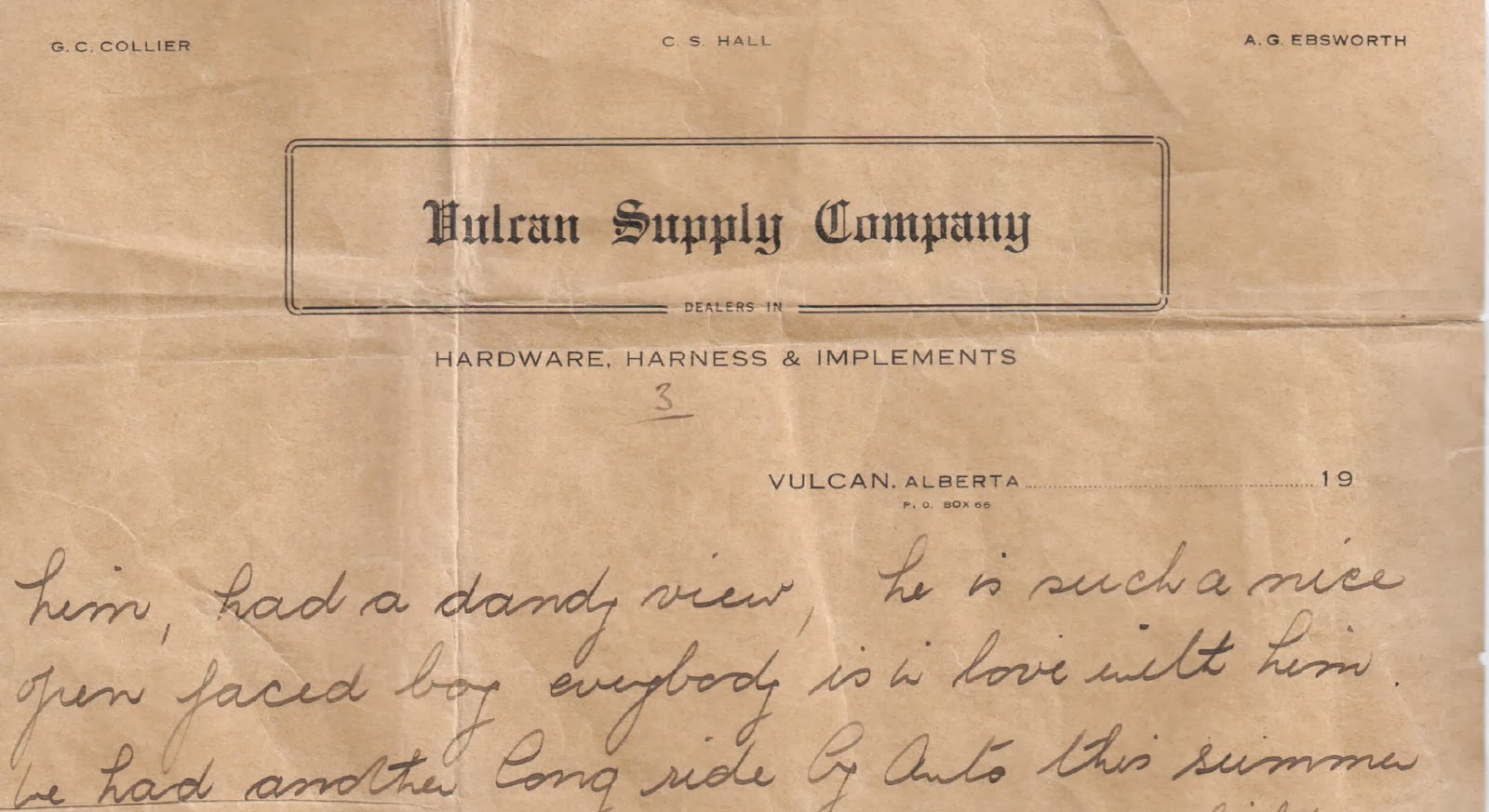
An old trunk in Australia held a small treasure - a letter written November 15, 1919 in Vulcan Alberta Canada. Victoria Collier wrote the letter on stationary of the Vulcan Supply Co. and addressed it to a Miss Scholz. 

The letterhead provides 3 names in its business header, one being G. C. Collier. In the first paragraph the writer talks about welcoming the boys home [back from the war] and adds "Geoff has his four brothers home now. One was killed and one sent to Siberia."

The letter gives a fascinating peek into post-war times in the small town. It also provides terrific clues to the families, providing tiny entries such as these:


"My sister Mabel is well and talks of coming out to see me..."
"Aunt Julia in England... is 85 next birthday..."

A genealogist can't let those clues go, can they? You guessed it, I had to investigate to see if I could turn up anything more on the families!

In 1911 the Collier family was living in Medicine Hat, Alberta. They are recorded as:
  • Goffrey, 22, harness maker born England
  • Violet, 21
  • Walter, brother, 20, salesman for stoves, born England
The 1916 census for Alberta reveals that Guthrie [sic] Collier, 27, his wife Violet, 26 and two sons Russell (4) and Albert (10 months) were living in Lethbridge Alberta. Guthrie was born in England and shows his immigration year as 1907. Violet was born in Tasmania and gives her immigration year as 1910.[Ancestry.com ]

By 1921 the family was living in Bow River Alberta and were listed as:
  • Joseph [sic], 33 born England, harness maker, owns his own shop, immigrated 1907
  • Violet, 31 born Tasmania, immigrated 1911
  • Russell, 9, born Alberta
  • Albert, 5, born Alberta
  • Ruby, 3, born Alberta 

The Lethbridge Herald of July 04, 1940 - Page 8 reveals that Godfrey's mother was visiting the family. I found evidence that she died in 1943 and is buried in Lethbridge Alberta

Searching in U.K. records found Godfrey as a young man in 1901 with his family in Dorset. His parents were William, born Buckland Newton, Dorset, and Emily Collier born
Piddletrenthide, Dorset. Their children were Charles E. 16, Harry J. 14, Godfrey C. 12, Walter G. 10, Horace A. 7, Sydney L 4 and William W. 2 [Ancestry.com ]


British Army WWI Service Records, 1914-1920
According to online ships passenger lists on Ancestry.com , 19 year old Godfrey arrived in Canada on
25 Mar 1908 on board the Empress of Ireland


Godfrey's brother Horace enlisted in the British Army in WW1 and was killed 13 October 1914. He was a Lance Corporal in the Dorsetshire Regiment.

Further research found Violet and Geoff's graves in Vulcan Cemetery, Vulcan Alberta.

Violet Nora Collier
1890-1962

Godfrey Cyril Collier
1889-1965

Finding Violet's middle name on her grave marker allowed me to find her and her sister Mabel (mentioned in Violet's letter) and their parents. Violet was born in 1890 in Frankford Tasmania to Alfred Boucher Welch and Albertina Bugg. Her sisters Mabel Dora were born in 1884 and Florence Kate in 1886. [http://portal.archives.tas.gov.au/menu.aspx?detail=1&type=P&id=302555]

Violet's father Alfred Welch was from Surrey England. He and Albertina applied for land in Tasmania in 1882.  The record states that Alfred was 21 and Albertina was 25 and they had recently arrived on the SS. Garanne or Garonne [Tasmania, Australia, Land Applications and Warrants, 1868-1887] The Garonne arrived in Sydney from London England on 10 November 1882.

20 year old Violet arrived in British Columbia Canada from Sydney Australia on 21 September 1910 on board the Marama. [Canadian Passenger Lists, 1865-1935]
 
Read Newly found First World War-era letter from Alberta woman a window through time to early 20th century for the complete story. You can also download the entire letter in .PDF format

February 27, 2014

52 Ancestors: Great-Grandpa's Horse Saves the Day!

52 Ancestors: Great-Grandpa's Horse Saves the Day!
1882 Wedding
David George Simpson & Sarah Stead
Amy Johnson Crow has a new challenge for geneabloggers called Challenge: 52 Ancestors in 52 Weeks. Amy challenges genealogists to write about one ancestor once a week. I'm having fun with this and I hope you are too! 

My great-grandfather David George Simpson (1861-1921) was a coal dealer in Ramsgate England. My grandmother, his daughter Ruth, used to tell me stories about her dad. I loved hearing them! 

One I remember most was how her dad made his daily rounds with a cart and his horse to deliver coal to his customers. Great-grandpa had epilepsy and so frequently he suffered seizures on his route. Apparently his horse, knowing the route well, simply carried on without any guidance from David.  

At each house on the route, the horse would stop and the customer would come out, check on Great-grandpa, take their allotment of coal and send the horse on its way. Then the horse would take Great-grandpa home when the route was done.

Grandma Ruth also told me that her father had what she called "a withered left arm". I don't know exactly what she meant by that but she said he had no use of it, and when I look at photos I have of David George it does seem that he hides one of his hands. 

My Great-grandpa had a sad childhood. When he was 13 his father died suddenly of pneumonia. David's mother was pregnant with her 5th child and David was her oldest. Two months after the father's death, David's youngest sibling was born but sadly that child died at the age of one month. David's mother had to take in laundry to support her family. After David married his widowed mother came to live with the family.

David George died of an epileptic seizure at the age of 59 at his home in Ramsgate. 

Simpson Family Ramsgate, Kent England ca 1900
Standing Left-Right: Ruth (my grandmother), Albert, Lillian, Ernest (Uncle Ern), Frank
Seated: David George & wife Sarah Stead. In front is Uncle Syd. Syd, Ern, Frank and Ruth emigrated to Canada while Albert settled in Australia.

February 26, 2014

Update: FamilySearch Adds More Than 4.5 Million Indexed Records


FamilySearch Adds More Than 4.5 Million Indexed Records and Images to Collections from Brazil, China, Ghana, Italy, Netherlands, Philippines, and the United States
 
FamilySearch has added more than 4.5 million indexed records and images to collections from Brazil, China, Colombia, Ghana, Italy, Netherlands, Paraguay, Philippines, Portugal, Spain, and the United States. Notable collection updates include the 1,165,725 indexed records from the U.S.,West Virginia Marriages, 1780-1970, collection; the 469,903 images from the GhanaCensus, 1984; and the 415,997 indexed records from the UnitedStates Census, 1860 . 

 Search these diverse collections and more than 3.5 billion other records for free at FamilySearch.org.

February 25, 2014

Such a Great Idea - Father Gives Daughter Priceless Gift

Such a Great Idea - Father Gives Daughter Priceless Gift
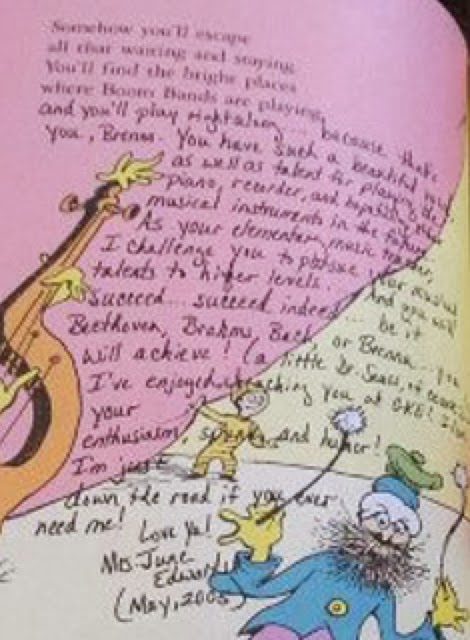
This is an inspiring story about a loving and creative dad! What a wonderful gift he gave his daughter the day she graduated from High School. 

He started with the Dr. Seuss book "Oh The Places You'll Go" which he took to her teachers and coaches at the end of every school year. As he put it

"Every year, for the past 13 years, since the day you started kindergarten I’ve gotten every teacher, coach, and principal to write a little something about you inside this book."

Such a great idea! Please take a moment and read the whole story Father Gives Graduating Daughter a Priceless Gift