Discover your inside story with AncestryDNA®

May 18, 2009

Abandoned in Australia Part 4: the children left behind

Determined to focus on what happened to poor Sarah's sons - Ebenezer the child born at sea en route to Australia in 1867, William, Charles and Edward, I set aside the other wonderful clues in Sarah's Death Registration.

More help poured in from Australians who had read my query. The first item to arrive was the death registration index for little Ebenezer. Sending off for the certificate revealed that on 8 Oct 1867, Ebenezer Sydney STEAD, male 5 months old, born at sea, the son of William Stead and Sarah Elvery, died of consumption and was buried the next day at Haslam's Creek cemetery.

Poor William Stead and his family! In the space of 5 months he lost his wife, 31 year old Sarah Elvery, and his newborn son Ebenezer. There he was, living at his brother Edward's home in Sunny Corners (near Sydney), a widower with 4 children under the age of 7. What choices he was faced with! Stay in Australia? Return to England? He must have agonized over how he would care for all his children.

Research into Sunny Corners, where his brother Edward was living with his wife and young family, showed it to be very isolated. Presumably William knew no one other than his brother Edward. He would need a job, but who would care for his children while he worked and where would he find one? I knew he returned to England, as he remarried there one year later (November 1868). But which children besides my great grandmother Sarah did he take back with him? And who did he leave behind?

After a rather lengthy exchange of responses to my original query, and me sending off to Australia for certificates, and searching the 1881 English census (which was not online at that time) I had my answers.

Edward Stead, living in Sunny Corners, had a pregnant wife and 3 young children when his newly widowed brother William arrived with his 4 young children and a newborn infant. Edward's one year old daughter Alice had recently died and while William was living with the family, Edward's one year old son Edward Jr. also died.

When William's infant son Ebenezer died 5 months later, William makes his choices. It must have seemed very fitting for William to leave HIS one year old son Edward with his brother Edward. Edward's one year old son Edward Jr is dead, now he is being given his one year old nephew, also named Edward. But William only brings two of his four children back to England with him. He also leaves his 8 year old son William Jr with his brother Edward. Thus Edward and his wife (whose name is also Sarah, the same as William's wife) are left with two of Edward's nephews - William (called Will) age 8, and little Edward, one year old.

And so my great great grandfather William Stead returned to Kent England with my great grandmother Sarah age 5 and her older brother Charles age 7. I do not know if the families had contact over the years. Did William ever see his children left in Australia again? What is known is that little Edward left behind, married and had a family but died as a young man. The older brother Will appears to have also died as a young man, and never married.

Years later I found the descendants of little Edward, who thought that their ancestor Edward was the natural son of Edward and his wife Sarah. But they were puzzled by a photograph (a CDV taken in the mid 1860's) of a young woman which had been passed on down in the family from little Edward. On the back was written "your mother Sarah Stead nee Elvery". They knew that Edward, the undertaker living in Sunny Corners, was married to Sarah Bailey, so who was this Sarah Elvery?

For those who have been reading all Parts of Abandoned in Australia, you will recall that my grandmother also had a CDV taken mid 1860s given to my great-grandmother by her father William Stead (husband of Sarah Elvery) with the words on the back "your mother Sarah". Yes it was the identical photograph. William Stead must have given each of his children that photo of their dead mother. And so almost 130 years later two families' mysteries were solved.

The descendants of little Edward, left behind in Australia, learned that his parents were William Stephen Stead and Sarah Elvery. Edward had been left at the age of one with his uncle Edward Crunden Stead, undertaker living in Sunny Corners Australia, and his wife Sarah Bailey, and raised as their own.

And I finally found out what happened to poor Sarah Stead nee Elvery - my great great grandmother. She died at the age of 31 a few weeks after giving birth to a son on board the ship Light Brigade, just before it docked at Sydney Harbour Australia in May 1867.

I also discovered that family lore in this case turned out to be fairly accurate - great great grandpa William Stead left 2 children, Will and Edward, behind in Austrlia, to be raised by his brother Edward Crunden Stead. He returned to England with my great grandmother Sarah Stead, and her older brother Charles. Charles went on to marry and raise a family and I am now in touch with his descendants as well.

An added note to the tragic story of William Stead and his wife Sarah Elvery - after I was able to obtain census records for the family in England, I discovered that William was deaf. Years later another descendant sent copies of the family bible which stated that William, my great great grandfather, fell ill with measles at a young age and was left completely deaf. And so now his story takes on even more of a tragic overtone (if that is possible!)

A young newly widowed William in Australia in 1867 with 5 young children under the age of 7, facing difficult choices when his baby dies a few months later - and being completely deaf - what other choices did he have? Finding work would have been extremely difficult I suspect. I used to wonder how he could leave his sons behind. But now I think I have a partial understanding of his actions and believe that it must have been one of the most difficult choices he was ever faced with. I only hope he was able to see his two sons again.

See all 4 parts in the series Abandoned in Australia

May 17, 2009

Abandoned in Australia Part 3: Finding Sarah's Death Certificate

My next big clue in my hunt for my great-great grandmother Sarah Stead and her abandoned sons, was a response from another helpful Australian who sent me the index entry for my Sarah's death registration in New South Wales

Instructions followed explaining how I could order a copy of Sarah's death certificate. It was an exciting day for me when it finally arrived! I had not realized that Australian death certificates provide details on all children of the deceased!

Also registered was the death of Ebenezer T. Stead, died 1867, parents William and Sarah. According to the actual death certificate, Sarah died of Typhus on 8 June 1867, aged 31. Typhus is a disease transmitted by body lice, but ship Typhus takes a different form, and is transmitted by rat fleas, which bite humans and pass the disease on to them. It has a high mortality rate and is usually found in impoverished, overcrowded conditions.

It was looking like Sarah had a son (Ebenezer), but died shortly after, and that her son Ebenezer died also. What a tragedy! 31 year old Sarah, pregnant with her 5th child, embarking on a new life in a new country with her husband and 4 children under the age of 7, bitten by rat fleas and dead 2 weeks after arriving in Sydney.

Sarah's Death Certificate gave this information:

8 June 1867. Sarah Stead, female 31 years old. Died of Typhus of 1 week duration. Father unknown Elvy [should be Elvery], labourer. Mother unknown. Informant: Edward Crunden Stead, brother-in-law, Ensmore. Registered 8 June 1867 St. George. Buried 9 June 1867 Haslam Creek Cemetery by Edward C. Stead, acting undertaker. Baptist minister officating. Born Kent England, in Australia 14 days. Married in Ramsgate at age 19 years to William Stead. Children listed: Edward (dead); William 7 and 1/2 years old; Charles 6; Sarah J. 4; Edward S. 2 and 1/2 years; Sydney 3 weeks.

Her brother-in-law Edward Crunden Stead was the official undertaker where Sarah was buried at Haslem's Creek Cemetery, now Rookwood Cemetery.

I now had so much new information that I hardly knew what path to follow next in my genealogy research! I had all Sarah's children - their names and approximate years of birth. I had a clue to finding Sarah's marriage to William Stead. I had much more than I set out asking for! My original intent was simply to find out what happened to poor Sarah and her two abandoned sons.

Forcing myself to not become distracted, I tried to focus on Sarah and her sons William, Charles and Edward. Who went back to England with my great-grandmother Sarah and her father, and who was left behind in Australia? That was my burning question now.

The answers to my questions did not take long and I will post those tomorrow. See all 4 parts in the series Abandoned in Australia

May 16, 2009

Abandoned in Australia Part 2: The query and the responses

After several disappointing tries at writing a query asking for help with my Stead family mystery which I sent to an Australian newsgroup (all of which had zero responses) I re-sent my query with what I hoped was an attention-grabbing title ABANDONED IN AUSTRALIA!

Over a dozen Australians wrote in response, offering to help.

This is part of the query I sent to the list on 13 July 1995:


Hello! This is my first time on this conference, and I have high hopes that someone out there can help me with my mystery. It concerns two children left behind in Australia by my g-g-grandpa William STEAD in 1867. Since most of this is family lore, I have very little sourced information. Here is the story as it has passed down through the years:

William Stephen STEAD b. 6 July 1834 England, md. Sarah ELVERY. They had 4 children: three boys supposedly named William, Edward, and Charles and a daughter Sarah Jane. In 1867 the family sailed to Australia and 4 days after arriving, Sarah ELVERY died. Some time later (days? months? a year?) William Sr. sailed back to England with Charles and Sarah Jane, leaving William and Edward behind. I know that William Sr. was back in England by 24 Nov. 1868 because on that date he remarried to Mary Lydia GORE.

A letter written by my grandmother's sister in 1970 states that there were two cousins in Australia and that Will, the son of William Sr., died. It is very little to go on, but I would really like to find any evidence of these two boys.... William STEAD and Edward STEAD, left in Australia after their mother died. Who were they left with? What happened to them?

I realize Australia is a B I G country, but I'm hoping someone recognizes the STEAD surname, or can advise me where I might begin a search. Sarah Jane STEAD, the daughter brought back to England, was my g-grandmother, and she married David George SIMPSON in England.


Within a few weeks I had the following information, including photocopies of all documents and a map of the general area in Australia where events occurred.

From the Public Record Office (Melbourne): The N S W index to vessels Arriving.
Vessel "Light Brigade"
Owner "Black Ball Line"Year of voyage 1867
Reference 2140-2485

The passenger list of "Light Brigade" showing arrivals on 21 May 1867 included my family:

STEAD:
* William, age 32, gardener, from Ramsgate Kent. Church of England, able to read and write
* Sarah age 30, wife, from Sandwich Kent. Church of England, able to read and write
* William S. age 7, child from Ramsgate
* Charles age 5 child from Ramsgate
* Sarah age 3 child from Ramsgate <== My Great-Grandma who married Simpson
* Edward age 1 child from Ramsgate
* male "infant" born at sea

The list of "Particulars" showed two deaths on the voyage and three births. Date of departure from Plymouth was 13 Feb. 1867; date of arrival in Syndey was 21 May 1867 where they were quarantined. The total number of days on voyage was 97. Price per adult was 12 pounds 17 shillings

I was pretty excited - there were the 3 boys as named in the letter (Will, Edward and Charles) and my great grandma Sarah Jane. The male infant born at sea must refer to the "dying in childbirth" that Grandma's sister Lily said happened to poor Sarah the mother.

But what should I do next? I didn't have long to think about that, or to wait, as more responses and information poured in from those who read my query.

See all 4 parts in the series Abandoned in Australia

May 15, 2009

Abandoned in Australia Part 1: The mystery

Many years ago I decided to try to find evidence of a rather poignant and mysterious family story, one told to me by my Grandmother. The story was about my Grandmother's mother's family.

Family lore told the tale of how my great-great grandfather William Stephen Stead's wife, Sarah, (no surname known) died in childbirth on her way from England to Australia, and how William then turned around and came back to England with 2 of his 4 children, leaving two behind in Australia. The time period was given as around 1868.

Over time the family in England lost touch with the family in Australia. Grandma always said that it was two little boys left behind, and that one died while the other lived, married and raised a family in Australia.

I wanted to know more. But how would I research this?

My Grandmother had a CDV (Carte de Visite) taken circa mid 1860s of a young woman. Grandma said her mother had given it to her and told her it was the only picture she had of her mother who died in Australia. On the back was written "Your mother Sarah Stead"

The only other item that Grandma had was a letter written by her sister Lily which gave some details. This letter from Lillian Simpson, granddaughter of William Stephen Stead, written in 1964, stated

"Since then they found out that Grandfather had married twice - would I let them know of any children of that marriage. I told them there were two sons and one daughter, all deceased, and I never knew the second wife. Grandma [Sarah Elvery] died four days after they arrived in Australia. When my mother [Sarah Jane Stead] was only four years old, Grandfather came back to England, leaving Uncles William and Edward out there, and brought back mother and Uncle Charles with him."

Grandma had one other item of interest - a letter from her niece, the step-daughter of her sister Lillian. Pansy, the step-daughter said in her letter:

"Great-grandma's name, was, I think, Stead. I don't know if you know that in 1867 Great-Grandfather Stead [William Stephen] sailed to Australia. His wife died soon after. He left two sons out there - Edward was one. I don't know the other one's name. He brought Grandma Simpson [Sarah Jane Stead] and Uncle Charlie Stead back. Daisy and Ethel were from the two sons left in Australia so I know they were cousins, and they visited mum in Enfield."

And so I began my hunt for poor Sarah. Remember this was many years ago - back in 1995 before Internet Genealogy was in full swing, long before ships passenger lists or vital records or other genealogy databases were online.

So I began my search with a posting to an Australian newsgroup, titled "Stead in Australia". No responses. I tried again, this time calling my post "Looking for Stead" Still zero replies.

It was then I decided that I needed to grab readers' attention with my post title. I re-sent the original post but this time I called it "Abandoned in Australia". This brought a tremendous response. Over a dozen helpful Australians writing to say they would go on a hunt for my missing great-great-grandmother Sarah Stead and her children.

Stay tuned for Part 2 tomorrow with my original post and the responses. See all 4 parts in the series Abandoned in Australia

May 14, 2009

Indiana Marriages 1811-1959 online

FamilySearch Labs has added Indiana Marriages 1811-1959 to their online set of Collections at Record Search.

I wanted to write about this a few days ago but became frustrated at not being able to easily find a list of databases as they are added. Even when I found this specific database noted, the text was not copyable!

Don't get me wrong, FamilySearch is amazing and we genealogists should be bowing down before them. But why can't they issue a Press Release or Database Announcement that we bloggers can easily copy? Or have I just missed it somewhere out there on the 'net?

Free Membership at Newspaper Archives

Cedar Rapids, Iowa (PRWEB) May 12, 2009—NewspaperARCHIVE, the world’s largest online newspaper archive, is now offering free membership. The membership gives full access to all NewspaperARCHIVE tools and written content with few limitations.

“The new free membership option is really a great option,” said Dave Stoddard, Online Marketing Manager for NewspaperARCHIVE. “As the largest digital newspaper archive in the world, NewspaperARCHIVE is a great place for anyone to look up ancestors, read about history as it happened, research historical events, or discover your past in any number of ways.”

Anyone with a valid email address can sign up for a free membership. No credit card information is required, and the sign-up process takes about 30 seconds. Each free member can view newspaper pages as well as take advantage of the entire NewspaperARCHIVE toolset. An upgraded service which removes limits is also available at a monthly or annual subscription fee.

Tools include a filing cabinet to save newspaper pages, a page to host and add comments to your favorite newspaper pages, search alert tools, and tips and tricks to search through the archives effectively. The Free membership also allows members to read through more than 1,000 unique articles covering the past several hundred years of history, each with newspaper pages connecting the article to news from the past, as well as a daily newsletter bridging historic and current events through newspaper pages.

The NewspaperARCHIVE newspapers cover history from 1759 to 2009, and span all 50 U.S. states as well as several countries throughout the world. They consist of more than 95 million pages from 3,000 publications.

Start your free membership at NewspaperARCHIVE.com

May 12, 2009

Genealogy Remembrance Garden

Spring is here. It's time to start planting flowers and shrubs outside. I think many of us will also be planting vegetables this spring! I always have a herb garden and love to cook using those fresh herbs or the herbs I dry over the winter months.

This year I am thinking about all my ancestors who have long since left this earth. I decided that in their memory I'm going to create a Genealogy Remembrance Garden. My garden will have plants and flowers of course, but it will also have items (garden architecture) that remind me of various ancestors.

For example my mother was allergic to flowers so I will place another elephant bell in her memory in my meditation garden at the side of the house. I call it my Meditation Garden because it is quiet and peaceful.

My great grandmother ran a boarding house and my grandmother always said her mother was a fantastic cook. I will add another batch of sage to my herb garden in her memory.

My existing meditation Garden is a large area covered in small stones. I placed potted plants, a small pond, and many architectural items that are pleasing to me such as elephant bells, coloured glass and marbles, bird cages, windchimes, pieces of driftwood, statues and other objects I find.

My grandmother loved anything red so we'll plant a red flowering plant for her. I haven't decided what kind yet.

For ancestors who I did not know personally, I'll choose a plant or object that I feel represents them. I'll look for another birdcage for my great grandfather, who was said to love birds.

My husband moves large boulders that we find on our farm property, and I have started creating a life-size chessboard with pieces. I think I should find chess pieces to represent my grandfather, who enjoyed an evening chess game!

My husband wants to have small photo plaques made for each ancestor we remember in the Remembrance Garden, so that I can place those with the item or in the flower bed beside their flower, or in the earth of the plant I add in their memory. I like that idea so he is figuring out how this can be done. We thought we could always have them done at a local cemetery where they make photo plaques to install on tombstones.

It's going to be a fun planting time this year. This might also be a really fun project to work on with your children or grandchildren! Get them involved. Talk about each ancestor you are going to add to the Remembrance Garden and let the children come up with a plant or object that represents a specific ancestor. Why not add an item for each grandchild too? They are your descendants and the Genealogy Remembrance Garden doesn't just have to be about ancestors.

May 11, 2009

Content Update: Newspaper Archives

Adding a Newspaper Page Every Second!

Here are just a few of the latest publications that have been added to NewspaperARCHIVE.com and the titles you can expect to find soon. For a complete listing, visit the New Content Page at NewspaperARCHIVE.com. They are adding content at a rate of more than 80,000 pages per day; that's one page every second!

Phoenix, Arizona
Arizona Republican, The (1893)

Ukiah, California
Mendocino Dispatch Democrat (1890 - 1893)
Mendocino Dispatch Democrat (1894 - 1897)

Sterling, Illinois
Sterling Gazette (1890 - 1893)
Sterling Standard (1890 - 1893)
Evening Gazette (1890 - 1892)
Sterling Gazette (1895 - 1897)
Sterling Standard (1894 - 1897)
Evening Gazette (1887)
Sterling Evening Gazette (1894 - 1896)

Kokomo, Indiana
Kokomo Daily Tribune, The (1894)
Kokomo Daily Gazette Tribune (1894)

Logansport, Indiana
Logansport Reporter (1890 - 1893)
Logansport Pharos (1890 - 1894)
Logansport Journal (1890 - 1894)
Logansport Chronicle (1893)
Logansport Reporter (1894 - 1897)
Logansport Pharos (1895 - 1897)
Logansport Journal (1895 - 1897)

Ackley, Iowa
Ackley World Journal (1918 - 1976)
Ackley World (1901 - 1916)
Ackley World, The (1902 - 1913)
Ackley Enterprise (1890 - 1892)

Algona, Iowa
Algona Upper Des Moines (1891 - 1894)
Algona Republican (1890 - 1894)
Algona Courier (1893 - 1894)
Kossuth County Advance (1895)
Algona Upper Des Moines (1895 - 1898)
Algona Republican (1895 - 1898)
Algona Courier (1895 - 1896)

Altoona, Iowa
Altoona Herald, The (1890 - 1891)
Altoona Herald, The (1896)

Estherville, Iowa
Emmet County Republican (1897)

Humboldt, Iowa
Humboldt County Republican (1893)
Humboldt County Independent (1892 - 1893)
Humboldt County Republican (1895)
Humboldt County Independent (1895 - 1897)

Malvern, Iowa
Malvern Leader (1891)

Orange City, Iowa
Sioux County Herald (1893)

Rock Valley, Iowa
Register (1892 - 1893)
Register (1894 - 1896)

Sioux Center, Iowa
Sioux Center Nieuwsblad (1897)
Sioux Center News (1896 - 1897)

Sumner, Iowa
Sumner Gazette, The (1890 - 1893)
Sumner Gazette (1889)
Sumner Gazette, The (1894 - 1897)

Wapello, Iowa
Wapello County Supervisors Books (1892)

Williamsburg, Iowa
Williamsburg Journal-Tribune (1890)
Williamsburg Journal Tribune (1891)
Williamsburg Journal Tribune (1894 - 1896)

Bessemer, Michigan
Gogebic Iron Spirit (1891 - 1892)

Ironwood, Michigan
Ironwood Times, The (1894)
Interstate News-Record (1891)
Gogebic Advocate, The (1891 - 1892)
Ironwood News-Record, The (1892)
Advocate, The (1891)
Daily Advocate, The (1891)
Daily Advocate (1891 - 1892)
Advocate (1891 - 1892)
American Citizen, The (1893)
Lake Superior Citizen (1894)
Lake Superior Citizen, The (1894)
Ironwood Times, The (1897)

Marshall, Michigan
Daily Chronicle, The (1890 - 1894)
Daily Chronicle (1891 - 1893)
Democratic Expounder (1891 - 1894)
Marshall Statesman (1890 - 1893)
Daily Chronicle, The (1887 - 1898)
Evening Statesman, The (1887)
Democratic Expounder (1895)
Evening Statesman (1887)
Marshall Statesman (1894 - 1897)

Jefferson City, Missouri
Cole County Democrat (1893)
Cole County Democrat (1887)

St Louis, Missouri
Railroad Telegrapher (1891)

Helena, Montana
Helena Independent, The (1896)

New Brunswick, New Jersey
The Daily Times (1893)
Daily Times, The (1892 - 1893)
Daily News Times, The (1894)
Daily Times, The (1896 - 1898)

East Las Vegas, New Mexico
Las Vegas Daily Optic (1892 - 1894)
Las Vegas Daily Optic (1895 - 1897)
Las Vegas Daily Optic, The (1897)

Delphos, Ohio
Daily Herald, The (1898)
Delphos Daily Herald, The (1895)

Piqua, Ohio
Piqua Daily Call, The (1890 - 1893)
Miami Helmet, The (1890 - 1892)
Piqua Daily Call, The (1894)
Miami Helmet, The (1897)

Xenia, Ohio
Daily Gazette (1890 - 1894)
Daily Gazette (1895)

Greenville, Pennsylvania
Shenango Valley News (1890)
Advance Argus (1890 - 1894)
Shenango Valley News (1894 - 1897)
News, The (1897)
Greenville Advance Argus, The (1887)
Advance Argus (1887 - 1898)
Evening Record, The (1897)

Lebanon, Pennsylvania
Lebanon Daily News (1890 - 1893)
Lebanon Daily News (1887 - 1897)

Brownsville, Texas
Daily Herald, The (1892 - 1894)
Daily Herald, The (1895 - 1897)
Brownsville Daily Herald, The (1897 - 1898)

Weimar, Texas
Weimar Mercury, The (1889 - 1893)
Weimar Mercury, The (1894 - 1897)
Daily Tribune, The (1898)

Salt Lake City, Utah
Salt Lake Tribune, The (1890)
Salt Lake Tribune, The (1896 - 1897)

For a complete listing, visit the New Content page at NewspaperARCHIVE.com

May 10, 2009

Smile for the Camera:

Smile for the Camera, 13th Edition: All Creatures Great and Small

The word prompt for the 13th Edition of Smile For The Camera is All Creatures Great And Small. Show us a photograph of the family pet. The pet that made it into every family snapshot. That pampered pet your ancestors took to the photographic studio to immortalize in an expensive photograph. The best friend who was there for your ups and downs.


Barley & Webley love their ATV rides around the farm. Webley rides in the laundry basket. Don't worry, he wears a harness and is securely fastened. The basket is secure and they don't go fast. It's not a thrill ride, it's a leisurely drive around the property and into the woods.

6 Generations of Mothers

Happy Mother's Day to the 6 generations of mothers pictured below - my daughter, me (is it okay to wish myself a Happy Day?), my mother, her mother - my grandmother, Grandma's mother -my great-grandmother and Great-grandma's mother - my great-great grandmother.


May 9, 2009

Tombstone Rubbings (again) and Coffin Plates as an Art Form

Patricia posted a comment yesterday informing me that this practice is not allowed in many cemeteries. I had no idea this was the case so please do ask the cemetery before heading out to do a tombstone rubbing.

I also want to thank my friend Howard for sending me three very helpful links regarding tombstone rubbings.

There is much good info here: http://www.gravestonestudies.org/faq.htm

Special problems in Connecticut: http://www.ctgravestones.com/Conservation/Rubbings.htm

There may be other similar things in >other states: http://www.gravestonestudies.org/resources.htm

Because tombstone rubbings are so controversial and may not be allowed, I came up with another idea of an art-genealogy activity with my grandchildren. I realize not everyone will have access to what is required for this project, but lucky me, I'm married to a man who collects the items needed!

Coffin plates. These are the decorative metal plates, often beautifully engraved with designs, which have the deceased's name and dates of birth and death. These metal plates were never meant to be attached to the coffin. They were usually propped on a stand during the funeral then given to the family of the departed person, as a memento.

In earlier years some were attached to the coffin and buried but around the 1860s it began to be popular to keep them in the family to remember the loved one who had died. Different countries have different traditions of course and not all countries used coffin plates or if they did, they did not consider them a family keepsake.

In any case, we have a fairly large collection of these beautifully decorated coffin plates. My oldest grandson has always loved sitting on the steps with his grandfather, reading the ornate script and asking questions about the individual whose coffin plate he held. Every summer they follow the same routine - out come the coffin plates that are not on display and our grandson spends a happy hour or two with Grandpa.

Some of our coffin plates are of ancestors long deceased (such as this one for John Elgie, a great uncle), but most are not family members. We do however research the names on every coffin plate we obtain, so usually we have a pretty good family history on each one. I think it will be fun and interesting to talk about the one(s) they choose - the time period it was made, the artwork and the person for whom it was made.

We will let each of the grandchildren choose a coffin plate (or plates) that they would like to rub and have framed for their wall. I think they are going to enjoy this activity, and I may even save it for a rainy day!

May 8, 2009

Tombstone Rubbings

While wandering around the Cemetery the day before my parents' Memorial Service last weekend, I was quite struck by the many artistic and ornate tombstones I saw. Many are quite beautiful, ornate carvings with delicate lines and images.

It struck me that tombstone rubbings are not often seen, yet they are a beautiful and fun way to preserve an old tombstone and to memorialize an individual. Tombstone rubbings allow you to create artwork for your home and to encourage children or grandchildren to take an interest in genealogy.

Since my two eldest grandchildren (9 and 11) are coming in a few months for their annual holiday on Grandma and Grandpa's farm, I need a new genealogy project for them. In past years I have done a Cemetery Hunt, created Ancestor Cards and Genealogy Crossword Puzzles.

This year not only are we going to create a Genealogy Time Capsule, but I have decided I am going to incorporate Tombstone Rubbings!

You need:

White paper (Rice paper or plain white paper such as butcher's paper)
Rubbing wax, charcoal or large black crayon
Soft brush
Water
Masking tape
Scissors

The first thing to do is to gently and carefully clean the tombstone you have chosen. Don't use harsh cleaning materials or soap, just a bit of water and your soft brush. You want to remove any bird droppings, moss, etc if possible. But be careful to not damage the stone in any way.
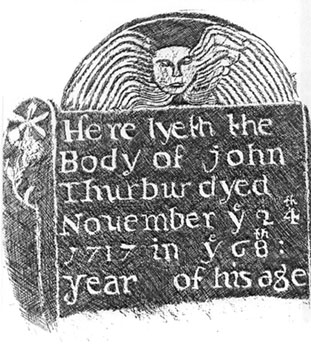
If you use water to wash off the stone you will have to wait until it is thoroughly dry before taking the next step. Now you need to cut your paper so that it is the right size to cover the tombstone. Tape it securely to the stone so that it doesn't slip. I like to go around the sides quite far and tape the paper there. This will help you get a good non-blurred image as you rub.

Take your rubbing wax or crayon and start rubbing around the edges of the tombstone. Start lightly, as you can always go back and darken the rubbing later. When the edges are done, move to the central part of the stone. It's a personal choice as to how dark or how light you want the rubbing to be.

When you are satisfied with your rubbing, carefully remove the masking tape from the edges, roll the rubbing up (gently!) and take it home to frame or hang on your wall as is. If you used charcoal you should spray your rubbing with hair spray to help set the charcoal before you roll it up.

Please be respectful of any tombstone you are doing a rubbing on. Do not take any chances on damaging a stone, and remember that someone's loved one lies beneath it.

This will be a fun activity to do with my grandchildren and I have an idea for incorporating it into yet another Genealogy Activity with them! More on that tomorrow.....

May 7, 2009

A Wonder of Relationship

In January I wrote an article for this blog called I May Be My Own Grandma

This morning Jean-Yves Baxter of GeneaNet posted a link on Facebook to an article called A Wonder of Relationship. I found it quite interesting and similiar to my own genealogy research discoveries!

The following remarkable genealogical curiosity appeared originally in Hood's Magazine, and is a singular piece of reasoning to prove that a man may be his own grandfather. Continue reading the full article found in The World of Wonders, 1873

May 6, 2009

Neglect of Farnham Cemetery

We were in Arkell Ontario this past weekend. Some of my father's ancestors were in the group of first pioneer settlers in 1831 and I wanted to see if their tombstones survived. There are two cemeteries in Arkell.

One is the Arkell Pioneer Cemetery which has been saved from total destruction by a dedicated group. This group gathered all stones surviving whether broken or not, reconstructed the broken tombstones, and cemented them carefully in a large raised area. Many of my King ancestors are found there and it really wonderful that this cemetery was carefully tended before it was too late.

The second cemetery is Farnham Cemetery. It too has many early graves of those pioneer settlers in 1831, as well as their descendants. But it is a mixture of nicely tended lawn, and completely neglected stones.

The neglected stones lie almost buried in the ground, having toppled over some time ago. Many are broken, and bits and pieces of the tombstones jut up in the overgrown mess of vegetation.

Many lie in an area that is difficult to get to, up against the back fence of the cemetery property, and in the brush. My husband spent some time climbing around there trying to brush away some of the dirt and growth but it was too difficult with bare hands.

Some lie near the front of the cemetery, under a big tree. You can see that these early stones were in eat rows and many are missing. We could see corners of toppled tombstones jutting out from the ground so it is very possible that many of the stones have toppled and been buried over the years.

At one side of the cemetery is a garbage dump, very near the neglected and overun tombstones at the back. There is a small grove of trees with a pit full of household garbage. Since the cemetery backs on to homes, it appears that the local homeowners are using the back part as their own private dumping ground. The photo we took of that didn't turn out so I can't show it but you would no doubt be disgusted.

This cemetery needs a good cleanup. It needs a volunteer group who will unearth and right the toppled stones, or cement them into a base (as has been done in the Pioneer Cemetery) before it is too late. I wish I lived nearer so I could organize a cleanup group! I find it disrespectful to the memories of those buried there, and a historical oversight that our pioneers who settled there in 1831 should be so forgotten.

My Peter Bell and his wife Elizabeth are buried there. Peter's stone stands quite near the front gates, but Elizabeth's has toppled and is almost completely buried by the grass that has overgrown around and over it. They came to Arkell in 1831 and were among the first group of hardy pioneers who braved many hardships and separation from family and friends in England to settle here. Do they (and all the others) not deserve more respect?

May 5, 2009

I REMEMBER Uses The Fourth-Most Trafficked Website in the United States To Bring Memories Together Like Never Before

May 5, 2009 – Lindon, Utah – Footnote.comicontoday announced the launch of I Remember, a Facebook application aimed at helping connect Facebook users in order to share memories of loved ones. Few events in life generate the emotions and memories as does the passing of a friend, family member or colleague. However, without the appropriate tools and forum to preserve and share these memories, a loved one’s legacy may be lost. Now with I Remember, Facebook users can create a meaningful experience to honor those individuals that had an impact on their lives.

“A big challenge with gathering memories and stories together is getting everyone to contribute and share in one place,” explains Russell Wilding, CEO of Footnote.com. “Facebook helps eliminate that barrier by bringing millions of people together on a daily basis. The I Remember application simply leverages Facebook’s successful platform so friends and family can participate in remembering people that meant the most to them.”

Using I Remember, Facebook users can share stories, upload photos, post comments and add facts about an individual. These facts will automatically generate a timeline of the individual’s life and a map detailing important places and events. Further, shared information will undoubtedly spark more memories. Soon a robust page can be created through the simple efforts of a few people coming together.

In addition, contributions using I Remember on Facebook will also be accessible on Footnote.com, a premier history website. From the I Remember pages on Facebook, users can easily tap into the over 53 million historical documents found on Footnote.com to discover additional information about those people they are remembering.

Learn more about the I Remember application

May 4, 2009

Making a Genealogy Time Capsule Part 3

Once you have your Genealogy Time Capsule made, you're ready to take the final step. You can hide it inside a building or outside.

You can hide it in the rafters of an attic, or above the pipes or duct-work in a basement. Behind the insulation works well too. If you happen to be renovating, hide it in the walls!

You can bury it - choose a prominent landmark (a tree, a boulder, etc) if you want to remember where it is.

Choose the driest spot you can find. For example on top of a hill is better than in a low lying area or a ditch.

A good location is under your deck or porch, as it is dry and near a house.

If you have a walkway or patio you could lift one of the stones and bury it underneath.

Remember, you are wrapping your time capsule in many many layers of plastic if it's being buried outside so don't worry about someone in the future mistaking it for junk! I'm quite sure their curiosity would compell them to unwrap it.

You can make this very ceremonial by including your children or grandchildren. Have them plant a tree on top of the spot you have chosen. Impress on them that they are to show or tell their children where it is. In turn those children are to tell the next generation and so on until the date you have chosen for it to be dug up and opened.

I was in Guelph this weekend for my parents' Memorial Service. My two oldest grandchilden (age 11 and 9) were there so I told them about the Genealogy Time Capsule. They were intrigued and enthused, and looking forward to making one on their annual week-long stay at our home this summer. We have decided to establish a date - perhaps July 1st which is Canada Day, and a year, when the Genealogy Time Capsule is to be opened. We left them discussing whether they want to open the Genealogy Time Capsule 50 years from now in their lifetime, or 250 years from now!

May 3, 2009

Making a Genealogy Time Capsule Part 2

We have talked previously about what items to put into a Genealogy Time Capsule. Now it's time to think about what kind of container we will use.

The first thing is to decide if you are going to hide your Genealogy Time Capsule inside a building or outside. If inside, the container does not have to be waterproof. If outside, you must waterproof it as best you can.

We thought of using the following easy-to-find containers:


1. Metal Cookie Tin
2. Plastic storage box
3. Old tackle or tool box (we found an old army ammo box which was perfect!)
4. a sturdy box that an appliance came in
5. large dog biscuit container with lid

Any of the above are fine to simply hide somewhere in your house or other building (we'll talk about locations for your Genealogy Time Capsule in a separate post)

If you are going to hide your Capsule outside you can use the Metal Cookie Tin, or plastic boxes but not a cardboard one. The metal tins or plastic tubs are not waterproof where they close so you must waterproof the closures. You can do this by caulking the edges. You can also wrap the entire container in plastic bags and seal tightly with clear packing tape.

To be extra cautious, you can tuck your items into ziplock plastic baggies before placing them in the containers.

You can also use plastic PVC piping and end caps. These can be purchased at any hardware or plumbing store. Simply cut the PVC piping to the lengths you want, add your genealogy items and seal the end caps with plumber's adhesive.

If you are involving children or grandchildren in this project (as we plan to do) why not give each of them their own smaller container. They can fill it with items they choose, with letters and drawings they have created, with toys, and so on. Then you can seal their smaller container and place it inside the larger Genealogy Time Capsule. We thought a large plastic Cottage Cheese container or Wet Ones Container would work well for our grandchildren.

May 2, 2009

Making a Genealogy Time Capsule

When my husband and I were building our home in the country 12 years ago, we filled a 1-Litre plastic pop bottle with odds and ends of items for a make-shift Time Capsule. We dropped in coins, a note explaining who we were, and other small items that we thought would be fun for someone to find whenever our house is torn down. We sealed the bottle and dropped it between the walls of the basement.

Now our idea is to create a Genealogy Time Capsule to be found and opened in 100, 200 or even more years from now. So let me share with you our ideas for what we could put in our Genealogy Time Capsule.

1. Our Family Trees. Print a chart or create your own on a pre-printed blank tree.
2. Photographs of us, our family and other loved ones - all labelled on the reverse
3. Dated and signed letters that we write to whoever finds the Time Capsule
4. Newspaper Clippings - news, obituaries, anything of interest genealogically speaking
5. Copies of documents such as birth certificates, marriage records, family bible pages

We also plan to add such items as digital cameras (a non working one of course!), an old pair of glasses, an old watch, a couple of old keys - anything that we ourselves would love to find that belonged to someone 100 years ago. Think how much fun it would be to find a pair of glasses that your great great grandmother wore... Think in terms of artifacts that you'd like to find. What you use today will be an artifact in the future!

Burn a CD ROM with photos or other genealogical information. How about including a video? Sure it might not be able to be read in the future but then again, some information might be gleaned from it and a CD doesn't cost very much to include

Put in something you made - a doily that you crocheted, a scarf you knit, a needlepoint (does anyone do these anymore?), a picture you drew, a tiny figurine you carved from wood or soapstone. How about a favourite recipe? That would give future generations an idea of the kinds of food their ancestor made and ate. Even better if it's an old family recipe.

A child's toy, doll or stuffed animal would be nice to include, especially if you involve your children or grand-children in the project. Let them choose an item or two that says something about them. Perhaps they can write or print a little note to go with the item. Date it, put their name and draw a picture of themselves playing with it. Or take a photo of them playing with the toy.

You can add anything you want but our plan was to keep it as genealogy-related as possible. I'm definitely putting in coins from this year. What fun it would be to find coins that someone had put in a Genealogy Time Capsule 100 years ago!

Put all your items in ziplock plastic bags to help protect from water. Go crazy, let your imagination run wild. Involve your entire family and make this a way and time to spend some quality time together, quality time that involves genealogy.

My next post will give you our ideas and tips on containers you might want to use for your Genealogy Time Capsule. We have several different suggestions so stay tuned! We also have quite a few ideas for the location of your Genealogy Time Capsule so again if this is a project that sparks your interest, keep watching for that post on this blog.

May 1, 2009

Newspaper Archive - Not to be Missed!

I have just discovered Newspaper Archive. And I love it! Why did it take me so long to find this site? I played around in it almost all day yesterday, found quite a bit of information on my Michigan ancestors and happily saved and took snapshots of the newspaper articles for my family tree.

They have quite a long list of newspapers scanned and fully searchable, and more are being added. The little blurb at the top of the home page reads

Easily Find Over 3.39 Billion Names • Over 1.13 Billion Articles • 826 Cities • 241 Years • 3,426 Titles

The site is easy to use and very nicely laid out. The search engine functions well and you can choose basic (first and last name) or advanced (exact phrases, keywords, exact year or a range of years, location and more)

When you get results you see a bit of text relevant to your search terms, then you click to view the newspaper page which loads in .pdf format. It is easy to find what you want within the page by clicking on the binoculars icon at the top! That brings up a search screen which searches within the .pdf image. Very cool.

You can zoom in or out. You can save your .pdf file to your computer (the full newspaper page) or you can use the little camera icon to take a snapshot. This allows you to outline the article you want, and it automatically copies it as a graphic to your clipboard. Simply open your favourite graphic program (I use IRFANVIEW) and paste the graphic, then save it to your computer. I really like this option.

You can even browse the list of available newspapers by title or by location. I noted several countries besides America. I plan to go back and have an in-depth look to see what's available for Canada. I saw it listed but didn't have time to explore. I'm eager to get back, and yes, I'm officially a fan of NewspaperArchive.com

April 30, 2009

Black Sheep Canadian Ancestors Submissions

The topic for the last Canadian Genealogy Carnival was Black Sheep Canadian Ancestors

The prompt was
"Do you have a blacksheep ancestor in your family tree? Maybe one of your ancestors was a rogue, a scoundrel, a cad or just someone who done Grandma wrong...

Did great-grandma spend time in prison? Was Grandpa a bigamist? Did Great-Uncle Harry try to set fire to his neighbour's house? Most of us have one or two rebellious ancestors who didn't quite fit the mold. Even if you haven't got a blacksheep Canadian ancestor, tell us about any blacksheep Canadian.

The carnival has ended and we have some very intriguing posts about some very interesting Black Sheep in the family!

Kathryn Lake presents The Lone Axe Murderess posted at LOOKING4ANCESTORS. Kathryn tells a gripping tale of Phoebe and her lover Thomas. Don't miss this Blacksheep story!

Evelyn Yvonne Theriault presents Black Sheep and Moonshine posted at A Canadian Family. Black Sheep and Moonshine - not all Evelyn's ancestors were farmers!

Janet Iles presents Janet the researcher: Black Sheep Canadian Ancestors posted at Janet the researcher. Is someone who took part in a riot before coming to Canada, a "black sheep"? If yes, then Janet's 4th great grandfather could be called one. This is a very interesting post with lots of historical data about Berczy Settlers.

Linda Hurtrubise presents Reprobate Ancestor posted at Linda Blake Hurtubise. Linda tells us she doesn'tt have much information about this ancestor but his Ontario death record listed much more information than usual. The cause of death: "partly old age; but also the effects of bad conduct in early life" There is much more on this unusual death record. We'd all love to have an ancestor record that is so colourful. He must have made a deep impression on the registrar to rate such a detailed death record!

Earline Bradt presents Blacksheep Canadian Ancestor: The Quaker Loyalist Turncoats posted at Ancestral Notes. An intriguiging story of Loyalities and choosing sides during the 1837 Rebellion. A tragic story, occuring in a black period of our history.

Derek Green presents My Canadian Black Sheep - Daniel Norman Williams posted at The Big Ol' Green Tree. Derek's Great-Grand Uncle, Daniel Norman Williams, born in Sombra, Ontario, was hanged for murder in Oregon in 1905. The case went to the Oregon Supreme Court and established some legal precedents that are still cited in cases today.

Brian presents William Massey Paid A Heavy Price posted at Ancestors At Rest. Brian gives us very brief glimpses of his MANY Blacksheep Ancestors! But the main topic is his ancestor William Massey who stole from American Express in 1863 when it was just emerging from the Wells Fargo Company. Fascinating!

Lorine McGinnis Schulze presents Baa baa blacksheep, have you any cows? posted at Olive Tree Genealogy Blog. Lorine's great-grandmother's brothers spent time in jail for stealing a cow! Imagine going to jail in 1901 for a year and a half just for stealing a cow.

Well done to all the submitters! Thanks for participating in this month's Canadian Genealogy Carnival