


The tune-in numbers for the first episode of Who Do You Think You Are? are in, and they look promising! More than 6.85 million viewers tuned in to watch the show making it the No. 2-rated show that hour.
This Friday ? Emmitt Smith This week's episode is one you don't want to miss. Tune into NBC this Friday at 8/7c as former NFL football player Emmitt Smith sets out to discover his slavery roots. In this episode, look for the Monroe County Courthouse in Monroe County, Alabama, and the Mecklenburg County Courthouse in Mecklenburg County, Virginia. Lisa Kudrow calls Emmitt's episode "unbelievable" and the most compelling of the seven.
Last Week's Episode featured Sarah Jessica Parker, who learns that her 4th great-grandfather John S. Hodge was among the hundreds of thousands who tried to strike it rich by heading West during the 1849 California Gold Rush. Unfortunately, Sarah discovers John S. died soon after settling in El Dorado County, California. Sarah also pays a visit to Massachusetts and meets with researchers at the New England Historic Genealogical Society and Massachusetts Historical Society, who reveal that one of her ancestors was accused of witchcraft in 1692 during the infamous Salem Witch Trials. Luckily, Sarah finds out that the court surrounding the trials was dissolved just before her ancestor was accused, so she was never tried.
Check out the teaser to the episode featuring Emmitt or last week's episode with Sarah Jessica Parker at NBC unless you live in Canada in which case you cannot view these online NBC videos.

Updates about Olive Tree Genealogy website and other FREE genealogy records. Bringing you tutorials, genealogy book and app reviews, genealogy news, genealogy specials and more. Helping you find your family tree and ancestors.
March 11, 2010


March 10, 2010
New Family Search Indexing Projects
FamilySearch Indexers have a wide variety of records to choose from this week. Civil and church records are available from Argentina, Canada, France, Peru, and the United Kingdom. Six different groups of U.S. census records are also ready to be indexed.
New Projects
· Argentina, Cordoba—Registros Parroquiales, 1722–1924 [Parte B]
· Canada, British Columbia—Deaths, 1872–1986 [Part 4]
· Canada, New Brunswick—Births, 1810–1906
· France, Quimper et Leon, St. Louis—Registres Paroissiaux, 1722–1909
(In partnership with Cercle Généalogique du Finistere)
· Perú, Lima—Registros Civiles, 1887–1921 [Parte A]
· U.K., Bristol—Non-Conformist Registers, Pre-1900 [Part A]
· U.K., Warwickshire—Parish Registers, 1754–1900 [Part 1C]
· U.S., Indiana, Clay County—Marriages, 1811–1959
· U.S., Michigan—1910 Federal Census
· U.S., Military—1920 Federal Census
· U.S., Minnesota—1910 Federal Census
· U.S., Montana—1910 Federal Census
· U.S., Puerto Rico—1920 Censo Federal
· U.S., South Dakota—1945 State Census [Part A]
March 9, 2010
Giving Maggie a Face & Place
The word prompt for the 21st Edition of Smile For The Camera is "Give Their Face A Place." March is Women's History month and you are asked to picture women back into history. The unknown, known and unsung women who are often the foundation of our family history. Give their face a place. The interpretation is yours.
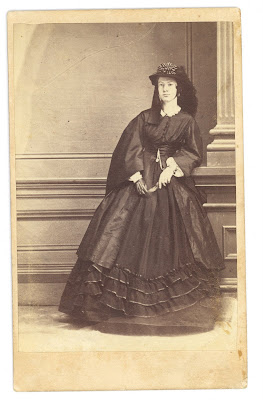
I've chosen this beautiful woman in her gorgeous clothes. This CDV (Carte de Visite) was taken circa 1864-1865 in Ohio.
The writing on the verso (reverse) of the photo reads "The Compliments of W T C to Mrs. M R R" I know that WTC is William T. Cunningham.
The inscription in the album which contained this beautiful photo reads "Mrs. Maggie R Remley’s Album. Presented Sept 17th. 1864 by Captn. J R R"
And so I suspect that the Mrs MRR of this photo is Mrs. Maggie R. Remley. I believe her husband was Capt. Joseph R Remley who served in the Civil War.
I know nothing else of Maggie. What did she think about when this photo was taken? What was her daily life like? She wore such beautiful clothing and her hair is done so nicely with a lovely bonnet on top that I suspect she and her husband had a bit of money behind them!
But who was Maggie and what were her dreams and hopes? I hope she lived a long and happy life but I suspect it was, like most women in that time period, fraught with hardship and hard work.
March 8, 2010
What About the Women?
Today (March 8) is International Women's Day. Pam Tessier gave me the idea for this blog post in her email to one of the genealogy mailing lists I look after. Super idea Pam - thanks!
In honour of the unsung and unknown female ancestors in our family tree, take some time today, this week and this month to pick one and find out more about her.
How often do we give up on a female ancestor? We find their first name and it becomes difficult to find a surname or her parents so we shrug our shoulders and set her aside "for now". But do we ever get back to her and dig deeper?
Your female ancestors had every bit as much to do with who you are as your male ancestors so let's give those women a place.
Look over your pedigree chart. How many of your female ancestors have complete details of their birth or death? Choose one of them and set a goal to find at least one fact about her that you didn't previously know.
Women had hard lives. They often bore children a year apart. They toiled over woodstoves or open hearths to prepare meals for large families. They tended sick babies when there was little or no medical help or medications such as what we take for granted today. They buried many of their children but they carried on.
Let's honour them by not neglecting them in our genealogy research. They deserve to be known so let's find them!
In a 5-generation pedigree chart for my ancestry, I find three women for whom I have only partial information. They are
* Fanny McGinnis nee Downey born circa 1820-1830 somewhere in Ireland, died 1904 in Morriston Ontario. I have no idea who her parents were.
* Jane Peer nee Greenlees born circa 1819 somewhere in Ireland, died 1899 in Guelph Ontario. I know who her parents were
* Georgiana Fuller nee Golding born 1840 Lenham England. I know who her parents were
I've chosen Georgiana Fuller nee Golding. She was my great great grandmother. I know a little bit about Georgiana and she certainly intrigues me! Georgiana's baptism record is in St Marys Church in Lenham and it states that she was born to "the widow Golding". Her mother's name is given as Hannah Golding whose husband had been Edward. However Edward Golding died in 1837 in Lenham so unless the widow Hannah had the longest pregnancy in history, Edward Golding was not my Georgiana's father.
A lot of searching found nothing more except that the Widow Hannah had another child born in 1843 in Lenham. I do not know who his father was either.
Eventually I did find Georgiana's father because luckily her marriage certificate to Charles Fuller in 1858 provides his name - George Norris. However Georgiana used the Golding surname from her birth to her marriage.
It sounds like I know a lot about Georgiana! I know her parents - George Norris and the widow Hannah Golding. I have Georgiana's baptism and marriage record. I have the names of her ten children born between 1859 and 1880. Poor Georgiana was pregnant for most of those 20 years. It horrifies me to see how close together some of those pregnancies were! For example Georgiana bore her 5th child - my ancestor Charles in August 1867. In October 1868, a little over one year later, she gave birth to another son Alfred. She must have been exhausted.
I have her in various census records - 1851, 1861, 1871 and 1881. In 1881 she is 41 years old and some time between that census and the 1891 census Georgiana died. Her husband Charles is listed in 1891 as a widower.
My goal during March is to find Georgiana's death and figure out what happened to her.
March 6, 2010
Answers to Genealogists' Questions about Episode 1 of Who Do You Think You Are
This informative email just in from Ancestry.com is NBC's official partner on the series Who Do You Think You Are and is a recommended website for genealogists.
An hour doesn’t offer much time to delve into the research processes that genealogists used as they traced the family history of actress Sarah Jessica Parker for this week’s episode of Who Do You Think You Are? We sat down with the research team who worked on Sarah Jessica’s family tree to talk about what it took to find her elusive gold miner ancestor. I’ve recapped that conversation here:
First Steps First
Similar to Sarah Jessica Parker’s own assumptions at the beginning of the show, research on the tree began with vague ideas that her family was comprised of recent immigrants. The team first developed a skeleton of Sarah Jessica’s family history. “We documented every connection and every life event for her ancestors,” says Natalie Cottrill of ProGenealogists, who appeared with Sarah Jessica in the episode, “finding information about Sarah Jessica’s family in court records, newspaper articles, books, and personal letters published in books.” And that’s how they found John S. Hodge.
The First Nugget
The first clue about John S. Hodge’s life came from his son’s obituary, which stated that John S. Hodge died in 1849 on his way to California from Ohio. Since the death date came from an obituary written decades after John S. Hodge died, the team looked for primary sources recorded during or around the anticipated lifespan for John S. Hodge. For starters, the team wanted to determine why the ancestral John S. Hodge was going to California, as the son’s obituary stated. Considering the time period – 1849 – it seemed probable that John S. Hodge could have been heading to the California gold fields.
The Right John?
The search led to a John Hodge, who was the right age to be Sarah Jessica’s ancestor, listed as a miner in the 1850 U.S. Federal Census for El Dorado County, California. This record shifted research to determining whether the California John Hodge was the ancestral John S. Hodge, and the researchers turned to records associated with the 49ers. “We found a letter written by someone in Ohio to John S. Hodge, which had been published in a book,” says Natalie. “One of my colleagues tracked down the original set of letters, which provided more details, including information about John S. Hodge’s 1950 [sic. Read "1850"] death.” Estate and other documents further confirmed that the ancestral John S. Hodge and the California miner John Hodge was the same individual.
If you missed the Sarah Jessica Parker episode of Who Do You Think You Are?, you can watch full episodes online at NBC.com. And you won't want to miss former NFL football player Emmitt Smith set out to discover his slavery roots this Friday, March 12, at 8/7c on NBC. Lisa Kudrow said his episode is the most compelling of the seven (and, personally, I have to agree). Check out the teaser to the episode featuring Emmitt.
March 5, 2010
Who Do You Think You Are, Episode 1 Sarah Jessica Parker
"Who Do You Think You Are?" premiered tonight Friday, March 5 (8-9 p.m. ET)
Ancestry.com is NBC's official partner on the series and is a recommended website for genealogists.
The show gave viewers an up-close and personal look inside the family history of Sarah Jessica Parker
I watched with great interest and made a list of what I loved and what I didn't like about Who Do You Think You Are (Episode 1). I'm interested in your thoughts - did you watch the show? What did you think of it? How would you compare it to Faces of America (if you watched that show)
I enjoyed Who Do You Think You Are first episode much more than Faces of America. I liked how it focused on one person's journey and didn't jump around from person to person showing us bits and pieces from each, as Faces of America did. I also liked seeing Sarah Jessica Parker physically on the journey, not just sitting and waiting to be told to turn a page in a book as in Faces of America. I liked the connection that Sarah Jessica Parker began to feel with America as she journeyed to places her ancestors had lived.
The show gave historical context to Sarah Jessica Parker's ancestors. It helped Sarah Jessica Parker connect to them as real people living real lives. She not only saw them as part of history, she connected to them as people not just names and dats.
I liked how Sarah Jessica Parker did some of her own research rather than rely exclusively on help from historians, librarians and genealogists. They did do a lot of research for her and helped her a great deal which showed just how knowledgeable and helpful such professionals are, but I was glad to see Sarah Jessica at a microfilm reader and engaging in the task.
I really liked how the show captured the excitement of researching one's family and making a find such as an ancestor on a census record. Genealogy is exciting. It's fun and it's a wonderful mystery waiting to be solved! Who Do You Think You Are captured that and for that I give it a huge tip of my hat!
What didn't I like? I'm going to nitpick now because I didn't find any major fault with the show BUT I found Sarah Jessica Parker's responses to details of her ancestors overly dramatic. That detracted from my overall enjoyment of the show.
One event actually made me cringe. When an original 1692 document was handed to Sarah Jessica Parker no one wore gloves. The librarian taking it out of the folder did not wear gloves and Sarah Jessica was not given any. As well Sarah Jessica Parker had a pencil which she used to point to the words as she read the document. I cringed every time her pencil jabbed towards a word and just barely escaped touching the paper.
I chuckled seeing Sarah Jessica Parker in those empty libraries and archives, consulting with genealogists and historians. Oh to find an empty library where every book and microfilm and every staff member is just waiting for ME to come along! I know, I know, it's a tv show and Sarah Jessica Parker is a celebrity so obviously they had to film it when no one was there. But still, it made me chuckle.
Overall I really enjoyed Episode 1 and look forward to Episode 2!
My Rating for Episode 1 is A-
Ancestry.com
The show gave viewers an up-close and personal look inside the family history of Sarah Jessica Parker
I watched with great interest and made a list of what I loved and what I didn't like about Who Do You Think You Are (Episode 1). I'm interested in your thoughts - did you watch the show? What did you think of it? How would you compare it to Faces of America (if you watched that show)
I enjoyed Who Do You Think You Are first episode much more than Faces of America. I liked how it focused on one person's journey and didn't jump around from person to person showing us bits and pieces from each, as Faces of America did. I also liked seeing Sarah Jessica Parker physically on the journey, not just sitting and waiting to be told to turn a page in a book as in Faces of America. I liked the connection that Sarah Jessica Parker began to feel with America as she journeyed to places her ancestors had lived.
The show gave historical context to Sarah Jessica Parker's ancestors. It helped Sarah Jessica Parker connect to them as real people living real lives. She not only saw them as part of history, she connected to them as people not just names and dats.
I liked how Sarah Jessica Parker did some of her own research rather than rely exclusively on help from historians, librarians and genealogists. They did do a lot of research for her and helped her a great deal which showed just how knowledgeable and helpful such professionals are, but I was glad to see Sarah Jessica at a microfilm reader and engaging in the task.
I really liked how the show captured the excitement of researching one's family and making a find such as an ancestor on a census record. Genealogy is exciting. It's fun and it's a wonderful mystery waiting to be solved! Who Do You Think You Are captured that and for that I give it a huge tip of my hat!
What didn't I like? I'm going to nitpick now because I didn't find any major fault with the show BUT I found Sarah Jessica Parker's responses to details of her ancestors overly dramatic. That detracted from my overall enjoyment of the show.
One event actually made me cringe. When an original 1692 document was handed to Sarah Jessica Parker no one wore gloves. The librarian taking it out of the folder did not wear gloves and Sarah Jessica was not given any. As well Sarah Jessica Parker had a pencil which she used to point to the words as she read the document. I cringed every time her pencil jabbed towards a word and just barely escaped touching the paper.
I chuckled seeing Sarah Jessica Parker in those empty libraries and archives, consulting with genealogists and historians. Oh to find an empty library where every book and microfilm and every staff member is just waiting for ME to come along! I know, I know, it's a tv show and Sarah Jessica Parker is a celebrity so obviously they had to film it when no one was there. But still, it made me chuckle.
Overall I really enjoyed Episode 1 and look forward to Episode 2!
My Rating for Episode 1 is A-
Amsterdam Burial Registers Online
This just in from Amsterdam Archives! What great news for those searching their Dutch roots.
Amsterdam, March 4, 2010
History at the click of a mouse
Amsterdam City Archives presents its award-winning Archives Database: a wealth of digitized archival material, directly available online. The easy-to-use website provides quick access to Amsterdam’s historical documents. Find your Dutch ancestors with just the click of a mouse, with the help of a straightforward search system and instructions in English. Now, the Amsterdam burial registers, another indispensable source for genealogical research, have been added to the Archives Database, bringing the total number of scans to more than seven million.
Easy to use
Finding the document you need is easy. Simply enter a name in the indexes that give access to the genealogical sources, and the documents will appear on your screen. Or search the Amsterdam City Archives’ inventories, accessible in full on the website. These contain treasures such as letters written by Charles Darwin; an eighteenth-century trade agreement with the newly founded United States of America; the archives of the Portuguese-Israelite Synagogue, containing the excommunication of seventeenth-century philosopher Spinoza; and the archives of institutions such as the Heineken brewery and the renowned Concertgebouw.
Opening up 20 miles of archives
The number of scans available for direct download is growing day by day. Cannot download the document you are looking for yet? The Amsterdam City Archives will scan it at your request, and it will be online within three weeks. Together, the Amsterdam City Archives and its visitors are opening up all 20 miles of Amsterdam’s archives online, making research easy, no matter where you are.
Quality scans, low costs
The quality of the scans is perfect for research. Every original detail is legible. Yet the standard is such that the costs are low. What’s more: to celebrate the addition of the burial registers to the Database, the Amsterdam City Archives now offers five scans free of charge to every newly registered user of the Archives Database. Just send your login name to fifescansforfree@gaa.nl
Best Archives on the Web
After first attaining a national award, the Archives Database has now found international acclaim, securing the Best Archives on the Web Award 2009.
About the Amsterdam City Archives
The Amsterdam City Archives (Stadsarchief Amsterdam) is the largest municipal archives in the world. It preserves documents pertaining to the history of Amsterdam and provides information about the city and its inhabitants, now and in the past. The Amsterdam City Archives is a pioneer in the field of digitizing archival material. Apart from the Archives Database, the website of the Amsterdam City Archives features an Image Bank, containing more than 260.000 photos, drawings, and prints related to the city.
March 4, 2010
Who Do You Think You Are? Book Release
This just in from Megan
Who Do You Think You Are? Book Release
Megan Smolenyak Smolenyak of Honouring Our Ancestors has a new book out which I am sure will interest many.
Her press release follows:
Who Do You Think You Are? Book Release
Megan Smolenyak Smolenyak of Honouring Our Ancestors has a new book out which I am sure will interest many.
Her press release follows:
March 3, 2010
I am thrilled to announce that my new book, Who Do You Think You Are?: The Essential Guide to Tracing Your Family History
is being released tomorrow! The book is a companion piece to NBC's ground-breaking new genealogy series, Who Do You Think You Are?, which premiers on Friday.
Who Do You Think You Are
P.S. Amazon is currently selling Who Do You Think You Are?: The Essential Guide to Tracing Your Family History
for $16.47 (list price is $24.95). A great bargain!

March 3, 2010
Free 1930 USA Census on Internet Archives
Internet Archives now has the microfilm copy of the original 1930 census as collected by the Census Bureau available for download.
This could prove to be very helpful for finding an elusive ancestor that you just can't find on the indexed census records on other sites such as
Ancestry.com
This could prove to be very helpful for finding an elusive ancestor that you just can't find on the indexed census records on other sites such as
Ancestry.com
February 27, 2010
CSI Genealogy: Free Canadian Census Chart for Family Groups
There was a good response from the Genealogy community about my CSI Genealogy: Census Charts post a few days ago.
Due to the interest shown, I have created a blank Canadian Census CSI Chart to use for a family group in all Canadian Census records. Please feel free to download and print a free copy of this chart. I hope it helps you organize your genealogy census data by family!
You can either SAVE the image to your computer hard drive then print it from any graphic program (be sure to use the LANDSCAPE orientation) or print it directly from the page when it loads.
February 26, 2010
Genealogy Treasures: A Watercolour Spurs Us to Find Out More

My husband's grandmother gave him this watercolour painted in 1916 by J. Ades Fowler. We did a little research and found that the artist's full name was Joseph Ades Fowler and he died 5 March 1921 in Huron County Ontario.
According to his death certificate, Joseph Ades was born in Brighton England on 19 August 1850. His profession is given as architect, which surprised me. I thought he would be listed as an artist but perhaps painting was a hobby and not a profession for him.
His death certificate also revealed that Joseph Ades had a son Henry Ades Fowler who was living in Maywood (?) Illinois at the time of his father's death. Joseph Ades was living in Goderich Ontario at the time of his death.
We're very interested in learning more about Joseph Ades Fowler! When did he come to Canada from England? Why did his son move to Illinois - and what happened to him? Did he have other children and if so, did they stay in Ontario or move to the USA?
How did Joseph Ades' painting end up in an antique store or auction? Was he a prolific painter? His work seems quite good, but did he only paint a few or did he paint dozens?
Did he design any of the buildings in Goderich?
If you are an antique hunter as my husband and I are, you know how compelling the stories of the person who owned the object are. Genealogy and antique hunting go hand in hand. We like to find out about the people behind the objects - the provenance as it is called by antique enthusiasts. Sometimes we've been lucky enough to meet up with a descendant, and sometimes the antique ends up being returned to the family.
So Joseph Ades Fowler - who are you and what buildings did you design and see built in your lifetime? Where are your children or grandchildren?
If anyone has any answers or any more clues, please leave a comment here on this blog. Perhaps with help we can find a living descendant.
UPDATE Aug. 21, 2013: I received this email today:
Several years ago you posted an inquiry (that I just saw) about a painting by Joseph Ades Fowler. I’m not very good at reading blogs and how to reply on them so not sure if you received any replies. Joseph Ades married by maternal great grandfather’s sister Mary Heathcote Green. Joseph came to Toronto, Canada, it seems by himself, around 1870.
Two years later, in the spring of 1872 Mary came to Toronto from London England with her father Josiah James Green (a druggist/chemist), mother and 3 siblings. Joseph Ades and Mary were married in the fall of 1872. I don’t know if they knew each other in England but in researching the Toronto directories discovered they lived on the same street in Toronto so perhaps that is how they met!
I haven’t come across anyone else online researching my extended family but I do have some information on their family in my old research files (which I have yet to document) so if your questions about Joseph Ades haven’t already been answered let me know and I will dig in my files and send you some answers about his career and family.
Thanks, Gayle Farnes
February 25, 2010
CSI Genealogy: Census Forms Help Organize FIndings
How many times have you taken a careful look at your genealogy research only to realize that you never did get around to hunting for Great Grandpa Joe in the 1850 or 1851 census? Have you ever taken a good hard look at the chronology of the family you are searching? How often have you looked over your genealogy research? You might be very surprised at the clues and facts you've missed along the way!
But how can we organize our research so that it's easy to see what we have, what we still need to find, and what we've missed?
This is where CSI Genealogy comes into play!
C=Charts S=Success I=Investigation
With CSI Genealogy you create CHARTS to have a SUCCESSFUL INVESTIGATION into your family tree.
I've already shown readers of this blog a CHART I created for assessment and tax records. I've also got a chart for all those census record years you find. This chart is for Canadian census records so they cover the years 1842, 1851, 1861, 1871, 1881, 1891, 1901 and 1911.
Using Excel I created empty columns for each census year. On the left I have empty cells for name of husband, wife and children. I also left spaces for "others" meaning anyone else who shows up on a census year.

So I find my McGINNIS family in 1861 and carefully list their names and ages. I do this for every census year. This helps me see at a glance who I am missing, what census year(s) I still need to find and when an ancestor goes missing or dies.
You may notice the tiny notations in 1881 column on this chart. These indicate "married" (md) and are just my way of knowing I need to look under a married surname for women. I also note it for males just to have a quick reminder that a son is married and may not be living with his parents that year
Because some census years ask for citizenship or immigration status, I have a spot for that too.
Lastly, I like to keep track of exactly where the family lived each census year. I only list the parents' location on this chart, but I have another chart for locations and land records that I'll show you another time.
Because there is room, I have noted death years on the right (but I'm creating a new chart which will have a column for death year and another for death location). I've also made notes which remind me of important facts. On this chart for my McGINNIS family, I've noted that their daughter Fanny was baptised in Guelph in 1847. That indicates to me that they should show up in the 1851 census but as you can see, I have not found them.
I'm not likely to find them as the first page of the census I need is missing - and I suspect they were on that page! But I still want to be reminded that they were in the area as early as 1847, because I may want to hunt for other records that will provide more information regarding their settlement year.
Every time I pull this chart for my McGINNIS ancestors out, I am reminded that I've never been able to find Joseph, his wife Fanny and their four youngest children in the 1881 Canadian Census. Yes, I've looked in 1880 American Census too with no luck.
I may never find them - they may have been on the move and missed both census years, or the Fanny and son Joseph I found in Guelph *might* be the right ones (and Joseph Sr might be dead by then, but then where is young Robert?) or ..... At this point I have no explanation but this chart very nicely reminds me to KEEP LOOKING! And if I never find them on a census for those years, perhaps I will find them in another genealogy record.
February 23, 2010
Letters as Loot - Fascinating Project of Leiden University!
Thanks to the subscribers of the New-Netherland mailing list discussing the New Netherland Institute online, I found Letters as Loot, an absolutely wonderful project by the University of Leiden.
Quoting from the Leiden University website:
Every month, a new letter is translated and posted online. In the Monthly Letter posted in May/June 2009 was a fascinating letter written in 1664 by my ancestor Hendrick Meesen Vrooman to his brother Jacob. Hendrick had recently arrived in New Netherland (present day New York) and wrote to tell his brother Jacob in Leiden all about the new land he had settled in.
What an insight into both my ancestor and the time period when the English took New Netherland and it became New York.
Hendrick says in his letter "Furthermore I let you know that there have arrived three English ships at the Manhattans with soldiers and they have claimed the land and they say that it belongs to their king. And Stuyvesant [the governor of the New-Netherlands] has given it to them without one shot, with an agreement."
I spent an enjoyable hour browsing the other letters held at University of Leiden website. Just choose English from the main page if you do not read Dutch.
Quoting from the Leiden University website:
The National Archives in Kew, UK hold a treasure that causes real excitement among scholars: the recently rediscovered collection of Dutch documents from the second half of the 17th to the early 19th centuries, comprising over 38,000, both commercial and private, letters. These so-called sailing letters were confiscated during the wars fought between The Netherlands and England.
The research programme Letters as loot: Towards a non-standard view on the history of Dutch aims at exploring this extraordinary and highly valuable source for a new history of Dutch.
The project comprises three sub-projects. Two cross-sections are made in the source material at a chronological distance of about hundred years: the first of the period 1665-1674 (2nd and 3rd Anglo-Dutch Wars) and the second of the period 1776-1784 (4th Anglo-Dutch War and American War of Independence).
Every month, a new letter is translated and posted online. In the Monthly Letter posted in May/June 2009 was a fascinating letter written in 1664 by my ancestor Hendrick Meesen Vrooman to his brother Jacob. Hendrick had recently arrived in New Netherland (present day New York) and wrote to tell his brother Jacob in Leiden all about the new land he had settled in.
What an insight into both my ancestor and the time period when the English took New Netherland and it became New York.
Hendrick says in his letter "Furthermore I let you know that there have arrived three English ships at the Manhattans with soldiers and they have claimed the land and they say that it belongs to their king. And Stuyvesant [the governor of the New-Netherlands] has given it to them without one shot, with an agreement."
I spent an enjoyable hour browsing the other letters held at University of Leiden website. Just choose English from the main page if you do not read Dutch.
February 22, 2010
FamilySearch New Projects Coming Soon
Friends at FamilySearch tell me that recently completed projects have been removed from the available online indexing batches and will now go through a final completion check process.
These projects will be searchable online at pilot.familysearch.org in the near future.
· Canada—1871 Mortality Census
· Mexico, Hidalgo—1930 Federal Censo
· U.S., Alaska—1920 Federal Census
· U.S., Indiana, Marshall County—Marriages, 1811–1959
· U.S., Illinois—1910 Federal Census
· U.S., Rhode Island—1905 State Census [Part 3]
February 20, 2010
Help Find American WW2 Soldier
Can anyone help Jill find this American WW2 soldier? Jill found his Dog Tags in Australia and has asked my help in finding out about Stanley

Details can be found at American WW2 soldier

Details can be found at American WW2 soldier
February 19, 2010
Live Roots Adds Access to FamilySearch Record Search Results
According to LiveRoots.com you can now view results from the Record Search pilot from within the Live Roots website.
Quoting from Live Roots website:
I decided to give this new feature a try so went to the FamilySearch page on Live Roots. I was impressed with the speed of the search and the display of results but wanted to ask Illya D'Addezio, owner and creator of Live Roots, a few questions.
I wondered what the purpose was of adding this feature to the Live Roots website. According to Illya
When I first used the new feature for FamilySearch, I mistakenly thought I was searching an index but Illya explained that it is not an index/image hosting
initiative, but a real-time, server to server access. This is the same as all of the other partner searches on Live Roots. A search on LiveRoots using the FamilySearch feature results in the LiveRoots server contacting FamilySearch server, obtaining the results and presenting them in LiveRoots in the format determined by Illya.
My concern that new records on Family Search would have a delay before being searching in Live Roots was put to rest when Illya explained this, because his method means that as soon as new records are available on the FamilySearch website, they are immediately available in the Live Roots experience.
My last question to Illya was "Why use the Live Roots FamilySearch feature rather than go directly to the Family Search website" He resonded that
It's a great utility, and you really should try it out. Start your journey at the FamilySearch page on Live Roots.
Quoting from Live Roots website:
The FamilySearch Record Search pilot include millions of indexed records, and is expanding each month. When you perform a search in Live Roots, you will see a link to the FamilySearch Record Search feature in the "Available Partner Services" section.
You also have the ability to search a specific collection within the Record Search pilot from the corresponding resource page. Resources from the pilot are cataloged in Live Roots as soon as they are posted online.
I decided to give this new feature a try so went to the FamilySearch page on Live Roots. I was impressed with the speed of the search and the display of results but wanted to ask Illya D'Addezio, owner and creator of Live Roots, a few questions.
I wondered what the purpose was of adding this feature to the Live Roots website. According to Illya
The objective of Live Roots is to be a genealogical search "experience," not just a simple search engine. When you use a traditional search engine, the experience ends with a listing of results. With Live Roots, that's only the beginning. From the results, Live Roots shows you relationships between resources, and allows you to locate and/or preview related results from
other data repositories (e.g. Ancestry, Footnote, etc.).
What this amounts to is research efficiency, especially when your research involves a lot of repetitive searching, for example, a brick wall ancestor. Using Live Roots you can perform the same search across a dozen different repositories within a few minutes without ever having to reenter your search criteria or leave the Live Roots environment.
When I first used the new feature for FamilySearch, I mistakenly thought I was searching an index but Illya explained that it is not an index/image hosting
initiative, but a real-time, server to server access. This is the same as all of the other partner searches on Live Roots. A search on LiveRoots using the FamilySearch feature results in the LiveRoots server contacting FamilySearch server, obtaining the results and presenting them in LiveRoots in the format determined by Illya.
My concern that new records on Family Search would have a delay before being searching in Live Roots was put to rest when Illya explained this, because his method means that as soon as new records are available on the FamilySearch website, they are immediately available in the Live Roots experience.
My last question to Illya was "Why use the Live Roots FamilySearch feature rather than go directly to the Family Search website" He resonded that
"One of the main advantages to using Live Roots is the consistency it offers between the numerous data and book repositories, along with some of the
research management tools that simplify keeping track of when/where you found a useful resource. Bringing Family Search into the experience just adds to the efficiency, as now when you locate a record in Family Search, you can quickly see if
there are any related records in sites such as Ancestry or Footnote (and vice-versa)"
It's a great utility, and you really should try it out. Start your journey at the FamilySearch page on Live Roots.
February 15, 2010
List of Winners in OliveTreeGenealogy Birthday Celebration
As promised, the random draw for 5 lucky winners of the 5
amazing prizes offered by Footnote.com , Ancestry.com and GenealogyBank.com has been made.
The 3 winners of a Footnote.com Annual subscription are:
Lisarps@gmail.com
mcgivney@yahoo.com
Katfrmwi@aol.com
The winner of Ancestry.com Annual World Deluxe
Subscription is
kathie.fortner@yahoo.com
The winner of the GenealogyBank.com 30 day membership is
bpayne@xtra.co.nz
Congratulations to the 5 winners and thank you everyone for participating in this celebration. A huge thank you goes to Ancestry.com, Footnote.com and GenealogyBank.com for being so generous and supportive during OliveTreeGenealogy's
birthday.
If you are one of the winners, please contact me at olivetreegenealogy@gmail.com to claim your prize.
I'm already planning for OliveTreeGenealogy's 15th birthday party next year and MORE wonderful prizes!
The list of winners is also being posted on the OliveTreeGenealogy.com Birthday celebration page
And now - time for Birthday Cake!
Lorine
amazing prizes offered by Footnote.com
The 3 winners of a Footnote.com
Lisarps@gmail.com
mcgivney@yahoo.com
Katfrmwi@aol.com
The winner of Ancestry.com
Subscription is
kathie.fortner@yahoo.com
The winner of the GenealogyBank.com 30 day membership is
bpayne@xtra.co.nz
Congratulations to the 5 winners and thank you everyone for participating in this celebration. A huge thank you goes to Ancestry.com, Footnote.com and GenealogyBank.com for being so generous and supportive during OliveTreeGenealogy's
birthday.
If you are one of the winners, please contact me at olivetreegenealogy@gmail.com to claim your prize.
I'm already planning for OliveTreeGenealogy's 15th birthday party next year and MORE wonderful prizes!
The list of winners is also being posted on the OliveTreeGenealogy.com Birthday celebration page
And now - time for Birthday Cake!
Lorine
February 13, 2010
Don't Forget Olive Tree Genealogy's Birthday Draw on Feb 15
It's not too late! You have until Midnight EST Sunday Feb. 14th to enter the draw for one of FIVE great prizes for Olive Tree Genealogy's 14th Birthday Celebration!
You can read more about this Happy 14th Birthday OliveTreeGenealogy celebration and enter for a chance to win one of the 5 prizes
The draw for 5 lucky winners will take place on Feb. 15th. Names will be chosen from subscribers to the Olive Tree Genealogy newsletter, so for a chance to win, be sure you are a subscriber. You can subscribe to this free newsletter
(which comes out 3 or 4 times a month) to enter your name
Thanks to the generous support of Footnote.com , Ancestry.com and GenealogyBank.com 
there will now be FIVE lucky winners in the Olive Tree Genealogy Birthday Draw!
Footnote.com has generously donated THREE Annual Subscriptions to their detabases for the Birthday Celebration! Footnote.com helps you find and share historic documents. Their website brings you many never-before-seen historic documents through their unique partnerships with
The National Archives, the Library of Congress and other institutions.
Ancestry.com , the world's leading resource for online family history, have generously offered to provide an Annual World Deluxe subscription as one of the prizes for the Olive Tree Genealogy Birthday Celebration! The World Deluxe Subscription includes historical records and images from the
United States, Canada, the United Kingdom, Ireland and more locations around the globe.
GenealogyBank.com is very kindly donating a free 30-day membership for unlimited access to their databases.
Genealogy Bank has the largest Newspaper Archive for Family History Research. Over 4,000 newspapers provide first-hand accounts about your ancestors that can't be found in other sources
You can read more about this Happy 14th Birthday OliveTreeGenealogy celebration and enter for a chance to win one of the 5 prizes
The draw for 5 lucky winners will take place on Feb. 15th. Names will be chosen from subscribers to the Olive Tree Genealogy newsletter, so for a chance to win, be sure you are a subscriber. You can subscribe to this free newsletter
(which comes out 3 or 4 times a month) to enter your name
Thanks to the generous support of Footnote.com
there will now be FIVE lucky winners in the Olive Tree Genealogy Birthday Draw!
Footnote.com
The National Archives, the Library of Congress and other institutions.
Ancestry.com
United States, Canada, the United Kingdom, Ireland and more locations around the globe.
GenealogyBank.com
Genealogy Bank has the largest Newspaper Archive for Family History Research. Over 4,000 newspapers provide first-hand accounts about your ancestors that can't be found in other sources
February 10, 2010
Smile For The Camera: Be My Valentine
The word prompt for the 20th Edition of Smile For The Camera is "Valentine." Love is in the air, so celebrate with Smile by sharing a photograph of a Valentine; be that person or paper. The interpretation of Valentine is yours. Admission is free with every photograph!
This is a Valentine postcard from 1910 that I purchased many years ago. It was in a box of miscellaneous paper ephemera
It's an odd postcard in my mind, as the sender expresses no words of love or romance, yet has chosen a Valentine card image for Maggie (the recipient). Perhaps it was the only card he had on hand, or found in the shop, but it's always struck me as an amusing card for James to send to Maggie.
I've not done any research on Maggie or James so have no idea who they are! I'm sure Maggie at least could be found in the 1910 census records.

1910
Miss Margaret Rasch
146 North Division St
Buffalo N[ew] Y[ork]
Maggie
We have all got bad colds and the roads are very bad so geo [George?] hired Roy Smith to take you the machine [today?] You will get the machine before you do this card. [can't read this word] from James

Subscribe to:
Posts (Atom)