


Sunday. Morn. Went to S. James to Church with Pa. Aft. stayed in [can't read] to B./S. Martin's [can't read rest]

Updates about Olive Tree Genealogy website and other FREE genealogy records. Bringing you tutorials, genealogy book and app reviews, genealogy news, genealogy specials and more. Helping you find your family tree and ancestors.
March 15, 2011
Ada Harland's Diary England Mar. 15, 1914
Mar. 15, 1914


Finding a Palatine Ancestor
About 18 years ago I discovered I had Palatine ancestors. I had no idea what a Palatine was. This is where research of historical events and peoples comes into play. Finding a new group of ancestors often means you need to research what that group experienced, where they lived, why they immigrated and when, and just about anything you can find out about them.
The Palatinate or German Pfalz was subject to invasion by the armies of Britain, France, and Germany. As well as the devastating effects of war, the Palatines were subjected to the winter of 1708 and 1709, the harshest in 100 years.
Spotlight On Palatine Genealogy
Search for Palatine Denizations (Naturalizations) 1708 at http://www.naturalizationrecords.com/usa/ny_denization.shtml
The scene was set for a mass migration. At the invitation of Queen Anne in the spring of 1709, about 7 000 harassed Palatines sailed down the Rhine to Rotterdam. From there, about 3000 were dispatched to America, either directly or via England, under the auspices of William Penn. The remaining 4 000 were sent via England to Ireland to strengthen the protestant interest.
Palatine Immigrants to New York
Search for Palatine ancestors in Palatine Ships Lists to New York or Palatine Child Apprentices 1710-1714 at
http://www.olivetreegenealogy.com/palatines/palatine-indentures.shtml
In 1710, three large groups of Palatines sailed from London. The first went to Ireland, the second to Carolina and the third to New York with the new Governor, Robert Hunter. There were 3 000 Palatines on 10 ships that sailed for New York and approximately 470 died on the voyage or shortly after their arrival.
Pennsylvania Palatine Ancestors
Start your research with Palatine Ships to Pennsylvania 1727 to 1808 online at
http://www.olivetreegenealogy.com/ships/palship_list.shtml
Over the next 100 years, impoverished Palatines fled from Germany to America - many arriving in Pennsylvania. Olive Tree Genealogy has a Pennsylvania German Pioneers Project which includes the list of ships carrying Palatines from Germany to Philadelphia from 1727 to 1808 as well as names of passengers, Oaths of Allegiance and Ships Passenger Lists.
March 14, 2011
So Many Apps, So Little Time!
Do you like to be notified via your iPhone or iPad the minute someone mentions you on Twitter, or sends you a message or comments on something you posted or liked on Facebook? Do you hate the normal push notifications on your iPhone or iPad?
If yes, then you might like this little (free) app I recently installed on my iPhone and iPad. It's called Boxcar and it's been around for awhile. I didn't hear about it until November when I read a review on TechCrunch
I'm always on the lookout for a good app. There are so many that sometimes I feel it's impossible to make a choice! So I like to find reviews by people or companies I trust and then try the app myself.
I downloaded Boxcar from the App Store last month and set it up for my Twitter and Facebook accounts. I really like it. I can't tell you it has a lot of specific genealogical uses but there are so many iPhone and iPad apps that I thought I'd share one I use and like. And no, I don't get paid anything to promote Boxcar, I just like it!
You can set Boxcar up to send you instant notifications on your Email accounts, RSS feeds (so you could get notified when your favourite genealogy blogs are updated), Foursquare and many other services.
There's also a paid upgrade to Boxcar which eliminates ads but they're very unobtrusive in a bar across the bottom of your device - so for me that's not a big deal.
If you try Boxcar and you think of a great way to use it to help with genealogy, please let me know by way of a comment here on my blog. I'm always looking for ways to incorporate my iPhone or iPad apps into my love of genealogy.
March 12, 2011
From Theory to Fact: 30 Years in the Making
For 30 plus years I've searched for a record showing where my McGinnis family came from in Ireland. I don't mean the town or village (although that would be nice), I mean the County.
Lest you think I'm a pretty bad genealogist who can't find what might seem to be a simple little record, let me explain:
My McGinnis roots stem from a large family group that arrived in Puslinch Township, Wellington County Ontario circa 1831. That's early for Ontario. At that time it was a wilderness called Upper Canada and was very sparsely populated.
As anyone who has searched for ancestors in Upper Canada can testify, genealogy records pre 1851 are few and far between. There are no census records (they didn't begin until 1851), no vital registrations (they didn't start until 1869) and church records are sparse.
If, like mine, your ancestors were Catholics in Ontario you're pretty much out of luck for church records as most are in the hands of local priests who have them locked securely away. The public is not allowed access even to older records in the mid 1800s.
There were few newspapers in that time period. Of the few that were published, not many have survived. Those that survive for the area I need are not indexed. So an approximate date of an event is a necessity in order to hunt for an obit or other record.
Ships passenger lists were not archived until 1865. There are substitutes but my McGinnis don't show up on any. Don't get me wrong - there ARE some records for this early time period in Ontario - tax and assessment records, land records, and a few other miscellaneous record sets. But every local area has different records that have survived. So it's a long process to find out what records exist and where they are kept.
Back to my Irish family who arrived from somewhere in Ireland circa 1831. I have land records for them. I have tax and assessment records back to 1833. I have death records. I have marriage records. I have some Catholic Church records of baptisms in the 1840s. I have Catholic Church burial records for many of them. In fact with my 30 plus years of research on all branches of the original McGinnis settlers, I've got an entire filing cabinet drawer full of relevant documents.
In order to learn where in Ireland my McGinnis family originated I have searched all 9 children down several generations. I've hunted for obituaries and death records in particular, praying for a mention of a town or county in Ireland. Nothing.
However there was one son for whom I have not been able to find a death record or obituary. I knew he died between 1881 and 1891. I knew where he lived. But nothing could be found.
Family lore from descendants of his branch claimed Belfast as his place of birth. Family lore from my branch claimed Belfast as the place of birth of my great-grandfather's sister.
I had my brother's DNA done. We linked in with McGinnis families near Belfast. I contacted a descendant of one of the two known sisters from Ireland. She had early photos and on the back of one was written, in period handwriting, "Katesbridge Ireland" Katesbridge is in Co. Down and not far from Belfast.
This was all pretty exciting for me as it definitely gave me enough clues and pieces of circumstantial evidence to hesitantly proclaim that PERHAPS my Joseph McGinnis was from Katesbridge or Belfast in Co. Down. Perhaps.
Still unable to find a death date for the one remaining brother (Hugh) who was born in Ireland, I set my research aside. Then the breakthrough - two amazing women who have written several history books, spent many years going through newspapers to gather obituaries for (drum roll please!) people who had lived in Puslinch Township. Doesn't sound impressive? It is. "A Celebration of Lives: Obituaries of Puslinch Township Wellington County Ontario" was published recently as a two-volume set consisting of 1,408 pages. There are over 6,500 obituaries. It's impressive.
It had limited printing but I managed to get the last copy. It arrived last week. Of course I skipped right to the "M" pages and unbelievably there it was - an obituary for my Hugh McGinnis of Hespeler. His obit stated he was born in Co. Down Ireland. I know an obituary is only as reliable as the person giving the information but it is another piece of evidence. I wish I could find his death registration but still no luck, even with now knowing the month and year and location of his death.
This morning I scrolled through every image on Ancestry.com for a period of 12 months from his death with no success. His death is not there. But I have the obituary and that thrills me! It adds to the growing weight of clues.
Second wonderful item - Hugh's wife was born in USA circa 1810. Due to finding other bits and pieces of clues, including finding her parents' and siblings' names, I found a record in 1830 in Potsdam New York which I was pretty sure was her family. Pretty sure, but not positively proven, so not good enough for me.
Did I mention that one of Hugh's brothers married one of his wife's sisters? The finding of the Potsdam record was important because I know that Hugh (and probably his siblings) was in America before 1831. This would give me more locations for searching if my theory about Potsdam was correct.
And there it was in my new-found obituary book. The obit for Hugh's wife stating that she was born in Potsdam New York in 1810!
I love it when a theory becomes fact. Proven fact. I don't care how long it takes, I refuse to give up! And the moral of my story is that you should never give up either. You never know when that little tidbit of information will fall into your hands. Maybe it wasn't available when you first began your research. New data is being found and transcribed all the time. Who knows, maybe the piece you need is waiting for you right now.
So stop reading this blog post and go back and look over your earlier research! Is there a clue there? Something you couldn't find 10 or 15 or more years ago, but maybe now you can? What are you waiting for???!!
March 11, 2011
Six RootsTech Videos Online
And RootsTech just keeps on giving... For those who missed the amazing RootsTech Technology-Genealogy Conference in February, now's your chance to watch a few selected videos
The following Videos are now online for all to enjoy:
* Jay Verkler, February 2011 Presenter: “RootsTech: Turning Roots, Branches, Trees Into Nodes, Links, Graphs”
* Barry Ewell, February 2011 Presenter: “Digitally Preserving Your Family History”
* Curt Witcher, February 2011 Presenter: “The Changing Face of Genealogy”
* Brian Pugh, “Cloud Computing: What It Is and How Its Being Used”
* Thomas MacEntee, February 2011 moderator: “Virtual Presentations Roundtable”
* Brewster Kahle, February 2011 Presenter: “Personal Archiving and Primary Documents”
Quoting from the RootsTech website: "Learn more about how technology is enhancing the world of family history—all from the comfort of your home or office."
I was privileged to interview both Jay Verkler and Curt Witcher during RootsTech. My interview with Mr. Witcher can be found here.
March 10, 2011
Woohoo! I Made it into the Top 40 Genealogy Blogs!

After writing about the nominations for Top 40 in a previous blog post To Scramble or Not to Scramble..., you can probably imagine my surprise at actually being voted into a top place! Especially because I didn't scramble.
So thank you to all my loyal readers who voted for my blog! I appreciate your support so much, it makes the hard work of writing a daily blog worthwhile. Knowing that someone (or several someones) out there enjoy or gain knowledge from what I write means the world to me.
I'm one of 5 in the "Everything" Category. I love the description of an "Everything" blog:
"These are the "variety shows" of geneablogs. Find a little (or a lot) of everything here: news releases, product reviews, tips, finds, rants, raves, shout-outs and humor."I also chuckled over their statement that I've been blogging since "the Middle Ages"! It's true, I started blogging in 2003 before most people had even heard of a blog. Since Feb 9, 2003 to March 9, 2011 I've written 1,141 blog posts (I didn't write very often the first 4 years my blog was online). My family always says I like to talk! And I guess that's the proof.
Being voted in to Top 40 with 39 other amazing blogs has my head spinning and I'm honoured to be in such good company. I hope if you haven't read the rest of those on the list that you'll take a few minutes to have a look at them.
March 9, 2011
Debunking The Post Family Genealogy Myth
Let me DEBUNK THE MYTH of the POST family, and the completely erroneous 'lineage' published in The Genealogical Magazine of New Jersey, Vol. X, No. 1. January 1935, under the title "The Post Families of New Jersey" by Dirk P. De Young.
This article sets forth a completely unsourced and non-viable lineage for Adriaen Crijnen Post. To his credit Mr. Young gave more than one disclaimer in his article:"it [the lineage presented] must be accepted with the usual reservations until documentary proof of the connection is forthcoming"However, this disclaimer is widely overlooked by researchers, and the suggested lineage has been repeated and sent forth into the genealogical community for so many years that many Post researchers accept it without question.
Let's take a critical look at Mr. Young's theory:
He suggests that Adriaen Crijnen Post was the son of Pieter Adrian's [sic] Post who died in The Hague in 1637. The major flaw in this proposed father for Adriaen is the patronymic of Crijnen which is attached to Adriaen. If he were indeed the son of Peter his patronymic would be Pietersz. (or variations such as Pietersen, Pieterse).
The second flaw is that the author presents no baptismal source to substantiate his proposal. I suspect Young simply found some promising POST names in The Hague area and tried to slot Adriaen into the family.
What we do know is that Adriaen Post, who may have been from The Hague, Netherlands, resided in Brazil in the West India Company's colony with his wife Clara (Claartje) Moockers. Their names are found in the baptism record for Adriaen's daughter Maria who was baptised in Recife Brazil in June 1649. [Source: Doopregister der Hollanders in Brazilie 1633 - 1654] At this baptism Adriaen's patronymic of Crijnen is recorded.
The author of the incorrect lineage, does, in his favour, state very clearly
"That Capt. Adrian Post was a son of Peter Adrian's [sic] Post who died in the Hague in 1637 is inferred only, from circumstances"This disclaimer is unfortunately overlooked by many Post descendants who continue to use this flawed lineage as if it were fact.
If we look at the author's 'circumstances' for inferring the fatherhood, there are 3 extremely weak arguments:
- "Capt. Adrian Post must have been born about 1600"[My question: "What is his source and/or reasoning???"]
- ".. and he came to America from The Hague" My comment: That is like saying that all people with the name of xxx who lived in any_city, Netherlands are related].
- "Moreover according to Dutch custom he was probably named after his grandfather"[My comment: Adriaen is a very common name]
"Adrian Pieter's son [sic] Post b. about 1500 as father of Pieter Adrian's son [sic] Post who died in The Hague 1637"Some mental math will reveal that a man born in 1500 would be pushing the limits to have a son who died in 1637. Assuming an age of 50 for the birth of Adrian Pieter's son, that would make the supposed son, Pieter Adrianse 87 at his death. Yes it is possible (unlikely in my mind) - but Young gives no baptismal records to substantiate his claim.
The most revealing flaw (and this in itself should be enough to make the entire proposed genealogy suspect!) is Young's outline of Pieter Post, son of Gerrit, b. ca 1300. The next generation is given as
"__ Post. A generation *assumed*, particulars unknown" (starred word is mine and given for emphasis).Then Young continues with a Pieter Post born about 1360-75 who he gives as the son of ____ Post.
Without sources, it is all guesswork. It is mythology. Without sources it is simply bad genealogy and should be discarded as quickly as possible.
Please continue reading my article on the Post family, which is fully sourced. I hope descendants will read and search the records for themselves before jumping to conclusions. I hope descendants will use the critical skills of analysis and evaluation to think about *any* family trees they find online or in books before they eagerly merge the data into their own lineage.
March 8, 2011
International Women's Day: Mary Warner, Ancestor Extraordinaire
International Women's Day (8 March) is a global day celebrating the economic, political and social achievements of women past, present and future. And that's why today I want to celebrate an amazing ancestor of mine.
Anna Maria (Mary) Warner was 44 years old in 1779 and the mother of 10 children ages 4 to 19. Her husband Isaac Vollick had been imprisoned three times by patriots for his loyalty to the British King. After Isaac joined Butler's Rangers and was forced to flee to Canada, Mary was left with her ten children, six of them small.
Mary continued to aid the British, and in the summer of 1779 she and the children were taken from their home at North River New York by American patriots. As Mary and the children watched, the patriots torched their log home and it was burned to the ground. With only the clothes on their backs Mary and the children were marched 80 miles north through the forest and abandoned.
They were left in destitute circumstances, having no food or shelter. Mary's youngest child was only 4 years old. With her children in tow, Mary made her way through the wilderness to Canada and finally reached Montreal. There they received food rations, lodging and blankets and for the next 3 years Mary and her younger children lived in desperate conditions, dependent on the British Government for food, clothing and shelter. Her three oldest sons left - two to join their father in Butler's Rangers, the third boy heading back to New York.
Finally in 1782 Mary was reunited with her husband and older sons. They settled in the Niagara area as impoverished Loyalists. Niagara was a wilderness and those Loyalists who agreed to settle there were still dependent on the Government. They had nothing - their homes, land and possessions were all left behind in New York and other states.
Mary and her husband carved out a new life in this wilderness. They survived what became known as "the Hungry Year" when food was in short supply, government rations had dried up, and the settlers ate bark from trees to survive. Many died but Mary and her family were among those who lived.
Mary is my hero. She kept her children alive in the most difficult of times. She carried on each day with strength and determination. And I am privileged to have some of her DNA, some of her genetic material. It is from other strong women such as Mary that I descend. I salute them all.
March 7, 2011
Finding a Ships Passenger List for an Ancestor Arriving in Canada Before 1865
Before 1865 Ships Passenger lists on ships sailing to ports in Canada did not have to be archived. Thus very few have survived. It is a challenging time period to find passenger lists! But there ARE alternate records.
Genealogists can consult shipping agent records, emigration agent ledger books, newspaper extracts and more. The following online projects may be of help in finding an ancestor arriving in Canada before 1865. I've talked about these projects before but this is an updated list which I hope will guide genealogists in the right direction.
* Return of Irish Catholic (Counties Wexford & Carlow) families who Sailed from New Ross to Upper Eastern Canada in 1817
* Alms House Admission Foreigners & Nativity Records with Ships Names 1819 - 1840 (New York City, New York) includes individuals who had sailed into Canada first
* Ships passenger lists for Peter Robinson Settlers sailing 1825 Ireland to Canada (includes passenger lists and surgeon's logs of the sick and dying)
* St. Lawrence Steamboat Co. Passenger Records 1819-1836
* The Hawke Papers, letterbooks of Chief Emigrant Agent Anthony B. Hawke are available at the Archives of Ontario from 1831 to 1892. Search the database 1865 - 1883 The 1831-1865 records are not online but can be consulted at the Ontario Archives
* Passenger Books of J & J Cooke, Shipping Agents with sailings from Londonderry Ireland to Quebec and St. John New Brunswick from 1847 to 1871.
* People from the Fitzwilliam estate in Ireland who settled in Ontario, 1847-1855 Settlement in East half of Ontario
*A Story of Emigration: Southwest Wicklow (Ireland) to Ontario 1840s Settlement in West half of Ontario
* Index of Names of Emigrants from the 1845-1847 Records of James Allison, Emigrant Agent at Montreal
* Records of James Allison, Emigrant Agent at Montreal, 1823-1845
* Emigration Agent Returns of Emigrant Orphans, 1847
* Filling in the Gaps: Partial Ships Passenger Lists 1850-1855 Names of Individuals in the New York Almshouse who arrived in Canada before going on to New York (includes name of ship, date of arrival and more)
* Return of Emigrants Landed at the Port of Kingston Ontario, Canada 1861-1882 gives the final destination of the individuals, their date of arrival at Kingston and more.
* Petworth Immigrants 1832-1837
* Emigrants from England in New York City Almshouse 1818-1830 - 254 names of English immigrants to Canada & USA including the name of the ship they sailed on
* Irish Immigrants at Grosse-Île - 33,026 immigrants whose names appear in surviving records of the Grosse-Île Quarantine Station between 1832 and 1937.
* Saint John New Brunswick Customs House Passenger Lists 1815, 1832, 1833-1834 & 1837-1838 - the only known surviving lists from this time period. Most of the Customs House records were lost in 1877 in the Great Fire of Saint John. Famine lists from 1845-1850 appear also to have been lost.
* Colonial Archives Database contains over 70,000 detailed descriptions of documents in the archival collection mainly of the British and French colonial periods. Search Tip from Lorine: Use French keyword "passagers" to virew the 526 entries re passengers to New France, Louisiana etc. Note that the records are NOT duplicated in both English & French. For eg. "passengers" gives 89 hits only
* Index to Miscellaneous Immigrants to Canada Before 1865 A number of lists have been indexed by name in this database. Many of the records relate to immigrants from the British Isles to Quebec and Ontario, but there are also references to settlers in other provinces. The database also includes other types of records such as declarations of aliens and names of some Irish orphans.
March 5, 2011
Finding Ancestors on 1851 Agricultural Census Canada
Recently I talked about the 1861 Agricultural Census for Ontario and the goof that Ancestry.com made when bringing it online.
Why search for ancestors in an Agricultural Census? These records provide details of exact location of land, type of farming, house lived in, livestock and more.
Ancestry.com doesn't appear to have the 1851 or 1871 Agricultural Census schedules(at least they are not easily found!) but there's good news!
You can search for ancestors in the 1851 Agricultural census at Collections Canada. Caveat: This search engine can NOT be searched by name.
It can only be searched by location but I have an Olive Tree Genealogy Tip to get you right to the first page of Schedule B (the Agricultural portion of the census)
First go to 1851 Agricultural census at Collections Canada.
1. Select Canada West (Ontario) from the drop down list for Province/Colony.
2. Tick the radio button beside "B" for Schedule
3. Tick the radio button for "Descriptions with a digitized image" This limits the search to the surviving digitized Agricultural Census returns. To give you an example if you search without ticking this box, you will see 618 results. But many are not online, it is a list only. If you tick the box you see 302 results, and all have images
 4. To narrow your search by township or county (or both) simply add them as keywords. I had ancestors in Flamboro Township in Wentworth County in 1851 so I entered keywords "flamboro wentworth" and got 3 hits. Each hit has a list of available images. All I needed to do was start at the first image and begin looking.
Why search for ancestors in an Agricultural Census? These records provide details of exact location of land, type of farming, house lived in, livestock and more.
Ancestry.com
You can search for ancestors in the 1851 Agricultural census at Collections Canada. Caveat: This search engine can NOT be searched by name.
It can only be searched by location but I have an Olive Tree Genealogy Tip to get you right to the first page of Schedule B (the Agricultural portion of the census)
First go to 1851 Agricultural census at Collections Canada.
1. Select Canada West (Ontario) from the drop down list for Province/Colony.
2. Tick the radio button beside "B" for Schedule
3. Tick the radio button for "Descriptions with a digitized image" This limits the search to the surviving digitized Agricultural Census returns. To give you an example if you search without ticking this box, you will see 618 results. But many are not online, it is a list only. If you tick the box you see 302 results, and all have images
 4. To narrow your search by township or county (or both) simply add them as keywords. I had ancestors in Flamboro Township in Wentworth County in 1851 so I entered keywords "flamboro wentworth" and got 3 hits. Each hit has a list of available images. All I needed to do was start at the first image and begin looking.
Here's an example of what one page of the 1851 Agricultural Census looks like. The graphic used here is blurry but the original is crystal clear.
So don't be afraid to give this a try in your search for more details of an Ontario ancestor.
So don't be afraid to give this a try in your search for more details of an Ontario ancestor.
March 4, 2011
Who Do You Think You Are: Tonight's Episode Lionel Richie
Lionel Richie is tonight's guest on Who Do You Think You Are. Ancestry.com has once again partnered with NBC in Season 2 of Who Do You Think You Are? 
Great music runs deep! Lionel unravels the ancestral mystery of his beloved grandmother, a music teacher. He also finds his grandfather's secret on this episode.
Don't miss this episode tonight at 8/7 Central on NBC. I've got a bag of chips, can of pop (soda) and supper is in the slow cooker. I'm all set! This has become my favourite weekly show on TV
Say What?? Oh Those Confusing Genealogy Terms!
Oh Those Confusing Genealogy Terms!
There seems to be confusion among some genealogists as to the difference between an Abstract, an Extract, a Transcript or Transcription and an Image Copy. Let's first define these terms:
ABSTRACTor EXTRACT: This is a summary of a document. It is often in point form but can be in complete sentences. It contains all the important details such as names, places and dates.
Added March 5/11: EXTRACT: This is an exact copy of a portion of a document. Original spelling and grammar are retained
TRANSCRIPT & TRANSCRIPTION: This is an exact copy of a document. The entire document is written out exactly as found. No corrections or changes are made to the original. Punctuation, upper and lower case letters, any errors are kept as is. Misspellings are not corrected.
IMAGE COPY: A microfilm of a document. It could also be a photocopy, camera image or scan. Be careful to note whether the Image Copy is of an original document, transcript or extract.
Is it an exact copy of the original document, typed out or written out by a third party? If so, it's a Transcript or Transcription.
Perhaps you are looking at a microfilm of an original document (for example a church record or a census record). That is an image copy.
You might have found a book which gives summaries of wills. The full details of each will is not provided, but the book gives the main points - name of deceased, date of death, names of those mentioned in the will, date of signing and/or probate and names of witnesses. That is anExtract Abstract
Added March 5/11: You've consulted a book which includes a quoted paragraph from a lengthy will. You are looking at an Extract. It's probably obvious that the best course of research accuracy is to consult an original. But if you can't find the original, your next best is a Transcript. You must keep in mind though that a transcript is only as accurate as the person who did the transcribing! They may have introduced errors, which is why it is always wise to make the attempt to find the original.
The last choice would be an abstract. Yes it will give you the important points (although it too may have errors or important omissions) but you are not getting complete details and may be missing out on something that will provide you with clues for further research.
The cautious researcher will be careful to note what type of record is being consulted.
Added March 5/11: With thanks to readers who corrected my explanation of EXTRACT and provided sources for their corrections.
There seems to be confusion among some genealogists as to the difference between an Abstract, an Extract, a Transcript or Transcription and an Image Copy. Let's first define these terms:
ABSTRACT
Added March 5/11: EXTRACT: This is an exact copy of a portion of a document. Original spelling and grammar are retained
TRANSCRIPT & TRANSCRIPTION: This is an exact copy of a document. The entire document is written out exactly as found. No corrections or changes are made to the original. Punctuation, upper and lower case letters, any errors are kept as is. Misspellings are not corrected.
IMAGE COPY: A microfilm of a document. It could also be a photocopy, camera image or scan. Be careful to note whether the Image Copy is of an original document, transcript or extract.
Is it an exact copy of the original document, typed out or written out by a third party? If so, it's a Transcript or Transcription.
Perhaps you are looking at a microfilm of an original document (for example a church record or a census record). That is an image copy.
You might have found a book which gives summaries of wills. The full details of each will is not provided, but the book gives the main points - name of deceased, date of death, names of those mentioned in the will, date of signing and/or probate and names of witnesses. That is an
Added March 5/11: You've consulted a book which includes a quoted paragraph from a lengthy will. You are looking at an Extract. It's probably obvious that the best course of research accuracy is to consult an original. But if you can't find the original, your next best is a Transcript. You must keep in mind though that a transcript is only as accurate as the person who did the transcribing! They may have introduced errors, which is why it is always wise to make the attempt to find the original.
The last choice would be an abstract. Yes it will give you the important points (although it too may have errors or important omissions) but you are not getting complete details and may be missing out on something that will provide you with clues for further research.
The cautious researcher will be careful to note what type of record is being consulted.
Added March 5/11: With thanks to readers who corrected my explanation of EXTRACT and provided sources for their corrections.
March 3, 2011
Ancestry Goof with 1861 Canadian Census
 Agricultural Census returns are often overlooked by genealogists. Agricultural returns provide information such as lot and concession number, acreage, livestock and agricultural products.
In the Canadian 1851 and 1861 Census, the agricultural returns are listed by the name of the head-of-household. The agricultural returns for 1881, 1891, 1901 and 1911 were not kept.
Ancestry.com
The bad news is that only half of each page has been scanned. The 1861 Agricultural return consists of 69 columns ranging in data from Lot and Concession Number to number of acres cultivated, planted, woods etc to how many acres and bushels of various crops (wheat, barley, rye, potatoes and so on) your ancestor planted and harvested to questions about his livestock - what he has, how old they are worth.
These columns are listed on two pages in a ledger book - so we have a left side and a right side (two facing pages in the book). But Ancestry has only scanned and put online the questions and answers from the left side! So the questions (and answers) end at #38.
This is aggravating as the agricultural census allows researchers to add so much interesting detail to an ancestor. You can build a really good image of your ancestor working his farm and tending his crops and animals. I found out that my ancestor Levi Peer, had many hives of bees. I presume he obtained honey for cooking and for his children - perhaps even to sell to neighbours.
Here is the complete list of questions on the 1861 Agricultural Census. Wouldn't it be great to see both pages on Ancestry.com
March 2, 2011
More Cool Things About Flip-Pal Mobile Scanner That I Learned at RootsTech
 The Flip-Pal booth in the RootsTech Exhibit Hall was humming and packed with crowds every time I went by. For those who’ve been out of touch the past few months, the Flip-Pal Mobile Scanner is the latest “must have” for genealogists. Facebook has been buzzing with comments from genealogists such as “this is on my Christmas/Valentine’s Day/Birthday wish list!”
The Flip-Pal Mobile Scanner
This little device is a winner! I bought one when it first came on the scene and I love it. You can read my previous raves at Fun With 87 Year Old Auntie & Flip-Pal Mobile Scanner and
Flip-Pal Mobile Scanner, Best Thing Since Sliced Bread
When I stopped at the Flip-Pal booth I chatted with a member of the Marketing team named Walt, who told me that there are new developments planned for the future. He also informed me that Couragent, Inc. (formerly Rocky Mountain Ventures Company) announced recently that the Flip-Pal™ EasyStitch software is now available for Mac computers. The latest software for both Mac and Windows is available to customers on the company website, www.flip-pal.com/customer-care, in the Downloads section.
Walt mentioned that "It is fascinating to hear all the different ways people wanted to use a Flip-Pal mobile scanner to collect genealogy information: pictures, documents, personal writings of ancestors and even scanning gravestones."
 |
| Diane & I with Flip-Pal |
It's not a go and they didn't want me to share photos of it but since 3,000 participants had an opportunity to take a peek, I will tell you what it was - covers or skins for the lid! I loved them and would have bought one immediately if they'd been in production and available. Fingers crossed that FlipPal goes ahead with the idea. If they do, I'll let you know about it here.
Walt sent me an email after I arrived home from RootsTech to tell me that they had 2 shipments of Flip-Pal™ mobile scanners and sold out both times. The booth sold out the first day and after the second shipment arrived the second day, they sold out of that as well. Every day of the show saw customers coming by the booth well before the show officially opened and until after the lights were dimmed in the evening. You can’t ask for more success than that.
Disclaimer: After buying, using and loving the Flip-Pal Mobile Scanner, I became an affiliate. I don't receive anything for telling you about Flip-Pal or how much I love it, but I do receive compensation if you purchase a unit through one of my links like this one - Flip-Pal Mobile Scanner
March 1, 2011
ROOTS 2011- An International Conference on Family History Research
ROOTS 2011- An International Conference on Family History Research hosted by the Quebec Family History Society
This event will be the largest English-language genealogical conference ever held in Quebec. There will be numerous well-known speakers discussing all aspects of family history research, computer demonstrations, and a book fair. All lectures and events are in English.
Date: June 3rd, 4th, & 5th 2011
Place: McGill University, Montreal, Quebec, Canada
For complete program details and registration form visit the QFHS website at: www.qfhs.ca
Or e-mail: roots2011@bell.net
You may also write to:
ROOTS 2011, Quebec Family History Society,
P.O. Box 1026, Pointe Claire, Quebec, Canada H9S 4H9
or call: 514-428-0236
The Quebec Family History Society is a federally registered non-profit charitable organization
February 28, 2011
Dealing with Language Problems as You Trace Genealogy
by Rebecca Garland, Guest Author
While it’s hugely fascinating to dig back through old records to make the connections in your family tree, there’s nothing more frustrating that hitting the snag of language. As immigrants moved from one country to another, they brought their language with them. Unless the native languages of your ancestors trickled down to you, you’ll be at a loss when you start to pull up old letters or journals written by your ancestors. Even official documents from the old country would likely be written in a language other than English, stopping your search dead in its tracks if you can’t come up with a way to get the information you need.
Ask Your Relatives to Translate
In some cases you may be able to find a relative that still speaks the language well enough to translate it for you. This would likely be true if you’re a recent immigrant with only a few generations of family in a new country. In some cases the old languages are remarkable similar to what is spoken today making it easy for the language to carry on. Castilian, or formal Spanish, is a perfect example. In other cases, languages have died out over the year, but you might get lucky and find a built-in translator, but if not, you have other options.
Use a Dictionary or Website to Translate
There is an auto-translate function of Google as well as any number of online language dictionaries and programs. In most cases, these programs will give you a very rough translation – nothing at all like the translation of actual people working through the old languages, but at least you’ll get a very rough idea of what the documents are saying. If you’re just looking for a gist of the message, a dictionary will give you enough words to understand the point of the list, even if it’s not enough to let you in on the full story. This would be perfect for a list of names that you don’t understand, but not as great for family letters.
Use a Translation Service
You genealogy documents might be in a language still spoken today, even if it’s not spoken around you. In this case you can easily find a translation service. Look online or through the listings in your area to find a professional. Don’t despair if you realize you’re dealing with a version of the language that isn’t spoken or read today. There are scholars who spend their entire professional careers working with the languages or forms of handwriting we’ve forgotten. Again, this detailed search can be done online to find professional scholars and translators. It isn’t a free service, of course, but when it comes to a hobby as impressive as genealogy, it can be considered money well spent.
About the Author
Rebecca Garland is a veteran freelance business writer working hard to populate the internet with relevant, interesting content you can actually put to use. With advanced degrees and certifications in business, engineering, education and information science, Rebecca enjoys topics ranging from old handwriting and languages and genealogy to parenting and education.
February 26, 2011
Are Genealogists Desensitized to Horrors and Tragedies?
Last year while searching for hubs' English ancestors I stumbled on the Southwold Diary of James Maggs, 1818-1876 on Ancestry.com
When firing a cannon the following steps had to be taken:
1. Powder bags were placed down the front of the barrel
2. A cannon ball wasn inserted in the barrel and a ramrod used to push it all to the back or bottom.
3. A fuse was placed in a small hole drilled in the top back of the cannon that led to where the powder bags sat.
4. Aim the cannon, light the fuse and the cannon ball would shoot out
If a cannon was being fired repeatedly the inside of the barrel had to be swabbed out between each shot to remove any burning coals. Apparently James, or an assistant, didn't take the time to do this properly and the cannon exploded when he rammed the powder bag into the barrel.
For genealogists this is the kind of detail we long for. But often we lose sight of the tragedy itself and how it must have affected others. Imagine the shock of the crowd. Little children playing, perhaps eating sweet treats on this special day when suddenly someone is blown to pieces before their eyes. It must have been horrifying.
But we genealogists become somewhat desensitized to the horrors and the tragedies and simply add the notations and sources to our genealogy programs to share with other family members. Poor James. I wish we knew more about him other than this gory death. But I admit that hubs and I could hardly wait to share James' fate with the rest of the family.
It seems that the gorier the details, the happier we genealogists are. What are your thoughts? And how can we ensure that we retain our humanity by caring about each ancestor as a real once-living person and not just a name and date in our database.
This database contains the diary of James Maggs written between 1818 and 1876. James Maggs was, among other things, a respected schoolmaster in the town of Southwold. He was interested in maritime events and lived in the coastal town of Southwold in Suffolk County for much of his life.
Hubs' ancestors lived in Southwold and this diary was an amazing find. In it I found many references to the Martin family, Boniwell family and Markham family - all of whom were in hubs' lineage. One entry in particular proved fascinating (albeit dreadful)
Hubs' 5th great-grandfather was James Martin (ca 1781-1842), owner of the Red Lion Inn in Southwold. A search of his name brought up several references including a first-hand account of his death in 1842. James died while firing a cannon to celebrate the Prince of Wales' birthday. This was a yearly event and townspeople gathered for the fun and excitement of hearing the town cannons firing their salutes. But this year the cannon firing had tragic consequences for poor James.
On Nov. 9, 1842 on occasion of Prince of Wales' birthday and election of mayor, "our guns (cannons) were fired [and] one of the Preventive officers, James Martin, was, as is supposed owing to ye N.E. cannon not being carefully sponged, killed upon the spot - deceased was in the act of ramming her charge"
When firing a cannon the following steps had to be taken:
1. Powder bags were placed down the front of the barrel
2. A cannon ball wasn inserted in the barrel and a ramrod used to push it all to the back or bottom.
3. A fuse was placed in a small hole drilled in the top back of the cannon that led to where the powder bags sat.
4. Aim the cannon, light the fuse and the cannon ball would shoot out
If a cannon was being fired repeatedly the inside of the barrel had to be swabbed out between each shot to remove any burning coals. Apparently James, or an assistant, didn't take the time to do this properly and the cannon exploded when he rammed the powder bag into the barrel.
For genealogists this is the kind of detail we long for. But often we lose sight of the tragedy itself and how it must have affected others. Imagine the shock of the crowd. Little children playing, perhaps eating sweet treats on this special day when suddenly someone is blown to pieces before their eyes. It must have been horrifying.
But we genealogists become somewhat desensitized to the horrors and the tragedies and simply add the notations and sources to our genealogy programs to share with other family members. Poor James. I wish we knew more about him other than this gory death. But I admit that hubs and I could hardly wait to share James' fate with the rest of the family.
It seems that the gorier the details, the happier we genealogists are. What are your thoughts? And how can we ensure that we retain our humanity by caring about each ancestor as a real once-living person and not just a name and date in our database.
February 25, 2011
Who Do You Think You Are: Tonight's Episode Kim Cattrall
Don't miss tonight's episode of Who Do You Think You Are? with Kim Cattrall. Tonight Kim unlocks the 70-year-old mystery behind her grandfather's abandonment of his young family.
Ancestry.com has once again partnered with NBC in Season 2 of Who Do You Think You Are?
I'm looking forward to tonight's episode! Friday at 8/7 Central.
Ancestry.com
I'm looking forward to tonight's episode! Friday at 8/7 Central.
February 24, 2011
What Did We Do Before the Internet?
One of my friends posted a one line status update today on Facebook. It was a rhetorical question "What did we do before the Internet!" but it got me thinking. What DID we do before the Internet and Social Media?
I don't know about you, but I wrote lots and lots of letters. Snail mail letters. I wrote personal letters to family and friends - page after page of news of what was happening in my life and asking about theirs. I wrote letters responding to queries in genealogical magazines. And then I waited eagerly for the replies. Hearing the mailman drop letters through my front door mail slot was my bright spot of each day during the week. If I saw the return address of a friend or relative, or even better a large manilla envelope from a name I didn't recognize I would refrain from tearing the envelopes open. Instead it became a daily ritual - make a cup of tea then sit down on the couch and slowly open each letter (prolonging the anticipation much like I do at Christmas when opening presents). I'd spend an hour sometimes reading and re-reading what I'd received.
Part of me misses those days! Now I correspond via email - and my emails are usually succint, to the point and don't give too much personal information just in case I hit the wrong email return address! There's pros to email correspondence. It's fast. And it's efficient - no wasted words, no "Dear so and so" just gttting to the point.
In 1993 I joined a BBS system. I dialed long-distance to Toronto to connect to their BBS (I can't recall the name) to read messages from other genealogists. It was thrilling! Using DOS I could post messages either on the message board or privately to other users. It took a minimum of 2 days for those messages to be posted and replies made. But it was expensive.
After a few months I discovered there was a local BBS that could link up with many other BBS systems all over N. America. I was quick to join. It seems very archaic now but I had to drive out to a nearby town and see the Administrator to find out how to link in to his system. Once I joined in, I had free dialup as it was a local number. But now I had to wait 4 days minimum for messages and private mail to go out and replies come back.
That early BBS system was another highlight of my daily routine. I was hooked! I can't recall specifics but I know I managed to log into Compu-Serve and join message rooms. I think I remember using FidoNet. It was all great fun and seemed very very high-tech. Then a friend I'd "met" in a Compu-Serve room twisted my arm to try out this new thing called Windows. He claimed I'd never go back to DOS again.
And that really was my first time on the Internet. I think it was 1994 but can't remember for sure. Websites were battleship grey with black text. There were mostly libraries and archives websites, Rootsweb didn't exist, Ancestry.com wasn't around and none of the big sites we are used to were in existence. I think Mosaic was the browser I used.
I remember I signed up for Internet connection in the fall. I didn't think too much of it the first few weeks. I got lost trying to find things. I ended up in places like a library in Norway when trying to look for genealogy rooms (sites). I decided to give it 3 months and if things didn't improve I was cancelling my service. It took a few months but I finally kind of got the hang of it. I could find some genealogy sites and check them out. But there wasn't much there!
It was costing me a fortune as my internet connection was through Toronto (long distance). But then a local entrepeneur set up a service called Bconnex. I was the first person in town to join.
in late 1995, a friend convinced me to start my own website. Olive Tree Genealogy was born. It didn't have a domain name of its own. It was just a tilde site off my bconnex connection and had only a tiny bit of storage. In February 1996 I joined the fledgling Rootsweb.com servers, being one of their first sites.
What else did we do before the Internet? We played games - cards, Scrabble, Monopoly... I still play Scrabble but I play it online through Facebook. I don't play in real time - my brother takes his turn, my sister takes her, and I take mine. Sometimes it takes an entire day before we have all taken our turns. There is little interaction, occasionally one of us will post brief message.
What else did we do before the Internet? If we went out to a restaurant we talked. We laughed, we socialized. Now we take peeks at Facebook and Twitter on our iPhones or Blackberries.
What else? We used to go to stores and shop. We interacted with sales clerks, and sometimes with other customers. We touched and tried the items we were considering buying. Now we can go online and with a few clicks our shopping is done. Often our purchases arrive the next day.
Those of us doing genealogy research went far afield - to local museums, archives and libraries. We slogged through microfilm, reel after reel, screen after screen. Nothing was indexed and finding an ancestor in a census record meant looking at one page after the next, reading every name until that magic moment when an ancestor's name jumped off the page at us. It was a lot of fun, especially if you had a friend or spouse with you. Now we go to a website, use the search engine to type in an ancestor's name and bingo - with any luck, there he or she is. Yes, it's fast and it's efficient, but is it as much fun?
Don't get me wrong. I love the internet! I love technology. I love the speed of genealogy research online. I love connecting with family and friends on social media sites like Facebook. But there are things I miss about pre-internet.
I miss the sound of the mailman dropping that long-anticipated mail through my front door slot.
I miss long newsy letters from long-distance friends and family.
Most of all I miss the feeling of accomplishment and excitement after slogging through endless reels of microfilm and finding an ancestor.
I have a few wishes and hopes concerning the new world we are in:
My hope is that no genealogist thinks all research can be done online!
My hope is that we all put our phones away for that hour or two over dinner.
My hope is that we make time for simple pleasures that take place with one on one interactions in the real world.
But no, I wouldn't want to give up the Internet or my iPhone, Ipad, MacBookAir, Jambox and other delights! But I will make time in my life for more simple, non-technological pleasures too.
February 23, 2011
Two Thumbs Up for Springpad! (A Review & Tutorial)
I've been using a nifty little free productivity program (app) called Springpad. It's similar to Evernote which I also use and really like. But I'm kind of getting Springpad and having fun with it! Springpad is designed to help you organize your daily life in an effective and visually pleasing manner. Best of all, it's free.
Springpad has plenty of templates for organizing the most common work-related tasks such as shopping, recipe planning, grocery lists and so on, but users can easily create their own custom lists of tasks. You can also write notes and save them in folders which you name. I started a folder called "Lorine's Blogs" and in it I keep a list of blog post titles and ideas - topics I might want to write about. I also write some of my blog posts and save them on Springpad rather than compose them directly in Blogger (which is the blog format I use). This also allows hubs to proof-read my posts before I publish them.
Hubs also writes a genealogy blog (Ancestors At Rest) but he likes me to proof-read his posts before he publishes them. It wasn't working well for him to save them as drafts in Blogger, because I couldn't make changes if I wanted or needed to. So now he uses a folder in my Springpad where he writes and saves his blog posts and I go in and add suggestions or correct typos.
How does this work for genealogy? I'm sure there are many ways I haven't thought of but here are a few I'm working on:
1. You can easily create a research to-do list in the Check List area. Then when you are at a Library or Family History Centre or even a local museum you can easily open Springpad and look to see what's on your list of items. Did I mention you can get the Springpad app for your mobile phone or iPad? That allows you to access your work from any of your devices.
2. In the Task List area you can create a "Task" for each ancestor you are currently researching. Enter some basic facts (birth, marriage, death) as well as location and time periods for that ancestor, and add a point form list of their spouse and children and you have a mini-genealogy group sheet at your fingertips. I like to list all the census records that my ancestor was alive for - and beside each year I tick off if I have found them (and where). That allows me to very quickly determine if I need to have a search in a specific census year or years.
 This is what you see after you create your free account and log in to Springpad. Various templates are available to personalize your Springpad area and so this green one is one I chose. The "All My Stuff" folder and "Friends" folder are already there. To add a new folder you click on the large +
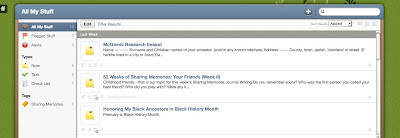 Inside "All My Stuff" you see Flagged Stuff (items you have flagged) and Alerts (items for which you've set a reminder). Then you see Types and under that are your choices of Notes, Tasks and Check List. Simply click on one and start writing or open a previously saved item.
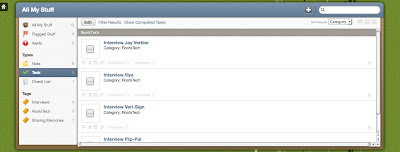 The last section is Tags. This is where you will see tags (keywords) that you have added to your notes which help you find and organize what you've added. One of my Tags is "Sharing Memories" This is a tag I will add to any Sharing Memories posts I write and save in Springpad. By clicking on that tag, all my posts tagged with that phrase will display for me. I've tagged several of my notes with the words "Interviews" and "RootsTech" Clicking on either of those keywords brings up all notes or tasks for that tag.
 Under each file you have created, there are tiny icons which display in bold with a pop-up one line of text to explain what each is for. One is to add tags (keywords), one toggles privacy (you can make your posts public or keep private), one toggles the Flag status and one allows you to add the note or task to a notebook.
There's much more you can do with Springpad but let me leave you with this brief overview. As I play around with it over the next few weeks I should be able to write more about this productivity tool.
It'd be great if readers could jump in with their own ideas or uses for Springpad for genealogy.
Non-Disclaimer: I really like Springpad and receive nothing from the company for telling you about it. In fact they've never heard of me and don't even know I'm writing this review/tutorial!
Springpad has plenty of templates for organizing the most common work-related tasks such as shopping, recipe planning, grocery lists and so on, but users can easily create their own custom lists of tasks. You can also write notes and save them in folders which you name. I started a folder called "Lorine's Blogs" and in it I keep a list of blog post titles and ideas - topics I might want to write about. I also write some of my blog posts and save them on Springpad rather than compose them directly in Blogger (which is the blog format I use). This also allows hubs to proof-read my posts before I publish them.
Hubs also writes a genealogy blog (Ancestors At Rest) but he likes me to proof-read his posts before he publishes them. It wasn't working well for him to save them as drafts in Blogger, because I couldn't make changes if I wanted or needed to. So now he uses a folder in my Springpad where he writes and saves his blog posts and I go in and add suggestions or correct typos.
How does this work for genealogy? I'm sure there are many ways I haven't thought of but here are a few I'm working on:
1. You can easily create a research to-do list in the Check List area. Then when you are at a Library or Family History Centre or even a local museum you can easily open Springpad and look to see what's on your list of items. Did I mention you can get the Springpad app for your mobile phone or iPad? That allows you to access your work from any of your devices.
2. In the Task List area you can create a "Task" for each ancestor you are currently researching. Enter some basic facts (birth, marriage, death) as well as location and time periods for that ancestor, and add a point form list of their spouse and children and you have a mini-genealogy group sheet at your fingertips. I like to list all the census records that my ancestor was alive for - and beside each year I tick off if I have found them (and where). That allows me to very quickly determine if I need to have a search in a specific census year or years.

 Inside "All My Stuff" you see Flagged Stuff (items you have flagged) and Alerts (items for which you've set a reminder). Then you see Types and under that are your choices of Notes, Tasks and Check List. Simply click on one and start writing or open a previously saved item.
 The last section is Tags. This is where you will see tags (keywords) that you have added to your notes which help you find and organize what you've added. One of my Tags is "Sharing Memories" This is a tag I will add to any Sharing Memories posts I write and save in Springpad. By clicking on that tag, all my posts tagged with that phrase will display for me. I've tagged several of my notes with the words "Interviews" and "RootsTech" Clicking on either of those keywords brings up all notes or tasks for that tag.

There's much more you can do with Springpad but let me leave you with this brief overview. As I play around with it over the next few weeks I should be able to write more about this productivity tool.
It'd be great if readers could jump in with their own ideas or uses for Springpad for genealogy.
Non-Disclaimer: I really like Springpad and receive nothing from the company for telling you about it. In fact they've never heard of me and don't even know I'm writing this review/tutorial!
Subscribe to:
Posts (Atom)