Discover your inside story with AncestryDNA®

April 6, 2014

Sharing Memories Week 14: Grade 9 - Love it or Hate it?

Me at Gr. 9 Initiation Day
Sharing Memories is a series of weekly prompts to help all genealogists (including me!) with writing up memories of our ancestors and our childhood. 

We all love to find a diary or letters written by great grandma or grandpa where they talk about their lives and share their memories. Think how excited one of your descendants will be to read about your memories and your stories! These stories will be lost after a few generations unless we preserve them. And what better way than in a weekly themed post. 

This week's prompt is "Grade 9". Did you love it or hate it? Did you walk to High School or take a bus? How did you feel going into Grade 9 - were you scared or excited?

We had Initiation Day in my High School. It was horrible. We Grade niners had to dress as Romans in old bedsheets to look like togas. We had to fashion crowns of ivy to wear on our hands too. We were slaves for the day and had to carry books for several students at once. We had to use our noses to roll marbles up the cement incline to the front door of the school and at lunch time we had to kneel on the floor under the lunch tables so the older students could use our backs as a foot rest. 

The worst was the shaving creme they squirted into our faces and mouths. Initiation lasted the entire day and it really wasn't any fun at all. I had my photo taken and put in the local paper while I was rushing down the hallway. 

Grade 9 was a bit of a blur for me. My father died that year on Christmas Day so from January on I really don't remember much of what went on in school. I was very shy and it was all my teachers could do to get a word out of me. 

My favourite teacher was Mr. Parrott. He taught English and I thought he was wonderful. He took an interest and tried to coax me to answer questions in class. He told my mother that I knew the answers but wouldn't put my hand up to volunteer them. Eventually he was able to get me to come out of my shell and start enjoying and participating in class.

I actually enjoyed High School and all the new things I was learning. I signed up for Music class and learned to play French Horn. As usual I joined the school choir. I also joined the school newsletter as a reporter/writer (yep I loved to write even back then!) 

I loved taking part in all of these activities but then my mother said I had to get an after-school and weekend job. The extra-curricular went out the window as I could not do both. I worked at our local library every day after school (4 pm - 6 pm), two evenings a week (7pm - 9pm) and all day Saturday. It wasn't easy to keep up with my school work and get good grades with all the hours spent working but somehow I managed. But I sure missed my after school activities.


April 5, 2014

Corpses of WW1 Soldiers Found as Glaciers Melt in Italy

A recent story online Melting glaciers in northern Italy reveal corpses of WW1 soldiers explains how dead soldiers from WW1 battles are being found and reburied by local villagers.

As the story explains, the bodies are often mummified. The two soldiers interred in 2012 were blond, blue-eyed Austrians aged 17 and 18 years old, who died on the Presena glacier and were buried by their comrades, top-to-toe, in a crevasse. Both had bulletholes in their skulls. One still had a spoon tucked into his puttees — common practice among soldiers who traveled from trench to trench and ate out of communal pots.

There are several photos and a lengthy explanation of the area and the fighting on The Telegraph article and it is well worth the read. 

Credits: Image is a cropped screen dump from The Telegraph article.

April 4, 2014

Genealogy Selfie Contest

Genealogy Selfie Contest
Selfie with WW1 ancestor,
WW2 ancestor & coffin plate
2nd Great grandpa
This sounds like fun! Enter Gould Genealogy's Genealogy Selfie Contest for a chance to win a  Conversion Pack (Video Converter and PhotoMaker X4 slide/negative scanner) from Kaiser Baas.

To enter, take a selfie pic of yourself with something genealogy related. Maybe you are standing in front of a stack of microfilm or at a microfilm reader. Maybe you're in a cemetery hunting for the grave of an ancestor. Or perhaps you are surrounded by a mountain of genealogy paperwork or charts. Next time you find yourself doing something genealogy related, grab your cell phone and snap a selfie.

You must then post it on Gould Genealogy's Twitter Account, Facebook Page or Google + page.  Details are at Genealogy Selfie Contest

April 3, 2014

52 Ancestors: Charles Fuller, an Ordinary Man But Loved by All

Charles Fuller in The Buffs, Ramsgate Kent England
I'm writing about my grandfather Charles Henry Fuller as part of Amy Crow's Challenge: 52 Ancestors in 52 Weeks 

I never knew my grandfather. He died in Guelph Ontario in 1941 at the age of 48. I do have many photos of Charles and heard many stories about him from my mother, her sisters and my grandmother Ruth. 

Charles was born and grew up in Ramsgate, a seaside town in Kent England. It was there he met my grandmother Ruth. I don't know much about his life in England although I have  photos of him as a young teen still living in Ramsgate.

As a young lad he joined The Buffs and was sent to ride along the coast on his bicycle watching for invading Germans. 

When Charles was 19 years old he and his fiance Ruth decided to come to Canada. On May 29, 1913  Charles Fuller and Ruth Simpson sailed on the Cunard Line ship Ausonia from Southampton to Montreal then Quebec, Canada. The ship arrived in Quebec on 9 June at 8:10 p.m. My grandmother often spoke of this journey with loathing. She was terrified of the water and the trip was something she never wanted to do again.

1914 Wedding Charles Fuller & Ruth Simpson
One year later in August 1914, Charles and Ruth were married in Toronto. Shortly afterwards they moved to Guelph where Charles obtained a position as bookkeeper in the Guelph Lumber Company. It didn't take long before he was promoted to manager. 

Apparently my grandfather had a wonderful singing voice and used to sing in the church choir as well as entertain on stage in amatuer vaudeville performances.  My aunt, his daughter, remembers the Sunday afternoons when her dad would entertain the neighbours and his family at the piano.

Charles in Blackface
Although it is certainly not appropriate in today's world, his forte was singing in blackface, much as the singer Al Jolsen had done.  This was a popular way to entertain in the 1920s. And Grandpa was certainly not a bigot, he respected everyone.


Charles was by all accounts, extremely kind-heared. He would help anyone and often brought strangers home for dinner. His wife, my grandmother, was used to having Charles walk in the door from work with one or two down-on-their luck men he'd spotted on the street. No one was turned away from their table and Grandma always found a way to stretch the meal to accomodate. 

WW1 had not seen Charles enlist because as the manager of the lumber company he was needed at home. Since he had been active in The Buffs in England I am sure he was disappointed at not being able to join in the fight. 


And so Charles lived out his short life, not having done anything particularly outstanding, but a kind decent man who was loved by family and friends. His mother adored him and in fact his parents left England, bought a house beside Charles and Ruth and planned to live out their lives in Guelph. Eventually they were so homesick for Ramsgate that they returned but that is how much his mother missed him. As an aside, she and  her daughter-in-law (my grandmother) did not get along and I'm willing to bet the years when they lived next door were a struggle for Ruth. 

Grandpa Charles fell ill sometime in 1940 and doctors could not determine what was wrong. After a year of pain and fatigue he died in the Guelph Hospital. My grandmother never got over his death and even though she married two more times during her life, she always spoke of "Charlie" and how much she missed him. In some strange ironic twist of fate and genetics, Charles youngest brother is still alive at the age of 102. 


April 2, 2014

Using Evernote to Make Virtual Binders for Genealogy Organization

Using Evernote to Make Virtual Binders for Genealogy Organization
Last week Renee Zamora left a comment on my blog post Spring Is Supposedly Here and My Spring Organization Fever is High. 

Renee mentioned that she is using Evernote to create binders in order to digitize all her paper files. I'm not sure I want to go totally digital for my genealogy but the idea of organizing my computer files using Evernote appealed to me. I use Evernote daily for gathering and organizing recipes, for saving receipts for items I purchase online, etc. But I'd never thought of pulling in files from my hard drive and organizing them into Notebooks.

I should preface this by saying that my computer files are a mess. I'm terrible at organizing them! My thousands of family photos, scanned documents and saved images from genealogy documents found online are a hodge-podge. Some are in the Documents folder on my laptop. Some are in the Pictures folder on my laptop. Some are on my desktop computer, some are on my Western Digital MyBookLive, some are on one of 3 Western Digital Passports, and some are in the Cloud - and more than one cloud! I use Dropbox, Bitcasa and Google Drive so depending on my mood that day I might put the 1851 Census for Levi Peer in any one of those spots.

You can see the problem I have when trying to find something specific. I know it's in one of those spots and I know it will be in a sub-directory of my Genealogy directory, but where?? Sure I can search for  what I want but it's not always easy to find, and it's certainly time-consuming.

Using Evernote I'm able to pull each file in to a binder (Notebook) that I've created. I can see at a glance what I've got on each ancestor and even better, I can click on the item in Evernote, choose to view it in Picassa or Preview or whatever program I want, and then I can easily move or copy it to the proper directory on my hard drive. Killing two birds with one stone! I am making it easier to see my saved files and am able to organize my hard drive at the same time.

My Genealogy "Binders" on Evernote
The first thing I did was create a Notebook (I'm calling Notebooks "Binders" in this blog post) called "Genealogy Binders". Then I created separate Notebooks (Binders) under this main Binder. My individual Binders are set up to suit me, so I have one Binder for each direct ancestor. I am also making individual Binders for documents and photos I have for siblings of my direct ancestors. Each of these individual binders goes into what Evernote calls a "stack". Think of a stack like the folders and sub-folders on your hard drive. You can see my setup for this in the image on the right. By the way I'm nowhere near done with setting up my binders!

Then I opened a binder and began creating individual notes within that specific binder. For example, I opened Peer Gen 1 Stephen - Mary Elizabeth Vollick. I click on "New Note". Then I go to the drop down menu called FILE and choose ATTACH FILES. I am then able to search for and insert an image or document from my hard drive. You can see the marriage registration I put into a note inside the Stephen Peer & Mary Vollick binder. The other notes I've added are on the left sidebar. I can also view these notes in different ways if I don't like the sidebar view.

Creating a Table of Contents for one "Binder"
Once I have all the notes I want in a binder, I can do lots of different things. I haven't finish playing around with all the choices but one I really like is creating a Table of Contents for a binder.

All I have to do is select all the notes in a binder. Evernote lays them all out for me in a pile and then I choose Create a Table of Contents and it's done. The TOC displays as a new note in that binder.  Update: Apparently creating a TOC is only available for MAC users. Sorry to all you Windows users out there!

Table of Contents for One Binder
I like that the list of contents in the TOC are linked to the individual note so I can click on any one I want and immediately view it full-size. I also chose to give each of my notes a title that began with a year because then I was able to sort the notes in chronological order. This helps me see at a glance what I have as a timeline for each ancestor and what I'm missing.

This is as far as I've gone in discovering how to set up and organize my genealogy files as virtual binders in Evernote but I am loving it! Once I have everything organized as I want, I'll decide what my next step is. I already shared one binder with a family member (easy to do from the Evernote program) and I'm going to check out my other options at some point.

April 1, 2014

Texas Tombstone Found During Construction Returned to Descendants

Texas Tombstone Found During Construction Returned to Descendants
A tombstone that was discovered beneath an East Texas construction site has been given to a relative.

Ron and Nelda Swinney claimed the stone Monday from the City of Tyler's Engineering Department. The Swinneys live in an area of Smith County along Highway 64, once known as Swinneytown. The Swinneys said they saw the stone on the news and researched to find that the baby's father was Ron Swinney's great-great-uncle.

"We just started having conversations how does this tombstone tie in to your family and they provided a family tree," said Tyler City Engineer Carter Delleney. 


The Swinney stone is now back in the family's hands and will eventually find its way to the Bascom Cemetery to be placed next to the baby's grandfather. Source: KLTV

The child was not quite 3 months old when he died in October 1883.

Read the rest of this story on KLTV at Tombstone discovered at Tyler construction site given to descendants

Credit: image is a cropped screen dump from the online video on KLTV

March 31, 2014

Interviewed on The Genealogy Professional Podcast - Such an Honour!

Interviewed on The Genealogy Professional Podcast - Such an Honour!
Marian Pierre Louis interviewed me a few weeks ago for her ongoing podcast series called The Genealogy Professional. If you haven't been listening you should. Marian has interviewed some fascinating bloggers and genealogists around the globe. 

It was my pleasure to do this interview and I feel very honoured to have been chosen as one of Marian's guests. My Podcast interview and biography can be found at TGP 18 Lorine McGinnis Schulze – Focus on New Netherland

March 30, 2014

Sharing Memories Week 13: Broken Bones & Other Accidents

Sharing Memories Week 12: Broken Bones & Other Accidents
Sharing Memories is a series of weekly prompts to help all genealogists (including me!) with writing up memories of our ancestors and our childhood. 

We all love to find a diary or letters written by great grandma or grandpa where they talk about their lives and share their memories. Think how excited one of your descendants will be to read about your memories and your stories! These stories will be lost after a few generations unless we preserve them. And what better way than in a weekly themed post. 

This week's prompt is "Broken Bones and Other Accidents". Have you ever broken a bone? How? Where? What about sprains or dislocations or traffic accidents? Tell the stories around these accidents. 

I've never broken any bones. But I've had accidents - I guess the worst one was a car accident when I was 20 years old. It was on the 401 Highway heading towards Montreal. I was driving my mother's Volkswagen, and it was night and I was tired. Long story short, the car ended up on the shoulder and then twisted around going the wrong way on the highway. All I remember is the headlights of other cars coming towards us and trying to dodge out of our way. Then the car flipped and began to tumble and roll on its back, spinning as it went. 

To this day I don't know how other cars managed to avoid us and I don't know how we survived. When the car came to rest in a ditch, the top was completely crushed down to the bottom of the windows. The only thing that saved me was I was thrown out of my seatbelt just as the roof caved in, and I was thrown under the seat.
When the ambulance came to take us to the hospital in Kingston, I was full of glass slivers and had a badly sprained neck and back, which still is bothersome to this day. My friend had a tiny cut on his finger and that was it!

My brother-in-law came to get us the next day and take us home while I tried to figure out how to break the news to my mother that her car was demolished. The police officers all shook their heads at the miracle of us making it out alive.

Oh and I met a really cute guy! He helped pull me out of the wrecked car, and had me sit in his car while we waited for the ambulance. It took so long to get there that we had a nice long chat, and he slipped his name and phone number into my purse! Unfortunately I didn't find it until several months had passed and I was in a relationship so never phoned him. I still chuckle over that.


March 29, 2014

Featured Database Brixham Devon Church Records

Featured Database Brixham Devon Church Records
This is a very location specific database but if, like me, you have ancestors from Brixham Devon, you will be thrilled that it's online and free. My Brixham ancestors go way back to the late 1500s so this free set of records for St. Mary's Church in Brixham is a wonderful asset.


In case anyone else has Brixham Devonshire ancestors, here is my list of surnames from this area: 

Moses, Hooper, Petherbridge/Pethebridge, Helling, Martin, Lelton, Downing, Moxey,  Skynner/Skinner, Cundett, Lucas, Nowell, Harvey, Joll, Prowse, Norman, Williams, Doust, Cole, Burd, Lambshead/Lamsed, Pearse/Pierce. My ancestors were living there before 1850.
 
Follow the links below to search for ancestors in transcriptions of the Parish registers by Judith Smith and Marie Simkus, provided by the Brixham Heritage Museum:


March 28, 2014

FamilySearch Update: Collections from Brazil, Canada, England, Mexico, Portugal, Spain, and the United States

FamilySearch Update: Collections from Brazil, Canada, England, Mexico, Portugal, Spain, and the United States
FamilySearch Adds Close to 11.1 Million Indexed Records and Images to Collections from Brazil, Canada, England, Mexico, Portugal, Spain, and the United States

FamilySearch has added close to 11.1 million indexed records and images to collections from Barbados, BillionGraves, Brazil, Canada, England, Mexico, Peru, Portugal, Puerto Rico, South Africa, Spain, Sweden, and the United States.

Notable collection updates include the 1,703,529 indexed records from the U.S., Texas, County Tax Rolls, 1846–1910, collection; the 766,368 indexed records and images from the new Canadian Headstones, collection; and the 2,917,490 indexed records from the England, Kent, Register of Electors, 1570–1907, collection. Search these diverse collections and more than 3.5 billion other records for free at FamilySearch.org.

March 27, 2014

WW1 Photo Album: Page 15 Canadian Soldiers in the CEF

Continuing on with my WW1 Photo Album archive here is page 15 in my mother's cousin Doris Simpson's album.
There are only two WW1 soldier photos on this page. Unfortunately they aren't labelled and I don't recognize the individuals. I suspect the one soldier on horseback was in the same Cavalry Unit in Toronto as my Uncle Ernest Simpson.


March 26, 2014

Spring Is Supposedly Here and My Spring Organization Fever is High

Spring Is Supposedly Here and My Spring Organization Fever is High
Supposedly Spring is here. I don't know about you but we have about 3 to 4 feet of snow still on the ground and yesterday we had a blizzard. Mother Nature's being very cruel this year. But the good thing about Spring is that suddenly I'm hit with a burst of energy and a strong desire to ORGANIZE!

Yep, every year I go through this. During the long winters I sit and think about the mess of my genealogy files. Every year I come up with a new way to organize them. Sometimes I go back to old ways, long discarded as not working. I've tried binders by surnames, binders by topics, pdf files on my computer, file folders by surname, file folders by topics... in short I believe I've tried every possible organizational method there is. In fact I've blogged about getting organized many times.

But I'm never happy. These past couple of years I've discovered quite a bit of detail (newspaper clippings, parish and church records, land petitions and so on) for several of my ancestors. I've also scanned many original documents in my possession. That's what made me realize my genealogy is getting out of hand. I'm overwhelmed by the sheer volume of my findings.

Hubs is in the same boat. He doesn't even remember who many of his further back ancestors are or what we know about them. So today we made a decision that starting this week we are going to set aside a minimum of one hour every day to sort, print and organize our genealogy files.

I'm going back to one of my very first methods that I used many years ago - binders. These binders will only be for my direct lines. However I'm not going to print genealogy reports or notes for my ancestors. Instead I plan to print a family group sheet for each of my direct ancestors. then print copies of all the documents I have for the parents on the family group sheet.

I suspect I will end up with many binders - each one holding ancestors sharing one surname for all generations. Ancestors whose data is skimpy will share a binder with other less detailed ancestors.  I'm not going to put all the siblings in these binders. I have them on my genealogy program and in my paper files and in my digital files so that will suffice for now.

For me it's about narrowing my focus, not expanding it! I tend to get carried away and research all siblings of every direct ancestor. Don't get me wrong, that is a very valuable research technique as it provides you with clues and information you may not find if you only research your direct. But I don't need to organize all those siblings into a binder.

So wish us luck! I have no idea how many weeks or months this will take but I'm excited about starting. 


March 25, 2014

52 Ancestors: Hannah Philpot Golding and George Norris - Friends With Benefits?

52 Ancestors: Hannah Philpot Golding and George Norris - Friends With Benefits?
Pluckley, Kent England
I'm writing about my 3rd great grandmother Hannah Philpot Golding as part of Amy Crow's Challenge: 52 Ancestors in 52 Weeks and also as part of Women's History Month Challenge
 

Hannah was born in 1805 in the little hamlet of Pluckley in Kent England to John & Susanna Philpot. 

Pluckley is said to be the most haunted village in England. At age 18, Hannah left Pluckley for Lenham, a nearby small town. There she married Edward Golding and over the next 14 years the couple had 6 children. When their youngest was 9 months old Edward died and Hannah was left a widow at the age of 28. 

Church in Lenham
Hannah had no family in Lenham but luckily she was able to take in laundry to support her young family. My mother went to Lenham to research my 2nd great grandmother Georgiana Golding who was born there in 1840. To our surprise Georgiana's mother Hannah was noted in the church record as "the widow Hannah Golding". My next find was the fact that Hannah's husband died some 3 years earlier in 1837. So obviously my 2nd great grandmother was an illegitimate birth. 

It took a few years to find out who had fathered Georgiana but eventually I had the proof that it was Hannah's next door neighbour, George  Norris. Hannah went on to have another child after Georgiana, and Georgiana named George as her father at her marriage to Charles Simpson, so obviously this was not a secret in the village. 

Hannah never remarried after Edward's death and George Norris remained single his entire life. I've always wondered what their relationship was. They never lived together so were they an early example of  "friends with benefits"? Was it a casual but consensual relationship? Or was it a long-lasting love that carried on over the years. I suspect I will never know. 

Kent County Insane Asylum
The last record of Hannah is the 1881 census where she is found as an 85 year old widow, an inmate of Kent County Asylum. Often paupers were sent to the Lunatic Asylum but it may also be that Hannah suffered from senility or some other disorder that labelled her as insane. It's very sad that none of her children could support her or take her into their own home. I have never found Hannah's death although she may be the Hannah Golding who died in June 1881 in Maidstone (which is where the Asylum was located).

As for George Norris he disappears after the 1861 census where he is found as a 50 year old single man living with his mother in Lenham.

March 24, 2014

Featured Database: Irish Emigration Database (IED)

Featured Database: Irish Emigration Database (IED)
If you have Irish ancestors this is a great database to check out. Irish Emigration Database (IED) is a free searchable set of records from various sources. The list of documents in this database are

  Wills

Searching for various names and topics resulted in dozens of fascinating newspaper accounts, letters and diaries. 

March 23, 2014

Sharing Memories Week 12: Gardening

Sharing Memories Week 12: Gardening
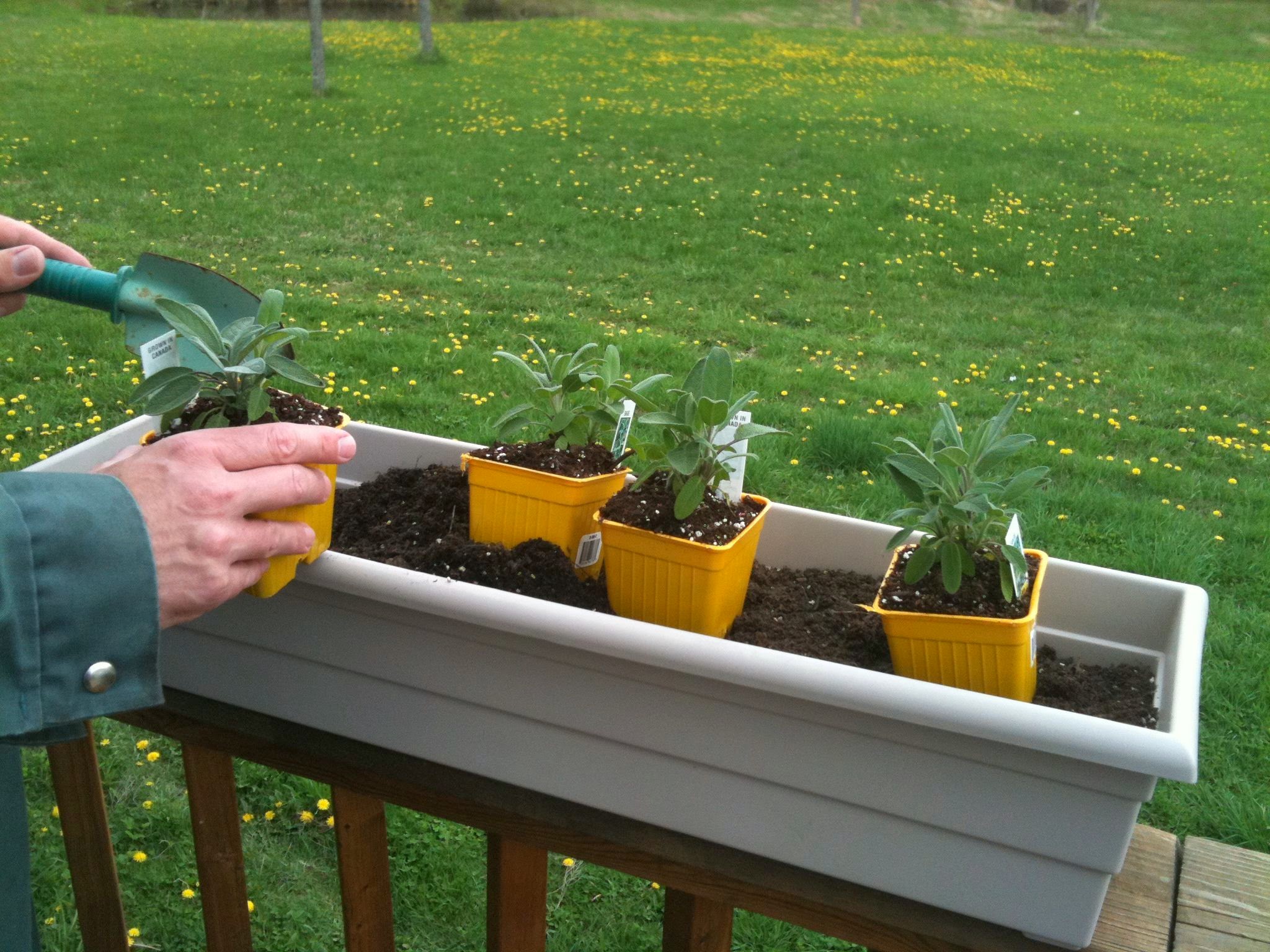
Hubs planting some of my herbs
Sharing Memories is a series of weekly writing prompts to help all genealogists (including me!) with writing up memories of our ancestors and our childhood. 

We all love to find a diary or letters written by great grandma or grandpa where they talk about their lives and share their memories. Think how excited one of your descendants will be to read about your memories and your stories! These stories will be lost after a few generations unless we preserve them. And what better way than in a weekly themed post. 

The prompt for today is Gardening. What kind of gardens did your parents have? How about your grandparents? Did they grow vegetables? Maybe your grandmother had a prize flower garden? Did any fruit trees or edible plants grow on your property or nearby? Did you garden as a child? Some families might just have had indoor plants.

My father loved African Violets and he grew them inside the house. I remember him using milk to wash their leaves. He also planted marigolds outside in our tiny planter on our front lawn. There may have been other flowers but I don't remember them.

In our back yard we had a pretty lilac tree that smelled really good but there were tons of bees around it all the time. I don't remember my mom or dad with any kind of vegetable garden but we did have a huge clump of rhubarb which my mom used to make stewed rhubarb for us.

My Aunt Rose was an amazing gardener. Her backyard was almost all vegetable garden. She always had used tea bags drying on the heating ducts because she used the leaves to fertilize her plants. 

I'm not a gardener both because of physical limitations but also because I just don't enjoy it! I do however grow my own herbs which I use in my cooking. Back in my late 20s and early 30s I tried my hand at a vegetable garden but the day I picked lettuce and made salad for company and didn't notice the little green worms crawling in the lettuce was the last time I had a vegetable garden.


March 22, 2014

Finding Aid for Heir & Devisee Commission Online Films


From H 1144 V58
Burford Christian BRADT
Canadiana.Org has digitized 21 films of the Heir & Devisee Commission Papers (Heir & Devisee Commission papers 1797-1854, found in their Heritage Collection), and that's a good thing for genealogists. But as mentioned in a previous blog post I wrote called Heir & Devisee Commission 1797-1854 on Canadiana.org - Listing Errors and a Workaround, their index and description of what is in each film is incorrect.

After realizing their description didn't match what was in the film I was viewing, I spent several weeks going through each online film and noting what volumes and dates each contained. In September 2013 wrote to Canadiana.org through their website and to their Twitter account to provide them with the corrections but had no response. That's right - no response to my offer to provide them with a detailed and correct description of the contents of each film. I call that a huge fail! 


What is the Heir & Devisee Commission?

"This microfilm consists of records documenting the review and determination of claims for land brought forward by the heirs, devisees, and assignees of individuals originally located by the Crown on land, in cases where no letters patent had been issued. The First Heir and Devisee Commission was in existence between 1797 and 1805." [Source: Ontario Archives] 
  
10 of 21 Films Are Wrong on Canadiana.org

H 1133 and H 1134  are correctly identified and described on Canadiana.org so let's move on to the incorrectly described films. 10 of the online 21 films are incorrect.  H 1135, H 1136, H 1137, H 1138, H 1139, H 1140, H 1141, H 1142, H 1150 and H 1151 are all incorrectly described and the wrong contents listed on the Canadiana.org website. 

Finding Aid for H 1135


Example of an index found in Heir & Devisee Commission Reels
H 1135 (Volumes16-20 Johnston District Location Certificates) does not contain what Canadiana.org has listed. H 1135 is described on Canadiana.org as containing Volumes 9-15. In reality this digitized film contains volumes 16-20. Here is Olive Tree Genealogy's list of contents which I obtained by viewing the entire film online. 


I have added image numbers to help genealogists find the start of each section. This will work as a Finding Aid for genealogists.

  • Image 14  V16 Johnston District  
  • Image 148 V 17 Johnston District Location Certificates, alphabetical  A-B
  • Image 149 “A” names Land Certificates
  • Image 186 “B” names Land Certificates
  • Image 319 V 18  Location Certificates C-F
  • Image 319 “C” names Land Certificates
  • Image 402 “D” names Land Certificates
  • Image 434 “E” names Land Certificates 1787-1795
  • Image 448 “F” names Land Certificates 1784-1803
  • Image 485 V 19 Location Certificates G & H
  • Image 486 “G” names Land Certificates 1785-1806
  • Image 547 “H” names Land Certificates 1784-1803
  • Image 619 “J” names Land Certificates 1784-1802
  • Image 665 V 20 Location Certificates K-M
  • Image  666 “K” names Land Certificates 1784-1810
  • Image  701 “L” names Land Certificates 1784-1801
  • Image 757 “M” names Land Certificates  1783-1803
My first set of detailed listings of the contents of film H1133 can be viewed at No Response from Canadiana.org so here are the Heir & Devisee Commission Film Details 

I have published the full set of corrections for the digitize records on Olive Tree Genealogy website at Heir & Devisee Commission This is a work in progress.

March 21, 2014

Finding an Ancestor in the Challenging Upper Canada Land Books

Finding an Ancestor in the Challenging Upper Canada Land Books
Upper Canada Land Book K
I've shown you how to find an ancestor's petition in the Upper Canada Land Petitions online. If you missed that, you can follow the step-by-step instructions at Searching Ontario Canada Land Records, eh? and Understanding Notations on the Envelope of an Upper Canada Land Petition

Now we're going to tackle the very challenging set of online records called Upper Canada Land Books.

As I mentioned in my tutorial on  Understanding Notations on the Envelope of an Upper Canada Land Petition, the envelope on an ancestor's petition should not be overlooked.

In fact if you are lucky there will be a notation on the envelope that tells you the Land Book the page where you will find the entry for your ancestor's petition for land. Even if there is no notation indicating the Land Book Volume and page number, there should still be an entry in the Land Books.  I'm going to show you how to find those entries whether they are notated or not on the Petition envelopes.

What Are the Upper Canada Land Books?

But first let me explain what the Land Books are. When an individual petitioned for land in Upper Canada (present day Ontario), he or she had to present supporting documentation with the petition. The petition and supporting documentation would be read in the Executive Council. This Council consisted of a Land Committee who were responsible for recommending a decision as to whether or not to grant the petition. The  Council Clerk then made a corresponding entry in the appropriate Land Book.  These books contain the deliberations, decisions and recommendations of the Land Committee of the Executive Council of Upper Canada.

Sometimes the Land Book only contains a summary of the petition. Sometimes there is more detail. It is always wise to uncover all records possible for a given ancestor and I do recommend finding your ancestor's entry in the Land Books. The dates covered by these digitized Land Books are 1792-1867.

These Land Books do not have an online index (except for Land Book C) but there are several different online listings of the microfilm reels providing Volume numbers and dates found in each reel. However none of the online listings agree so I've tracked down which online listing is correct and that is the one you will need to use.

The Digitized Upper Canada Land Books

Let me explain in more detail. The actual filmed Land Books are online at Heritage Canada. But you can't just jump in and start searching as there are 14 films numbered from C-100 to C-110, as well as H-1976 to H-1978. The "H" films are all Finding Aids but I don't find them very helpful.

Clicking on the "About" tab for film C-100 says that this film contains Upper Canada Land Books Vol. 18-19. No dates are provided for any of the films listed on Heritage Canada. They only list Volume Numbers but the envelopes of Land Petitions do not record Land Book entries by Volume number. Instead they record it as a letter such as "Land Book K" or "Land Book M"

So we can't use the Heritage Canada descriptions to help us find our ancestor's entry. But we must use their online digitized images of the Land Books! A search of Library and Archives Canada finds a listing but on their website it shows there are 22 microfilms (as opposed to Heritage Canada's 14).

Finding What Dates are Covered in the Digitized Land Books

It took me quite awhile to find a list that provided accurate details as to what dates and Land Books are covered in each film.

I tried the search engine on Collections Canada found at http://collectionscanada.gc.ca/lac-bac/search-recherche/arch-adv-elab.php?Language=eng but results using the "identifier" found in the two lines under a specific film number on the About tab for a specific film back on Heritage Canada bring up results that do not fit the Heritage Canada film.

For example the identifier for film C-100 for example is "RG 1 L1 205068" Entering this in the search engine brings up 5 results. Each is for a different film. The hit for C-106 shows the following details:

 "Upper Canada Land Minute Book T contains the minutes of meetings of the Executive Council between 10 August 1837 and 29 June 1839 (pages 1-614), plus a nominal index organized under A to Z. For Minutes omitted in April 1838, see Upper Canada State Minute Book K (RG 1, E 1, vol. 55; mikan #3815028). " It also states C-106 contains Volume 38. 
But Heritage Canada website description for C-106 states it contains Vol. 36-39. We're in the ball park but we still don't know exactly what is covered in the film on Heritage Canada's website!
However the good news is that eventually I found this list of microfilm numbers on the Library and Archives Canada website. So far the details on this list have proven accurate as to what is on each film on the Heritage Canada website.

Finding Your Ancestor's Land Book Entry Using Notations on the UCLP Envelope

Now we get to the fun part. First you must find your ancestor's petition in the Upper Canada Land Petitions. See my previous blog posts for help with this. Once you have found the petition, check the envelope carefully. If there is a notation such as "Entered in Land Book J, page 110" as was found on one of the examples I used, that of the petition of Elizabeth Bowman DeForest, you're in luck.

Next you consult the list of microfilm numbers I finally found, to find out what film contains Land Book J. It is
C-103 28 Upper Canada J 13 Aug. 1816 - 10 Feb. 1819

Now you go to Heritage Canada website and choose C-103. Once the first image loads you conduct a search the same way as we searched for the Upper Canada Land Petitions. See Searching Ontario Canada Land Records, eh? for a reminder of the method we used. It's a little different searching the Land Books because you are simply going by date which is found at the top of the images. Once you find the year and month you need, you check the page numbers until you get to the page you need.

And here is the entry for Elizabeth Deforest, found in Image 213 of C-103. It's a very simple entry and does not reveal any additional details about Elizabeth or her petition.

Finding Your Ancestor's Land Book Entry When the UCLP Envelope Has No Notation

But what if your ancestor's Upper Canada Land Petition envelope has no notation showing what Land Book it was entered in? What you must do in that case is note the dates - you want to write down the date of the original petition and the last date found on the envelope.

So in the case of my ancestor John Greenlees and his petition of 1826, I could see that the first date is 6 December 1826 and the last is 11 December 1826. So that is my timeframe. Checking the list of microfilm details on Library and Archives Canada I can see that my time period of interest is found on C-104.

C-104 31 Upper Canada M 9 Feb. 1824 - 13 Dec. 1826

Back to Heritage Canada and a quick search through C-104 to find December 1826 and there was his entry.

And that is how you find an ancestor's Upper Canada Land Book Entry using the Upper Canada Land Petitions.

March 20, 2014

Store Ledger from Maine 1922-1927 ONLINE

 Store Ledger from Maine 1922-1927 ONLINE
Ancestors At Rest has added another Ledger Book online. A  Store Ledger from Maine 1922-1927 is freely available as 11 pdf files. The best news is that the first file contains an index of names.

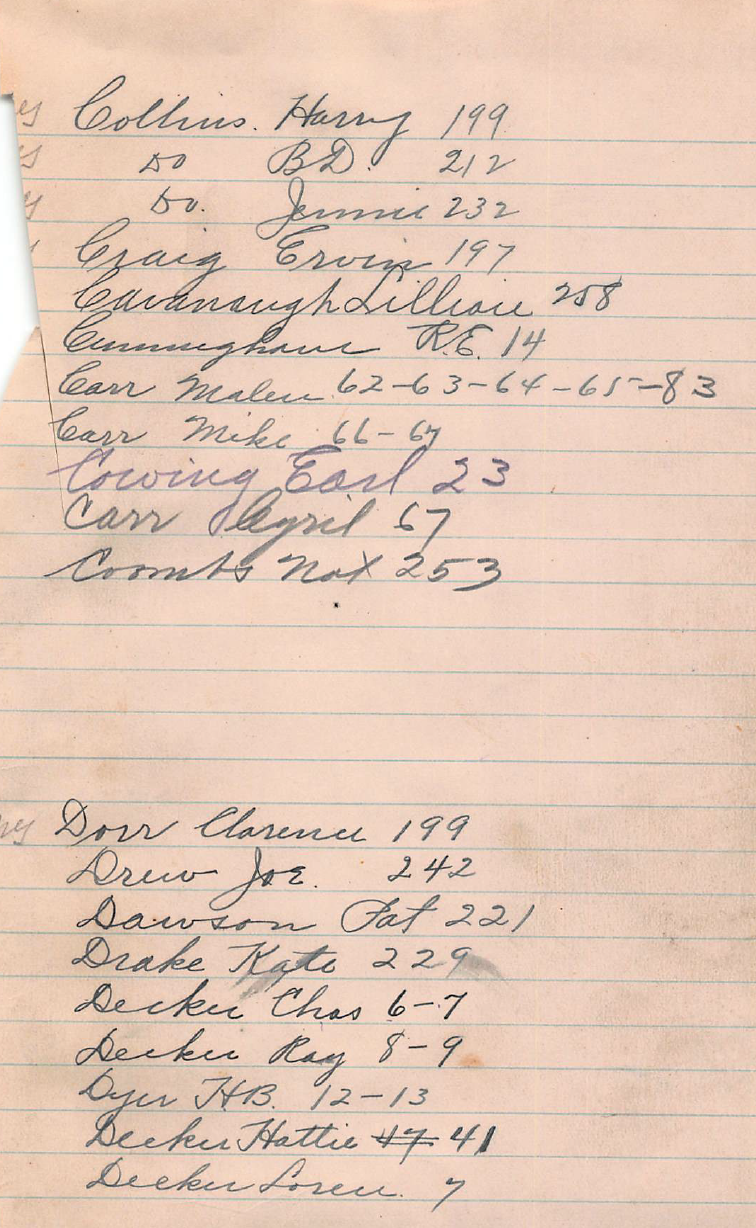
Here's a clip from the C and D indexes. The numbers beside each name refer to the page(s) in the ledger book where the entries for that individual are found.

The next helpful item is that each of the pdf files uses a consistent naming convention - that is with the number of the page in the ledger that is the start of the pdf file.  So if we want to find Decker, Chas 6-7 (from the image at the left) we have to look for the pdf file that contains pages 6 and 7.

A quick look shows that the PDF files available for download are:  Index, P. 1, P. 23, P. 43, P. 63, P. 85, P. 105, P. 123, P. 215, P. 241, P. 273

 Store Ledger from Maine 1922-1927 ONLINE
So we can see that we want to download the file called P.1. And sure enough as we scroll to pages 6 and 7 we spot the correct name. 

It looks like the Decker family needed coffee, raisins, and other assorted household items in 1923. Butter cost the household 30 cents! 

Because there is no identifying information in this ledger as to what store it was or the precise location, I searched for several of the individuals found in the index.

Of the 6 people I searched for in the 1920 census on Ancestry.com, I found 4 of them living in Penobscot Maine.

March 19, 2014

Understanding Notations on the Envelope of an Upper Canada Land Petition

A few weeks ago I explained how to find your ancestor's petition in the Upper Canada Land Petitions (UCLP) online. If you missed this step-by-step it is at Searching Ontario Canada Land Records, eh? 

One thing I mentioned in that post was that it is important to read and save the "envelope" for any petitions you find, as the envelopes tell us what the final outcome was to the petitioner's request. Let me show you 3 examples of what might be found on these envelopes.

 Here is the envelope for the petition of Abraham DeForest. Abraham's petition was a fairly simple one page request. He asked for extra lands as a Loyalist, above and beyond the lands he had previously received.

The envelope provides his abbreviated name  (Ab. Deforest) followed by this note:

"Recommended for 100 acres in addition to the lot he has received as family lands if is apparent from the Surveyor General Books he is entitled to them

Read in Council
August 12, 1795"

Then follows a darker notation "V Ent. P 299" This refers to the Land Book where the entry for Abraham's lands can be found. Sometimes there is more detail in these Land Books but often it is simply a summary notation of the petitioner's name and land.


The next envelope is for Abraham's wife Elizabeth Bowman. It's a bit more complex and has several notations in different handwriting. First, the numbers at the top of an envelope refer to the Volume, Bundle and Petition number which we talked about in my first post on finding the petitions.

Next we see the words "Petition of Elizabeth Deforest for land as D.U.E."  D.U.E. stands for "Daughter of United Empire Loyalist" which tells us that Elizabeth's father was a recognized Loyalist. As such Elizabeth was entitled to a free grant of land.

Next, it's a bit hard to read but the first word appears to be "Received" So the next notation reads

"Received 28th January 1817 from Abraham Bowman" and is signed by the Clerk John B-----

In lighter handwriting is the notation "DUE" and the signature of an official. It appears the Council recognized that Elizabeth was a DUE.

The sideways notation reads "Entered in Land Book J, page 110" and the final legible notation in dark ink reads

"Referred to the Council by His Excellency this day and Recommended 8th March. Read and granted 26th march 1817" This tells us that Elizabeth received the lands she requested. Although I am not including it in this blog post, Elizabeth's petition consisted of several pages. On one page she filled out a pre-written form stating she was the daughter of Jacob Bowman, a Loyalist, that she was married to Abraham Deforest and had never received the land grant she was entitled to as the daughter of a Loyalist. Also included was an affidavit from the Justice of the Peace stating that Elizabeth had appeared before the Magistrates and was accepted as the daughter of Jacob Bowman, Loyalist

This last envelope is for the petition of my ancestor Peter Bell. Peter was not a Loyalist so this is a good example of what you might find for a petitioner who is applying for land under some other regulation or for another reason.

Peter's original petition stated he had come from England to New York and lived there for 3 years before deciding to leave and settle in Canada. He gave his reasons as being unhappy under the American government. He asked for land beside his daughter and brother-in-law.

The envelope tells us what the Council's decision was. We start on the right as that is where notations were made first. Apparently there was not enough room so the notations continued on the back.

"Peter Bell applies to purchase Lot No. 8 in the 10th Concession of Puslinch. -- House, 1 May 1839"

Next notation reads "Referred to the --- of Crown Lands to -- herein for the information of the Hon [orable] Executive Council" It is signed by two officials. It seems the Council couldn't make its decision without more information.

The notations continue on the back "In Council 23rd May 1839. There is no authority to sell Clergy Reserves at present. This/The Act of Parliament --- the amount to be sold to me -- which is nearly exhausted." Signed by an offiical. While I cannot make out all the words I can read enough to know it is not looking like Peter is going to get the land he wants. But then comes this notation

"I should like to know what quantity of Clergy Reserves may yet be disposed of under authority. In a case of this kind, settlement should, if ----, be encouraged. "

Peter's petition went through quite a bit of red tape and there is one more note which was written on yet another bit of the outside envelope

It's pretty important as it comes from the Crown Land Office in Toronto and reads

"I beg to recommend the prayer of the Petitioner under the circumstances stated by him - the lot being vacant" It is signed by an official and this last notation tells us that Peter Bell ended up being allowed to purchase the land he wanted.

So don't overlook the envelope as an important part of the Upper Canada Land Petitions.  To find out what other types of land records are available in Ontario, see Finding Ancestors in Ontario Land Records

March 18, 2014

S. R. Turley 1896 Ledger Book, Culpeper Virginia ONLINE

S. R. Turley 1896 Ledger Book, Culpeper Virginia ONLINE
Great news. The S. R. Turley Ledger Book from Culpeper Virginia for the year 1896 is now online and available for download as a PDF file. There are 5 files total on the Ancestors At Rest website.

There are many names of customers in this one-of-a-kind ledger book. Each page has a customer name and the list of items purchased that year plus the cost. Some customers have more than one page of items. It's very interesting to see what food cost in 1896 and what an ancestor was buying!

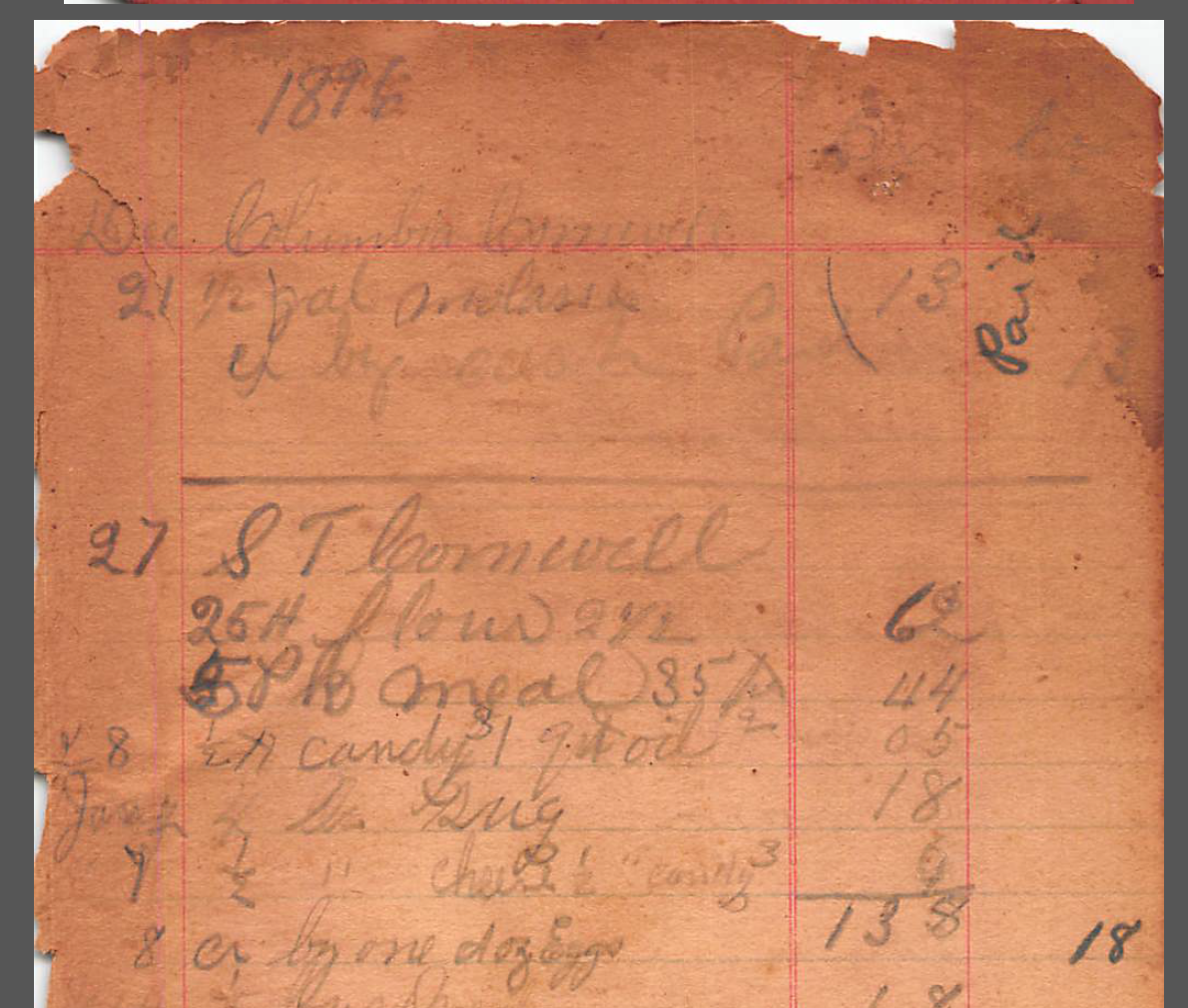
S. T. Cornwell in the image on the left, bought eggs, candy, oil, flour, socks, shoes and more. One pair of shoes cost $1.15 that year.

S. R. Turley 1896 Ledger Book, Culpeper Virginia ONLINE
In some cases, one page has several customer names on it, such as the page on the right. If your ancestor lived in Culpeper Virginia in 1896 there's a good chance you will find his or her name in this gem.

I had a quick look for some of these names and found several of them living in Prince William County, Virginia. It seems Mr. Turley was a very bad speller as many seem to be phonetic representations of the person's name.

For example there is a "Page Bumery" buying laundry and gloves on one page. However his real name  is Page Bumbery. We also see "Tasker Fisher" and "Georgiana Fisher" A search of the 1900 census shows a black man Tasker Fisher and his wife Georgia in Prince William County, Virginia. 

All pdf file downloads are freely available. Brian is scanning adding the ledger books he owns as quickly as he can, so be sure to keep checking on Ancestors At Rest for updates