


A few years ago I discovered a very interesting set of immigration records. While searching New York records on microfilm, I stumbled on a set of Almshouse Records which had the names of ships the Almshouse inmaates sailed on to America (which included USA and Canada). Often the year of arrival was also given.
Many of these records are now transcribed and online on Olive Tree Genealogy and although this is an ongoing project, I want to be sure visitors know it is freely available. The records are the Alms House Admission Foreigners & Nativity Records with Ships Names 1819 -1840 and 1855-1858 for New York City, New York
For individuals recorded 1819-1840 the ship name is given, but not the year of arrival. However you can get a rough estimate based on how long the individual has been in the Almshouse. In the 1855-1858 Almshouse records the information includes ship name, date of sailing, and ports of departure and arrival
Other valuable genealogical information is also found - such as exact death dates, discharge dates, where the individual is from and more. For example, under date 1820 March 11 - Elizabeth Kennedy age 34 is listed as having died June 14, 1820; her daughter Mary Ann died Nov. 5, 1820
In the early 1800's port cities in the USA bore the burden of immigration. By the time they arrived, so many immigrants were tired, hungry and poor they ended up in the City Almshouse. This meant the citizens had to take care of them. At first the citizens of the city asked the Mayors for funds to support the poor. Eventually they asked the states, and by mid-century some states (Pennsyvania, New York, Masschusetts) set up State agencies to deal with the issue. Eventually, beginning in the 1880's, the Federal Government nationalized the programs.
Dating back to the colonial era, New York City assumed responsibility for its citizens who were destitute, sick, homeless, or otherwise unable to care for themselves. The city maintained an almshouse, various hospitals, and a workhouse on Blackwell's Island (now called Roosevelt Island) for the poor.
These online Almshouse records are a wonderful substitute immigration record. At this point I need volunteer transcribers to help finish entering the data to go online, so if you would like to help please contact me through Olive Tree Genealogy - contact email bottom of every page.

Updates about Olive Tree Genealogy website and other FREE genealogy records. Bringing you tutorials, genealogy book and app reviews, genealogy news, genealogy specials and more. Helping you find your family tree and ancestors.


June 18, 2009
Quick Start Canada - Census Comparison Chart
For those seeking their Canadian roots - what sites have Canadian census records?
There is an updated Comparison Chart on "All Census Records which lists available projects for the Canadian census records (with clickable links) It has been Updated with Ancestry's and FamilySearch new holdings
You may want to take a look at Quick Start Canada (a Census Comparison Chart)
There is an updated Comparison Chart on "All Census Records which lists available projects for the Canadian census records (with clickable links) It has been Updated with Ancestry's and FamilySearch new holdings
You may want to take a look at Quick Start Canada (a Census Comparison Chart)
June 17, 2009
Limerick Ireland Private Papers and Business Collections online
If you have Limerick Ireland ancestors the following will be of great interest to you!
Limerick Ireland Private Papers and Business Collections can be searched online. The following genealogy databases are available to genealogists:
* Limerick Chamber of Commerce 1807-1946
* Maurice Lenihan Papers, 1759-1875
* Bedford Row Lying-In Hospital, 1868-1971
* Rentals and Particulars of Sale, 1808-1923
* P18 House of Industry
* Great Munster Fair Commissioners, 1852-1912 (from microfilm)
* Devon Estate Rentals, 1774-1893 (from microfilm)
* Fair Rent Tribunal, 1881-1916 (from microfilm)
* Coote Family Papers
June 15, 2009
Limerick Ireland Burial Registers Online
Limerick City Council has become the first local authority in the country to
put its burial registers on-line.
Burial records for the city’s largest cemetery, Mount Saint Lawrence,dating back more than 150 years will now be easily available to the public over the internet
It is now possible to access a copy of the original handwritten entries of burials in Mount St Lawrence cemetery, from 1855 onwards on Limerick City Council’s website, www.limerick.ie
Each entry in the record is handwritten and records the name of the person, the
date of burial, the location of the grave, the age of the deceased and the last residence. With the click of a mouse, it is possible to turn the pages of the book to view the next set of entries.
Mount St Lawrence was first opened in 1849 when a new graveyard was needed in
Limerick as a result of the both the 1830’s cholera epidemic and the Great Famine of 1845-1850.
Every person buried has a one line entry and these persons came from every street and lane in Limerick. For many years the majority of entries on a single page are from the Limerick Union and Limerick Lunatic Asylum. These were later known as St Joseph’s Hospital and the City Home.
Tips:
in order to view the registers you must first have a DjVu plug-in. You can download this by clicking the DjVu link above and following the steps
Please wait for the files to open. The files are large so download speeds will vary depending on your connection
There are four registers, please click on the links below to access the records:
Book One 1855-1896
Book Two 1896-1935 Parts of this volume are very faint and difficult to read
Book Three 1935-1961
Book Four 1961-2008
June 14, 2009
Front Pages Free from NewspaperArchive
This is very interesting - another freebie from NewspaperARCHIVE.com They've unlocked every front page of their newspapers, which means you can look through millions of unique newspaper front pages.
Just tick off the box labeled "Front Pages Only", type your word or phrase into the Keyword spot and your search will return results from newspapers from 1759 to 2008. You can read about the very first time man set foot on the moon, or President Kennedy's assination.
Maybe you're a military buff or an ancestor fought in WW1 or WW2 or Korea or Vietnam - or some other skirmish. If so, try searching for the name of the War or battle. Just for an idea of what is available I typed in "Korean War" This is what I got!
We discovered 231,272 results for Korean war in our Front Pages I would have to narrow my search to make it feasible to read some of the Front page stories so I would put a year of interest, perhaps even a month. That's easy to do by using the Refine Your Search fields on the right side of the Results Page.
One of my great great uncles Stephen Peer walked Niagara Falls on a tightrope and has the dubious distinction of being the only person to die falling from his tightrope, so I decided to search for anything about him. I used "Niagara Falls tightrope Peer" as my keywords. I got 2 results for Front Page news and a notice that there were 80 other results for my search in inside pages!
One result from the Front Pages was from an 1887 newspaper, the other more recent so I knew the 1887 was probably the one I wanted. And sure enough there it was on the front page of the Semi-Weekly Statesman in Marshall Michigan - the headline read
I copied and saved the article by using the Graphic Select Tool which is to the right of the Text Selector. This Front page article is the first one I've seen that mentioned the possibility of suicide in Stephen's death, so it was interesting from a historical AND a genealogical viewpoint.
Have fun discovering what Front Page News is there at your fingertips on NewspaperARCHIVE.com .
Just tick off the box labeled "Front Pages Only", type your word or phrase into the Keyword spot and your search will return results from newspapers from 1759 to 2008. You can read about the very first time man set foot on the moon, or President Kennedy's assination.
Maybe you're a military buff or an ancestor fought in WW1 or WW2 or Korea or Vietnam - or some other skirmish. If so, try searching for the name of the War or battle. Just for an idea of what is available I typed in "Korean War" This is what I got!
We discovered 231,272 results for Korean war in our Front Pages I would have to narrow my search to make it feasible to read some of the Front page stories so I would put a year of interest, perhaps even a month. That's easy to do by using the Refine Your Search fields on the right side of the Results Page.
One of my great great uncles Stephen Peer walked Niagara Falls on a tightrope and has the dubious distinction of being the only person to die falling from his tightrope, so I decided to search for anything about him. I used "Niagara Falls tightrope Peer" as my keywords. I got 2 results for Front Page news and a notice that there were 80 other results for my search in inside pages!
One result from the Front Pages was from an 1887 newspaper, the other more recent so I knew the 1887 was probably the one I wanted. And sure enough there it was on the front page of the Semi-Weekly Statesman in Marshall Michigan - the headline read
A TRAGIC AFFAIR: Steve Peer A Daring Rope-Walker Killed at Niagara Falls
I copied and saved the article by using the Graphic Select Tool which is to the right of the Text Selector. This Front page article is the first one I've seen that mentioned the possibility of suicide in Stephen's death, so it was interesting from a historical AND a genealogical viewpoint.
Have fun discovering what Front Page News is there at your fingertips on NewspaperARCHIVE.com .
June 11, 2009
Caveat re 1861 Canada Census Online
A source in the UK who has been doing her own transcription of the 1861 Toronto census, wrote to me to share a very interesting (but disturbing) problem with the new 1861 Canada census on Ancestry.com
My correspondent states:
My correspondent states:
For the past few years I have been working on my own transcription of the Toronto Ontario census for 1861. When the Ancestry.comindex and film came online last night I was curious to have a look and found that I could browse the actual film pages.
I was surprised that Ancestry.com
In my inspection I came across one of the pages that the Library & Archives Canada (or its predecessor) used to introduce a ward. This lists the names of the wards and the number of folios used by each:-
St Andrew's 1111
St David's 1460
St George's 489
St James's 1413
St John's 1604
St Lawrence's 749
St Patrick's 1149
This totals 7975 folios.
This infers that at least 3780 households are missing, and since Ancestry has included the introductory and concluding pages around the wards and the divisions within the wards, this must be an under-estimate.
I have inspected Ancestry.com
June 10, 2009
Unregistered Cemeteries in Ontario
Did you know that unregistered cemeteries in Ontario exist only at the whim of the local land owner?
From the Ontario Genealogical Society (OGS) website
OGS is asking for help. They have provided a list of unregistered cemeteries in every County/District in Ontario. If you see a cemetery that is of interest to you, the OGS asks us to write to our MPP asking why it is not registered. Names and Addresses are provided.
Please do your part to help protect these cemeteries where our ancestors are buried.
From the Ontario Genealogical Society (OGS) website
The Ontario Genealogical Society is aware of about 1 200 unregistered cemeteries in this province. "Unregistered" means that the provincial government does not recognize it as a cemetery and so it has no legal protection. It can be removed at whim and without notice.
We have been attempting to get them registered but the Registrar, Cemeteries Act (Revised), has informed us that it is up to the owner of the land where the cemetery is located to apply to have it registered. The Registrar will not simply add them to his list as was done by his predecessor in the early 1990s. Leaving this situation in the hands of the land owners is not satisfactory as they have no incentive to register the cemetery.
OGS is asking for help. They have provided a list of unregistered cemeteries in every County/District in Ontario. If you see a cemetery that is of interest to you, the OGS asks us to write to our MPP asking why it is not registered. Names and Addresses are provided.
Please do your part to help protect these cemeteries where our ancestors are buried.
June 9, 2009
Great News! Complete census of Canada ONLINE
Great news! You can now search for ancestors in the 1861, 1871 and 1881 Canada census, plus view the actual census images.
The 1861 census of Canada is now online, searchable and indexes linked to images of the actual census pages.
Since Canada didn’t officially become a country until 1867, the first national census wasn’t held until 1871. The 1861 Census of Canada is a collection of five provincial censuses. Censuses were taken throughout different times of the year in the provinces of New Brunswick, Nova Scotia, Prince Edward Island, Canada East (Lower Canada, or roughly southern Quebec), and Canada West (Upper Canada, or roughly southern Ontario). Nova Scotia and Prince Edward Island only recorded the names of the heads of households, while New Brunswick, Canada East and Canada West recorded the names of everyone in the household.
The 1871 census of Canada is also online.
This database is an every name index to individuals enumerated in the 1871 Canada Census, the first census of Canada since confederation in 1867. National censuses have been taken every 10 years since 1871 and every five years since 1971. The 1871 census includes the four original provinces – Nova Scotia, New Brunswick, Quebec, and Ontario. It is linked to actual images
The 1881 census of Canada, formerly online only as a transcribed text version is now available with indexes linked to actual online images.
June 7, 2009
Names of Americans in the Madeira Mamore Expedition of 1877-1879
Bob Moyer brings us this new and rather exciting database which he gathered from many different sources.
View the list of names of men in The Madeira Mamore Expedition of 1877-1879
See the list of sources for Bob's research project
The Disastrous American Expedition of 1878 that included the contractors P. & T. Collins (Col. George Earl Church) and the laborers who went to Brazil to build a railroad was also called the "The Railroad of Death" and a "railroad from no-place to no-where".
It was estimated that a worker died for every sleeper that was laid in the jungle and the loss of workers was on a scale that rivaled the Panama Canal project. The purpose of this project is to create a database of names by transcribing newspaper accounts, books and other sources about the expedition.
Careful attention has been given to separate these names from the later Farquar Jekyll expedition of 1907-1912. Thousands of men from many countries lost their lives in both expeditions.
Most of the participants in the 1877-1879 were from Pennsylvania, New Jersey, Deleware and New York.
View the list of names of men in The Madeira Mamore Expedition of 1877-1879
See the list of sources for Bob's research project
June 6, 2009
Genealogists! Help Needed to change Restricted Archives of Ontario Hours
The Archives of Ontario has moved to a wonderful new state of the art archives building. We now have the proper facilities to access and research our history but many people are unaware that with the move we now have restrictedhours of operation.
We need your help
* At the present time the hours of operation of the Archives of Ontario are 8:30 a.m. to 5:00 p.m. Monday to Friday only
* In effect this means that any Ontario taxpayer and visitor from outside the province who works fulltime and or lives at a distance not longer have access to their records.
* If we want to have evening and weekend hours we have to make our concerns known.
* We will not get the old hours of 8:15 a.m. to 10:30 p.m. Monday to Friday and 10:00 a.m. to 8:00 p.m. on Saturday back. A good compromise might be 8:30 a.m. to 8:30 p.m. Monday to Friday and Saturday 10:00 a.m. to 8:00 p.m. The benefit is that those who will visit during the extended hours will have archival staff on hand to advise and assist you them.
Why do we need your help?
* Not all records are available online or will be for the foreseeable future.
* To access the full range of records to research your family you do need to visit archives for such records as estate files, Crown land records, Private Property land records, education records, divorce files, maps, and private papers such as the T. Eaton Co.
What can you and/or your group do?
* Go to the Archives of Ontariowebsite and click on Feedback (left side of page half way down). They ask you to "Please take a few moments to send us your comments by filling in the form below." Politely request extended hours back. Fill in your email address and you will in time get a personal reply. We want to flood the Archives with requests so they can show the government the need for the extended hours.
* Contact your local MPP if a resident of Ontario
When contacting your MPP please politely emphasis your use of the Archives of Ontario, its importance to the province and that these are our records and it is our right to have access to them.
* Sign our petition - contact Kathie Orr at kathie.orr@sympatico.ca if you belong to a group who will be meeting over the next month or so and she will email you the petition. In your email please use subject line "Petition re Restricted Archives of Ontario Hours"
* Have your group and any other interested parties sign our petition.
* Encourage others to do the same.
We are counting on YOU to help make the Archives of Ontario a place where all can go to use the documented heritage of our province.
Send completed petitions to
Petitions
c/o Ruth Burkholder
Ste 103 -12140 Ninth Line
Stouffville ON L4A 1L2
or
Petitions
c/o Kathie Orr
405 - 100 Maitland St
Toronto ON M4Y 1E2
June 4, 2009
Millions of Immigration Files being Transferred to NARA!
WASHINGTON - The federal government is opening the immigration files of millions of refugees, war brides, "enemy aliens" and other foreign nationals in the USA in the
first half of the 20th century.
A gold mine for historians, genealogists, scholars and descendants, the files include private details on such public figures as Spanish artist Salvador Dali as well as family heirlooms confiscated from Chinese laborers.
The immigration service signed an agreement Wednesday to transfer at least 21 million files to National Archives facilities near San Francisco and Kansas City. A searchable index is at www.uscis.gov/genealogy.
The files were compiled under the Alien Registration Act of 1940. They include photos, visa applications, birth certificates, personal letters and transcripts of
interrogations of celebrities and unknowns.
Documents in Guerino DeMarco's creased brown file show the gardener was arrested in 1942 and held for three months at New York's Ellis Island after visiting his mother in Italy.
Another Italian, Raffaele Annunziata, registered when he arrived from Salerno in 1948. Like others, he certified that he and his kin were not "idiots," "imbeciles,"
"feeble-minded" or "insane," and that he was not a "professional beggar" or "anarchist."
... read more
June 3, 2009
St. Mary's Church, Philadelphia Pennsylvania Records from 1788 online
The following genealogy records for St. Mary's Church, Philadelphia Pennsylvania are being transcribed by Olive Tree Genealogy volunteers.
St. Mary's, built in 1763, was the second Roman Catholic institution in Philadelphia. It was the site of the first public religious commemoration of the Declaration of Independence. Members of the Continental Congress attended services four times from 1777 to 1781. George Washington worshiped at St. Marys on at least two occasions. Puritan-born John Adams came too.
Pew Rentals St. Mary's Church, Philadelphia Pennsylvania
Introduction | List of Names - Pew Rents 8 Dec 1787 | List of Names - Pew Rents & Arrears 5 Nov. 1787 | List of Names - Pew Rents 24 June 1788 | Debts 24 June 1788 | Debts 8 Dec. 1788 | List of Names - Pew Rents 8 Dec. 1788 | Debts 24 June 1789 | List of Names - Pew Rents 24 June 1789 | Arrears on Pew Rents 8 Dec. 1789 | List of Names - Pew Rents 8 Dec. 1789 | Debts 24 June 1790 | List of Names - Pew Rents 24 June 1790 | Debts 8 Dec. 1790 | Money Due 24 June 1789 | Money Due 20 May 1790 | Debts May 1791 | Miscellaneous Notes | Additions & Corrections
Interments (Burials) in St. Mary's Church New Chapel Burying Ground
1788 | 1789 | 1790 | 1791 | 1792 | 1793 | 1794 | 1795 | 1796 | 1797 | 1798 | 1799 | 1800
St. Mary's Catholic Church cemetery includes the remains of Commodore John Barry, known as the "Father of the American Navy"; General Moylan, aid to George Washington; Thomas Fitzsimmons, a member of the Continental Congress who helped draft the United States Constitution; and Michael Bouvier, great-great-grandfather of Jacqueline Kennedy Onassis.
This is an ongoing genealogy project and volunteers are needed to help with transcriptions
June 2, 2009
Quaker Marriage Certificate 1858
I was antique hunting last month and spotted a beautful ornate framed marriage certificate hanging on the wall. Closer inspection showed it to be dated 1858, New York, and apparently a Quaker (Society of Friends) Certificate.
With the permission of the store owner, I am posting the details and names here. Wouldn't it be great if when we find something of genealogical merit in an antique store, we ask permission to copy the facts for posting online?
Here are the names and dates from the Marriage Certificate. I have tried to reproduce the layout of the signatures as the placement of names on the same line almost certainly indicates a relationship between the individuals.
Source: St. Jacobs Antique and Book Market, The Old Factory, 8 Spring Street, St. Jacobs Ontario (Canada)
With the permission of the store owner, I am posting the details and names here. Wouldn't it be great if when we find something of genealogical merit in an antique store, we ask permission to copy the facts for posting online?
Here are the names and dates from the Marriage Certificate. I have tried to reproduce the layout of the signatures as the placement of names on the same line almost certainly indicates a relationship between the individuals.
Andrew Holmes, Monkton, County of Addison Vermont son of Jonathan Holmes & Arletta his wife, and Ruth Cary of Halfmoon, Saratoga Co. New York, daughter of William Cary & Hannah his wife (Deceased). Society of Friends
Married in Morean New York, 3rd month 1858
Signatures:
Andreas Holmes, Ruth C. Holmes
Jonathan De bol, Mary Jane De bol
Rufus Hazard, Sarah A. Hazard
Eben Spicer, Eliza A. Spicer
Underneath in two columns
1st column
Mallie A. DeVol
Lydia Mott
James M. Cooper
Ruth E. Nessler
Jervis Cary
Wm. Cary
Maria D? Cary
2nd column
Elizabeth Cooper
Egbert Cary
Mary Ann Cary
Benjamin Angell
Mary Angell
Kesia Lang
Source: St. Jacobs Antique and Book Market, The Old Factory, 8 Spring Street, St. Jacobs Ontario (Canada)
May 31, 2009
Amsterdam/New Amsterdam: The Worlds of Henry Hudson
Apr 4 through Sep 27
Amsterdam/New Amsterdam: The Worlds of Henry Hudson, presented in collaboration with the New Netherland Project, Albany, and the National Maritime Museum Amsterdam/Nederlands Scheepvaartmuseum Amsterdam, will employ rare 16th– and 17th–century objects, images, and documents from major American and Dutch collections to bring the transatlantic world to life and reveal how Henry Hudson’s epic third voyage of exploration planted the seeds of a modern society that took root and flourished in the New World.
Focusing on the economic, cultural, and ideological connections that ultimately linked two global cities, Amsterdam and New York, Amsterdam/New Amsterdam will illuminate not only the global significance of Hudson’s voyage, but also the creative context out of which the exploration and settlement of New York itself arose, highlighting the Dutch role in creating the very character of New York as a place of opportunity, tolerance, and perpetual transformation.
In 1609, Henry Hudson, an Englishman sailing for the Dutch East India Company, made the first exploration of what is now New York Harbor and of the majestic river that today bears his name, laying the foundation for the Dutch claim on the area. His voyage of discovery led to the creation of the Dutch West India Company and ultimately to the founding of New Netherland, including its trading post at the mouth of the river — New Amsterdam.
The exhibition will invite visitors to consider the voyages of Hudson in the context of the Dutch role in the Age of Exploration, and as the first link between the Dutch civilization and culture of the Old World and that of the colony that they would soon build in the New. The multicultural, dynamic colony that grew up there was profoundly shaped by its Dutch origins, which continued to influence its development even after the Dutch ceded the young colony to the British in 1664.
May 30, 2009
Lost WW1 Photographs
A treasure trove of First World War photographs was discovered recently in France. Published here for the first time, they show British soldiers on their way to the Somme. But who took them? And who were these Tommies marching off to die?
At least 400 glass photographic plates preserving the images were found in the loft of a barn at Warloy-Baillon and cast out as rubbish. In recent months, the plates, some in perfect condition, some badly damaged, have been lovingly assembled and their images printed, scanned and digitally restored by two Frenchmen.
Read the rest of this amazing story in The Independent. Readers are being asked to view the photographs and help identify locations, soldiers, regiments and so on.
You must register with LiveJournal before you can leave a comment, then wait for your email address to be verified. It can be frustrating, as it seems that many usernames are already in use. I had to try 6 times using different usernames before I was able to register.
I left a comment on the photograph called "A Shortage of Overcoats My username is olivetree99 and the comment was given to me by Neil Cameron who asked me to post on his behalf.
Please take a look at these wonderful photographs and give input if you have any information at all.
May 29, 2009
Finding Your New Netherland Roots: A Two-Day Workshop on New Netherland Family History
10 & 11 September: Finding Your New Netherland Roots: A Two-Day Workshop on New Netherland Family History. In celebration of the 400th anniversary of the arrival of Henry Hudson in New York, the NYG&B, in collaboration with the Holland Society, and the New York Public Library, offer a Dutch research program featuring several of the leading experts in Dutch studies. Sponsors include The Van Pelt Family Association, The Algonquin Hotel, and The Historic Hotels of America program.
In celebration of the 400th anniversary of Henry Hudson’s arrival, this program will include presentations on the history of the Netherlands and its colony, as well as the persistence of Dutch culture in America, all designed to help you better understand the world in which your ancestors lived. The central focus of the program will be on resources and research methods to help you trace your roots through New York and New Jersey back to New Netherland and across the Atlantic, breaking through those brick walls that remain on your charts and expanding your knowledge of all your New Netherland ancestors.”
Thursday, 10 September will be a full day of lectures regarding Dutch research, culture, and history in the South Court Auditorium of the New York Public Library. Friday, 11 September offers a day of assisted research at the NYPL’s Milstein Division, and/or at the Holland Society Library.
In addition to the lectures and research, a number of festive social events will also be held. A gala banquet featuring Ms Peter G. Rose, the foremost authority on the food customs and diet of the colonial Dutch, will be held Thursday evening for an additional charge of $75. Ms Rose’s talk is entitled Art in Food and Food in Art.
A walking tour retracing the haunts of the early Dutch in what became New York will be held Saturday morning for an additional charge of $20.00.
The two-day program is available to members of the NYG&B and members of the Holland Society for $150. Non-members $200. Registration for the Thursday lecture program only is $90 members/ $125 non-members.
Thursday Lectures:
Social, Economic, and Religious Issues: Why the Dutch came to the New World.
The Dutch After 1664: How Did They Fare After the English Takeover?
Researching the People of New Netherland and Their Descendants: How to Identify and Make Best Use of the Available Sources
Beyond New Netherland: Some Tips on Researching Your Ancestors in the Netherlands
Case Studies: How Some Common New Netherland Genealogical Problems Have Been Solved
Our Speakers:
Christopher Brooks began researching his paternal grandmother’s Traphagen family in 1973. Utilizing a range of source material from American libraries, archives and his personal library, he has found that, with the maturing of the internet, much beneficial information relevant to New Netherland settlers is becoming available online to researchers through European archives. He lives in Kansas City, Missouri, where he works for a computer software company and is an avid researcher in New Netherland families and their European origins.
Firth Haring Fabend, a historian specializing in the Dutch in New York and New Jersey, is the author of the prize-winning books A Dutch Family in the Middle Colonies, 1660-1800, and Zion on the Hudson: Dutch New York and New Jersey in the Age of Revivals, both published by Rutgers University Press, and many shorter works. Her most recent book is Land So Fair, a historical novel and family saga set in New York and New Jersey in the eighteenth century with flashbacks to New Netherland.
Harry Macy Jr. edited The NYG&B Record from 1987 to 2006 and was also founding co-editor of The NYG&B Newsletter. He is a Fellow of The American Society of Genealogists, The Holland Society of New York, and The New York Genealogical and Biographical Society.
Peter G. Rose, Dutch food historian, is the author of several books on the subject of the influence of the Dutch on the American kitchen and lectures nationally and internationally on the subject.
Janny Venema, Ph D. is a historian and translator of New York colonial Dutch documents, working on the Rensselaerswijck collection housed at the New York State Archives.
We are very pleased to provide the famous Algonquin Hotel http://www.algonquin hotel.com. as our host hotel. Deluxe Queen Bed or Twin $189.00 per night; plus 14.25% tax.
For additional information or to register please visit www.newyorkfamilyhistory.org or contact Lauren Maehrlein at education@nygbs.org or by calling 212-626-6853.
May 28, 2009
Using NewspaperArchive.com Part 2
Continued from Using NewspaperARCHIVE.com Part 1....
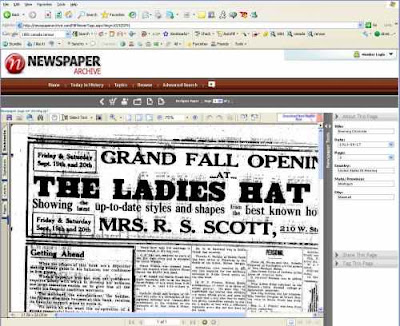
Step 6. Now you see the actual page of the newspaper. On the right you are provided with the Title, Date, page # and Precise location of the newspaper article.
Back to the newspaper page. It is displaying but I can't see my search terms highlighted. Sometimes they are, sometimes they are not.
Step 7 In this case, I don't want to start reading the whole page, so I click on the binoculars icon in the horizontal menu bar (4th icon from the left) Up pops a nice little search window that allows me to search the full newspaper page that is displaying
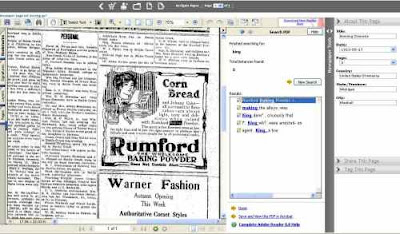
Now I see my term that I want (KING) in the Results window. Clicking on each of these in turn takes me directly to that word on the page. I can increase the magnification to any % I want. When I see an article I want to save, I have more choices.
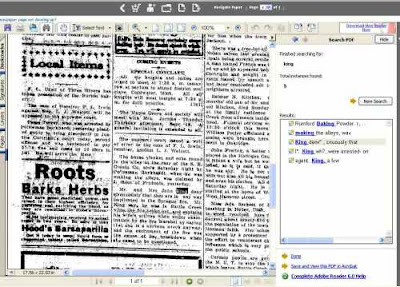
Step 8 I can SAVE to my computer with the disc icon far left. I can PRINT the page. I can SELECT TEXT and select the text I want (this option never works well fo r me, it selects more text than I want and when I copy and paste it, the text is garbled) or, the option I like best -- I can use the SNAPSHOT TOOL.
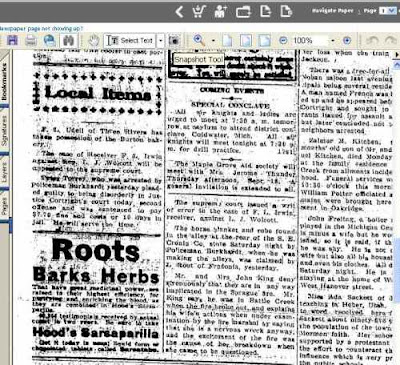
I took a screen shot so you can see where it is (see the words SNAPSHOT TOOL near the top?) Click on that little icon and then outline the article you want to save. You are starting in the top left corner of your article and drawing a little dotted outline (box) around it. Your article that you have outlined is automatically saved to your clipboard. It is saved as a graphic so now you can PASTE it into any graphic program you like. I use Irfanview.

After saving your article, if you have used Snapshot Tool, be sure to click on the little HAND icon if you still want to look around the newspaper page.
In a future post on this blog I will talk about keywords and search strategies that I have found useful on NewspaperARCHIVE.com as well as what to do when you get a page of HITS but clicking on one you want to see brings up "no results" for the keyword or keywords you searched on. Meantime I hope you enjoy searching for your ancestors on NewspaperARCHIVE.com!

Step 6. Now you see the actual page of the newspaper. On the right you are provided with the Title, Date, page # and Precise location of the newspaper article.
I want to mention something very important before we go on! At the top, above the newspaper page and the Reader horizontal bar, are little icons for NewspaperARCHIVE.com The first is a beak <, then a shopping cart, etc. The beak < is what you use to get back to your search results. Do not use the back button on your browser!
Back to the newspaper page. It is displaying but I can't see my search terms highlighted. Sometimes they are, sometimes they are not.
Step 7 In this case, I don't want to start reading the whole page, so I click on the binoculars icon in the horizontal menu bar (4th icon from the left) Up pops a nice little search window that allows me to search the full newspaper page that is displaying

Now I see my term that I want (KING) in the Results window. Clicking on each of these in turn takes me directly to that word on the page. I can increase the magnification to any % I want. When I see an article I want to save, I have more choices.

Step 8 I can SAVE to my computer with the disc icon far left. I can PRINT the page. I can SELECT TEXT and select the text I want (this option never works well fo r me, it selects more text than I want and when I copy and paste it, the text is garbled) or, the option I like best -- I can use the SNAPSHOT TOOL.

I took a screen shot so you can see where it is (see the words SNAPSHOT TOOL near the top?) Click on that little icon and then outline the article you want to save. You are starting in the top left corner of your article and drawing a little dotted outline (box) around it. Your article that you have outlined is automatically saved to your clipboard. It is saved as a graphic so now you can PASTE it into any graphic program you like. I use Irfanview.

After saving your article, if you have used Snapshot Tool, be sure to click on the little HAND icon if you still want to look around the newspaper page.
In a future post on this blog I will talk about keywords and search strategies that I have found useful on NewspaperARCHIVE.com as well as what to do when you get a page of HITS but clicking on one you want to see brings up "no results" for the keyword or keywords you searched on. Meantime I hope you enjoy searching for your ancestors on NewspaperARCHIVE.com!
May 27, 2009
Using NewspaperArchive.com Part 1
I'm a huge fan of NewspaperARCHIVE.com and have been playing around with it for a few weeks now. I thought I'd show others some tips I've learned while using the site.
Step 1: Go to NewspaperARCHIVE.com
Step 2: Sign in if you are a member. You can subscribe if not a member or you can sign up for the Free Membership. Free Membership allows you to view 3 newspaper pages per day, at no cost.

Step 3: You have many choices and you may want to take some time to look around the site and read what is available (geared towards teachers, genealogists, writers, students, etc). I am going to jump right in to the Advanced Search. I have highlighted it for you in green. (near top of screen)
I am looking for newspaper pages concerning John & Iva King who lived in Battle Creek Michigan. They were supposedly charged with arson in the early 1900s and I hope to find evidence of this and any newspaper articles about the event.

Step 4: On the Advanced Search page you have many options:
Enter first name and last name of person you are searching for. I put JOHN KING
Enter various keywords. In "With all the words" I typed in the words ARSON IVA
I am leaving the other fields blank (With the exact phrase. With at least one of the words. Without the words)
Results per page: 30 is the maximum
Narrow by Publication Date: I selected "Between Years" 1910 and 1914
Narrow by Publication Location: I chose United States of America and Michigan

Step 5 Hit SEARCH. The new page loads with the number of hits and a brief excerpt. There are 3 hits for my search terms and the first 2 from the Evening Chronicle look like they are my John & Iva. I want to see those newspaper pages in order to figure out if my search terms (keywords) are too restrictive to catch all newspaper accounts, or if there are alternate search words I might want to use to look for more articles

You will see in the brief excerpt for a hit that the text looks rather weird and doesn't make total sense. That is because it is OCR text but never fear, the newspaper page will be exactly as printed on the day it was published!
Tomorrow I will show you how to use the Snapshot Tool, the Binoculars and also explain some of the idiosyncracies of the newspaper page images.
May 26, 2009
1881 Census Images online
The 1881 census of Canada offersinformation about Canada and Canadians.
Through the Library & Archives Canada online database, you can view digitized images of original census returns which list the name, age, country or province of birth, nationality, religion, and occupation of Canada's residents at the time of the 1881 Census.
The database is fully searchable and each "hit" is linked to the image of the actual census page.
May 24, 2009
Using Ireland Civil Registration Indexes to obtain Vital Stats Certificates: Step 3
Continuing from Step 2 of Using Ireland Civil Registration Indexes to obtain Vital Stats Certificates
The Irish marriage certificate I received was almost identical to English Marriage Certificates I have ordered and contained the following information:
When married
[First] Name and Surname [of bride and groom]
Age [of bride and groom]
Condition [of bride and groom - meaing were they single, widowed...]
Rank or profession [of bride and groom]
Residence at the time of marriage [of bride and groom]
Father's Name and Surname [of bride and groom]
Rank or profession of father [of bride and groom]
Church they were married in, Parish, City
Witnesses
Person marrying them
In case you are ordering another type of certificate, here is what you can expect to find on each:
A Pre 1997 Irish Birth certificate consists of date and place of birth, child's forename/s, fathers name, address and occupation, mothers name and maiden surname, name and address of person who registered the birth.
 An Irish Death certificate consists of the deceased's name, date and place of death, marital condition, occupation, age at last birthday, cause of death, name and address of person who registered the death.
 A pre 1957 Irish Marriage certificate consists of date and place of marriage, both spouses age, name, marital condition, occupation and pre-marriage address and their fathers names and occupations.
I think you will enjoy finding your Irish ancestor's Vital Records using these sites!
Subscribe to:
Posts (Atom)