Discover your inside story with AncestryDNA®

January 9, 2020

New Netherland (NY) Research is Not Simple or Quick

New Netherland Research is Not Simple or Quick

Lois asked a rather convoluted question which does not have a simple answer. Because of the several questions Lois asked, i am going to intersperse my answers with her questions.

Q: After 200 years of historical accounts of the immigrants from the Netherlands, debate is still continuing when the surname Teunise/Teunisen is researched. My ancestor was Teunis Nyssen, who had  7 children based on baptism records, one (Cornelis) from guardianship record after his mother Phoebe Janse died. By 1660, when the 2nd generation started marriage and having children, the names of daughters were Teunis with an “e” added and sons with “en”. Historians and genealogists either made decisions which person had which “Teunis” father, so for the children of Teunis Nyssen, Denyse was added to the name “de Nys, or of Nys, as opposed to child of Teunis Bogaert. 


Is my assumption on the addition of the “e” and “en” correct?
A: The simple answer is "NO". The patronymic was formed by adding -se, -sen, or -szen. Daughters would very often have the ending -x or -dr. added. I suggest that what you are finding ("e" vs "en") is simply the way the name/patronymic was recorded by that specific clerk or individual. See Dutch Patronymics of the 1600s for more help. 

Also, if you have not seen my page on the DAMEN family of New Netherland I urge you to take a look.  As well as a brief expanation of the family origins, you will find several resources for you to use. You will definitely want the 4th one but you may find the others very helpful as well:


Q: The “Teunis” problem seems to have led to the following children  being attributed to Nyssen:   Hillegonde, Geertje, James, Joris and Teunis. So the second question relates to children naming  traditions.    First son after father’s father, 2nd mother’s father and 1st daughter after mother’s mother, 2nd after father’s mother...with exceptions.    A son Teunis for Nyssen is possible, but many records show him by age as 1st son, whereas he would be Dionys (name for Teunis’ father), 2nd son was Jan named for mother’s father.  
A:  You should never take naming traditions or customs as being set in stone. They might be observed by the couple but they might not be. One parent might be honoured by having a grandchild named after him/her but another might be on the "outs" with the family. A rich uncle or someone who could bestow favours on the couple might be the person honoured with a child's name. There may be a missing child which had the name of the missing parent. There are many reasons why naming patterns cannot be relied on!

Q: Is there any way to ID all the men named Teunis who would have been fathers between 1640 and 1670, so the “supposed children” could be linked to the correct parents?  If there is, how can it be communicated to people who have ancestry trees in various websites?  
A: You could certainly devote many years of research and study into an attempt to find all men named Teunis (or Antonis) who could have been fathers in that 30 year time span.  But if you were thinking of the entire area of New Netherland you would have quite a lifetime project ahead of you. Even if you found them all, determing which children belong to which father would quite likely take yet another lifetime, if indeed it could be done. 

Researching the Dutch in New Netherland is not an easy task. It requires years of study to understand naming patterns, customs, patronymics etc *and* to find the records to assist in the research. There are records that Dr. Gehring has been working on translating from the Dutch for over 25 years now! 


Photo credit: Stuart Miles on FreeDigital.Net

January 7, 2020

I Am My Own Worst Genealogy Enemy

Five (5) years ago, in October 2014, I messed up big time.

I'm only now discovering my error and realizing the mess it has created for me, genealogy-wise

In the image on the left you can see many jpg files with names starting with "GBPRS_CANT_" followed by a string of numbers. I discovered them as I was going through my hard drive organizing genealogy files.

Because they do not have identifying file names (surname, date, location at a minimum) I began opening them. They are a mix of baptisms, burials and marriages from somewhere in Kent England. The dates range from 1607 to 1832 so far but I have not checked them all.

One of 47 images that are not identified. Years are 1639 and 1640
Because the images are challenging to read and I don't have all my mother's Kent ancestors memorized, I looked in the meta data for each file for information. Nothing. Nada. It is blank for each one.

That means I was in such a frenzy of finding and gathering the images that I couldn't be bothered stopping for a minute to add the meta data OR at the very least, rename the files with the surname of the ancestor! Any of those would have helped me figure out who each record is for. I could even have simply annotated each one with an arrow pointing to the ancestor found on the page.

Baptism of NIcholas Widlbore in 1611. I have now added an arrow & labelled this one correctly.
Since I didn't do any of that, I am stuck going through each image, and trying to match names with my master list of surnames. I've been at it for hours now and have only managed to properly label 9 of 47 files.

I hope I have learned a lesson. I pray I never repeat this silly mistake in future! What ridiculous mistakes have you made as you've gone along in your genealogy research?

January 5, 2020

Interment.net Published 368,000 Cemetery Records in the Month of December 2019

January 3, 2020, Menifee, CA — Interment.net published 368,107 cemetery records covering 59 cemeteries in 20 US states in the month of December 2019. They are now available for free viewing to the general public by visiting http://www.interment.net/new.htm

These records were acquired mostly from city and county offices as well as cemetery sextons. Most of these records include dates of birth, death, and burial, and many include plot locations and names of funeral homes.

States and counties covered in these records…

Alaska (Matanuska-Susitna Borough)
Colorado (Boulder, El Paso, Weld)
Florida (Alachua, Lake, Osceola)
Idaho (Ada)
Illinois (Douglas, Logan, Kane, Sangamon, Winnebago)
Iowa (Johnson, Clay)
Kentucky (Jefferson)
Massachusetts (Worcester)
Michigan (Charlevoix)
Minnesota (Ramsey)
Nebraska (Dodge)
North Carolina (Iredell)
North Dakota (Cass)
Ohio (Franklin, Lucas, Montgomery)
Oklahoma (Ellis, Oklahoma)
Texas (El Paso, Gillespie)
Utah (Salt Lake)
Virginia (City of Richmond, Bedford)
Wisconsin (Juneau, Waukesha, Richland)
Wyoming (Fremont, Johnson, Park)

All records were left unedited to reflect the same information exactly as appears from their original sources.

Since 1997, Interment.net has published transcriptions of cemetery records acquired from genealogists, government agencies, churches, and cemetery sextons. To date, more than 25 million records are available online for free, unlimited access. 

Genealogists may browse or search the full archive, or contribute their transcriptions, by visiting http://www.interment.net

January 3, 2020

Seeking The Primrose Girls from Galway Ireland to Canada 1853


The website Irish Central has an intriguing plea for help.

"Can you help? Seeking descendants of the 156 Irish “Primrose girls” who emigrated to Canada, in 1853.

A group of Irish amateur genealogists from a small Galway town are seeking to connect with descendants of 156 emigrants known as the “Primrose” girls after the name of the ship they sailed on to Canada in 1853. "

A letter sent from the Galway organization reads in part

We, “The Primrose Girls’ Project” are currently undertaking research on a group of workhouse orphan girls who traveled from Mountbellew Workhouse in County Galway, Ireland via the port of Limerick bound for Quebec Canada on the Primrose ship on July 16th, 1853. Our aim as a group is to discover what happened to these orphan girls on arrival in Canada. Record their stories and reconnect with their descendants’. These girls, so long forgotten in their native place, deserved to be remembered. The group are hoping to have a commemoration for the girls in 2021 in Galway.

Here is a list of the girls. If any of my readers know anything about any of the Primrose Girls, please leave a comment on this post. Please also read xxx about another earlier project (Irish Orphans to Australia in 1853) regarding the Mountbellew Workhouse. Also see Bytown or Bust for more information on these girls and the workhouse

A list of the Primrose girls:

Biddy Molloy, aged 18
Mary Carr, aged 19
Biddy Barrett, aged 16
Catherine Connolly, aged 20
Peggy Lohan, aged 18
Mary Rafferty, aged 17
Biddy King, aged 18
Catherine Higgins, aged 19
Ellen Egan, aged 15
Honor Gibbons, aged 23
Kitty Loughnane, aged 15
Mary Shannon, aged 15
Bessy Fallon, aged 16
Biddy Kelly, aged 18
Kitty Rabbitt, aged 18
Ellen Madden, aged 18
Ellen Brennan, aged 18
Honor Corbett, aged 15
Mary Brennan, aged 22
Mary Coffey, aged 17
Mary Down, aged 20
Winny Dowd, aged 17
Anne McGrath, aged 15
Biddy Healy, aged 16
Honor Brady, aged 16
Margaret Coffey, aged 19
Mary Concannon, aged 15
Biddy Toohey, aged 18
Celia McCabe, aged 19
Jane Murray, aged 15
Judy Healy, aged 20
Mary Killarney, aged 21
Biddy Cox, aged 20
Catherine Kilgannon, aged 15
Honor Quinn, aged 18
Mary Daly, aged 18
Biddy Breheny, aged 20
Catherine Fallon, aged 17
Kitty Heneghan, aged 26
Mary Dooly, aged 20
Mary Coffey, aged 18
Mary Kilfoyle, aged 18
Mary Warde, aged 16
Mary Mitchell, aged 16
Catherine Keogh, aged 20
Jane Kelly, aged 40
Fanny Gereghty, aged 15
Biddy Ruane, aged 40

Resolving Genealogy Discrepancies in Locations

Rory asked for clarification on a location:
I am reseaching a William Hanley. According to his obituary:

 " Mr. Hanley was born on May 4th 1857 at Buffalo Wellington County Ontario son of the late Richard and Elizabeth Hanley."

 The only village I can scare up is Buffalo Heights but that is in Peel Co. Any assistance is greatly appreciated.
Rory,

I think rather than try to figure out what was meant by "Buffalo" you might be further ahead to search for the family in the 1851 census. Find out where they were living, then check 1861.

The census records for Canada are available on Ancestry.com

I did a little bit of research and found the following which looks like a good fit for your family:

1861 Census Ellice Twp, Perth Co. Ontario
Richard Hanley, 31, farmer born Ireland
Elizabeth, 20, born Upper Canada
William, 3 born UC
Michael, 2 born UC
Ellen, 1 born UC

The marriage record for Michael provides his mother's name as Lizzie Tracey. "Michigan, Marriages, 1868-1925," index and images, FamilySearch (https://familysearch.org/pal:/MM9.1.1/N3NG-F72 )

The marriage of Ellen is found in 1878 Ellen Hanley, 19, born Stratford, living Peel Twp, daughter of Richard Hanley and Elizabeth Tracey married Jacob Wentz. Witness William Tracey of Peel Twp.

There is information on William found in the Boissevain and Morton Regional Library

Men of the Halifax Provisional Battalion crossing a stream
near Swift Current, Saskatchewan, 1885
https://www.collectionscanada.gc.ca/
Title: Hanley, William fonds. . Pages: One folder textual. . Abstract: Biographical information. Notes: Title based on content of fonds.

Information taken from W. V. Udall's files (Editor of The Boissevain Recorder) received from Beckoning Hills R Revisited book committee. William Hanley (1854-19 ) was born in Wellington County,Ontario; arrived Brandon 1882. Homesteaded in Saskatchewan on 32-3-2; participated in 1885 Riel Rebellion. Married Lucy Hallady April 19, 1892 at Moosomin, Saskatchewan; took up residence in Boissevain 1895. He was a livestock dealer. Further accruals not expected. Subjects: Riel Rebellion, 1885. Location / Call number: Click on the location field to begin an inter-library loan transaction • Boissevain and Morton Regional - MBOM ;MBOM ;MG14/C192. (-553)

This site might prove helpful to you regarding the Riel Rebellion mention. 

RED RIVER EXPEDITIONARY FORCE 1870-1877

  • Appendix II contains the list of 1, 704 men of the RED RIVER EXPEDITIONARY FORCE 1870-1877.
  • Appendix III contains the bounty warrants issued as a result of their service in the RED RIVER EXPEDITIONARY FORCE 1870-1877, as well as discharge date and location

1901 Census Boissevain (Village), Brandon, Manitoba
1911 Census Souris, Manitoba
1916 Census Broadway, Boissevain, Manitoba

January 1, 2020

Thousands of Newspaper Clippings to Sort!

Continuing on with our large genealogy research collection, we are now on Stage 3. We've triaged all the boxes into various topics as mentioned in my last blog post.

Yesterday we had a good look at the newspaper clippings. It's overwhelming. The image on the left shows some, but not all of the binders and boxes of clippings! There is another large plastic tub full of loose clippings.

Many are in binders but a very large number are loose and in plastic sleeves in boxes.

I pulled out one of the binders and took a photo to illustrate how they were originally organized . It is obvious by looking through the binders that she organized the clippings by surname, then glued the clippings to blank paper, attempting to keep family groups together. This is a wonderful resource of births, marriages, deaths, obituaries, graduations and so on. However there are hundreds, if not thousands, of loose clippings that are not sorted so we will have to think about how best to treat those.

I have not gotten a good sense of the time span for the clippings as we aren't taking the time right now to delve into each collection. For now we are focusing on sorting and finding space in our home to house all the books and binders so we can begin a more serious in-depth assessment and inventory.

The newer clippings may be available online so we have to decide if it is worth house space to devote to them. I did note some clippings from the early 1900s and late 1800s, and those may be worth preserving. We have some tough decisions ahead.


We found room in the basement for the binders of newspaper clippings which were labelled A through to Z , although we are missing some of the alphabet! I suspect those are some of the loose clippings as we know that the Heritage Assocation began removing clippings from the binders in order to inventory them before realizing the collection was too large for them to handle. 

We have saved binders to replace the missing letters and hopefully in the future we will be able to at least organize the loose clippings to insert in binders. But we won't use glue! 

Of course the question still remains - what do we do with the clippings once organized? We're mulling on that question.


December 30, 2019

First World War Archive Shared Online by Museum

The Royal Air Force Museum, has today launched a new website, casualtyforms.org, which enables online visitors to explore the Casualty Forms of officers of the Royal Flying Corps and Royal Air Force who served on the Western Front and in the Middle East during the First World War.

I had a search of the Casualty Forms and found one of my Peer relatives - Harold Emerson Peer, illegitimate son of Alberta Peer. He was born in 1894 in Elgin County Ontario Canada and I never knew what happened to him. I used the Advanced Search with Peer as the surname and Canadian in the Regiment field to find any Canadians.

Funding was secured through Esmée Fairbairn Foundation and The National Lottery Heritage Fund to conserve the collection. After digitisation, over a hundred of the Museum’s dedicated, online volunteers transcribed the information in the forms, making them available to search.

The RAF Museum also holds digitised First World War Casualty Cards at rafmuseumstoryvault.com


December 25, 2019

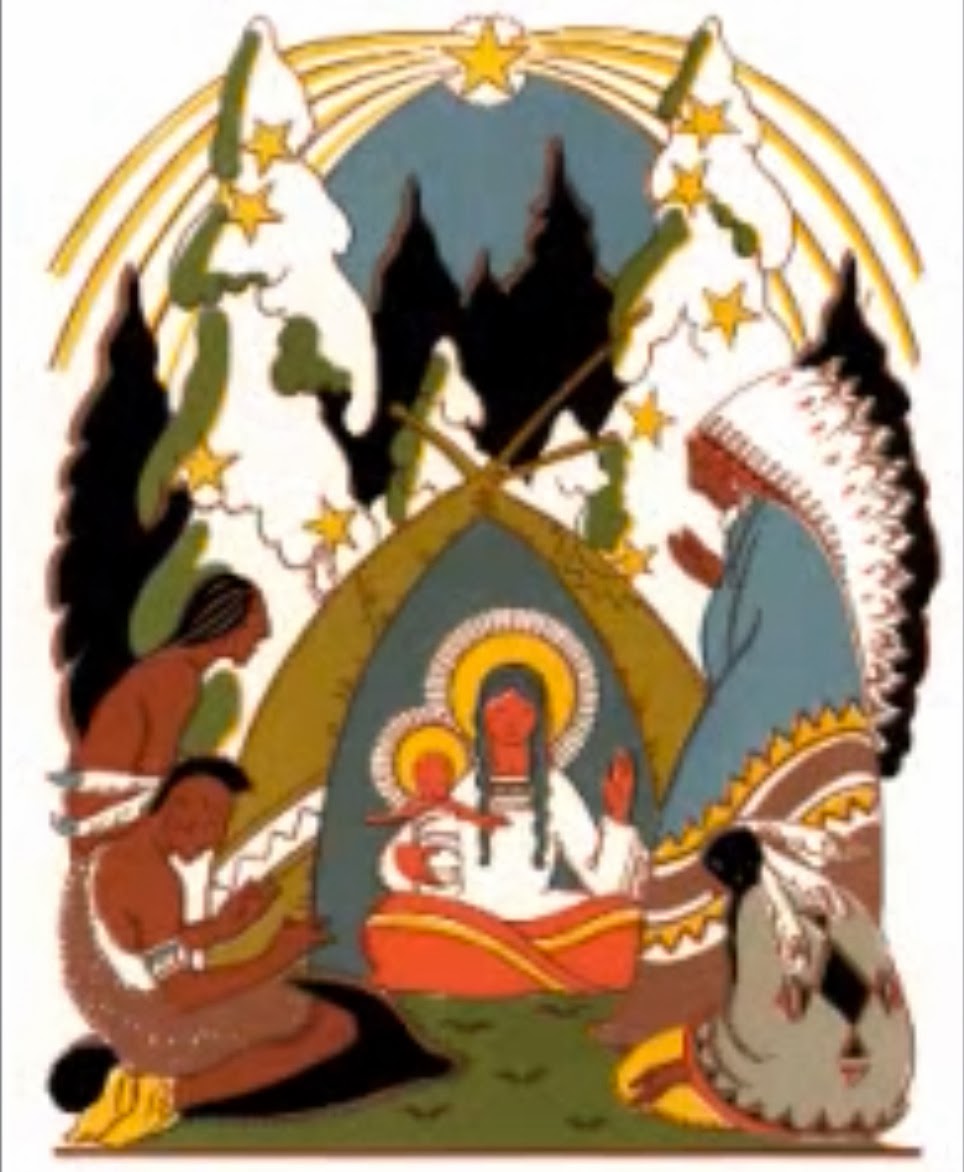
First Canadian Christmas Carol: T'was In the Moon of Wintertime (Jesous Ahatonhia)

Twas in the Moon of Wintertime (Jesous Ahatonhia)
A few years ago I wrote about this beautiful Huron Christmas Carol. I love it so much I'm bringing it back. It is the first Canadian Christmas Carol  written by the Jesuit Missionary Jean de Brebeuf circa 1643 for the Huron Indians in the wilderness of what is now Ontario. The Jesuits ministered to the Hurons at Ste Marie - a wilderness fortified village.

In 1649 the Iroquois, enemies of the Hurons, attacked and the Jesuit fathers set fire to the village fort rather than see it fall into Iroquois hands. Father Brebeuf and 7 others were tortured and killed by the Iroquois. The eight martyred missionaries were canonized by Pope Pius XI in 1930, and are known in Canada as the Canadian Martyrs.

The village has been reconstructed at the original site and is now a living museum as well as complete working village. Ste Marie Among the Hurons is a very popular tourist attraction in the Georgian Bay area and it is not far from my home.

Written in the Huron language, Father Brebeuf's Huron Carol is called Jesous Ahatonhia meaning Jesus is Born. It was not translated until the early 1900s at which time it was translated to French. In 1926 it was finally translated to English.  It is still a very popular hymn sung by Canadian school children and in churches. The English version is called "T'was in the Moon of Wintertime" and it is a haunting melody based on a 16th century French Canadian Melody. 
  I love this carol, I find it very stirring and can picture the Hurons sitting with the Jesuit fathers in the middle of our cold snowy winters, listening to the missionaries sing. As well it has many meaningful connections for me - first, I live near Ste. Marie Among the Hurons. Secondly, Father Brebeuf, now the patron saint of Canada, baptised my half-9th great grand uncle Francois-Joseph Hertel in Trois-Rivieres in 1642 during the short time he was in Quebec recuperating from a broken shoulder. Lastly, I am descended from Francois-Joseph Hertel's half sister Ots Toch, a half Mohawk, half French woman from New York who went on to marry the Dutchman Cornelis Van Slyke. The Mohawk were part of the Iroquois Confederacy, the enemy of the Hurons at Ste. Marie. 

As children, we Canadians learn this song in school. It still brings shivers when I hear it. 

And now without further ado, here is the Huron Carol Jesous Ahatonhia on video sung in the original Huron language version followed by the French version and a slightly different English version translated by Father Kierans

Huron Wendat Language Version

Estennialon de tsonwe
Jesous ahatonhia
Onnawatewa d' oki
n' onwandaskwaentak
Ennonchien skwatrihotat
n' onwandilonrachatha
Jesous ahatonhia Jesous ahatonhia

English Version by Middleton, most often sung

Another version of this beautiful carol
The Huron Carol ('Twas In The Moon of Winter Time)

'Twas in the moon of wintertime when all the birds had fled
That mighty Gitchi Manitou sent angel choirs instead;
Before their light the stars grew dim and wondering hunters heard the hymn,
Jesus your King is born, Jesus is born, in excelsis gloria.

Within a lodge of broken bark the tender babe was found;
A ragged robe of rabbit skin enwrapped his beauty round
But as the hunter braves drew nigh the angel song rang loud and high
Jesus your King is born, Jesus is born, in excelsis gloria.

The earliest moon of wintertime is not so round and fair
As was the ring of glory on the helpless infant there.
The chiefs from far before him knelt with gifts of fox and beaver pelt.
Jesus your King is born, Jesus is born, in excelsis gloria.

O children of the forest free, O sons of Manitou
The holy Child of earth and heaven is born today for you.
Come kneel before the radiant boy who brings you beauty peace and joy.
Jesus your King is born, Jesus is born, in excelsis gloria.

December 21, 2019

A Quick Way to Find Out of Print Books

Annie asked me for help finding a book that is out of print:
There is a book, now out of print, that traces my family history back centuries.  It's called the Stapletons of Drom. Do you have a resource for finding such books, long out of print?
Annie, the first thing I do is search Google books. Then I try WorldCat

Trying WorldCat I found 11 Libraries that have this book. Since I don't know where you live, you will need to go to WorldCat and type in your postal or zip code.

If you want to purchase a copy, Amazon has it

December 18, 2019

Rescued Ephemera William Kreis of New York 1929

In 1929, 24 year old William Kreis of Syracuse New York signed up for an Insurance Policy. The policy and an explanatory letter arrived at his door on October 4, 1929.


Sadly young William was killed in August 1931. I doubt his insurance policy paid any money to his heirs, as it was very restrictive.

 The Daily Messenger Canandaigua, New York Monday, August 24, 1931 - P 1 

 Syracuse Journal Monday, August 24, 1931  

  The Syracuse Journal article provides the sad story of how William refused to heed his doctor's advice to go to the hospital. As his condition slowly worsened, he relented but it was too late. He died in the hospital of The Good Shepherd 3 days after being admitted. He was survived by his wife Anna Kelly Kreis, his father Emil Kreis Sr and seven brothers: Albert, Emil Jr, George, Oscar, John, Frederick, and Ernest Kreis. His funeral service was in Split Rock and he was buried in Marcellus

Thanks goes to Annette P. for rescuing these treasures and sending to Olive Tree Genealogy for publication


December 16, 2019

Where to Find Explanations of Abbreviations in Genealogy Books

Lauren asked Olive Tree Genealogy a question: "I found my Great-Grandfather, Harold Applegren, in this illinois city directory and noticed the number one in parentheses next to his name. What would that mean? I know that he lived with his parents, but I don't know if that symbol is related to that or not."

She included a screenshot:


My Answer

It would be very unusual for a book to not have an explanation of the abbreviations and terms used in the book. It is usually found at the front of the book. So in this case, you should scroll back to the start of the city directory and look for that explanation.

It is always a good idea to check out explanations or details that are provided at the start (preface or introduction) or end of any set of records.  Don't overlook doing a little bit of reading to help you understand what you are looking at - the time frame, the location, abbreviations, a glossary or more might be included.


December 14, 2019

Using Search Engine Tools Provided to Find an Ancestor

Angus C. asked Olive Tree Genealogy about the parents of his 2nd great-grandparents, Kenneth Roderick McKenzie and Hughenia Ross 

Kenneth Roderick McKenzie October 1839 Boularderie, Cape Breton, Nova Scotia died 26 June 1916 North Sydney, Cape Breton, Nova Scotia and Hughenia Ross 1835 Boularderie, Cape Breton, Nova Scotia died 8 May 1869 Boularderie, Cape Breton, Nova Scotia In both cases for Hughenia Ross and Kenneth Roderick McKenzie I have not been able to find any information about their parents, where they were born or died is totally unknown to me. Any help and guidance you can give me to break through either (or both) my "brick walls" would be greatly appreciated.

A quick search of Nova Scotia Historical Vital Records using Hughenia's full name gave no results but using their "starts with" choice in the search engine, and only typing in HU provided this entry for a Hughessie McKenzie, died 1869 in Baddeck, Victoria County She was listed as born in Boularderie to John Ross, a farmer and Robina McKenzie. The informant is named as Kenneth R. McKenzie and her date of death matches what Angus C. sent me as well as her burial record which I found with a quick search online.

Her burial is recorded with her husband in Man O War Point Cemetery, Boularderie Island, Victoria County, Nova Scotia.

 Kenneth R MacKenzie, merchant, d June 26, 1916, age 83 his wife Hughenia Ross d May 8, 1869, age 33, their youngest child John Knox MacKenzie d Mar 21, 1869 age 4 mo.


A newspaper article extraction found on Ancestry.com revealed the marriage of Hughina and Kenneth, with much more detail. Angus C. can now send for the full article to see what, if any, other clues are found in it.

Name:     Hughinia Ross
Gender:     Female
Event Type:     Marriage
Marriage Date:     19 Nov 1863
Marriage Place:     Boularderie, Cape Breton, Nova Scotia
Spouse :     Kenneth W. [sic] McKenzie
Cleric 1 Name:     Rev. J. Fraser
Reference Date 1:     8 Jan 1863
Source:     Gazette (Royal Newfoundland Gazette) 1807-; Harbor Grace Standard ( also known as Standard and Conception Bay Advertiser) 1859-1936; Express (Newfoundland Express) 1851-1876; Record 1862-1863
Notes:     Bride was the youngest sister of W. Ross, M.P. for County Victoria, C.B. Bride was also sister of Roderick Ross, M.P. for Wapue, New Zealand. Groom was "late" of Harbour Grace.

Armed with the names of two of Hughina's brothers and her father and mother, I am sure more can be found about her parents.  Being curious I had a very quick search for the two brothers named in the marriage extract and found M.P. William Ross (1824-1912), son of John Ross and Robina McKenzie. Here is his wikipedia biography.

Given the variation in spelling of their names (McKenzie vs MacKenzie; Hughenia vs other variants) I urge Angus to not restrict his searching to an exact spelling but instead use wildcards or "starts with" tools provided in online search engines.

For those genealogists curious about how long my search took, it was approximately one hour for the information I found listed above. 

Continuing on because I am now fascinated by this family, I next found this entry on http://archiver.rootsweb.ancestry.com/th/read/NS-CAPE-BRETON/2000-07/0964797229

The following is a transcription of a letter from Rev. Gillis, minister
at St John's Presbyterian Church, Belfast, PEI, dated 1979. Baptisms done by Rev. John MacLennan on trips to Boularderie. 


Baptized on September 16, 1831 to John Ross & Robina McKenzie
* William born December 20, 1825
* Jane born May 20, 1827
* Angus born August 20, 1829


A search quick found Robina and John's burials recorded as 

John Ross, native of Durness, Sutherlandshire, Scotland,
d Dec 25, 1857, age 83

Robina, relict of late John Ross, d Dec 7, 1862 age 67 yrs
b in Parish of Eddrachillis, Sutherlandshire, Scotland


As much as I am having fun with this query, it's time for Angus C to take over. If they were my ancestors I would run, not walk, to ScotlandsPeople website to see what I could find for John and Robina. Another hint for Angus: The marriage of John and Robina can be found on the  FamilySearch website. Once you find it, you can get the image on ScotlandsPeople for only 6 credits. That marriage should provide you with the fathers of both bride and groom.

Calling All Crum/Crumb/Krom Descendants!

Olive Tree Genealogy is excited to announce that my latest book "The Crum family of Gelderland Netherlands, New York & Canada" is now available! It is 158 pages of footnoted and sourced research.

Gysbert Willemse Crum arrived in New Netherland (New York) with his mother, step-father and several siblings in 1662 on the ship De Vos. The Crum family of Gelderland Netherlands, New York & Canada follows Gysbert's descendants to the 11th generation. New documents for the family in Gelderland are included.

Available on Amazon.com and Amazon.ca

December 11, 2019

Finding Ships Passenger Records To Canada

Henry wrote to ask


My great uncle who originated in Germany, born 1872 or 1874, appears in the UK 1901 census as Ferdinand Roks living in London. Within the family there was no mention of him but it was suggested that perhaps he went to Quebec, Since he doesn't appear in a later census, it could be reasonable to assume that he left London sometime after 1901. How do I research the shipping companies or ships records or even the Quebec immigration records to try to trace him, especially as might have changed the spelling of his name.
My answer:

Ships passenger lists to Canada are available as early as 1865. You can search on Ancestry.com, where the passenger names are indexed and linked to images, or you can use Library & Archives Canada (LAC). LAC however does not have a name index so you have to search by date or ship name.

There are also hundreds of ships passenger lists on my Olive Tree Genealogy website. As well I have written a book "Filling in the Gaps: Finding Pre-1865 Ships Passenger Lists to Canada" if you need to find an ancestor before 1865.

December 9, 2019

Understanding Relationship Terms

Barbara wanted to know about relationship terms.

Can you tell me which of the following ‘removed’ are the equivalent of  3rd great grandfather (e.g.) That is, is a 3rd great grandfather the same as Third removed?

Are the two terms used for different reasons or can either be used.
The following is from other notes but I’m still none the wiser. "When cousins descend from common ancestors by a different number of generations they are called "removed."
Once removed means there is a difference of one generation. Your mother's first cousin would be your first cousin, once removed. She is one generation younger than your grandparents and you are two generations younger than your grandparents.
Twice removed means that there is a two-generation difference. Your grandmother's first cousin would be your first cousin, twice removed because you are separated by two generations."
Barbara, 

The short answer to your question is "No". The terms are quite different.

Since you have the correct definition of the terms "once removed" and "twice removed" but it's puzzling you, let me try to explain it a different way. You use the term "removed" when you are comparing two individuals to a common (shared) ancestor. So you need 3 people in the mix! "Removed" means the two individuals are a certain number of generations apart. 

Let's say you have a relative named Sally. Sally's father and your father are brothers. That makes you and Sally first cousins. 

Now let's say you have a child named Roger. Roger is also Sally's first cousin BUT he is one generation removed from her! That makes Sally and Roger first cousins once removed.

Your 3rd great-grandfather refers to a relationship between 2 people -you and your 3rd. great grandfather.

December 7, 2019

1945 Rescued Photo & Ration Card Ralph A. Hamilton Jr.


Annette P. has kindly sent Olive Tree Genealogy more wonderful ephemera that she rescues.

This is a photo of Ralph A. Hamilton Jr. circa 1945.

Annette also sent his copy of a Male Officers' Uniform, Clothing and Accessory Ration Card  dated 14 August 1945

His rank in the U.S. Army is given as 1st Lt.


I did a search for Ralph in the online military records but there is more than one so I cannot be certain which is this Ralph. If anyone recognizes his photo please leave a comment on this blog post! 

December 5, 2019

A Challenging Upper Canada (Ontario) Puzzle

Bob S. asked about a challenging ancestor named John Smith. Since Bob's query was very long, I took bits and pieces to respond to.

I have hit a brick wall with with my 2nd great-grandfather John Smith. Based on information that I have been able to find he was born between 1817 and 1826. Most information said that he was born in Canada, but his sons death registration said that he was English. He was a widower when he married my 2nd great-grandmother, Susannah Powles(s), on Jan. 13, 1856 at Christ Church, Tyendinaga, Hastings
Bob - First let me say what terrific research you have done already on this elusive ancestor. I am sorry I can't include everything you sent me here in this blog post.

Searching Land Records
I found a property owned by John M Smith but it said it was Lot 37 in Concession III.  Think that it is the same Lot/person because of proximity but am not familiar with these records.. I also tried looking for property that John Smith indicated on 1851Census.  I think that this is my John Smith but am not positive.  He listed in column "Residence if out of Limits" as "4th Con Richm"  which I interpreted as IV Concession in Richmond, Lennox County which is adjacent to Tyendinaga.  Searching the map for Richmond, Lennox at http://digital.library.mcgill.ca/.../fro-m-richmond.jpg.  I found a J Smith listed as owning property in Concession III Lots 13 and 14 on the 1880 map.  I am not sure if we would have retained that property (if it was his).
The first thing I want to suggest re this land confusion is that you consult land records. I have written extensively about searching for land records in Ontario and you may wish to familiarize yourself with what is available for Ontario Land Records. I suggest you start with the CLRI and also the Abstract Indexes to Deeds for all these properties you have found.

The Computerized Land Record Index (aka Ontario Land Record Index) summarizes land grants of Crown Land, sales of land from Canada Company sales or leases and from Peter Robinson settlers' grants. If your ancestor settled anywhere in Ontario and he was the first time owner of Crown Land, he should be on these lists.

The Abstract Indexes to Deeds are the indexed record of every transaction on a plot of land from Crown ownership to the present day. Using the Abstract Indexes to Deeds you can check for every instance of your name of interest on that parcel of land.

There was a property dispute between Susannah's children and grandmother and Indian Department has file that mentions the property description (part of Lot 38 Con 2).  I think that I have found this on the maps linked to the OliveTree website but the location appears to be off somewhat (lot 37 Con III).  Are these the same lots just different descriptions? 
No those are not the same lot but they were close, perhaps even bordering on each other. Each farm could be quite large so conceivably the lots could touch even though they are on different concessions.  

Formulate a Working Theory

Next - I took a look at that 1851/52 census for John who was visiting other Smiths. I suggest you formulate a theory (which you will work to prove or disprove) that they are his relatives, and quite possibly close relatives such as a father (or mother) and siblings. Research each of the Smith individuals found there and try to find something that links them to John. The following articles may be of help to you.

From Theory to Fact: 30 Years in the Making

Turn a Genealogy Guess Into a Working Theory

Assumptions vs Working Theories - The Good and the Bad

Also, you no doubt noticed the "F" in the column for Place of Birth for those Smith individuals in that 1851/52 census. You didn't ask what it meant so you may already know this, but for those who do not know, here is the official explanation in instructions to census takers in 1851:

"The BIRTH PLACE of each person: you will here note that those born of Canadian Parents are to be marked with an F." [Source: http://www.prdh.umontreal.ca/census/en/uguide/enum_1852.aspx] 

Coffin Plates & Other Death Records

  [I] have what appears to be a plate from a casket or box that indicated he died on Dec. 16th, 1888, aged 71 yrs 5 months.

This is a coffin plate. These were engraved with the deceased's name and death date and sometimes with more information, then placed on top of the coffin during the funeral. After the funeral, the plate was given to the family as a memento. You can read more about coffin plates on the AncestorsAtRest website where over 450 are shown with photos.  It is very possible that John's death was not registered. Even though it was mandatory to register a death, many people did not comply as it cost money and sometimes the trip to the Registry office was too difficult to make in the winter.

I suggest you try church records for the burial information. Check the census records to find out what religion John was, then look to see what church he might have used. Then check Ontario Archives to find out if that church has any surviving records.

Summary

I feel that your best bet is to trace those other Smiths John is visiting in 1851. It will be a lot of work but I believe well worth it. Check and compare every record you can find for them, including John. Are their similarities in the names of their children? In their places of birth? These are just a few of the questions you might ask yourself.


The land records should also help - often sons received land from fathers.

Best of luck!

December 3, 2019

Archiving a Large Genealogy Collection

2 of 15 boxes. Overflow in front seat
As some of you know, Olive Tree Genealogy recently received a very large collection of genealogy documents and books. My husband and I are slowly going through the 15 boxes of material, and sorting them into groups.

We are not studying the material or taking an inventory at this point. We simply want to organize the documents so we can choose our first set of records for inventory while storing the rest.

Then we plan to methodically go through each "group" or set of documents, taking a careful inventory and deciding how/if we can make the records accessible to genealogists and historians.


I neglected to take a photo of all our groups but here is how we organized the materials as we went through each box:

  • Published genealogy books
  • Published genealogy booklets
  • Family genealogies 
  • Newspaper clippings
  • Genealogy research notes
  • Garbage
Start of the "Groups" That's me in the chair

Garbage? Did Someone Say GARBAGE????

Yes there was garbage. This collection has obviously been underway for many dozens of years. There were binders of printouts from Ancestral File (Remember that?) and other assorted printouts that had no current genealogical value. We spotted printouts dating back to the early 1980s. Most pages were in plastic sleeves in binders, so we spent some time (several hours) removing pages from binders, then removing the paper from the sleeves. We shredded the paper, kept the sleeves for the hundreds of loose documents we spotted, and will be tossing the binders if we find we do not need them for other loose documents in this collection.

We'll move on to more of the groups in the next blog post. If you want to follow along on our progress on this journey, just click on one of the tags or keywords at the bottom of this post.

December 1, 2019

Receiving a Large Collection of Genealogy Documents!

Genealogy Boxes Arrive
A few months back  Olive Tree Genealogy was offered some newspaper clippings from a donation a historical society had received. I was very excited to be asked and of course I agreed. A very large package soon arrived by mail consisting of hundreds of loose obituaries from newspapers.

As I was planning on how best to organize and inventory the clippings, another surprise came my way. I was told there were about a dozen large filing boxes full of miscellaneous genealogy items from the same donated materials.

This was too good an opportunity to save important historical records to pass up even though the thought of dealing with so many boxes was somewhat overwhelming.

My husband kindly offered to drive to the Society, some 3 hours distance from our home, to pick up the boxes. To my astonishment, there were over 15 large boxes full of genealogy binders, genealogy books, loose newspaper clippings, and more.  Here they are arriving at our home.

What To Do with So Many Boxes?

My husband and I are planners. We like to be organized. So we took a breath and decided we needed to sort the collection. First we needed a place to put the boxes where they would not be in the way but would be accessible. Then we could slowly and methodically "triage" the contents into organized groups of items.

Step One - Move & Triage!

So we moved to step one - moving the incoming boxes into our living room. Some had gotten wet in the journey in the rain to our home so removing the contents from wet boxes was our first priority.

My dogs helping me start the process

We took a break at this point but we plan to triage the contents ASAP. We saw at a glance that there are various items - hardcover genealogy books, genealogy booklets, binders of newspaper clippings, binders of research notes, family genealogies, and more. This next step will be a fun sort to organize into groups that we can either move to our basement until we have time to work on the contents, or keep in my office for starting an inventory.

The Journey Begins

Please follow along on our journey to inventory and preserve these documents. We aren't archivists but we plan to do our best. We also hope to figure out a way to make the documents accessible to genealogists and historians. If you have ideas or suggestions, feel free to leave them in the comments on this blog post.